
Local SEO Lead Generation – And let’s cut the fluff—you’re here for customers, not just clicks. No fluff. Real results. And the secret to landing those ready-to-buy local customers? It all starts with a rock-solid digital foundation.
This isn’t about guessing what works—it’s about a strategic first step. We’ll kick things off with a comprehensive local SEO audit. Think of it as a health check for your online presence.
I’ll show you exactly what to look for, from glaring issues in your Google Business Profile to the quick-win keywords your competitors are totally sleeping on. You’ll learn how to analyze your current visibility, benchmark against the local players, and build a prioritized action plan that focuses on real impact, not just busywork. This initial phase sets the stage for everything that follows.
Building Your Local SEO Foundation

And in SEO, your foundation is everything. You can’t build a house on a shaky base—same goes for local SEO lead generation. Before you start ranking and pulling in calls, you need to know exactly where you stand. That begins with a thorough audit.
An audit isn’t just about finding problems; it’s about uncovering opportunities. It gives you a clear roadmap so you’re not just throwing tactics at the wall and hoping something sticks. You need a baseline—a starting point to measure all your future success against.
Your Initial Health Check
And sometimes, you just need a quick glance—no deep dive yet. Think of this first step like a diagnostic test for your online presence. You’re looking for quick wins and red flags that could be costing you customers right now.
A few things to check immediately:
- Google Business Profile (GBP) Completeness: Is every single section filled out? I mean every section. Missing hours, a weak description, or a lack of photos are easy fixes that make a huge difference.
- NAP Consistency: Your Name, Address, and Phone number. Identical everywhere online? Even small variations—like “St.” vs. “Street”—can confuse search engines and hurt your rankings.
- Website First Impressions: Does your site immediately tell visitors what you do and where you do it? Your phone number should be impossible to miss. Your website design for lead generation plays a huge role here, making it easy for users to take action.
The goal of this initial sweep is to identify the low-hanging fruit. These are the fixes that take minutes but can deliver tangible results quickly, building momentum for the bigger tasks ahead.
Local SEO Lead Generation: Sizing Up the Competition
Next, you need to understand who you’re up against. A quick search for your main services in your city will reveal the top players. And don’t just look at who is ranking #1—look at why they are ranking.
What are they doing right? Tons of reviews? Highly localized content? Benchmarking isn’t copying—it’s strategic reconnaissance. To build a strong local SEO foundation, exploring a comprehensive guide on how to improve local SEO for service businesses can provide valuable insights into what your competitors might be doing right.
This analysis helps you spot gaps. Maybe no one in your market has a great blog answering common customer questions. That’s your opening. Or perhaps their GBP photos are all terrible. That’s an easy win for you. This intel turns a generic strategy into a targeted, effective plan for generating local leads.
Mastering Your Google Business Profile for Maximum Impact
Let’s get straight to the point: your Google Business Profile (GBP) is your single most powerful tool for local SEO lead generation. Period. It’s your digital storefront, your business card, and your first handshake with a potential customer—all rolled into one.
And yet, so many businesses just set it and forget it. That’s a huge mistake. An empty or half-finished profile isn’t just a missed opportunity; it’s a red flag to potential customers that you might not be the best choice in the neighborhood.
This is where we turn that static listing into a lead-generating machine. We’re going way beyond just filling in your address. I’m talking about the advanced tactics that make your profile work overtime, ensuring that when a customer finds you, they have every reason to call, visit, or click through to your site.
Local SEO Lead Generation: Filling Out Every Single Detail
This sounds painfully obvious, but you’d be shocked how many businesses skip crucial sections. Google rewards completeness. The more information you provide, the more confident Google is in showing your business for relevant searches, which can dramatically boost your visibility in the local pack.
Think like a customer for a second. They need to know your hours, your exact location, and the specific services you offer—right now. Leaving these fields blank creates friction and sends them straight to your competitors.
Here’s what to nail down immediately:
- Primary and Secondary Categories: Be hyper-specific. Don’t just pick “Contractor.” Choose “Kitchen Remodeler” if that’s your specialty. Then, add all relevant secondary categories (e.g., “Bathroom Remodeler,” “Cabinet Maker”) to cast a wider net.
- Service Areas: Clearly define the neighborhoods, towns, or zip codes you serve. This is non-negotiable for ranking in searches from users in those specific locations.
- Attributes: Do you offer free Wi-Fi? Is your location wheelchair accessible? Virtual consultations? These attributes are filters. They help you show up in more specific, high-intent searches.
The data doesn’t lie. When someone pulls out their phone for a ‘plumber near me’ search, they aren’t just browsing. In fact, 88% of local mobile searches lead to a call or visit within a day, with a staggering 80% converting overall. A well-optimized GBP turns that immediate intent into a paying customer. You can dive into more local SEO statistics to see just how big the opportunity is.
Local SEO Lead Generation: Crafting Descriptions That Actually Sell
Your business description isn’t just a 750-character box to check. It’s your elevator pitch. It’s your one chance to tell a potential customer not just what you do, but why they should choose you over everyone else.
Don’t just say, “We are a local plumbing company.” That’s a missed opportunity.
Try something with more personality and value: “Your friendly neighborhood plumbers since 2005. We specialize in 24/7 emergency leak repair with transparent, upfront pricing. No surprises—just honest, reliable work from a team that treats your home like our own.” See the difference? One is a statement; the other starts building a relationship.
Pro Tip: Your business description is indexed by Google. Weave in your most important local keywords naturally, but always, always write for a human first. A compelling, clear description builds trust before they’ve even picked up the phone.
Local SEO Lead Generation: Leveraging Google’s “Micro-Content” Features
Your Google Business Profile has evolved far beyond a static directory listing. It’s now a dynamic platform with features designed for constant engagement. Using them consistently is what separates the amateurs from the pros in local SEO.
- Google Posts: Think of these as free mini-ads or social media updates that live directly on your profile. Use them to announce special offers, highlight a new service, or share your latest project photos. Posts expire every seven days, so consistent activity keeps your profile looking fresh and signals to Google that you’re an active business.
- Q&A Section: This feature is pure gold, and most businesses ignore it. Proactively populate this section by asking and answering your own FAQs. “What are your weekend hours?” “Do you offer free estimates?” “Is parking available?” Answering these upfront removes friction for potential leads and shows you’re on top of your game.
- Products and Services: Don’t just list your services; detail them. This is your digital showroom. Add compelling descriptions, high-quality photos, and even pricing for each one. This gives customers the specific information they need to make a decision right there on the search results page.
To help you get everything in order, I’ve put together a checklist that covers everything from the foundational basics to the advanced optimizations that will put you ahead of the competition.
Local SEO Lead Generation: GBP Optimization Checklist From Basic to Advanced
Use this checklist to ensure every element of your Google Business Profile is optimized to attract and convert local customers.
| Optimization Area | What to Do | Why It Matters for Leads |
|---|---|---|
| Core Information | Verify NAP (Name, Address, Phone) is 100% consistent everywhere online. | Inconsistency kills trust with Google and customers, tanking your rankings. |
| Categories | Select the most specific Primary Category. Add all relevant Secondary Categories. | Ranks you for your most profitable services and casts a wider net for related searches. |
| Service Areas | Define specific zip codes, neighborhoods, and cities you serve. | Critical for showing up in “near me” searches, even if the user isn’t right next door. |
| Business Description | Write a compelling, 750-character description with 1-2 primary keywords. | Your elevator pitch. It sells your value prop and builds immediate trust. |
| Photos & Videos | Upload at least 10 high-quality photos (storefront, team, work-in-progress). Add a 30-second video. | Visuals increase engagement by over 35%. People buy from businesses they can see. |
| Google Posts | Publish a Post (offer, update, event) at least once per week. | Keeps your profile fresh, signals activity to Google, and engages active searchers. |
| Q&A Section | Proactively add and answer 5-10 of your most common FAQs. | Removes buying friction and positions you as a helpful expert before they even call. |
| Products/Services | Add detailed descriptions, photos, and prices for your core offerings. | Turns your profile into a mini-sales page, qualifying leads directly in search. |
| Reviews | Actively request reviews and respond to every single one (good and bad). | Social proof is everything. 90%+ of customers read reviews before contacting a business. |
| Messaging | Enable the messaging feature and respond to inquiries within a few hours. | Captures leads who prefer texting over calling and shows you’re responsive. |
By systematically working through this list, you’re not just “completing” a profile—you’re building a powerful, self-sustaining engine for local lead generation that works for you 24/7.
Local SEO Lead Generation – Finding Local Keywords and Optimizing Your Website
Alright, your Google Business Profile is dialed in and ready to pull in traffic. Now, let’s turn our attention to your website—the place you actually close the deal. The entire local SEO game hinges on keywords. But not just any keywords.
We’re going after the hyper-local, high-intent phrases that your actual customers are typing into Google right this second. Forget generic terms like “plumber” or “roofing company.” That’s way too broad. You’ll be fighting a losing battle against national brands with massive budgets. We need to get surgical.
The goal is to find phrases practically dripping with local intent. You have to think like a customer who needs help now. What would they search for? That’s our starting point.
Uncovering Your Keyword Gold
Finding the right local keywords is part art, part science. It’s a mix of creative brainstorming and a little data-driven detective work. The best local keywords almost always have two parts: a service and a location modifier.
For instance, “HVAC repair” is a generic keyword. But “HVAC repair in downtown Denver” or “emergency AC service near Wrigleyville”? That’s specific. That’s valuable.
Here are a few ways I start mining for these gems with my clients:
- Brainstorm “Near Me” Variants: The “near me” search is absolute king in local SEO. List out every single service you offer and tack on modifiers like “near me,” “[neighborhood],” “[zip code],” or “[city name].”
- Use Google Autocomplete: This is a freebie right from the source. Start typing your services into Google’s search bar and pay close attention to what it suggests. These are popular, real-world searches people are making right now.
- Spy on Your Competitors: Check out the local competitors ranking at the top of the map pack and organic results. What phrases are they using in their website’s page titles and headings? Understanding how to find competitors of a website gives you a massive strategic advantage by revealing what’s already working for them.
Your keyword list should be a living, breathing document. This isn’t a one-and-done task. As you find new phrases or your services change, you need to keep it updated. It’s an ongoing process.
Weaving Keywords into Your Website’s DNA using Local SEO Lead Generation
Once you’ve got this list of keyword gold, it’s time to put it to work on your site. This is what we call on-page SEO, and it’s all about strategically placing your keywords where they’ll have the biggest impact—for both Google and your human visitors. The goal is simple: make it crystal clear what you do and where you do it.
Don’t just cram keywords everywhere. That’s a tired, old-school tactic that will earn you a penalty. We’re going to integrate them naturally.
The Most Important On-Page Elements
Focus your energy on these high-impact areas first. Getting just these few things right can provide a massive boost to your local visibility.
- Title Tags: This is the clickable blue link in Google’s search results. It’s arguably the single most important on-page ranking factor. A great formula to follow is: Primary Keyword | Secondary Keyword | Brand Name. For example: Emergency Plumber in Scottsdale | 24/7 Leak Repair | Mike’s Plumbing.
- Meta Descriptions: This is the little blurb of text under your title tag in the search results. While it doesn’t directly impact rankings, a compelling description with your keyword and a call-to-action can drastically increase how many people click on your listing.
- Header Tags (H1, H2): Your H1 is the main headline on the page. It absolutely must contain your primary keyword. Your H2s are the subheadings that break up the content—use variations of your keywords in these to add context.
- Body Content: Sprinkle your primary keyword and related terms throughout your page copy. The key is to write for humans first. Focus on answering your customer’s questions, and the keywords will fit in perfectly without sounding forced.
By optimizing these core elements, you’re sending powerful signals to Google about who you are, what you do, and where you do it. This is also where building out dedicated local SEO landing pages for each service and location becomes a total game-changer, letting you get hyper-targeted with your optimization.
Building Authority with Local Content and Links using Local SEO Lead Generation

This is where you really start to pull away from the competition. It’s how you build a genuine, defensible moat around your local search rankings.
Anyone can stuff a few keywords onto a webpage. But creating truly valuable local content and earning powerful local links? That’s how you build real authority and dominate the search results for the long haul.
It all starts with a mental shift. Stop thinking of yourself as just a service provider and start acting like a local expert—a community resource. This shift proves to both Google and your potential customers that you are a legitimate, embedded part of the local fabric. That’s a trust signal no algorithm can ignore.
Create Content That Actually Resonates with Your Community
Your content needs to scream “local.” It has to be so specific and relevant that a customer in your service area immediately knows they’re in the right place. Generic, one-size-fits-all blog posts won’t cut it here. We’re talking about creating assets that genuinely serve your community and showcase your expertise in a local context.
Here are a few ideas that work wonders for local SEO lead generation:
- Neighborhood-Specific Service Pages: Don’t just create a single “Roof Repair” page. Build out dedicated pages for “Roof Repair in Oak Park” and “Gutter Cleaning in River North.” Talk about projects you’ve done there, mention local landmarks, and discuss challenges specific to that neighborhood’s architecture or weather patterns.
- Hyper-Local Blog Posts: Write about things only a true local would know. Think “A Homeowner’s Guide to Maintaining Chicago’s Historic Bungalows” or “The Top 5 Landscaping Mistakes We See on the North Shore.” This builds incredible topical authority.
- Showcase Community Involvement: Sponsoring a local Little League team? Volunteering at a neighborhood festival? Write a blog post about it and share some photos. This kind of content is fantastic for demonstrating your local commitment and feels authentic.
The power of this approach is undeniable. Imagine a small business owner in Chicago frantically searching for an ’emergency plumber near me’ late at night. Local intent searches like this convert at rates between 8% and 15%, which crushes the 3% to 8% you see with broader national terms.
Creating useful, locally-focused content is the foundation. It gives you something valuable to share and, just as importantly, something for other local entities to link back to. It’s the fuel for your link-building engine.
Earn Links That Google Actually Respects
Local link building is all about relationships, not spam. Forget about buying links or submitting your site to thousands of sketchy, low-quality directories. Those days are long gone. Today’s strategy is about earning genuine endorsements from other respected local businesses and organizations.
These are the links that actually move the needle. A single link from the local Chamber of Commerce is worth more than a thousand links from generic, spammy websites.
Actionable Local Link-Building Tactics
- Join Local Business Associations: The first thing you should do is join your local Chamber of Commerce, BNI chapter, or any other relevant business group. Most have member directories that provide a high-quality, authoritative backlink.
- Sponsor Local Events and Teams: Sponsoring a local charity 5K, a youth sports team, or a community festival almost always comes with a link from their sponsors page. These are powerful, community-based links that show you’re invested.
- Partner with Non-Competing Businesses: Team up with a complementary local business for a joint promotion. A landscaper could partner with a pool installation company, for example. You can promote each other on your blogs and link to one another as trusted partners.
- Host a Local Scholarship: This is a classic but highly effective tactic. Offer a small scholarship to a local high school or community college. Their financial aid office will often link to your application page from their website—an incredibly valuable .edu link.
These strategies do more than just build links; they build real-world brand visibility and goodwill in your community. To get the most out of these efforts, make sure you’re following some foundational content marketing best practices to ensure your website provides a great experience for all the new traffic you’ll be getting.
Local SEO Lead Generation – Leveraging Reviews and Local Trust Signals
Let’s talk about trust. In local business, it’s everything. Your online reviews are the modern-day word-of-mouth, and they pack a massive punch for both your search rankings and a customer’s final decision.
Put yourself in their shoes. When you need a plumber or want to try a new cafe, what’s the first thing you do? You check the reviews. Your customers are doing the exact same thing. Mastering your online reputation isn’t just a “nice-to-have” for local SEO; it’s a non-negotiable part of the foundation that drives calls, clicks, and customers through your door.
Building a Bulletproof Review Strategy
You can’t just cross your fingers and hope for good reviews to trickle in. You need a proactive, repeatable process for generating a steady stream of authentic feedback from your happy customers. The more recent and positive your reviews are, the more trustworthy your business appears.
Here are a few practical ways to get this engine started:
- Make it dead simple: The single biggest reason customers don’t leave a review is friction. Use a simple tool to generate a direct link to your Google review form. Send it via text or email right after a successful job. No hoops to jump through.
- Time your ask perfectly: Don’t wait a week. The absolute best time to ask is immediately after you’ve delivered fantastic service. The positive experience is fresh in their mind, making them far more likely to share their thoughts.
- Get your team on board: Make asking for reviews a standard part of your process. Whether it’s your technician in the field or the cashier at the counter, empower your team to politely request feedback when a customer is clearly happy.
The goal isn’t just to get more reviews, but to get a consistent flow of them. Google loves to see fresh, ongoing activity. A business with 50 reviews from last month looks way more relevant and credible than one with 100 reviews from three years ago.
The Art of Responding to Every Single Review
This is where so many businesses drop the ball—responding to reviews. And I mean all of them. The good, the bad, and the lukewarm. How you handle public feedback says volumes about your business and your commitment to customer service.
Responding shows you’re engaged and that there’s a real human on the other side of the screen. This simple act builds immense trust. In fact, some studies show that businesses that respond to reviews can see conversions jump by as much as 80%. People want to do business with companies that listen.
For positive reviews, a simple, personalized “thank you” goes a long way. For negative ones—and this is critical—never get defensive. Acknowledge their issue publicly, apologize that their experience wasn’t perfect, and offer to take the conversation offline to make it right. This shows everyone else reading that you take accountability.
Locking Down Your Local Citations
Beyond reviews, another massive trust signal is your set of local citations. A citation is just any online mention of your business’s Name, Address, and Phone number (NAP). You’ll find them in online directories like Yelp, on industry-specific sites, and in local business listings.
The key here is absolute, unwavering consistency.
Your NAP information must be identical everywhere it shows up online. A tiny variation like “St.” versus “Street” or “Co.” versus “Company” might seem trivial, but to a search engine, it creates confusion. That confusion can signal unreliability, which can directly tank your local search rankings.
Think of it this way: each consistent citation is another vote of confidence, telling Google that your business is a legitimate, established entity at a specific location. It’s a foundational piece of local SEO that builds authority and, ultimately, drives more leads.
Putting It All Together: A 90-Day Action Plan to Measure Success
So, you’ve put in the work. Now comes the real question: is it actually working? Hope isn’t a strategy. This final piece is all about tracking, measuring, and refining your local SEO so you can see real-world results. We need to know what’s moving the needle.
We’re going to focus on the key performance indicators (KPIs) that directly translate to revenue. Forget vanity metrics like raw traffic. I’m talking about the data that pays the bills—the numbers that prove your local SEO lead generation strategy is a success.
Identifying the KPIs That Actually Matter
You have to get obsessed with metrics that show genuine customer intent and action. Chasing rankings for keywords that don’t convert is a massive waste of time and money.
These are the KPIs you should be watching like a hawk:
- Google Business Profile Actions: This is pure gold. Track the number of phone calls, direction requests, and website clicks coming straight from your GBP listing. These are high-intent actions from people ready to engage.
- Local Pack Rankings: Where do you show up in the “map pack” for your top 3-5 money keywords? A recent study found that 72% of people use Google to find local services, making this visibility non-negotiable.
- Website Form Submissions: How many people are filling out your “Contact Us” or “Request a Quote” form? This is a direct lead you can attribute right back to your SEO efforts.
- Organic Search Phone Calls: If you’re using call tracking software, you can see exactly how many calls came from users who found you through a non-paid Google search.
Stop guessing. Tools like Google Analytics and Google Search Console are free and incredibly powerful. You must set up conversion tracking for form fills and phone number clicks on your site. This is the only way to measure true ROI.
This timeline breaks down the core stages of building local authority. It starts with getting reviews, moves to actively responding, and finishes with verification.
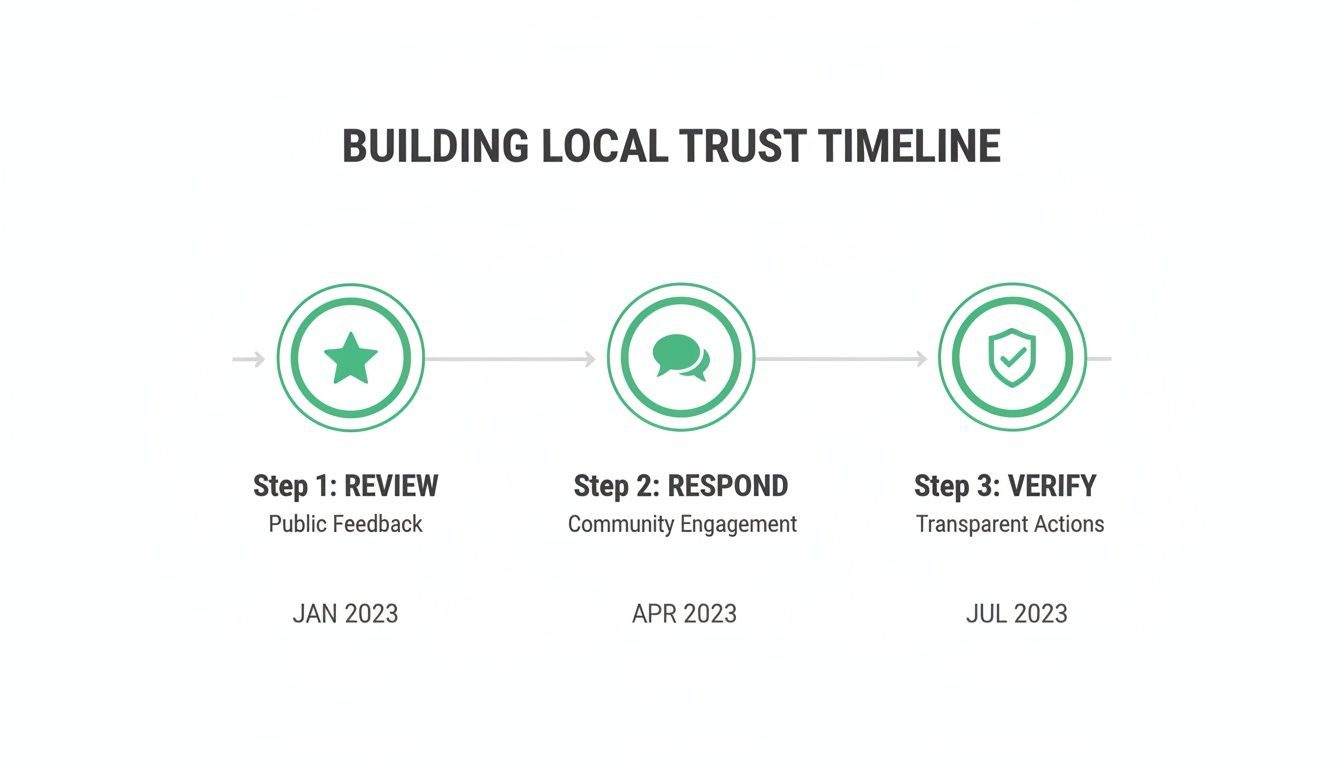
The insight here is simple but powerful—each step builds on the last to create a foundation of trust that both customers and search engines reward.
Your 90-Day Local SEO Lead Generation Sprint
Real progress in SEO takes time, but you can see meaningful momentum in just one quarter if you stay focused. A 90-day plan is perfect for this. It turns a big, intimidating goal into manageable weekly tasks that actually get done.
Here’s a structured action plan to guide your local SEO efforts over the next three months, focusing on foundational wins and sustainable growth.
| Month | Key Focus | Action Items | Primary KPI |
|---|---|---|---|
| Month 1 | The Foundation | Fully optimize your GBP profile. Correct all NAP inconsistencies across top-tier citations. Optimize your homepage title tag for your primary local keyword. |
15% increase in GBP profile views. |
| Month 2 | Content & Reviews | Publish two hyper-local blog posts (e.g., “Best HVAC Systems for Chicago Winters”). Launch a system to consistently request reviews from happy customers. |
Secure 5-10 new positive reviews. |
| Month 3 | Authority & Refinement | Sponsor a local community event or team to earn a quality backlink. Review KPIs from Months 1-2 and double down on what’s working. |
Your first local link and measurable movement in map pack rankings for one target keyword. |
This sprint isn’t about doing everything at once. It’s about taking deliberate, impactful steps each month that build on each other to create lasting momentum for your business.
Answering Your Local SEO Questions
Got a few questions still rattling around? Good. That’s completely normal. This whole local SEO lead generation thing can feel complicated, but the core ideas are actually pretty simple once you slice through the noise.
Let’s dig into the most common questions I hear from business owners. We’ll cover what really matters, what to expect, and how to get started on the right foot. Think of this as the final huddle before you go out there and start winning more local customers.
How Long Does Local SEO Take to Work?
This is the big one, isn’t it? While you can see some quick wins in just a few weeks from a well-optimized Google Business Profile—like a sudden uptick in calls—real, lasting ranking improvements usually take three to six months. It’s a marathon, not a sprint.
A few things will speed up or slow down your timeline:
- Your Competition: Are you a plumber in a small town or a real estate agent in downtown Chicago? Crowded markets take longer to crack.
- Your Starting Point: A brand-new website is starting from scratch. An established site that just needs a tune-up has a serious head start.
- Your Consistency: SEO has a compounding effect. The more consistently you publish local content, earn reviews, and build links, the faster that snowball starts rolling downhill.
What’s More Important: My Website or My Google Business Profile?
Honestly, they’re a tag team—you need both to win. Your Google Business Profile is usually the first impression a potential customer has. It’s what gets you seen in the map pack and drives those immediate actions like phone calls and requests for directions. It’s your top-of-funnel workhorse.
But your website is where you control the entire conversation. It’s where you build deep trust, show off everything you do, and ultimately turn a curious searcher into a paying customer with compelling content and clear calls-to-action.
Think of it this way: Your GBP gets you the date. Your website convinces them to stick around for a long-term relationship. One without the other is a massive missed opportunity.
Ready to stop guessing and start getting more local leads? The team at Mr. Green Marketing, LLC specializes in building custom digital marketing plans that deliver measurable results. Request your free audit and performance report today.
Leave a Comment
sing in to post your comment or sign-up if you dont have any account.