
How To Improve Brand Awareness. So you want people to remember your brand. The goal is to show up consistently, everywhere they are. And the magic number is 5-7 impressions—that’s about how many times someone needs to see your brand before it really sticks. This isn’t about just blasting your logo everywhere; it’s about a smart, multi-channel strategy built on a solid foundation.
How To Improve Brand Awareness – Defining Your Brand Before You Build It
Let’s be honest, you can’t build a memorable brand on a shaky foundation. Before you even think about ads or social media, you need absolute clarity on two things: who you are and who you’re talking to.
What makes your brand the only logical choice for them? This isn’t just marketing fluff. Getting this right from the start makes every other decision—from ad copy to product design—ten times easier.

1. Crafting Buyer Personas That Feel Real
A buyer persona is more than a list of demographics. It’s a detailed profile of your ideal customer. Give them a name, a job, and real-world problems.
- Pain Points: What keeps them up at night? What frustrations can you eliminate? A persona named “Small Business Sarah” might be overwhelmed by her marketing to-do list, for instance.
- Goals and Motivations: What are they trying to achieve? Sarah wants to grow her online store without hiring a huge team.
- Watering Holes: Where do they hang out online? Is it LinkedIn, specific industry blogs, or a particular subreddit?
This simple exercise shifts your marketing from a megaphone to a magnet. Instead of shouting at everyone, you start creating things that naturally pull the right people in because you’re speaking their language. And that’s what we want.
The goal is to move from “we sell eco-friendly coffee” to “we help environmentally-conscious professionals start their day with a guilt-free, high-quality brew.” See the difference? One is about you; the other is about them.
2. Defining Your Unique Value Proposition
Your unique value proposition (UVP) is the simple, powerful statement that answers one critical question: “Why should I buy from you and not your competitor?”
This isn’t a slogan. It’s the core promise of your brand, and it informs everything from your website copy to your visual identity. To see how this foundation directly impacts design, check out our guide on branding, logo design, and rebranding.
The consistency that comes from this work is what makes a brand stick. Remember, it takes 5-7 impressions for someone to even recall a brand, and consistent branding across all platforms can fuel growth by 10-20%. It’s no surprise that 59% of shoppers would rather buy from brands they already know. This initial step is non-negotiable.
How To Improve Brand Awareness – Winning the Search Game with SEO and PPC
Alright, let’s get real. Your brand needs to get in front of people, and where’s the first place they go when they have a problem? They search for it. And if you’re not showing up on that first page of Google, you’re practically invisible.
This is where we roll up our sleeves and get tactical with Search Engine Optimization (SEO) and Pay-Per-Click (PPC) advertising. Think of them as your one-two punch in the fight for attention. One builds long-term authority, while the other gives you a shot of instant visibility.
3. Laying the Foundation with SEO
SEO is all about getting your website to show up in search results naturally. This isn’t some black-hat trickery; it’s about proving to Google that you have the most relevant, helpful answer to what someone is looking for.
It all starts with keywords. But not just any keywords—you need to get inside your customer’s head and figure out the exact phrases they’re typing into that search bar. Are they just kicking the tires (“best running shoes for beginners”) or are they pulling out their wallet (“Nike Pegasus 41 sale”)? Tools like Ahrefs or Semrush are great for this, but honestly, some of the best insights come from just listening to your customers.
Once you’ve got your keywords, it’s time to put them to work.
- On-Page SEO: This is the low-hanging fruit. Weaving your target keywords into the right places on your site—page titles, meta descriptions, headings, and throughout your actual content.
- Content That Answers Questions: Build a library of blog posts, guides, and FAQ pages that tackle your customers’ biggest problems head-on. If you know people are searching for it, you should have a piece of content ready for them.
- Local SEO: This one’s a big deal if you have a physical location. Absolutely non-negotiable. Claim and beef up your Google Business Profile. Actively ask for reviews, upload photos, and make damn sure your name, address, and phone number are identical everywhere online.
The beautiful thing about SEO is that it’s an asset that grows over time. The blog post you write today or the backlink you earn this week can keep driving traffic and building your brand for years to come. A true investment.
4. Accelerating Visibility with PPC
If SEO is buying real estate, PPC is like renting a billboard on the busiest digital highway in the world. You pay for placement right at the top of the search results, getting your brand seen immediately. Platforms like Google Ads are incredibly powerful because you’re meeting people at the exact moment of high intent—they’re actively looking for a solution you offer.
But this isn’t about just throwing money at Google and hoping for the best. A smart PPC campaign is a strategic one. For a much deeper look at the nitty-gritty tactics needed to get to the top, checking out how to rank #1 on Google lays out a more detailed roadmap.
A winning PPC campaign really boils down to a few key pieces.
The Anatomy of a Winning PPC Campaign
First, your ad copy has to be sharp. It needs to grab attention, speak directly to the searcher’s problem, and have a crystal-clear call-to-action (CTA) like “Shop Now” or “Get Your Free Quote.”
Next up is targeting. You can get laser-focused here. You can target users based on:
- Demographics: Age, gender, location, even income level.
- Interests: Things they’ve shown an interest in across the web.
- Remarketing: This is huge—it lets you get back in front of people who visited your site but didn’t buy.
Finally, the landing page experience is make-or-break. When someone clicks your ad, the page they arrive on has to be fast, relevant, and dead simple to navigate. If it’s a clunky or confusing experience, you’ve just wasted your ad spend.
When you combine SEO and PPC, you create a powerhouse. PPC gives you immediate data and feedback that can sharpen your long-term SEO strategy. In turn, a strong SEO foundation builds a sustainable presence that reduces your need to constantly pay for clicks. Together, they make sure your brand isn’t just playing the search game—it’s winning it.
Creating Content People Actually Want to Share – How To Improve Brand Awareness
Let’s be honest—a huge chunk of corporate content is just plain boring. Your goal is to create stuff so genuinely useful or entertaining that people can’t help but talk about it.
This isn’t about churning out blog posts to hit a quota. It’s about becoming a trusted resource, the go-to name in your industry. When you do that, brand awareness isn’t something you have to chase; it becomes a natural byproduct of the value you provide.

5. Go Beyond Just Blogging
A blog is a fantastic starting point—it’s your home base for demonstrating expertise. But to truly build brand awareness, you need to diversify. People consume information in all sorts of ways, so you need to meet them where they are.
Think about the different formats you can use to tell your brand’s story and share your knowledge:
- In-Depth Guides and How-Tos: These are the cornerstones of a great content strategy. They solve a real problem for your audience and immediately position you as an authority.
- Engaging Video Content: Whether it’s a short-form TikTok tutorial or a deep-dive YouTube video, video is powerful. People spend an average of 2 hours and 21 minutes on social media daily, with video platforms like YouTube leading the pack.
- Insightful Infographics: Have some compelling data or a complex process to explain? An infographic makes that information easy to digest and incredibly shareable.
- Snackable Social Posts: Not every piece of content needs to be an epic. Turn a key stat from a blog post into a graphic or a quick tip into a text-based post.
6. Storytelling Over Sales Pitches
People connect with stories, not sales pitches. And your content is the perfect place to weave your brand’s unique narrative into everything you create.
Instead of just listing product features, tell the story of how that product solved a major problem for a real customer. Don’t just announce a company milestone; share the behind-the-scenes journey of the challenges and wins it took to get there.
The most effective brand stories aren’t about the brand at all—they’re about the customer. Your brand is simply the guide that helps them become the hero of their own story. That’s a narrative people remember and share.
This shift in perspective changes everything. It turns a dry case study into a compelling success story. It transforms a simple “About Us” page into a mission people actually want to get behind.
7. Develop a Sustainable Content Calendar
Consistency is key, but so is sanity. A content calendar is your best friend for staying on track without burning out. And it doesn’t have to be some overly complicated spreadsheet—it just needs to work for you.
Start by mapping out key themes or “content buckets” for each month. For a local coffee shop, these buckets might be:
- Educational: “How to Brew the Perfect Pour-Over”
- Community Spotlight: “Featuring Local Artist of the Month”
- Behind-the-Scenes: “A Day in the Life of Our Head Roaster”
- Product-Focused: “Introducing Our New Seasonal Blend”
Once you have your themes, you can plug in specific ideas. That “How to Brew” theme? It could be a detailed blog post, a 60-second Instagram Reel, and a printable PDF guide. You’ve just created three pieces of content from one idea.
For more tips on building out a solid plan, our guide on content marketing best practices offers a great framework. This approach ensures you’re consistently putting out valuable, varied content that reinforces your expertise and keeps your brand top of mind.
How To Improve Brand Awareness – Building Buzz with Social Media and Partnerships

You can’t just throw content at the wall and hope something sticks. And you definitely won’t build a community by shouting into the void. Social media is a massive, ongoing conversation, and if you want to get noticed, you need a smart plan for joining in.
The classic mistake I see businesses make is trying to be everywhere at once. Don’t. Your audience isn’t on every single platform, so you don’t need to be either. The real goal is to figure out where your ideal customers actually hang out and go deep on those specific channels.
With over 5 billion active social media users globally, you’re fighting for a sliver of attention. This isn’t about just posting; it’s about showing up in a way that resonates with each platform’s unique culture.
8. Choosing Your Channels Wisely
What absolutely kills it on LinkedIn will likely fall completely flat on TikTok. Every platform has its own language, rhythm, and unwritten rules. Your first job is to learn them.
- LinkedIn: Your professional playground. Think insightful articles, company milestones, and genuinely helpful content for people in your industry.
- Instagram: It’s all about the visuals. We’re talking high-quality photos, behind-the-scenes Stories, and snappy Reels. This is the spot for e-commerce, restaurants, and any brand with a strong aesthetic.
- TikTok: This platform runs on authenticity and creativity. Short, entertaining, or educational videos that feel native—not like a polished ad—are what win here.
- Facebook: Its broad user base makes Facebook incredibly versatile. Perfect for building tight-knit communities in Groups, sharing updates with loyal fans, and running laser-targeted ad campaigns.
Your content needs to be a direct reflection of both the platform’s style and your brand’s personality. Never just syndicate the same exact post everywhere. Adapt it.
Expert Tip: Don’t just chase the big platforms. Niche forums, subreddits, or industry-specific communities can be goldmines. Being an active, helpful member in a smaller, focused community often builds more loyalty than a thousand likes on a generic Facebook post ever could.
9. The Exponential Power of Partnerships
Ready for a major growth lever? Let’s talk partnerships. This is one of the fastest ways to get your brand in front of a warm, relevant audience that someone else already spent years building.
The key is finding non-competing businesses that share your exact customer profile. You’re essentially borrowing trust and expanding your reach exponentially. And when a brand your ideal customer already loves introduces you—that endorsement is pure gold.
Identifying and Pitching Potential Partners – How To Improve Brand Awareness
Finding the right partner is like casting for a movie; the fit has to feel natural. You’re looking for brands that align with your values and speak to the same crowd without being a direct competitor.
A high-end wedding photographer, for example, could team up with:
- A boutique floral designer
- A custom stationery artist
- A popular local wedding venue
- A bespoke bridal gown shop
Once you have your list, your outreach needs to be about them, not you. Your pitch has to scream “win-win.”
- Start with a genuine compliment. Show them you’ve actually followed their work and admire what they do.
- Point out the audience overlap. Clearly explain why a partnership makes perfect sense for their followers.
- Propose a specific idea. Don’t just say, “let’s partner.” Suggest something concrete, like a joint giveaway, a co-hosted webinar, or a guest blog post swap.
- Make it easy to say yes. Outline the next steps and show you’re willing to do the heavy lifting to get things rolling.
This approach turns marketing from a solo mission into a collaborative effort, letting you tap into established networks to take your brand from unknown to unforgettable.
Measuring What Matters to Scale Your Brand – How To Improve Brand Awareness
If you’re not measuring, you’re just guessing. And guessing is an incredibly expensive way to build a brand. Likes and follows might feel good on a social media report, but they don’t pay the bills. They’re often just vanity metrics, not business metrics.
To figure out if your brand awareness efforts are actually working, you have to cut through that noise. It’s time to focus on the key performance indicators (KPIs) that signal real, tangible growth in how many people recognize, remember, and seek out your brand.
10. Moving Beyond Vanity Metrics
The first step is a mindset shift. You have to connect your marketing activities to actual business outcomes. High engagement is great, but what did that engagement do? Did it lead to more people visiting your website directly? Did it cause a spike in searches for your brand name?
These are the questions that move you from simply being busy to being effective. Let’s look at the metrics that tell the real story of your brand’s growing influence.
Key Brand Awareness KPIs You Must Track
Here are the core metrics that paint a clear picture of whether your brand awareness is truly growing. The good news? You don’t need a massive, expensive software suite to get started. Many of these can be tracked with free tools you probably already use.
- Direct Traffic: This is the gold standard. When someone types your website URL directly into their browser, it’s one of the purest indicators of brand recall. An upward trend here means more people know you by name. You can find this data right in Google Analytics.
- Branded Search Volume: This metric tracks how many people are specifically searching for your brand or product names. A direct signal that your marketing is prompting people to look for you. Monitor this easily in Google Search Console.
- Social Media Reach & Engagement: Look past the likes and dig into reach (how many unique people saw your post) and shares. A share is a powerful signal—it means your content resonated so strongly that someone was willing to stake their own reputation on it by passing it along to their network.
- Backlinks: When other reputable websites link to yours, it’s a huge vote of confidence. It tells both search engines and people that you’re a trusted authority in your space. More quality backlinks mean your brand’s footprint is expanding across the web.
Tracking these metrics is all about creating a feedback loop. See a spike in direct traffic after a partnership announcement? That tells you the partnership worked. Notice a blog post getting tons of shares? That’s a topic you need to create more content around.
To really get this right, you need a solid framework. You can learn how to effectively measure your marketing effectiveness and build a reporting system that gives you real answers.
Here’s a simple dashboard you can build to keep your most important brand awareness KPIs in one place.
How To Improve Brand Awareness – Brand Awareness KPI Dashboard
This table breaks down the key metrics to track across different channels, helping you measure the true impact of your brand awareness campaigns.
| Metric | What It Measures | Tool to Track | Good Benchmark |
|---|---|---|---|
| Direct Traffic | Brand recall and direct interest. | Google Analytics | >20% of total traffic |
| Branded Search Volume | How many people are searching for you by name. | Google Search Console | Consistent month-over-month growth |
| Social Media Reach | The number of unique people who see your content. | Native Social Platforms | Varies by platform; aim for growth |
| Share of Voice (SoV) | Your brand’s visibility vs. competitors. | Brandwatch, Talkwalker | Growing percentage against key competitors |
| Backlink Growth | Authority and trust signals from other sites. | Ahrefs, Semrush | Steady increase in referring domains |
Having a dashboard like this turns vague goals into concrete numbers, giving you a clear scorecard for your efforts.
11. From Measurement to Scaling Your Efforts
Once you have a handle on what’s working—once you know which levers actually move the needle—it’s time to press harder. Knowing your numbers gives you the confidence to invest your time and budget where they’ll make the biggest impact.
This is where you graduate from foundational tactics to more advanced growth strategies. You’ve built a small fire with your initial efforts; now it’s time to add fuel.
Advanced Tactics for Compounding Growth
With data on your side, you can now explore strategies that require a bigger investment but offer exponential returns. Think of these as your brand awareness force multipliers.
- Launch a Strategic PR Campaign: Public relations isn’t just for damage control. Proactive PR is about getting your brand featured in industry publications, podcasts, and news outlets your target audience trusts. A single mention in a major publication can drive more awareness than months of social media posting.
- Collaborate with Influencers: This is about finding creators who have already built the trust of your ideal audience. A genuine endorsement from the right influencer can introduce your brand to thousands of potential customers in a way that feels authentic, not like another ad. In fact, 79% of marketers track engagement metrics like likes and shares from these campaigns to gauge success.
- Develop a Referral Program: Turn your happiest customers into your most passionate advocates. A well-designed referral program incentivizes word-of-mouth marketing, which is still one of the most powerful forms of promotion. It creates a system that can scale your brand’s reach organically.
By combining consistent measurement with a willingness to scale the winners, you create a powerful cycle. You measure to find what works, then you scale what works to grow faster. And this is how you turn small, initial wins into the long-term, compounding growth that builds a category leader.
How To Improve Brand Awareness – Your 30-90-180 Day Brand Awareness Action Plan
All the theory in the world doesn’t mean much without action. This is your roadmap. We’re taking everything we’ve talked about and breaking it down into a practical plan you can start using today.
This isn’t just a to-do list; it’s a strategic framework built to create real momentum. So print it out, stick it on your wall, and let’s get to work building a brand people actually remember.
This timeline shows how sustainable growth happens in phases—you start by measuring what works, scale the winners, and then reinvest in new growth channels.
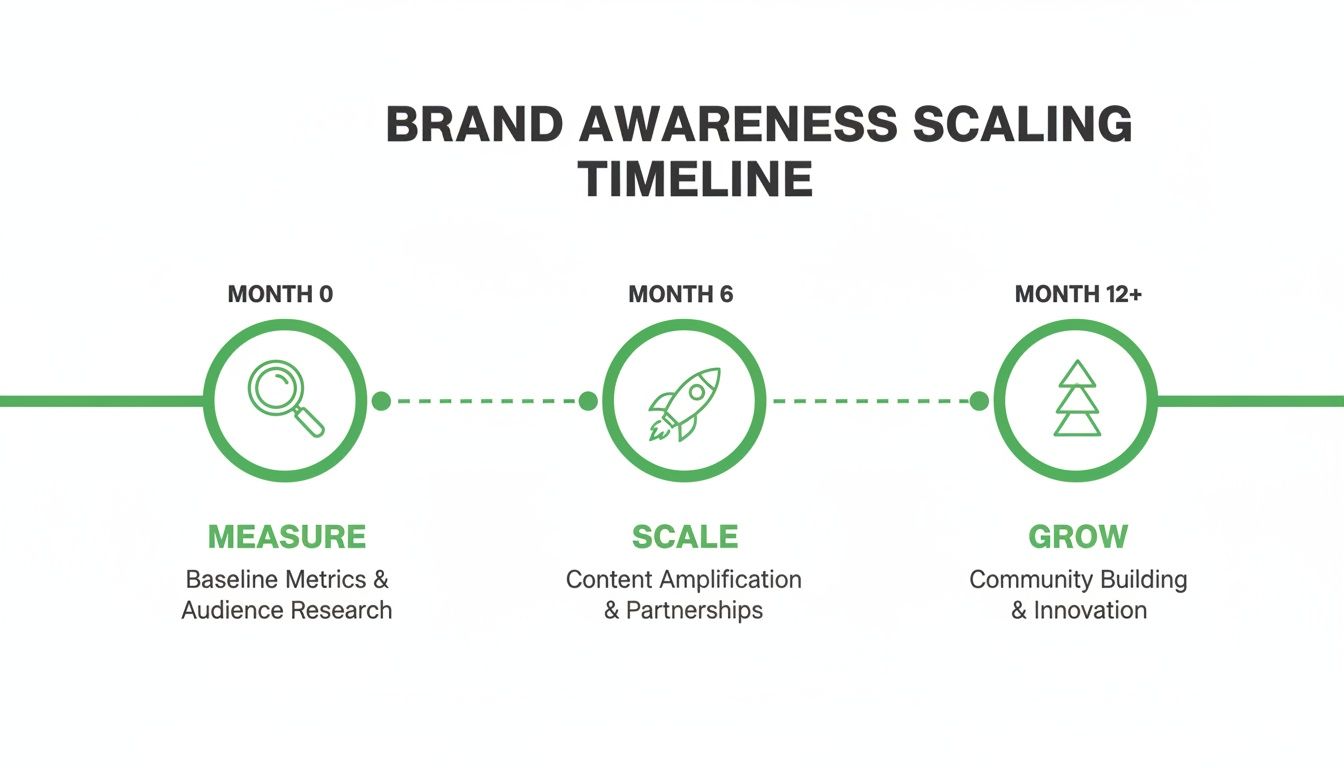
You can’t skip steps. You measure first to find what works, scale those successes, and then pour fuel on the fire with new channels.
How To Improve Brand Awareness – The First 30 Days: Foundational Quick Wins
This first month is all about getting your house in order. We’re not launching massive campaigns yet—we’re laying the groundwork for everything that follows. The goal is to set a solid baseline and plug any obvious holes in your current approach.
- Weeks 1-2: Conduct a Full Brand Audit. Get a clear picture of where you stand right now. Use Google Search Console to check your branded search volume and Google Analytics to measure direct traffic. Document these numbers—they are your starting line.
- Weeks 3-4: Optimize All Social Profiles. Consistency is key. Make sure every social media bio is compelling, uses the same language, and links back to your site. Use the same profile picture and banner image everywhere for instant recognition.
How To Improve Brand Awareness – The Next 90 Days: Building Momentum
With a solid foundation in place, it’s time for focused, consistent action. This phase is all about creating assets and building relationships that will pay dividends for months and even years to come.
This is where the real work begins. The goal isn’t perfection; it’s consistent execution. A good plan you stick with is infinitely better than a perfect plan you abandon after two weeks.
- Month 2: Launch Your First Content Campaign. Using your audience research, create and publish 2-3 cornerstone content pieces. These could be in-depth guides, original data reports, or ultimate tutorials. Promote them heavily across your newly optimized social channels.
- Month 3: Start Partnership Outreach. Identify 10 potential partners who share your audience but aren’t direct competitors. Send personalized outreach emails proposing a simple win-win collaboration, like a joint social media giveaway or a guest post swap.
How To Improve Brand Awareness – The 180-Day Plan: Scaling and Optimizing
After six months, you have data. And with data, you can make much smarter decisions. This phase is about doubling down on what’s actually working and strategically exploring new channels for growth.
To get more ideas for your long-term plan, exploring proven strategies for building brand awareness can give you a major leg up.
- Analyze Your Data: Dig into your KPIs. Which blog posts drove the most direct traffic? Which social channel has the highest engagement rate? The numbers will tell you the story.
- Scale the Winners: Reinvest your time and budget into the channels and tactics that have shown the best results. If a particular blog topic really took off, turn it into a webinar or create a short video series about it.
How To Improve Brand Awareness – Your Top Brand Awareness Questions, Answered
Look, I get it. Kicking off a brand awareness strategy can feel a bit like shouting into the void. You’re putting in the work, but the immediate ROI isn’t always obvious. Over the years, I’ve heard the same handful of questions from business owners trying to get their footing. Let’s tackle them head-on.
How Much Should I Actually Spend on Brand Awareness?
There’s no magic number, but a solid rule of thumb is the 5-15% rule. That means setting aside 5-15% of your total revenue for your entire marketing budget. From there, a healthy chunk of that should go directly to brand awareness, especially if you’re in a growth phase.
If you’re a new business, you’ll want to lean closer to that 15% mark—maybe even a little more. Why? Because right now, nobody knows you exist. An established brand with some recognition, on the other hand, can afford to shift more of its budget toward direct-response marketing while maintaining a smaller percentage for awareness.
How Long Does It Realistically Take to See Results?
This is always the tough pill to swallow. Brand awareness isn’t like a PPC campaign where you can track clicks the next day. It’s a long game. You might see some early signs within the first 90 days, like a little bump in direct website traffic or more people searching your brand name in Google Search Console.
But building real, memorable brand recognition? That takes relentless consistency over 6 to 12 months and beyond. Think about it: it takes an average of 5-7 impressions before someone even starts to recognize your brand. That doesn’t happen overnight.
The biggest mistake I see is treating brand awareness like a campaign with a start and end date. It’s not. It’s an ongoing business function, just like accounting or customer service. A marathon, not a sprint.
What’s More Important: Brand Awareness or Lead Generation?
Ah, the classic chicken-or-the-egg debate. The honest answer? You absolutely need both. And they feed into each other in a powerful loop.
Lead generation—like running an ad for a free guide—is often how someone first interacts with your brand. But strong brand awareness makes those lead-gen efforts cheaper and way more effective because you’re not starting from zero. People already have a little bit of trust in you. Focusing on just one is a recipe for stalling out. A healthy marketing strategy balances those short-term wins with long-term brand building.
Ready to stop guessing and start building a brand that actually gets noticed? The team at Mr. Green Marketing, LLC specializes in creating data-driven strategies that turn awareness into action. Let us show you where you stand today—request your free audit and performance report.
Leave a Comment
sing in to post your comment or sign-up if you dont have any account.