
Podcast Promotion Services: You publish consistently, the episodes sound good, and the download graph still looks flat. That’s the familiar small-business podcast problem. Quality helps people stay, but it doesn’t automatically help them find you.
The audience opportunity is now too large to treat promotion as an afterthought. Global monthly podcast listenership crossed 550 million in 2026, while the United States reached roughly 165 million monthly listeners, or about 55% of the 12+ population, according to 2026 podcast audience and advertising data. U.S. podcast ad spend is projected to exceed $3 billion in 2026, with global spending expected to pass $5 billion in the same projection.
That scale changes the job. Podcast promotion services aren’t a person posting an episode link or buying one ad. They build a discoverability system that connects your RSS feed, episode pages, YouTube videos, social clips, email, guest relationships, and conversion tracking.
And the silence after launch isn’t a verdict on your show. It usually means the content hasn’t reached enough of the right people in the places where they already browse. The guide below shows what promotion partners handle, how platform-native discovery has changed the old cross-promotion playbook, how to compare pricing, and how to choose a practical channel mix for your budget.
Podcast Promotion Services: Table of Contents
- Introduction Why Great Podcasts Still Need Promotion
- What Podcast Promotion Services Actually Do
- Inside the Service Menu From Distribution to Repurposing
- Pricing Models Deliverables and What to Expect
- How to Measure Success KPIs and Attribution That Matters
- Choosing the Right Partner A Vendor Evaluation Checklist
- Putting It All Together Workflows Case Example and Next Steps
Introduction Why Great Podcasts Still Need Promotion
A founder at a regional consulting firm launches a podcast after months of planning. The logo looks polished. The first guests are credible. The host publishes on schedule, shares each episode on LinkedIn, and waits for momentum.
Instead, the first few episodes attract a small circle of colleagues, guests, and existing clients. Then the numbers settle into a narrow range. The host starts questioning the format, even though the core problem is distribution. The show has content, but it lacks enough repeated exposure to become part of a listener’s routine.
That distinction matters for brand growth. A brand awareness strategy gives a business a broader framework for becoming familiar, while podcast promotion applies that thinking to a show people need to discover, sample, remember, and revisit.
Promotion is a system, not a single tactic
A useful promotion system answers four questions:
- Where will discovery happen? Search, YouTube recommendations, social feeds, podcast apps, guest channels, email, and paid placements can all play different roles.
- What will people see first? A compelling clip, thumbnail, episode title, guest quote, or host recommendation may be the first contact with your show.
- What happens after the click? The listener should land on a clear episode page, a strong YouTube upload, or a podcast app listing that makes the next action obvious.
- How will you judge value? Downloads matter, but qualified listening, site visits, leads, and attributable conversions give a stronger business picture.
The service becomes especially valuable when your internal team can record conversations but can’t consistently turn each one into a coordinated campaign. A promotion partner handles the repetitive work and protects the release window, when attention is most concentrated.
The modern listener rarely follows one path
Some listeners still find shows through friends and family, podcast directories, or guest recommendations. Others discover an episode through a vertical video, a YouTube search result, a social feed, or an in-app recommendation. Your audience may never type the exact show name into a podcast app.
So the central question isn’t, “How do we get more downloads?” It’s, “How do we create several credible paths into the right episode, then make the next listen easy?”
That’s the promise of a well-built service: better reach without forcing the host to become a full-time editor, social manager, media buyer, and analyst.
What Podcast Promotion Services Actually Do
Think of a podcast promotion service as a tour manager for your show. The host and guest create the performance. The tour manager handles venues, schedules, posters, press, travel, and follow-up so the audience has more chances to encounter the work.
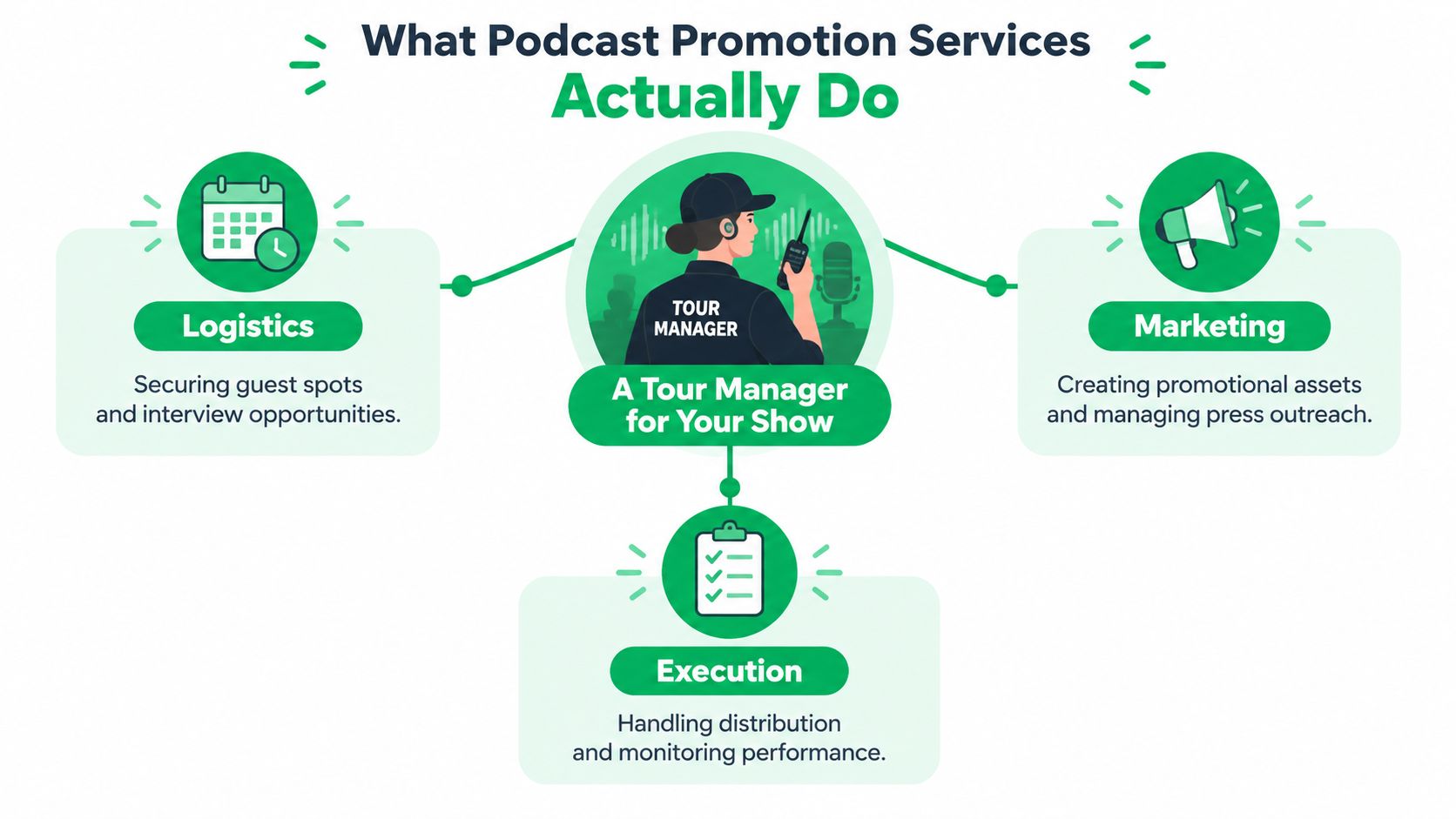
The “venue” in this analogy is a platform. Your episode may appear in an RSS-powered podcast app, on YouTube, in Google results, inside a social feed, in an email newsletter, or through a guest’s audience. Each place has different creative requirements. A podcast app needs clear metadata. YouTube needs a useful title, description, thumbnail, and video format. Social platforms need a strong opening moment that works without much context.
The work usually falls into three jobs
First, services make the show findable. They review the RSS feed, episode titles, descriptions, categories, links, transcripts, show notes, and platform listings. They look for missed search language and broken paths between the episode, the website, and the listening destination.
Second, they make the show shareable. A full episode is rarely the best social asset. A service may extract a sharp discussion point, add captions, frame the guest clearly, create a short audiogram, or turn the idea into a quote graphic and written post.
Third, they make promotion repeatable. Instead of improvising after every upload, the team uses a release workflow. The episode receives coordinated distribution, guest outreach, clips, email support, and reporting according to an agreed schedule.
That’s different from DIY posting. A founder who publishes one link on one channel is completing a task. A promotion team is building a network of entry points around the episode.
Practical rule: If a proposal talks only about posting frequency, ask how the service improves discovery, creative quality, distribution, and measurement together.
Podcast Promotion Services: Full service or a la carte support
You may need full-service help when nobody owns the workflow, your team can’t produce video clips consistently, or each episode launch feels like a new emergency. You may only need a la carte support when your internal team already handles strategy and distribution but needs editing, YouTube packaging, paid media management, or reporting.
The right scope depends on the bottleneck. A podcast marketing strategies guide can help your team think through the wider channel plan, but a vendor should still translate that plan into assigned deliverables, deadlines, owners, and reporting.
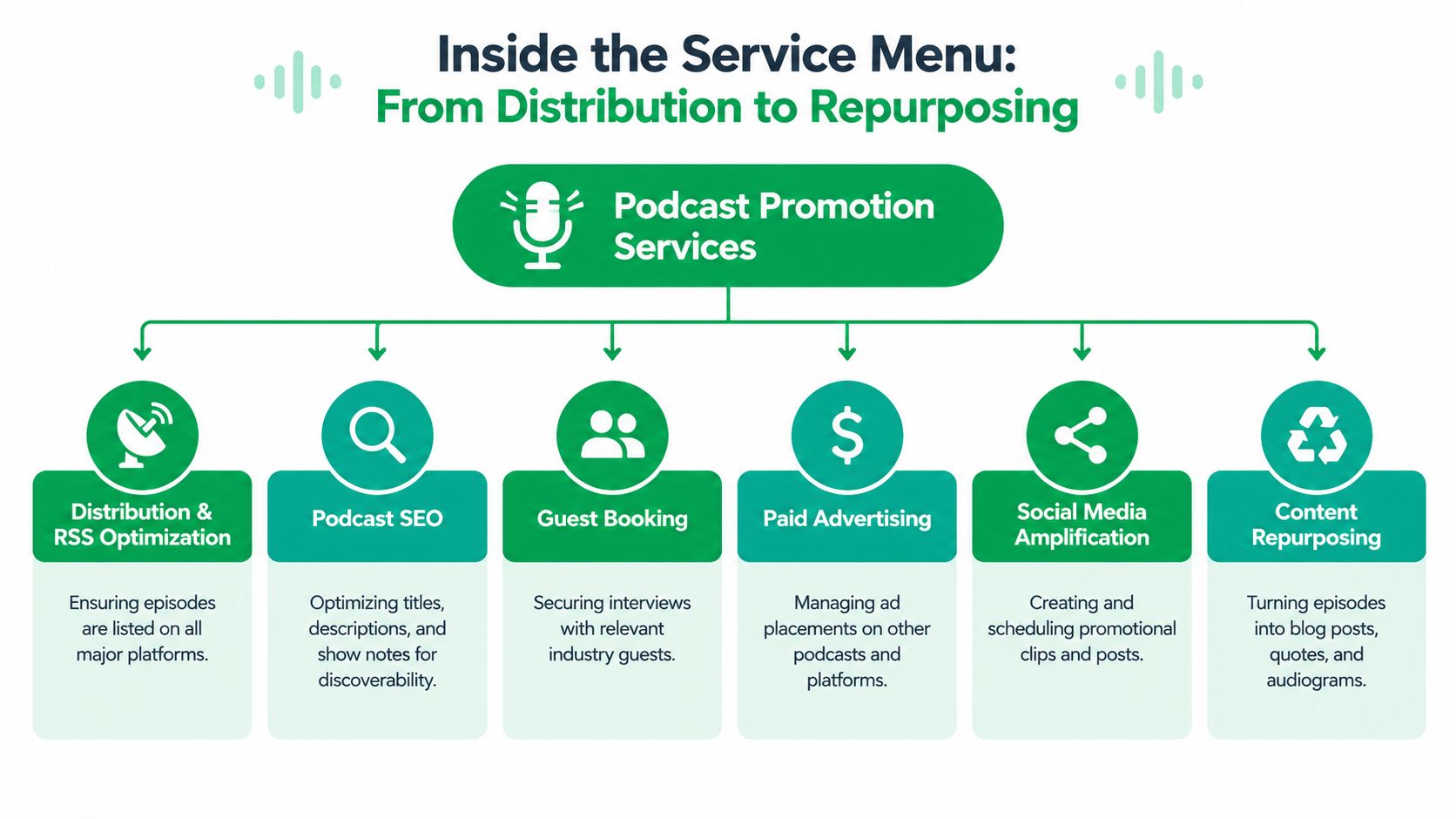
Podcast Promotion Services: Inside the Service Menu From Distribution to Repurposing
A good service menu should feel like an operating system, not a pile of disconnected add-ons. Each offering solves a different part of the discoverability problem.
Distribution and RSS optimization
The RSS feed remains the foundation. A service checks whether episodes publish correctly, whether titles and descriptions are complete, whether links point to the right destinations, and whether the show appears consistently across major listening platforms.
This is the least glamorous part of promotion, but failures here waste every later investment. For a small business, ask for a documented publishing checklist and ownership of platform access. You shouldn’t discover a feed or listing problem after a campaign has already started.
Podcast Promotion Services: Podcast SEO
Podcast SEO includes show names, episode titles, descriptions, show notes, transcripts, category choices, internal links, and page structure. The goal isn’t to stuff keywords into every sentence. It’s to make the topic, audience, guest expertise, and useful takeaway clear to both search systems and people.
A service should explain how it chooses topics and phrases. If the answer is only “we optimize metadata,” ask to see an example of the original title, revised title, show notes, and intended search purpose.
Guest booking and relationship outreach
Guest booking can support reach, authority, and business development. A relevant guest brings expertise, potential sharing, and a reason to follow up after publication. But booking shouldn’t become a vanity exercise where the show collects recognizable names without serving its target listener.
For an SMB, define the guest profile before outreach begins. Industry relevance, customer overlap, practical expertise, and willingness to share often matter more than general fame.
Paid advertising and audio amplification
Paid promotion can place an episode or clip in front of a selected audience, support a launch, or reinforce a relationship with a guest. It works best when the creative has a clear promise and the destination has a measurable action.
Keep media spend separate from service fees in the proposal. Otherwise, you won’t know whether a higher invoice reflects strategy and production or a larger advertising budget.
Podcast Promotion Services: Social media amplification
Short-form video is now a core promotion asset. A service might create vertical clips for YouTube Shorts, Instagram Reels, LinkedIn, or other social placements, then write captions and schedule distribution.
The reason to prioritize this work is audience behavior. One 2026 discovery study found that 61% of listeners attributed discovering their favorite podcast to YouTube or social media when those channels were included (Podnews coverage of the discovery study). That doesn’t mean every clip will perform. It does mean a podcast app-only strategy leaves an important discovery path underdeveloped.
Repurposing for YouTube, email, and owned channels
Repurposing turns one conversation into multiple useful formats: a full video upload, short clips, a written summary, a newsletter item, social copy, quote cards, or a website article. The best teams don’t duplicate the audio everywhere. They adapt the idea to the channel.
A lean SMB workflow might prioritize one strong YouTube upload, a few carefully selected clips, one email mention, and a useful episode page rather than producing a large volume of weak assets. A content distribution strategy can help connect those assets to a broader publishing system.
Podcast Promotion Services: Pricing Models Deliverables and What to Expect
Podcast promotion services are usually purchased through a recurring retainer, a defined project, performance-linked terms, or a hybrid arrangement. The model matters less than the clarity of the scope. A low fee can still become expensive if editing, creative revisions, platform management, reporting, or advertising are excluded.
| Pricing Model | Typical Deliverables | Best For | Watch Out For |
|---|---|---|---|
| Retainer | Ongoing strategy, episode promotion, clips, distribution, reporting, and campaign management | SMBs that publish consistently and want an accountable operating partner | Vague monthly scope, unused deliverables, or unclear revision limits |
| Project-based | Launch plan, metadata cleanup, channel setup, campaign assets, or a limited promotion sprint | New shows, seasonal campaigns, or teams testing a service | No ongoing owner after launch, incomplete handoff, or missing measurement |
| Performance-tied | Compensation connected to agreed actions or outcomes | Businesses with strong tracking and a clearly defined conversion path | Attribution disputes, low-quality traffic, and incentives that favor volume over fit |
| Hybrid | Base fee for strategy and production, plus separate media spend or outcome-based incentives | Teams that need predictable execution with flexible campaign investment | Hidden ad costs, unclear ownership of creative, or complicated reporting |
What the proposal should spell out
Ask for the exact number and type of assets, platforms covered, approval process, turnaround expectations, reporting cadence, and access requirements. If the vendor mentions paid promotion, require a separate line for media spend. If the vendor promises audience growth, ask what counts as a qualified result and how it will be verified.
Download guarantees deserve caution. A download can come from a poorly matched audience, an accidental click, or a listener who never reaches the useful part of the episode. A strong proposal connects promotion to audience fit, listening quality, site behavior, and business actions rather than treating a single volume metric as success.
Podcast Promotion Services: Match the model to your internal capacity
Choose a retainer when the show is part of an ongoing marketing calendar and your staff needs dependable execution. Choose a project when the bottleneck is setup or a specific campaign. Consider a hybrid only when both sides agree on the tracking rules before work begins.
Budget conversations become easier when you describe the constraint clearly. “We need a YouTube-first launch with a small paid test and clear lead tracking” is more useful than “We need maximum exposure.”
How to Measure Success KPIs and Attribution That Matters
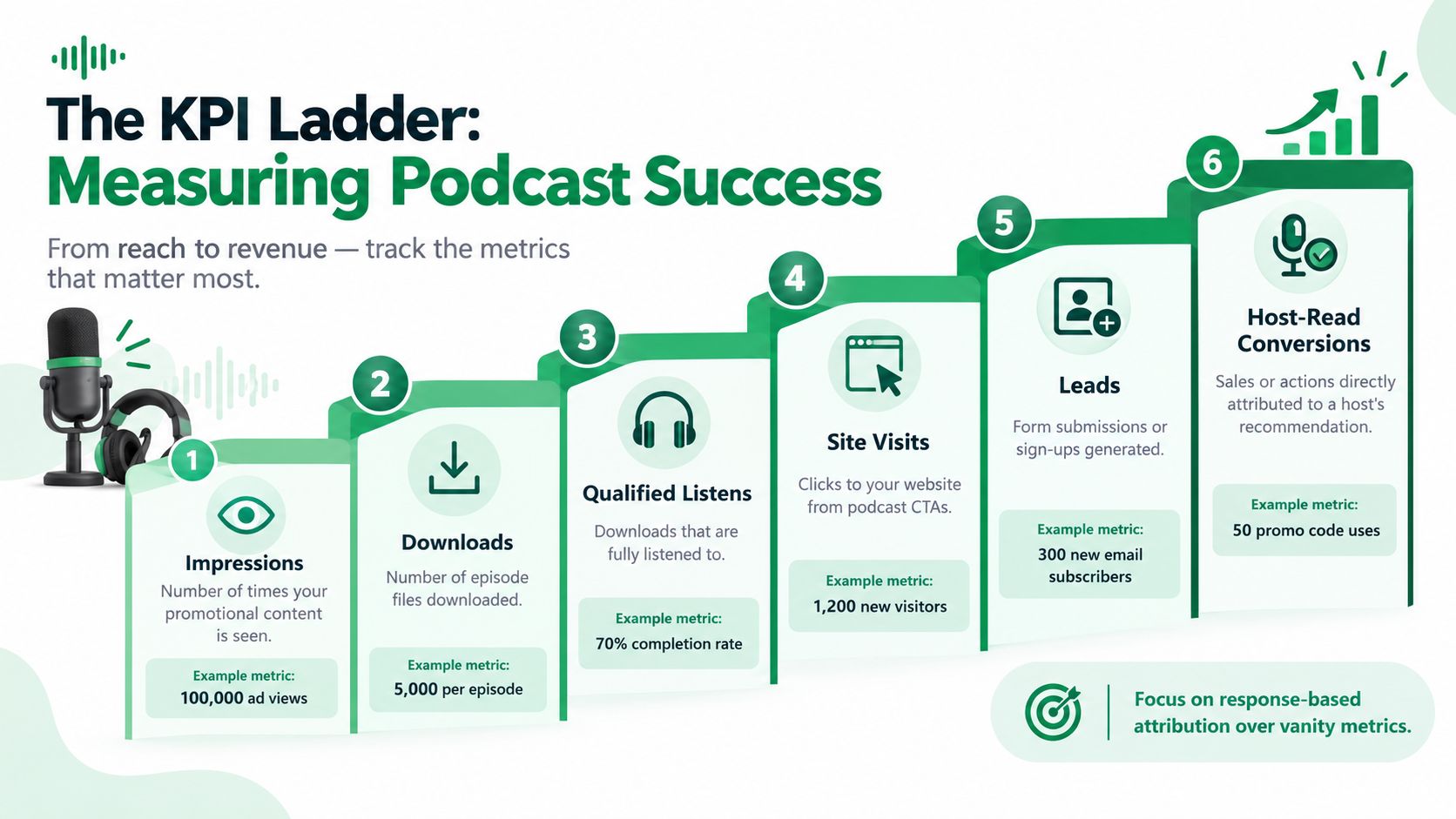
A podcast dashboard can look busy while telling you very little. Impressions show exposure. Downloads show that a file was requested. Neither metric proves that the right person listened, visited your site, joined your list, booked a call, or bought something.
Build measurement as a ladder. Start with reach, then move toward behavior and business response.
Use the metric that matches the decision
A service should report which content was seen, which episodes were downloaded, and whether listeners stayed engaged. It should also show traffic from podcast links, form submissions, booked conversations, purchases, or other actions tied to the show’s purpose.
One 2026 benchmark found that podcast ad spending rose 28% year over year in Q1, while response-based reporting tracked downstream actions such as site visits and lead generation (Magellan AI’s podcast advertising benchmark). The useful lesson isn’t the growth figure alone. It’s that promotion decisions become stronger when teams connect placements to actions beyond impressions.
Measure the response, not just the applause.
For host-read advertising, use distinct landing pages, tracked links, campaign-specific calls to action, and promo codes where appropriate. A Harris Poll brief reported that 68% of podcast listeners trusted host recommendations, 67% found host-read ads effective, and 49% said they took an action after hearing a podcast ad (podcast advertising statistics summary). Among those who acted, 20% made a purchase and 23% visited a website or social page, according to the same source.
Protect the early release window
Promotion timing matters because discovery can concentrate soon after publication. A 2026 roundup reported that platform recommendations and in-app search drive 30% to 60% of first-time show discovery, while search can account for 30% to 70% of lifetime discovery for topical episodes in the first 7 to 14 days (New Media podcast statistics).
That supports a coordinated release workflow. Prepare the episode page, YouTube packaging, clips, guest message, email, tracking links, and paid creative before publication. Don’t wait until the episode is live to start making the assets.
A small business doesn’t need an enterprise dashboard. It needs a reliable weekly view of reach, qualified listening, site visits, leads, and attributable conversions, with notes explaining what changed and what the team will test next.
Choosing the Right Partner A Vendor Evaluation Checklist
Start vendor evaluation with channel fit, not personality. A friendly account manager can’t compensate for a weak YouTube workflow, unclear reporting, or a plan built entirely around old-fashioned cross-promotion.
Audience behavior supports a broader checklist. One Canadian study cited in recent discovery coverage found podcast-to-podcast discovery fell from 22% in 2020 to 13% in 2025, while 40% of monthly users said YouTube was their most-used podcast platform (podcast discovery trends). The implication for an SMB is practical: ask how the partner handles YouTube, short-form clips, podcast-app search, metadata, and owned channels together.
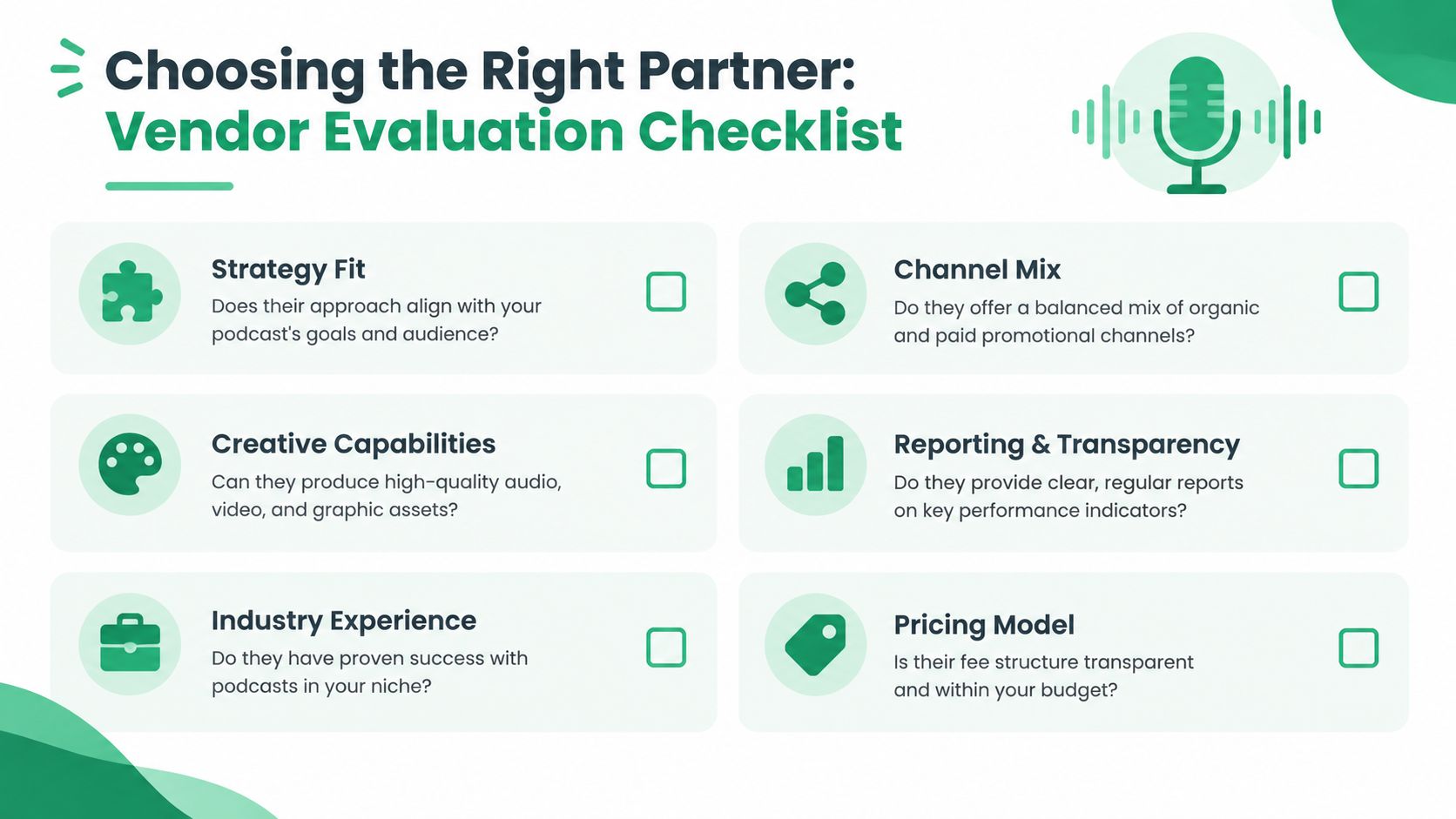
Score the proposal against six questions
- Strategy fit: Can the team explain your target listener, business objective, episode themes, and desired action in plain language?
- Channel mix: Does the plan balance organic distribution, YouTube, social clips, email, guest amplification, podcast apps, and paid reach where appropriate?
- Creative capability: Can the partner produce usable audio, vertical video, thumbnails, captions, show notes, and landing-page copy?
- Reporting transparency: Will you receive source-level traffic, campaign activity, listener behavior, leads, and clear notes about limitations?
- Relevant experience: Has the team worked with shows that resemble your industry, sales cycle, audience, or content format?
- Pricing clarity: Does the proposal separate strategy, production, media spend, revisions, software, and optional work?
Ask for evidence, not promises
During a discovery call, ask the vendor to walk through a recent episode workflow from recording to reporting. Ask who writes the title, who approves the clip, how quickly assets are delivered, where the files live, and what happens if a guest doesn’t share.
A strong partner can also explain what it won’t do. Be cautious when a proposal promises guaranteed popularity, vague “major platform exposure,” or a large volume of posts without describing audience fit. Another warning sign is a polished social package with no plan for the episode page, YouTube search, or conversion tracking.
Word of mouth still matters. One 2026 industry summary reported that 78% of listeners found new shows through friends and family, while podcast directories accounted for 50% and YouTube for 39% (podcast discovery statistics). That’s a reason to keep guest and referral sharing in the mix, not a reason to ignore platform-native distribution.
Putting It All Together Workflows Case Example and Next Steps
A practical SMB workflow begins before recording. The team chooses an episode angle tied to a customer question, prepares a searchable title and description, records the conversation, and marks moments that could work as short-form clips.
After editing, the promotion partner publishes the episode, uploads the video to YouTube, creates platform-native social assets, sends the guest a simple sharing package, and includes the episode in the company’s email or content calendar. A small paid boost can support the strongest asset, but the campaign still needs tracked links and a clear destination.
The weekly report then answers useful questions. Which topic attracted attention? Which clip drove the most qualified traffic? Did listeners visit the service page? Did a guest introduction create a sales conversation? The team uses those answers to adjust topics, packaging, distribution, and calls to action.
Consider a local professional services firm whose episodes receive steady listens but almost no inquiries. The first improvement may not be a bigger media budget. It may be a clearer episode promise, stronger YouTube packaging, clips that explain one useful idea, and a call to action leading to a relevant resource instead of a generic home page.
Mr. Green Marketing, LLC offers podcast promotion alongside SEO, PPC, social media, video production, and content strategy, so a business can connect episode distribution with broader visibility and lead-generation work. The useful next step is an audit that identifies where discovery is breaking down, then prioritizes the fixes your team can maintain.
If your podcast has good conversations but inconsistent reach, visit Mr. Green Marketing, LLC to request a free audit and performance report. Their team can review your distribution, YouTube and social clip opportunities, search visibility, and measurement setup, then help shape a promotion plan around your business goals.
Leave a Comment
sing in to post your comment or sign-up if you dont have any account.