
Facebook Ads Best Practices: And no, better Facebook Ads performance doesn’t usually come from raising the budget or narrowing the audience until it looks “perfect.” Those moves can amplify a strong campaign, but they can also multiply weak tracking, mismatched landing pages, tired creative, and poor offer positioning.
The practical answer is a connected operating system. You need a clear business objective, a campaign structure that matches the funnel, useful audience signals, persuasive creative, reliable conversion events, disciplined testing, privacy-resilient attribution, and policy-safe execution. Meta’s network reaches about 2.35 billion people daily across its platforms, so the opportunity is enormous, but scale makes operational mistakes expensive. The platform’s reach and benchmark context explain why Facebook ads best practices should focus on signal quality and disciplined optimization, not cheap impressions alone.
This list covers ten practices, from audience design and creative iteration to bidding, reporting, and account health. It ends with a practical audit sequence for SMB and e-commerce teams that need to know what to fix first. Mr. Green Marketing, LLC can also support strategy-led PPC execution through a free Facebook Ads audit and performance report where a deeper account review makes sense.
Facebook Ads Best Practices: Table of Contents
- 1. Define and Segment Your Audience with Laser Precision
- 2. Build Compelling Visual Creative and Video Content
- 3. Implement a Structured Testing and Optimization Framework
- 4. Master Conversion-Focused Landing Pages and Pixel Tracking
- 5. Use Dynamic and Retargeting Campaigns to Maximize Customer Lifetime Value
- 6. Optimize Bidding Strategy and Budget Allocation Based on Business Goals
- 7. Craft Compelling Ad Copy and Headlines That Drive Action
- 8. Align Facebook Ads with Broader Marketing Funnel and Attribution
- 9. Monitor, Report, and Iterate on Key Performance Indicators
- 10. Comply with Facebook Policies and Maintain Ad Account Health
- 10-Point Facebook Ads Best Practices Comparison
- Run the 10-Minute Facebook Ads Audit
1. Facebook Ads Best Practices: Define and Segment Your Audience with Laser Precision
Start with customer reality, not the targeting menu. A premium Amazon buyer may need proof of quality and durability, while a budget-conscious shopper may respond to value, convenience, or an introductory offer. Sending both people the same ad creates a messaging problem before it becomes a media problem.
Build a small set of meaningful segments around demographics, interests, behaviors, purchase history, customer value, and funnel stage. An e-commerce brand might separate first-time visitors, repeat customers, cart abandoners, and purchasers. A local service provider could distinguish homeowners in its service area from people who have recently shown relevant purchase intent, provided the targeting complies with Meta’s rules.
Practical rule: Start with a few commercially distinct segments, then consolidate segments that behave alike. More ad sets don’t automatically mean more precision.
Use website activity and first-party customer data to create custom audiences where consent and platform requirements allow. Lookalike audiences can help expand from a strong customer source, while Advantage+ detailed targeting may find useful prospects beyond manually selected interests. Meta’s current delivery guidance recommends Advantage+ detailed targeting, Advantage+ placements, and Advantage+ campaign budget, a sign that audience control now works best as a balance between useful signals and algorithmic flexibility. Meta’s delivery guidance is the right reference before building a highly restrictive structure.
For the strategic foundation behind segmentation, review this guide to buyer persona development. Then connect each segment to a distinct promise, proof point, and next action.
2. Facebook Ads Best Practices: Build Compelling Visual Creative and Video Content
Creative earns the first pause. A polished product photo, a clear demonstration, or a credible customer story can communicate faster than a paragraph of copy. Generic stock imagery often creates distance, especially for local services where prospects want to see the people, process, and outcome behind the offer.
Match the format to the buying context. A home services company might use a before-and-after demonstration, an Amazon seller could use a carousel to explain product categories, and a founder-led brand might record a direct video answering the question prospects ask before buying. Carousels give several products or visual proof points room to work. Meta says carousel ads can show multiple images at the same cost, making the format practical for product ranges and step-by-step explanations.
Reels need deliberate creative, not automatic repurposing. The share of Facebook ad impressions attributed to video ads in Reels rose from 7% in Q3 2024 to 14% in Q3 2025, according to benchmark reporting on the changing placement mix. That Reels inventory analysis shows why placement-specific variations matter. One winning hook can attract concentrated delivery, then fatigue quickly.
Build variation into production
Create multiple hooks, openings, visual sequences, testimonials, and calls to action. Short-form video should communicate its offer quickly, show the product in use, and remain understandable without sound. Use captions and test authentic customer material before paying for elaborate production. For practical planning ideas, review these video marketing best practices.
Refresh creative when frequency rises, response weakens, or comments show that the message no longer feels relevant. Track the business outcome after each refresh, not only thumb-stop rate or cheap video views. Creative iteration is part of signal quality: clearer ads produce better engagement signals, while varied assets give delivery more viable paths without forcing a full account restructure.
3. Facebook Ads Best Practices: Implement a Structured Testing and Optimization Framework
Testing should resolve a business question. Changing the audience, creative, headline, bid strategy, and landing page together can produce a different result, but it hides the cause. Build experiments around one meaningful variable at a time.
Keep the offer and conversion event stable while testing a hook. Keep the creative stable while comparing audience signals. Compare placements only after confirming that the ad renders correctly and produces acceptable downstream conversion quality. Some tests should be deliberately boring. That makes the result usable.
Record each experiment with four fields:
- Hypothesis: State what should improve and why.
- Variable: Change one element, such as the opening frame, headline, audience signal, or landing page.
- Primary outcome: Judge purchases, qualified leads, or another business result instead of clicks alone.
- Decision rule: Set the evidence threshold before results arrive, including when to pause, keep, or repeat the test.
Campaign structure also affects how much testing an account can support. Meta says ad sets generally need around 50 optimized conversion events to exit the learning phase. The official learning-phase explanation explains why excessive fragmentation can limit delivery and learning for smaller accounts. A local business with limited conversion volume may gain clearer feedback from a simpler structure than from many narrowly divided ad sets.
Allow enough time and spend to observe meaningful behavior, while setting a review point so a weak test does not run indefinitely. Document the result, audience, creative, budget, and context. Then use that record to choose the next experiment, rather than restarting the account with another round of unrelated changes.
4. Facebook Ads Best Practices: Master Conversion-Focused Landing Pages and Pixel Tracking
A Facebook ad can attract attention and still lose the conversion after the click. The landing page must continue the ad’s promise. A seasonal product ad should open the relevant offer, not a generic homepage. A consultation ad should lead to a focused form that explains the next step.
Keep the ad and page aligned on the headline, imagery, offer, and call to action. Remove navigation that pulls visitors away from the intended action, while keeping the proof a cautious buyer needs. Local service pages may require service-area details, testimonials, credentials, and a phone option. E-commerce pages should make product information, shipping, returns, and purchase controls easy to find.
A landing page also needs an operating check, not just a design review. Test mobile loading, every button, form validation, confirmation messages, and the destination URL. These examples of high-converting landing pages offer useful patterns for evaluating page structure without copying another business’s message.
Tracking should cover the full customer journey. Set up the Meta Pixel for meaningful events such as sign-ups, purchases, and form submissions, then use Conversion API where appropriate. Pixel events do not guarantee accurate reporting. Check browser and server event consistency, deduplication, event parameters, consent handling, and whether the recorded conversion represents a valuable business outcome. Follow Meta’s Pixel and Conversions API setup guidance when configuring the connection.
Review the event first, the page second, and campaign performance third. A broken form or misclassified event can make a strong campaign look weak, or send optimization toward the wrong action. For an SMB audit, submit the form yourself, confirm the event in Events Manager, compare it with the CRM or order record, and only then adjust budget or creative.
5. Facebook Ads Best Practices: Use Dynamic and Retargeting Campaigns to Maximize Customer Lifetime Value
A first visit usually signals interest, not readiness. Retargeting gives the business another chance to answer objections, reinforce the offer, or simplify the next step. Dynamic product ads make that message more relevant by showing items tied to browsing behavior, provided the catalog, event setup, consent controls, and exclusions are configured correctly.
Build audiences around intent. A product viewer needs a different message from someone who added the item to a cart. A past purchaser may be ready for replenishment or a complementary product, while a recent purchaser should generally leave acquisition campaigns that no longer fit.
Use a sequence instead of repeating one promotion:
- Reassure: Address product concerns, delivery questions, or service credibility.
- Clarify: Explain how the product or service works and who it suits.
- Prompt: Present the clearest next step, adding an incentive only when the economics support it.
Frequency requires active review. Repeated exposure to the same creative can create annoyance and fatigue, erasing the benefit of relevance. Rotate hooks, set separate exclusion windows, and handle customer lists according to consent and platform requirements.
Retargeting can also cover people who watched videos, engaged with a page, opened a lead form, or used a trial. Each group calls for a distinct conversation. A course business might show webinar attendees enrollment information, while a SaaS company could address activation barriers before presenting an upgrade. This retargeting advertising guide offers further context for matching those audiences with appropriate messages.
6. Facebook Ads Best Practices: Optimize Bidding Strategy and Budget Allocation Based on Business Goals
Cheap clicks do not equal profitable acquisition. Benchmark data illustrates the gap: traffic campaigns in one 2025 benchmark set averaged 1.71% CTR and $0.70 CPC, while lead campaigns averaged 2.59% CTR, $1.92 CPC, a 7.72% conversion rate, and $27.66 CPL. The benchmark report shows why campaign objective and downstream value matter more than CPC alone.
Choose an optimization event that matches the business result. Traffic campaigns can support content distribution, but they should not be evaluated like sales campaigns. Lead campaigns require lead-quality checks, not only inexpensive form completions. E-commerce accounts should connect purchase data and margin to the ROAS target.
Budget allocation balances stability with exploration. Concentrating spend on proven campaigns can protect efficiency while limiting discovery. Distributing spend across too many tests can leave each ad set without enough useful signal. Change budgets gradually, monitor delivery, and avoid rebuilding the account whenever performance shifts.
Let automation work within guardrails
Advantage+ campaign budget and Advantage+ placements can help the system shift delivery toward opportunities across ad sets and placements. Configure the account around the available conversion volume, especially when the signal is limited.
Use caps and rules only when their effects are clear. A restrictive cost control may protect a target in theory while preventing delivery in practice. Before changing bids, inspect the offer, creative, event quality, and landing page. The bid is often not the bottleneck.
For broader paid media context, see this PPC bid strategy guide. The practical sequence is simple: confirm the business goal, verify the event signal, then adjust bidding and budget based on delivery evidence.
7. Facebook Ads Best Practices: Craft Compelling Ad Copy and Headlines That Drive Action
A strong visual earns attention. Copy explains why the offer matters and gives the prospect a reason to continue. Lead with the customer’s desired outcome, then support it with a credible mechanism or proof. “Cloud-based system” names a feature. “Give your team one place to manage client requests” shows the practical benefit.
Write for a defined segment. A local contractor can name the service area and problem. A B2B software company may need a measured operational promise, while an e-commerce brand can clarify use case, fit, shipping, or product confidence. Plain, conversational language often works better than inflated slogans because it answers a real concern.
Test one angle at a time:
- Pain-led: Address the frustration or risk prompting action.
- Gain-led: Show the desired improvement or experience.
- Proof-led: Use a verified testimonial, review, demonstration, or credential.
- Curiosity-led: Create interest without hiding the offer behind a misleading tease.
Short copy suits a simple offer that can be understood quickly. It can fail when buyers need context, qualification, or reassurance. Longer copy earns its place for complex or high-consideration offers, especially when it develops a pain, gain, or proof angle in a clear sequence. Keep the opening strong and make the next action obvious. Review Its ad copy guidance when adapting copy for mobile placements.
Headlines should complete the message rather than repeat the primary text. Avoid unsupported claims, fake urgency, and vague calls to action. “Learn how the service works” sets a different expectation from “Book a consultation.” Match the button, headline, body copy, and landing-page action. Small inconsistencies create friction, even when the writing is polished.
8. Facebook Ads Best Practices: Align Facebook Ads with Broader Marketing Funnel and Attribution
Facebook ads should be judged within the customer journey, not as isolated clicks. A prospective buyer may read an educational article, watch a product demonstration, return through a retargeting ad, and then contact sales. Assigning the final conversion entirely to the last ad can hide the work done by earlier touchpoints.
Map that journey to business outcomes. For a B2B company, an educational asset may create awareness, a product explanation may support consideration, and a demo request may signal conversion. For a subscription business, separate free-trial registration from paid activation. For local services, connect calls and forms to qualified revenue instead of treating every inquiry as equal.
Use consistent UTMs and naming across campaigns, ad sets, and ads. Record source, medium, campaign, and creative in analytics, then reconcile those fields with CRM stages, payment records, and sales outcomes. A practical attribution model can assign 40% of credit to the first meaningful touchpoint, 40% to the lead-generating interaction, and 20% to the closing touchpoint. The exact weights are a working assumption, not a universal rule. Change them only when sales evidence supports the change.
Privacy restrictions, consent choices, modeled conversions, and incomplete journeys will create gaps between Meta reporting and business records. Strong event governance and first-party records help, but attribution still requires consent controls, validated events, and a consistent reporting window. Avoid counting platform-reported conversions and CRM revenue as interchangeable measures.
Attribution is a decision framework, not a perfect receipt. Use it to allocate budget more intelligently, then validate the answer against actual revenue and lead quality.
Give each funnel stage a specific job. Evaluate awareness through reach and qualified engagement, while judging lower-funnel campaigns by qualified leads, purchases, margin, or retained customers. Meta Ads benchmarks also show why traffic and lead campaigns should not be compared through CPC alone. Their objectives attract different intent and delivery conditions.
9. Facebook Ads Best Practices: Monitor, Report, and Iterate on Key Performance Indicators
A report earns its place by changing a decision. If a dashboard cannot show whether to pause an ad, repair a page, revise the offer, or increase spend, it is only a collection of numbers.
Build a compact scorecard around the business model. E-commerce teams may track purchases, contribution margin, conversion rate, CPA, and ROAS. Lead-generation businesses need qualified lead rate, cost per qualified lead, booked appointments, and revenue by source. Local providers should connect forms and calls with service-area quality, rather than treating every inquiry as a success.
Check delivery, spend pacing, disapprovals, and tracking failures often enough to catch problems early. Review performance trends over a consistent comparison period, since daily auction movement can make frequent edits counterproductive. Record the baseline before each change, then annotate launch dates, creative swaps, budget edits, promotions, and site changes.
Turn metrics into actions
A falling CTR may signal creative fatigue, weak relevance, or an ineffective opening. Stable clicks with fewer leads can point to a landing-page, form, offer, or event problem. Rising CPA alongside a healthy conversion rate may reflect auction pressure or a budget change. Examine the full chain instead of treating one metric as the diagnosis.
Benchmark reporting for early 2026 lists global averages of 1.49% CTR, $0.83 CPC, and $9.40 CPM for Meta ads. That benchmark source offers context, not a target. Qualified conversions, revenue, margins, sales cycle, geography, and customer quality should determine the decision.
Set alerts for unusual movements, then require human review before automated rules make major changes. A practical reporting system connects platform signals with business outcomes and preserves a record of what changed. That makes creative iteration, budget decisions, and measurement audits easier to evaluate.
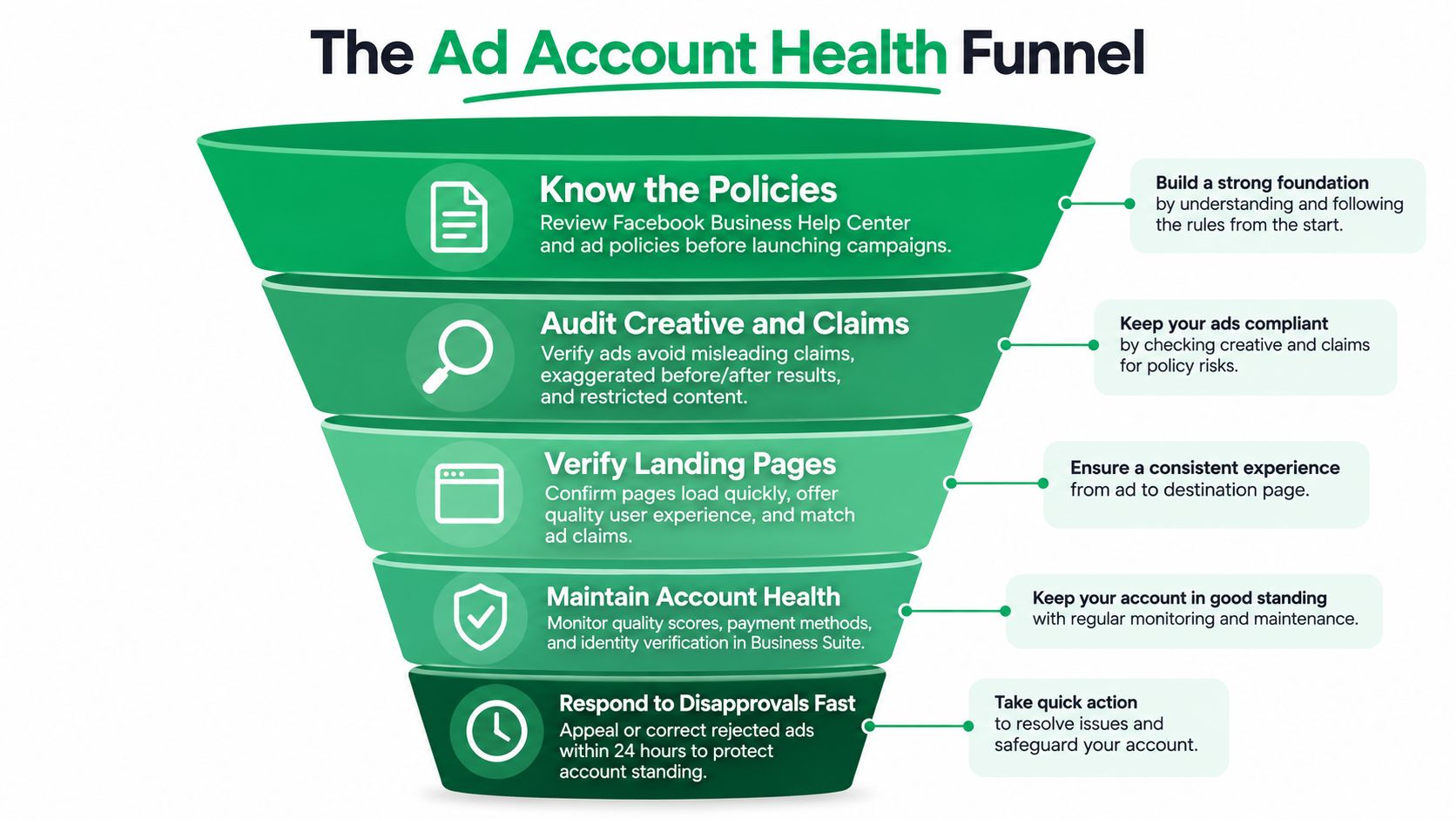
10. Facebook Ads Best Practices: Comply with Facebook Policies and Maintain Ad Account Health
Account health is part of performance management. A campaign that generates leads but risks disapproval, payment interruption, or restricted delivery isn’t operationally sound. Policy review belongs before launch, not after a disapproval forces a rushed rewrite.
Check claims against evidence, especially in health, finance, employment, housing, dating, supplements, and income-related offers. Avoid personal-attribute language that implies you know sensitive details about the viewer. Don’t use exaggerated before-and-after imagery, unsupported guarantees, deceptive landing pages, or urgency that isn’t real.
Review the policy category that applies to the business, then inspect the complete user experience. The ad may be acceptable while the landing page creates the problem through unclear pricing, missing business information, broken navigation, or an offer that doesn’t match the creative. Keep payment details current, maintain transparent business information, and give authorized team members appropriate access.
Treat placement updates as operational changes
Meta says that, starting in March 2026, Facebook Feed placement includes the Facebook Friends tab. The Facebook Feed placement update means advertisers should preview and evaluate this broader inventory as part of the Feed environment rather than assuming every delivery context is unchanged.
Use Ads Manager previews on desktop and mobile. Meta recommends high-resolution images, vertical 4:5 creative for single-image Facebook Feed ads, 1:1 or 4:5 for Facebook Feed, and 9:16 for Instagram Stories. The placement aspect-ratio guidance also advises avoiding text overlays that obstruct the visual.
Keep records for substantiated claims, respond to disapprovals with corrected versions, and review account status regularly. A cautious workflow may feel slower at launch, but it protects the data and learning you’ve already paid to acquire.
10-Point Facebook Ads Best Practices Comparison
| Item | Implementation complexity | Resource requirements | Implementation cost | Time to results | Expected outcomes |
|---|---|---|---|---|---|
| Define and Segment Your Audience with Laser Precision | Medium, requires strategy and data management | Customer lists, pixel data, audience modeling tools | Free to implement; requires data collection | 7–14 days after refinement | Higher relevance, lower CPA, improved ROAS and conversion rates |
| Leverage Compelling Visual Creative and Video Content | Medium–High, creative production and iteration | Design/video production, editing tools, creative testing budget | $500–$5,000+ depending on production quality | 3–7 days per creative test cycle | Much higher engagement (video 3–5x), reduced ad fatigue with variation |
| Implement a Structured Testing and Optimization Framework | Medium, process and disciplined analysis | A/B testing tools, dashboards, testing budget | No additional cost; built into campaign management | 7–30 days per test cycle (volume-dependent) | Data-driven improvements, reduced wasted spend, repeatable winners |
| Master Conversion-Focused Landing Pages and Pixel Tracking | High, technical setup and CRO expertise | Web dev, CRO tools, pixel/Conversion API setup, analytics | $500–$2,000 for landing page platform/setup | 2–4 weeks after pixel data accumulation | Higher conversion rates (30–50%), accurate ROI and better optimization |
| Use Dynamic and Retargeting Campaigns to Maximize CLV | Medium, requires integration and audience pools | Pixel data, product catalog, retargeting audiences | No additional cost; requires existing pixel/catalog | Immediate (dependent on audience size) | 2–3x ROAS vs cold traffic, recovered lost sales, higher LTV |
| Optimize Bidding Strategy and Budget Allocation Based on Goals | Medium, strategic setup and monitoring | Conversion data, historical performance, budget rules | No additional cost; strategy change only | 5–7 days per bidding strategy change | Improved ROI and scalable spend when aligned to objectives |
| Craft Compelling Ad Copy and Headlines That Drive Action | Low–Medium, copywriting and iterative tests | Copywriter or in-house writing, A/B testing | Free in-house; $500–$2,000 for professional copywriting | 3–7 days per copy test cycle | Higher CTR (20–50%), clearer value prop and better relevance |
| Align Facebook Ads with Broader Marketing Funnel and Attribution | High, cross-channel tracking and modeling | Attribution tools, UTM discipline, CRM/analytics integration | No cost with built-in tools; more for advanced platforms | 30–60 days to establish meaningful attribution | Clearer contribution insights, better budget allocation across funnel |
| Monitor, Report, and Iterate on Key Performance Indicators | Medium, dashboarding and regular review | Reporting tools, data aggregation, analyst/manager time | $0–$500/month depending on tools | Immediate insights; trends visible after 2–4 weeks | Early problem detection, trend identification, faster optimization |
| Comply with Facebook Policies and Maintain Ad Account Health | Medium, ongoing review and governance | Policy knowledge, account monitoring, creative/legal review | No cost; requires time investment | Immediate impact on approval rates and account health | Reduced suspension risk, lower costs and consistent campaign continuity |
Facebook Ads Best Practices: Run the 10-Minute Facebook Ads Audit
Start with the campaign objective. Ask whether it matches the business result and the funnel stage. A traffic objective sending visitors to a sales page may be appropriate for a specific learning goal, but it shouldn’t become the account’s primary sales engine. Confirm that the optimization event reflects a meaningful action, such as a qualified lead, completed purchase, or booked appointment.
Next, inspect the audience structure. Check exclusions for recent purchasers, existing leads, employees, and overlapping retargeting groups where those exclusions make commercial sense. Look for unnecessary fragmentation, narrow segments with too little conversion volume, and audiences that receive the same message despite having different intent. Detailed targeting still has a role, but the stronger question is whether Meta has useful signals and enough creative variety to find likely converters.
Review the ads in placement previews. Look for repeated hooks, declining response, comments that reveal objections, and creative that feels stale in Reels or mobile Feed environments. Compare the message with the landing page. The headline, offer, image, form, and call to action should tell one consistent story.
Then verify measurement. Confirm that Pixel events fire on the correct pages, Conversion API events arrive with the expected parameters, and deduplication works. Compare Meta events with Google Analytics UTMs, CRM records, payment data, and sales outcomes. If attribution differs, document why before changing budgets.
Prioritize the fixes
Use this order:
- Fix tracking and destination mismatches first: A broken event or irrelevant landing page can corrupt every later decision.
- Improve audience and creative testing next: Consolidate weak structures, add meaningful creative variation, and test one major variable at a time.
- Review budget and bidding after the foundation is sound: Give campaigns enough room to learn, but don’t scale a result you can’t validate.
- Check policy and account health continuously: Resolve disapprovals, validate claims, preview placements, and monitor delivery changes.
The largest account isn’t necessarily the healthiest account. A smaller advertiser can compete with a clearer offer, cleaner events, better creative iteration, and tighter feedback between ad results and business revenue.
Mr. Green Marketing, LLC offers a free Facebook Ads audit and performance report that reviews account setup and identifies opportunities involving lead quality, conversion tracking, creative performance, and return on ad spend. For an SMB or e-commerce team that needs an outside review, that can turn a scattered set of metrics into a prioritized work plan.
Start with the foundation, document every meaningful change, and scale only after the system produces trustworthy evidence. More spend can buy more data, but it can’t repair a campaign that measures the wrong outcome.
Mr. Green Marketing, LLC provides strategy-led PPC execution, Facebook Ads audits, performance reporting, and conversion-focused digital marketing for SMBs, e-commerce sellers, Amazon vendors, and local service providers. Visit Mr. Green Marketing, LLC to request a free audit and performance report and identify the tracking, creative, landing-page, and budget opportunities in your account.
Leave a Comment
sing in to post your comment or sign-up if you dont have any account.