
3rd Party Verification Explained – You’re about to ship a new offer, onboard a new seller account, or send your first batch of remote approvals, and the same worry keeps showing up, if you can’t prove the claim, how do you keep the deal moving? That’s where third-party verification earns its place. It gives you an outside check on identity, intent, data, or performance, so you’re not asking buyers, auditors, or platforms to trust your word alone.
For SMBs, the pain is practical. A missing signature slows a sale. A sloppy document trail creates a dispute. A marketplace listing gets flagged because the supporting proof isn’t clean. And when multiple tools, agencies, or vendors are involved, the question turns from “Did we get this right?” to “Can we prove who checked what, and when?” A good verification process answers that cleanly.
If you’re collecting files from clients, vendors, or partners, a third-party document collection guide can help you think about the handoff side of the workflow, where documents need to be gathered, checked, and tracked without turning the process into a bottleneck.
Introduction to 3rd Party Verification
A local service business feels the need first. A customer calls in, agrees to a plan, and wants the work started today. The team has the order, but not a face-to-face signature, and the notes in the CRM aren’t enough to settle the question if the customer later disputes the authorization. That’s the basic business problem third-party verification solves, it lets an independent party confirm what was said, submitted, or claimed.
Third-party verification acts as a trusted checkpoint between your business and the final decision. Instead of relying on your own staff to certify everything, an outside reviewer checks the information against agreed rules and leaves an audit trail. That matters because modern sales and service often happen over the phone, in apps, or through shared platforms where paper signatures aren’t realistic and trust has to be built differently.
Practical rule: if a buyer, regulator, or marketplace needs evidence later, the verification step should be strong enough to stand on its own.
Investopedia describes third-party verification as the use of an outside organization to review and confirm customer information and intent, and notes that it’s the standard approach for phone and digital transactions where a signature can’t be secured. It also ties the practice to formal frameworks such as ISO 17029 and ISO 14064-3, which bring structure to planning, risk assessment, evidence testing, and conclusions. That’s why this isn’t just a sales tactic. It’s a trust system with rules, evidence, and accountability. Investopedia’s explanation of third-party verification
A simple way to remember it, your team gathers the story, the verifier checks the story, and the final record shows what was confirmed and why. That’s useful whether you’re a local agency, a manufacturer, or an Amazon seller trying to reduce friction without giving up control.
If your accounting or operations team already worries about clean records, a guide on data accuracy for AP teams is a useful companion, because many of the same discipline points show up in verification workflows.
3rd Party Verification Explained: Understanding the Key Concepts of Third Party Verification
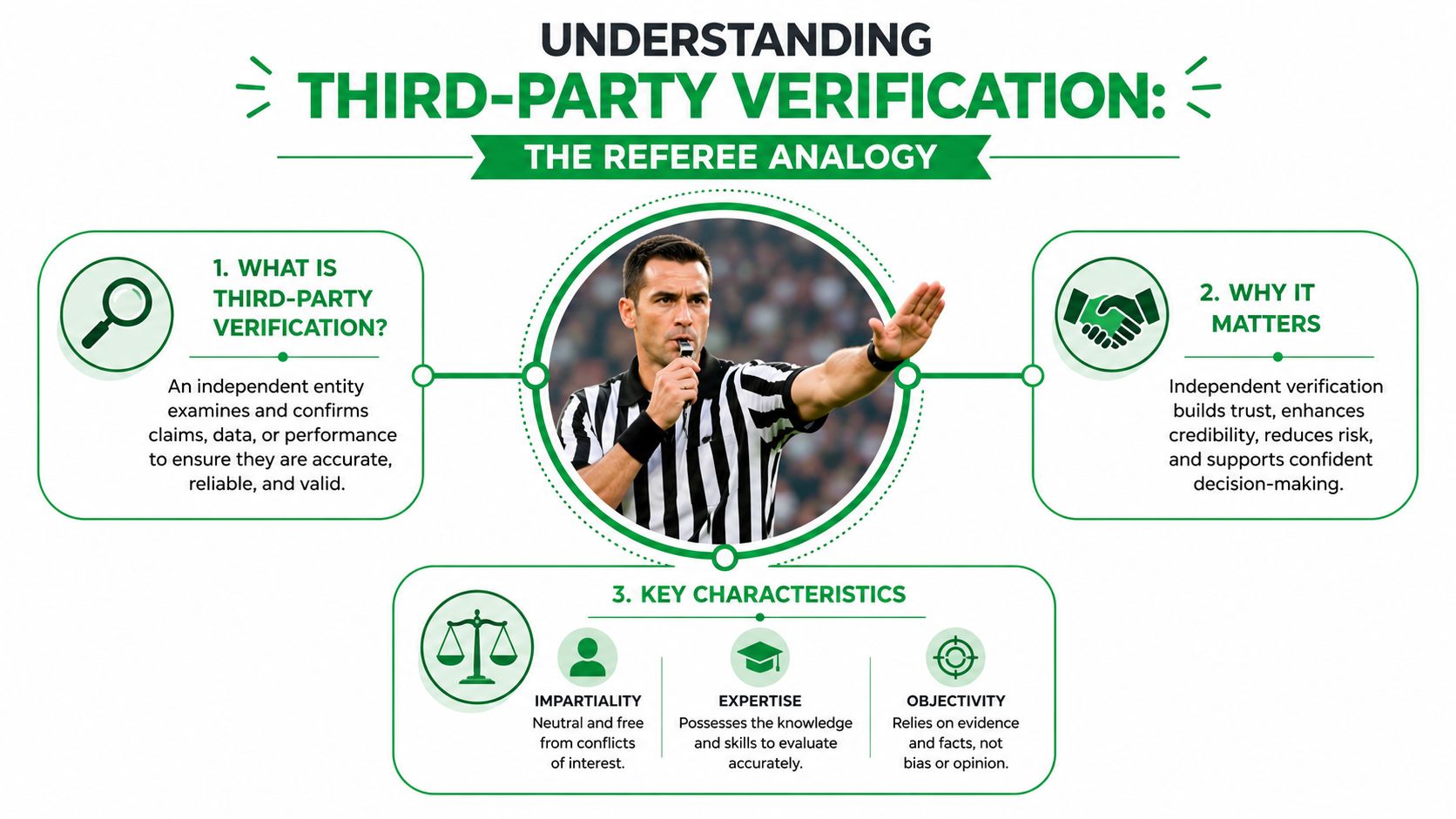
Third-party verification operates on the same principles as an impartial referee, but the point is bigger than a game call. A neutral verifier checks agreed criteria, reviews the evidence, and confirms whether a claim holds up. For an SMB, that can mean a customer consent record, a compliance statement, a product claim, or an onboarding detail that needs a clean trail behind it.
What makes it different from an internal review
An internal review can still be useful, but it usually comes from the same team that built the process or made the claim. Third-party verification adds distance. That distance matters because it lowers the chance that convenience, sales pressure, or routine shapes the result.
The structure is what gives the result weight. Investopedia connects this to standardized methods like ISO 17029 and ISO 14064-3, where the verifier plans the work, assesses risk, tests evidence, considers materiality, and reaches a conclusion. That is more than checking a form and moving on. It is a disciplined process that turns raw documents, logs, or statements into something others can rely on. Investopedia on the verification framework
3rd Party Verification Explained: Why buyers trust it
Independent verification works because people are more comfortable when the checker has no stake in the outcome. When the review process is transparent and the evidence is easy to trace, the claim feels less like a sales pitch and more like a verified fact.
That is why a verification badge, report, or certification is more than decoration. It shows that someone else reviewed the claim against a known standard. For SMBs, that can shorten sales conversations, reduce hesitation, and make compliance conversations easier to handle.
If you are managing proof-of-process documents in operations, legal, or finance, the guide on data accuracy for AP teams is useful for thinking about source checks, correction loops, and record quality in a practical way.
The three traits that matter most
One useful test: if the verifier cannot explain the rules, show the evidence, and stay independent, the result will not carry much weight.
The core traits are independence, expertise, and objectivity. Independence means the verifier is not grading its own work. Expertise means it understands the standard being checked. Objectivity means it applies the same rules to every case, rather than changing the standard based on who submitted the file.
Those traits sound simple, but they separate a decorative approval from a trustworthy one. For SMBs, that difference shows up quickly when a buyer, platform, or regulator asks for backup.
3rd Party Verification Explained: Types and Workflows of Third Party Verification
A lot of confusion comes from treating verification like one thing. It isn’t. A phone sale, a digital identity check, a product badge, and an ad lead audit all use different evidence and different failure points. The workflow changes because the risk changes.
Phone-based verification
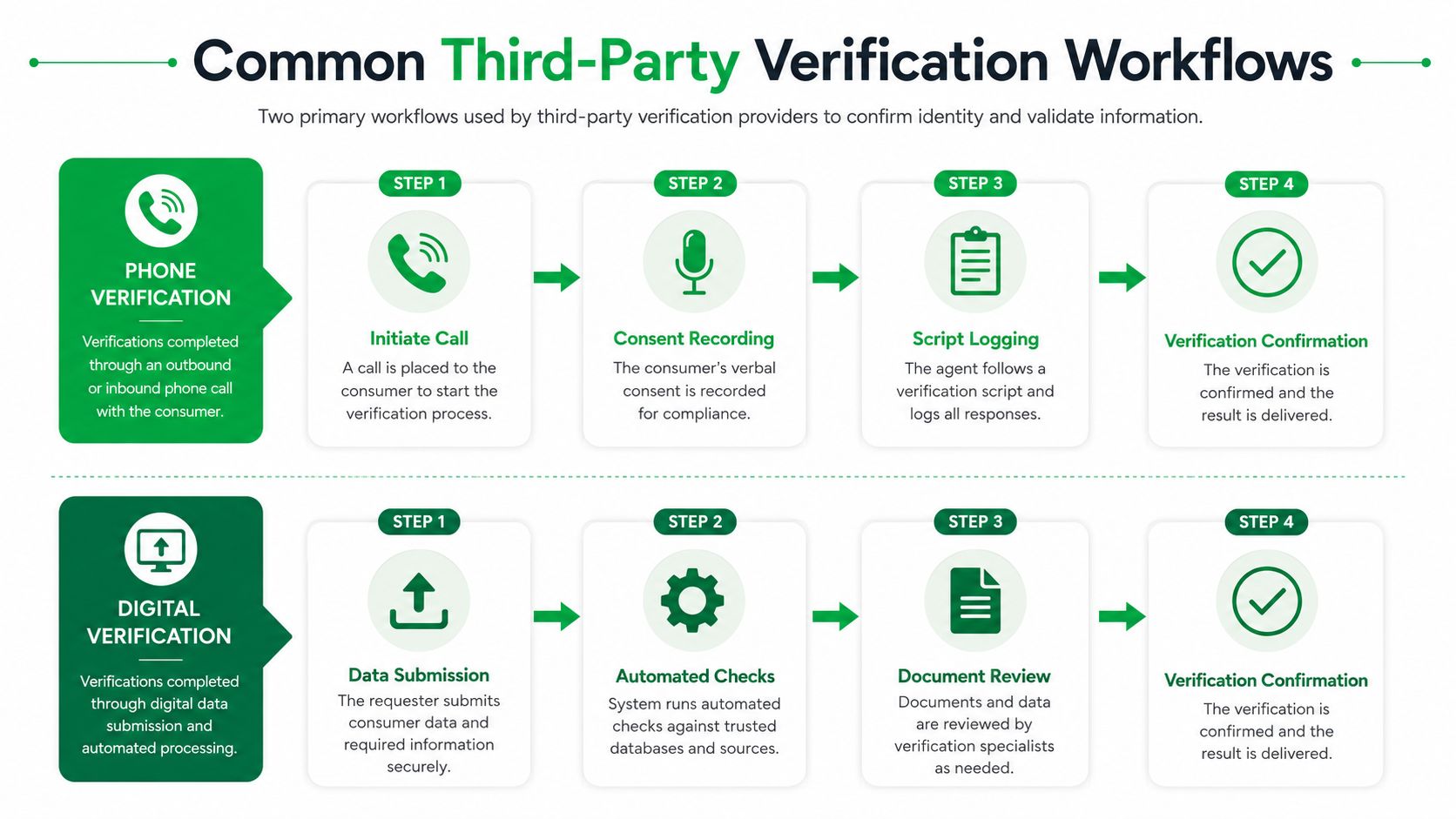
This is the version many SMBs use first, especially in services, insurance, financing, and remote sales. A rep starts the call, the customer gives consent, the script is logged, and the final confirmation is stored for later review. The key isn’t just the call itself. It’s the audit trail around the call.
That’s why the workflow matters as much as the recording. If the consent language is inconsistent, or the notes don’t match what was said, the proof gets weaker. A clean phone verification process should show who called, what was agreed to, and where the confirmation was preserved.
3rd Party Verification Explained: Digital verification
Digital verification relies on submitted data, automated checks, and document review. Think of onboarding forms, ID uploads, database checks, or API-based review against trusted records. The logic is the same as phone verification, but the evidence is machine-readable and easier to scale.
A practical example is an Amazon seller or marketplace vendor that needs stronger proof for account, catalog, or review-related claims. The system can check fields, compare documents, and flag mismatches before a human reviewer makes the final call. If you’re comparing proof styles for signed records, understanding Medallion Signature Guarantees can help you separate notarization, identity checks, and higher-assurance transfer controls.
Ongoing monitoring and changing systems
The hardest part for many teams is not the first check, it’s the second one. Recent assurance guidance emphasizes continuous oversight of AI-enabled services, including cataloging third-party arrangements and repeating verification when models or controls change. That matters because a tool that looked clean at onboarding can drift later.
If a vendor changes its model, its data sources, or its controls, the original approval may not be enough anymore.
That shift is especially important for SMBs using software vendors, lead tools, or outsourced platforms. A one-time approval is useful, but it doesn’t protect you if the underlying process changes and nobody notices.
3rd Party Verification Explained: Business Benefits and Legal Compliance
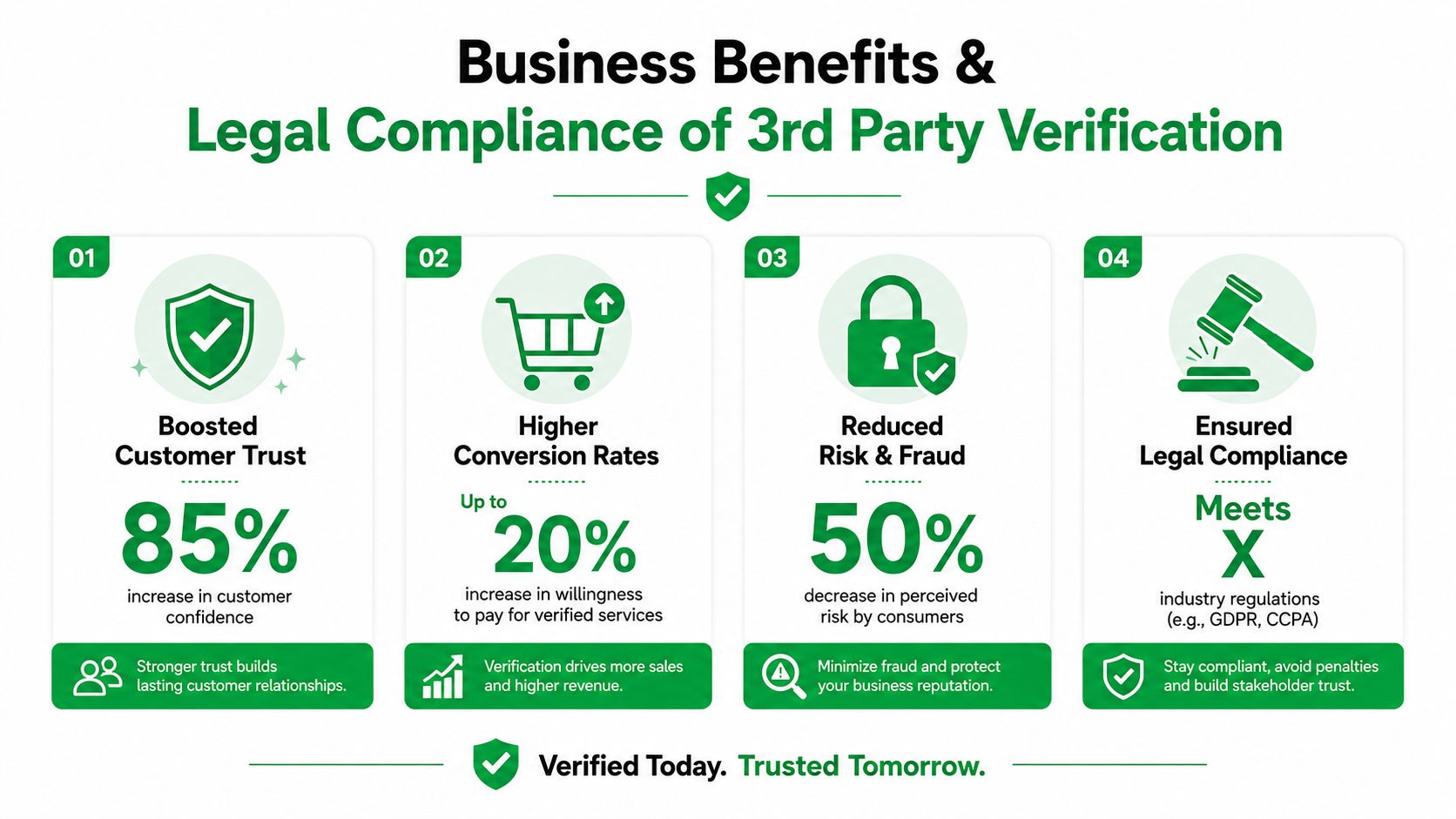
A buyer sees a third-party seal on a report, a regulator sees a documented review, and both sides get the same benefit, clearer evidence. Independent verification helps a claim travel farther because it is backed by someone outside the business, not just by the business itself. That matters for small and mid-sized companies that need trust without creating extra confusion for customers or compliance teams.
The market shows that businesses are paying attention to this kind of proof. One estimate places the third-party verification services market at $14.39 billion in 2025 and projects it to reach $43.71 billion by 2033, implying a 14.9% CAGR over that period, while another estimate places it at $15 billion in 2025 with a 12% CAGR from 2025 to 2033 (Verified Market Research). Different research firms use different baselines, but the direction is the same, demand is expanding.
Why the business case is real
Independent verification lowers hesitation because it gives buyers a cleaner way to judge a claim. A certificate, audit note, or reviewed record works like a trusted receipt. It does not replace judgment, but it gives people something concrete to inspect instead of asking them to accept a self-claim at face value.
For SMBs, that can reduce friction in everyday sales. A prospect does not need a long internal explanation when a third party has already checked the claim. If a dispute comes later, the records are also stronger because the review was not handled in-house only.
3rd Party Verification Explained: Where compliance gets strict
Regulated workflows leave less room for mistakes. Canada’s Output-Based Pricing System requires the verifier to be independent and accredited to the right standard, and it makes clear that the verifier’s scope must fit the facility’s activity. If the scope is wrong, the submission can be invalid even when the underlying data are accurate. Canada’s OBPS verification requirements
That same logic shows up in environmental disclosure systems and assurance programs. The reviewer cannot just be generally credible. It has to be the right reviewer for the job, with the right scope and the right procedure.
For teams already managing customer records, how to choose a digital marketing agency is a useful reminder that vendor selection works only when the scope fits the need. The same principle applies here, just with more compliance pressure.
3rd Party Verification Explained: Vendor Selection Checklist for Third Party Verification
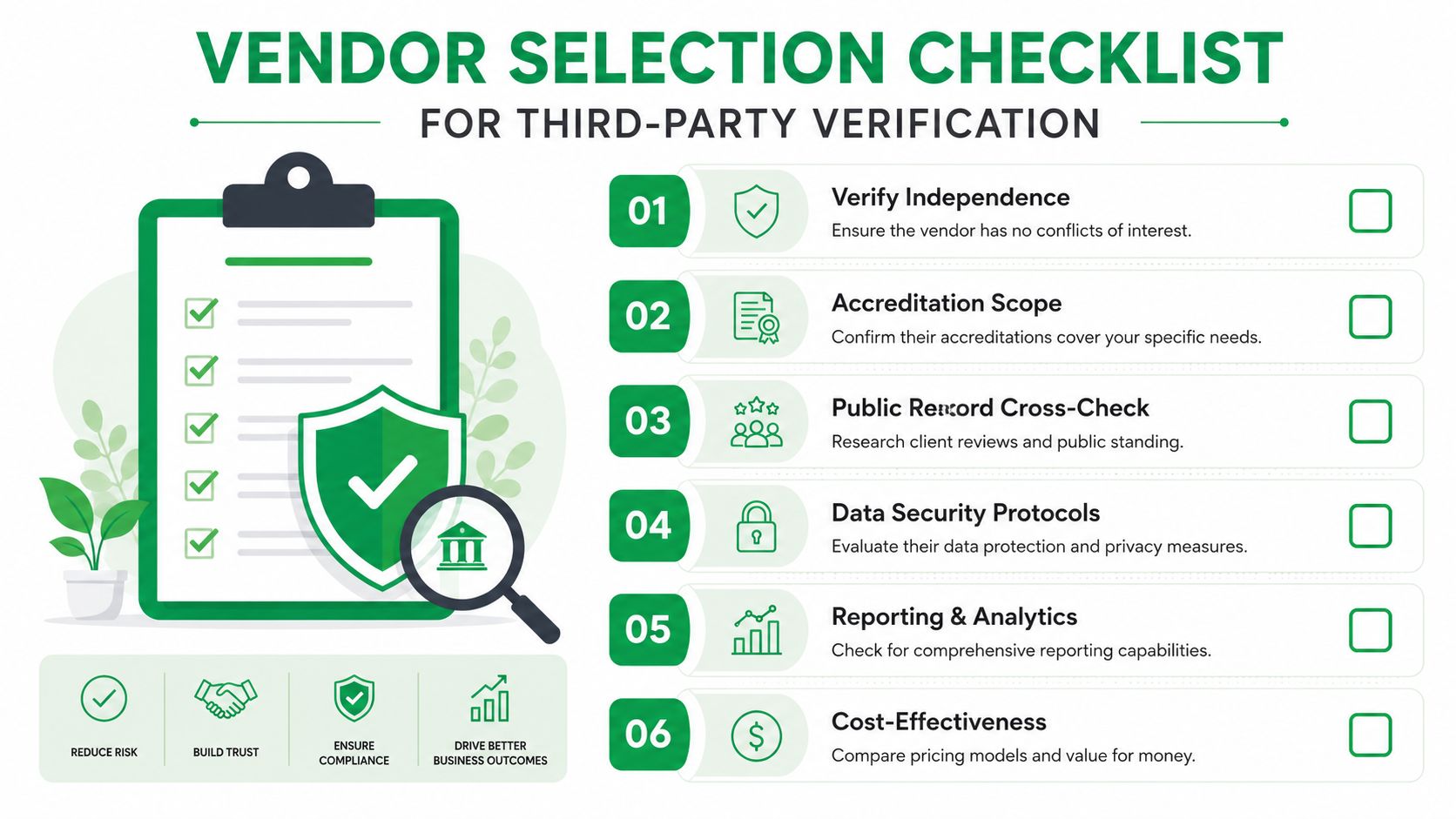
Choosing the verifier is the part frequently rushed, and it’s the part that can cause the biggest headache later. If the verifier isn’t independent, or its accreditation doesn’t match the work, the result may be useless even if everyone acted in good faith.
Verify the verifier before you sign
Start with independence. Ask whether the firm has any conflict in the outcome, any revenue tie to the claim, or any relationship that could blur judgment. Then confirm the scope, not just the logo on the certificate. A verifier can be accredited and still be wrong for your use case.
Practical rule: don’t stop at credentials. Confirm the exact standard, scope, and method the reviewer is allowed to use.
3rd Party Verification Explained: Check public records when answers conflict
If the verifier’s own answers don’t line up with public records, don’t smooth it over. Open-source searches, court filings, expert interviews, and sample testing are part of effective due diligence when the story doesn’t match the evidence. That’s especially useful for SMBs buying assurance from a vendor they don’t know well. Ethisphere on third-party due diligence
A clean way to think about it is this, the vendor’s sales deck is not the source of truth. The source of truth is the paperwork, the accreditation, the public record, and the reviewer’s actual controls.
Use a short do and don’t list
- Do request the scope certificate: Make sure it covers your exact standard, process, or reporting need.
- Do ask who signs the final report: You want to know whether the same person who reviewed the file can also issue the result.
- Do compare claims against public records: If a verifier says one thing and the record says another, pause.
- Don’t assume accreditation means suitability: General credibility isn’t the same as right-fit authority.
- Don’t skip escalation for higher risk: If the claim is sensitive, use deeper review methods before you rely on it.
If you’re comparing vendor relationships more broadly, how to choose a digital marketing agency is a helpful parallel, because the same discipline applies, fit first, then pricing, then process.
3rd Party Verification Explained: Implementation Steps and Best Practices
A verification program works best when it’s treated like a process, not a one-time task. Start with the business reason. Maybe you need better phone-sale proof, cleaner vendor onboarding, stronger ESG records, or fewer disputes in your marketplace channel. That goal determines the controls you need.
Then define the risk level. Low-risk claims may only need basic review and standard logging. Higher-risk claims need stricter identity checks, better documentation, and a tighter audit trail. The point is to match effort to exposure, not to use the heaviest possible process for everything.
Build the workflow before you automate it
Pilot the process with a small set of real cases. Use the same documents, calls, or submissions your team would normally see, and see where people get stuck. If the script is too long, the form fields are unclear, or the approver doesn’t know what counts as acceptable evidence, fix that before rollout.
Once the workflow is stable, connect your systems. That could mean an API, a call platform, a document review queue, or a shared dashboard. The tools matter less than the logic, who submits, who reviews, who approves, and where the record lives.
Keep the controls alive after launch
Document the policies in plain language so staff can follow them without guesswork. Train people on consent, evidence handling, and escalation. Then build review cycles into the calendar, because a good process can still drift if nobody checks it.
If a control isn’t reviewed, it slowly becomes a memory instead of a safeguard.
That matters in regulated environments too. Canada’s verification guidance makes clear that the verifier must stay independent and properly accredited, and that the wrong scope can invalidate the submission even if the data itself is sound. OBPS verification rules
For teams turning the process into a broader rollout, CRM implementation guidance is a useful reminder that adoption depends on workflow design, staff training, and clean handoffs. Verification works the same way, the tool is only as good as the process around it.
Measuring Success with KPIs
A verification program should prove its own value. If it takes too long, creates too many exceptions, or doesn’t reduce disputes, it’s not helping enough. The easiest way to see that is with a small KPI set that stays consistent month to month.
Start with turnaround time, from request to completed report. That tells you whether the process is fast enough for sales, onboarding, or compliance deadlines. Then track pass-fail rates so you can see whether submissions are arriving cleanly or getting stuck on the same missing items.
Choose metrics that reflect both speed and quality
A useful dashboard usually includes a mix of operational and business metrics:
- Turnaround time: How long it takes to finish a verification.
- First-pass completion: How often a file is approved without rework.
- Dispute reduction: Whether fewer customers or partners question the result.
- Audit readiness: Whether the record set can survive external review.
- Cost per verification: What the process costs relative to the value it protects.
You don’t need a huge dashboard to get value. You need a stable one. If your team changes the definitions every month, the numbers won’t tell you much.
For a practical lens on measurement discipline, how to measure marketing campaign effectiveness is a useful reference, because verification metrics work best when they connect activity to outcomes instead of just counting activity.
Use the numbers to make decisions
If turnaround time is creeping up, the bottleneck may be intake, not review. If first-pass completion is low, the issue may be training or document quality. If disputes don’t improve, the verification criteria may be too weak to matter.
That’s the primary point of KPIs here. They don’t just report performance. They show where the control is failing, where the process is confusing, and where the business can tighten the system without adding friction.
Examples and Common Questions
A local service provider with phone sales can use a scripted verification call to confirm intent before work starts. The team records the conversation, logs the consent, and stores the confirmation with the order. When disputes come up, there’s a clean trail instead of a memory fight. The payoff isn’t a magic number. It’s fewer messy reversals and less time spent arguing over who authorized what.
An Amazon vendor or marketplace seller usually needs a different path. Digital identity checks and document review can help validate submissions, reduce obvious mismatches, and give the account cleaner proof. That’s especially useful when the seller is managing listings, brand records, or supplier paperwork across multiple systems.
Common questions SMBs ask
What if the verifier’s accreditation doesn’t match more than one market?
Use the strictest applicable standard and confirm the scope for each jurisdiction. If the reviewer can’t cover the exact use case, don’t force the fit.
When should a one-time check become continuous monitoring?
When the third party’s system can change after onboarding, especially if it’s software, AI-enabled, or tied to recurring reporting. If the process can drift, repeat verification makes more sense.
What if the verifier changes its controls mid-contract?
Treat that like a material change. Recheck the scope, ask for updated evidence, and decide whether the original approval still stands.
How much evidence is enough?
Enough means enough to support the claim under the standard you’re using. If the public record conflicts with the verifier’s statements, go back to open-source checks, supporting documents, and sample testing before you rely on the result.
And if you’re building the broader trust stack around digital operations, keep one rule in mind, the goal is not to collect more paperwork. It’s to collect the right proof, from the right reviewer, in a way that still makes sense six months later.
A CTA for Mr. Green Marketing, LLC. If you want help turning verification-heavy workflows into clear, trustworthy customer journeys, request a free audit and performance report from Mr. Green Marketing, LLC, and use it to spot where trust breaks, where forms confuse users, and where your current process needs tighter proof.
Leave a Comment
sing in to post your comment or sign-up if you dont have any account.