
Startup Branding Strategy: You’ve built something real. The product works, a few customers like it, and the team keeps saying the same thing: “We need branding.” Then the usual scramble starts. A logo from a freelancer. Homepage copy written in a rush. Social posts that sound different every week. Sales decks that look like they came from three separate companies.
That mess isn’t a style issue. It’s a business issue.
Founders usually feel the problem before they can name it. Prospects don’t quite get the offer. Early customers can’t repeat what makes the company different. Investors see effort, but not a sharp identity. And the team starts improvising because there’s no clear system to follow. Random acts of marketing. Expensive, too.
A working startup branding strategy fixes that by turning instinct into decisions. It gives you a position, a voice, a visual system, and a rollout plan your team can use. Not theory. Operating instructions.
If you want a useful primer before you formalize your own process, Bulby’s guide to brand strategy is a solid companion read because it frames strategy as the logic behind every outward brand decision, not just the design layer.
The mistake I see most often is founders treating branding like a finish coat. Something you add once the “real” business is built. It works the other way around. Branding helps customers understand why your company exists, why they should trust it, and why they should remember it. Without that clarity, even a strong product can feel interchangeable.
And interchangeable is dangerous.
Startup Branding Strategy: Introduction
A founder usually reaches this point after a few frustrating signals pile up at once. Website traffic comes in, but the right people don’t convert. Sales calls go long because the pitch keeps changing. Product screenshots look polished, but the rest of the business doesn’t. The company feels newer than it is because the brand feels unfinished.
That’s the moment to stop tweaking and start structuring.
A startup branding strategy should answer a practical question: how do you make the market understand you quickly, trust you early, and recognize you consistently? If the answer lives only in your head, you don’t have a brand system. You have founder intuition. Useful at the start. Limiting after that.
Practical rule: If your designer, copywriter, salesperson, and co-founder would all describe the company differently, you’re still in brand discovery.
Strong branding doesn’t require a bloated process. It requires the right sequence. First, define what the company stands for and where it fits. Then shape the language customers will hear. Then build a visual identity that expresses those decisions. Then launch it across every high-value touchpoint.
Simple. Not easy.
What works is compression with discipline. A tight process, clear deliverables, and no skipping the hard thinking up front. What doesn’t work is starting with moodboards, collecting opinions from everyone, or treating the logo as the strategy.
Here’s the playbook founders can run.
Startup Branding Strategy: Uncovering Your Brand Core DNA
Before you touch colors, type, or taglines, you need a point of view. Most early branding problems come from teams trying to express a brand they haven’t defined yet.
According to a 2025 industry report by Exploding Topics, 81% of consumers require trust in a brand before considering a purchase, making this foundational discovery work critical for new startups (Exploding Topics report reference).
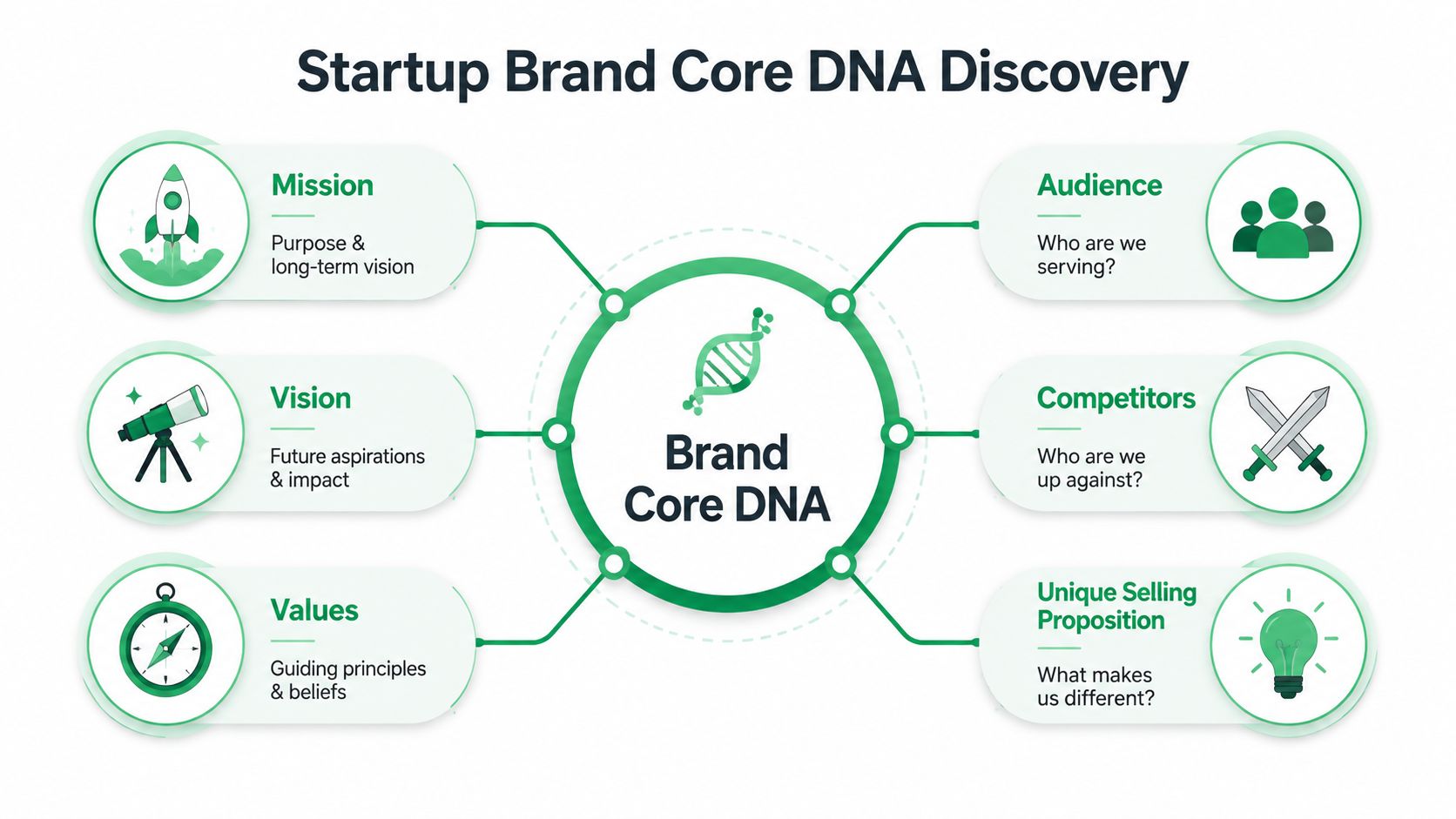
Run the founder alignment session
Start with the fastest useful exercise. Lock the co-founders in a room for one focused session and answer six questions in writing. No laptops if you can help it. No wordsmithing yet either.
- Purpose
What problem are you solving, and why does it matter enough to build a company around it? - Audience
Who are you serving first? Not everyone who could buy. The people with the clearest pain and shortest path to action. - Competition
Who else is trying to solve this problem, directly or indirectly? Include spreadsheets, consultants, and doing nothing. - Positioning
What category should people place you in, and what do you want them to believe about your difference? - Personality
If your brand were a person in the room, how would it speak, decide, and show up under pressure? - Promise
What outcome are you willing to stand behind every time?
Many founders often drift into abstraction. Pull it back to real words customers would understand. Plain language beats clever language at this stage.
Get out of founder mode
Founders are close to the product. Too close, sometimes. That’s why discovery has to include customer language, not just internal opinion.
Talk to customers and prospects. Ask what they were trying to solve before they found you. Ask what alternatives they considered. Ask what made them hesitate. Ask what words they’d use to describe your product to a colleague. Then log exact phrases. Those phrases often become homepage headlines, objection handling, and campaign copy later.
If your audience definition is still fuzzy, sharpen it with something like a buyer persona development framework so you’re not building messages for a fictional average customer.
Your first job in branding is not to sound impressive. It’s to sound unmistakably relevant.
Startup Branding Strategy: Audit the competitive field
Competitor review isn’t about copying patterns. It’s about locating white space.
Build a simple matrix with four columns:
| Brand element | Competitor A | Competitor B | Your opportunity |
|---|---|---|---|
| Positioning | Broad and generic | Technical and feature-heavy | Clear business outcome |
| Voice | Formal and distant | Casual but vague | Direct and confident |
| Visual style | Blue SaaS sameness | Minimal but cold | Warm, structured, memorable |
| Proof style | Claims-first | Demo-first | Problem-solution-first |
Patterns matter more than perfection. If everyone sounds like a platform, maybe you should sound like a guide. If everyone talks features, maybe you lead with clarity and consequence. And if every competitor looks polished but interchangeable, that’s an opening.
Startup Branding Strategy: Write the positioning statement
Don’t leave discovery as a pile of notes. Turn it into a one-page brand core document with these fields:
- Who we serve
- What problem we solve
- What category we’re in
- Why we’re different
- What customers should trust us for
- What we will never sound like
That last line helps more than founders expect. “We will never sound inflated.” “We will never mimic enterprise jargon.” “We will never use hype where proof is needed.” Boundaries create consistency.
Clarity first. The logo can wait.
Startup Branding Strategy: Defining Your Brand Voice and Messaging
Once the core is defined, the next job is making the company sound the same everywhere. Website, sales emails, demos, social posts, support replies. Same brand. Different contexts.

Experts recommend a single 2–3 hour co-founder session to answer six foundational brand questions: Purpose, Audience, Competition, Positioning, Personality, and Promise. This session is the minimum viable starting point for a coherent brand strategy (foundational brand questions reference).
Separate voice from tone
Founders often mash these together. Don’t.
Voice is stable. It’s your brand personality.
Tone shifts with context. It changes depending on whether you’re announcing a launch, handling a delay, or writing a founder note.
A useful way to define voice is with paired traits. Pick one side, then describe what it means in practice.
- Clear, not academic
- Confident, not arrogant
- Warm, not chatty
- Direct, not abrupt
That final qualifier matters. It prevents teams from overcorrecting.
Startup Branding Strategy: Build a messaging hierarchy
You need more than a tagline. You need a layered system that tells the team what message comes first, what supports it, and how to prove it.
Use this simple structure:
Level 1 headline
This is the core value proposition. One sentence. It should tell a prospect what you do and why it matters.
Example framework:
We help [audience] achieve [outcome] without [common pain].
Level 2 pillars
Choose three supporting ideas that reinforce the main claim. These are the recurring themes you’ll repeat across your site, deck, and outbound messaging.
For example:
- Speed to value
Explain how quickly a customer can get started and see utility. - Operational simplicity
Show how your offer reduces friction, confusion, or workload. - Credibility and trust
Reinforce why buyers should believe you now, not later.
Level 3 proof points
Attach evidence, examples, product details, process notes, and customer language. Keep it specific. If a pillar can’t be supported, it may be marketing fiction.
If you need help shaping those statements into tighter language, reviewing a set of sample branding statements can speed up the draft process.
Messaging test: If your homepage hero, sales intro, and LinkedIn bio all emphasize different benefits, your hierarchy isn’t working yet.
Turn voice into usage rules
A real verbal identity includes do-this and don’t-do-this examples. Fragments help here. Fast. Concrete. Unmistakable.
Try a small guide like this:
| Situation | Say this | Avoid this |
|---|---|---|
| Homepage copy | Plain outcome language | Abstract mission jargon |
| Sales outreach | Problem-aware and concise | Over-explaining the product |
| Social posts | Opinionated and useful | Trend-chasing filler |
| Support replies | Calm and helpful | Defensive corporate language |
And if LinkedIn matters in your mix, a good LinkedIn posting strategy can help translate your voice into repeatable founder content without sounding staged.
The companies that get messaging right do one thing consistently. They decide how they sound before the team starts publishing. The ones that get it wrong let every channel invent its own personality.
That never scales well.
Startup Branding Strategy: Designing a Memorable Visual Identity
A founder usually feels the pain here fast. The product is taking shape, investor conversations are starting, a landing page needs to go live, and suddenly every touchpoint looks like it came from a different company. The job of visual identity is to fix that. It gives the business a consistent face people can recognize, remember, and trust.

For an early-stage startup, the goal is not a giant brand system. The goal is a small, usable one that works across the first real launch assets. Homepage. Pitch deck. Social profile. Sales one-pager. Product screens, if the brand shows up in-app.
That trade-off matters. Founders waste time in two directions. Some overinvest in polish before they have traction. Others patch together a logo, two random fonts, and a color they happen to like, then wonder why the company feels forgettable.
Build the minimum viable identity system
Start with the pieces your team will use in the next 60 to 90 days. That usually means:
- Logo set
Primary logo, icon or mark, horizontal lockup, and light and dark versions. - Color palette
A restrained primary palette with enough contrast for web, slides, and social graphics. - Typography rules
One display face, one body face, and clear usage rules so marketing and product do not drift. - Core asset kit
Favicon, social profile image, simple post template, deck cover treatment, and image style direction. - Usage guide
A short document that shows sizing, spacing, color values, and examples of correct and incorrect use.
Small system. Clear rules. Fast to apply.
If the team cannot create a deck slide, a LinkedIn graphic, and a simple landing page section without asking the designer what to do each time, the identity is still incomplete.
Write a brief that leads to usable design
Design quality depends heavily on input quality. A vague brief gets you mood boards and subjective debate. A sharp brief gets you options tied to business use.
Include five things:
- Core business context
What the company sells, who it serves, and what buyers need to understand quickly. - Brand attributes
Three to five words that describe how the brand should feel in market. Precise words. Not generic ones like modern. - Category cues and avoid lists
Show the visual patterns buyers already expect, then mark what you do not want to copy. - Priority applications
List the assets that matter first, in order. Website hero, pitch deck, founder social, product UI, trade show banner, packaging, whatever applies. - Constraints
Small team, no in-house designer, heavy mobile traffic, dark-mode product, print needs, accessibility requirements, or low-budget production.
If you want a clearer sense of how those inputs turn into approved files, this breakdown of the graphic design process for brand work is useful for setting expectations before rounds begin.
A quick visual explainer helps here.
Test the identity in real operating conditions
This is the part founders skip, and it causes problems later.
Do not review the logo only on a presentation slide. Put the identity where it has to work. Browser tab. Mobile screen. LinkedIn banner. Sales PDF. Light background. Dark background. Tiny favicon. Screenshot shared in a group chat.
A mark that looks polished in a concept sheet can fail badly once it shrinks. A color palette can look distinctive but create weak contrast on a landing page. A type choice can feel premium but slow down production because nobody on the team knows how to use it consistently.
Review the system against actual brand tasks, not design taste.
Protect the work from common startup mistakes
Three mistakes show up constantly.
The first is optimizing for originality alone. Buyers still need familiar signals. If you remove every category cue, the brand may look interesting but harder to place.
The second is letting too many opinions into the room without a decision-maker. Design by committee rounds off the edges until the identity says nothing.
The third is approving files without usage standards. A startup does not need hundreds of pages of guidelines. It does need enough direction that the next freelancer, marketer, or founder can apply the brand correctly on day one.
A startup brand does not need to look expensive. It needs to look intentional.
One practical option during this phase is working with a strategy-led partner such as Mr. Green Marketing, LLC, which handles branding, logo creation, and digital execution in the same workflow. That setup helps when the identity needs to ship across real launch assets instead of sitting untouched in a folder.
A memorable visual identity does one job well. It makes the company easier to recognize under pressure, across channels, with limited time and limited budget.
Executing Your Brand Launch and Rollout
A brand isn’t launched when the logo is approved. It’s launched when every public touchpoint tells the same story on the same day.
That’s where many startups stumble. They finish the strategy work, maybe even the design work, then roll changes out slowly. New logo on LinkedIn. Old deck in sales calls. Homepage updated, but email signatures still off-brand. It creates doubt because the company looks undecided.
A structured 30-day branding timeline is proven to work: Weeks 1–2 for strategy and positioning, Week 3 for visual identity, and Week 4 for guidelines and initial asset creation. This compressed framework helps startups launch investor-ready brands in under a month (30-day branding timeline reference).
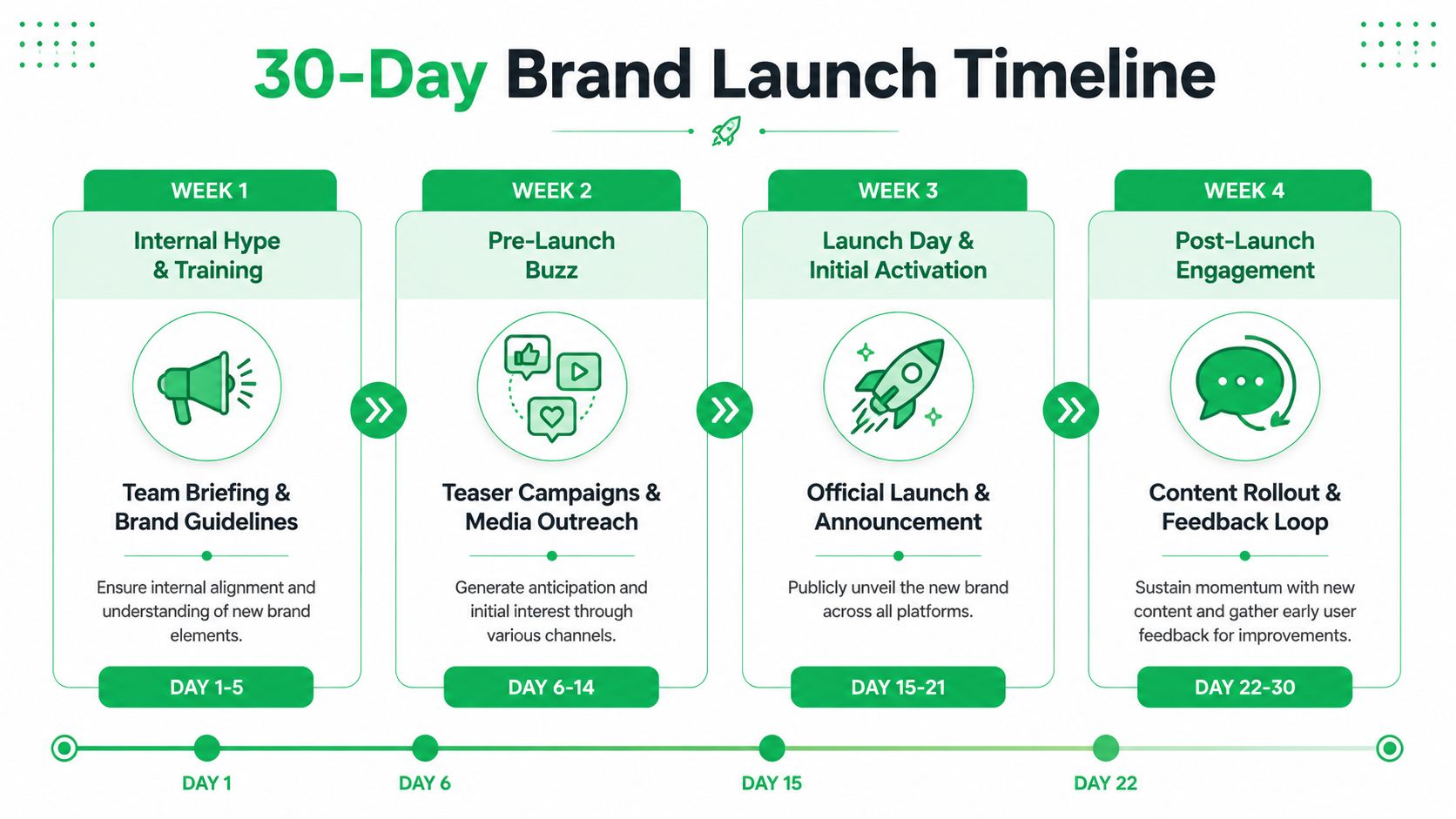
Use a controlled rollout plan
The cleanest launch is coordinated, even if the audience size is small. You don’t need a major PR event. You need internal alignment and one go-live date.
A simple operational roadmap looks like this:
Weeks 1 and 2
Lock the strategic foundation. Finalize positioning, voice, audience definition, and the key message hierarchy. Approve the verbal decisions before design rounds start drifting.
Week 3
Build the visual identity and test it in actual use. Not just logo boards. Apply it to the homepage hero, one social graphic, a pitch deck slide, and an email signature.
Week 4
Create the guidelines and swap the assets everywhere that matters first. Website. Social profiles. Founder bios. Sales deck. Proposal template. Demo environment. Newsletter shell. Hiring materials if you’re recruiting.
Build the launch checklist
Use a checklist because memory is unreliable when deadlines stack up.
- Website
Update homepage messaging, navigation labels, about page, imagery, and metadata language to match the new brand. - Social profiles
Replace profile images, banners, bios, pinned posts, and post templates. - Sales materials
Refresh deck design, one-liners, intro emails, proposal templates, and meeting follow-ups. - Internal materials
Rename folders, centralize approved files, and document final versions. - Founder-facing assets
Update LinkedIn summaries, speaker bios, podcast intros, and investor outreach language.
Brands don’t feel consistent because of one big reveal. They feel consistent because nobody encounters the old version after launch day.
Keep launch scrappy, not sloppy
Founders often assume launch means paid campaigns. Sometimes it doesn’t. Sometimes the smartest move is a founder note, a homepage update, a few strong customer-facing posts, and outreach to warm contacts who already know the problem you solve.
If partnerships or creator relationships fit your market, this guide with practical advice on startup influencer marketing can help you activate the brand without bloating the rollout.
The key is sequence. Internal first. External second. No partial rollouts if you can avoid them.
Measuring Brand Success and Ensuring Consistency
Once the brand is live, the work changes shape. You stop building the system and start protecting it.
That matters because early-stage branding usually weakens through drift, not through one dramatic mistake. A founder writes a rushed landing page. A sales rep rewrites the deck. A contractor pulls the wrong colors. A new social manager uses a different tone because nobody gave them rules. Small inconsistencies pile up. Trust gets fuzzy.
The data is clear: consistent brand presentation across all platforms can increase revenue by up to 25%. It’s not just an aesthetic choice but a foundational driver of financial performance for startups (brand consistency and revenue reference).
Track signals that show understanding
You don’t need a giant measurement stack to know whether the brand is landing. Start with signals that reveal whether people recognize, remember, and repeat the right message.
Look at things like:
- Branded search interest
Are more people looking for your company by name after launch and outreach? - Direct traffic patterns
Are more visitors coming straight to the site rather than only through one campaign source? - Sales call repetition
Are prospects describing your value proposition back to you in the language you intended? - Social engagement quality
Are people responding to your ideas, not just liking the design? - Team compliance
Are internal documents and customer-facing assets staying aligned without constant correction?
Those are practical indicators. They tell you whether the market and the team are learning the brand.
Create a lightweight governance system
Most startups don’t need a giant brand book. They do need one reliable source of truth.
Keep these documents in one shared place:
| Asset | What it should include | Why it matters |
|---|---|---|
| Brand core sheet | Positioning, audience, promise, differentiators | Stops strategic drift |
| Voice guide | Traits, examples, approved phrases, avoid list | Keeps writing consistent |
| Visual rules | Logos, colors, type, spacing, image direction | Prevents design improvisation |
| Template library | Decks, posts, email signatures, one-pagers | Makes consistency faster |
Review the brand whenever the business changes in a meaningful way. New audience. New product shape. New buying motion. Different market expectations. Not because you’re bored with the look.
Operating principle: Evolve when the strategy changes. Don’t rebrand just because the team wants something fresher.
Know the difference between refinement and reinvention
Healthy brands adjust. Unstable brands overreact.
Refinement means tightening copy, improving templates, clarifying a message, or upgrading imagery while keeping the core intact. Reinvention means changing the category story, the visual language, and the promise at the same time. That’s heavier. It should be earned by business reality, not internal restlessness.
Founders who maintain consistency build familiarity. Familiarity builds trust. And trust lowers the friction around every next interaction, from the first site visit to the follow-up sales call.
That’s the payoff of a disciplined startup branding strategy. Less confusion. Better recall. Stronger trust signals. A company that feels coherent before it feels big.
If your startup needs help turning rough positioning, scattered visuals, and inconsistent messaging into a launch-ready brand system, Mr. Green Marketing, LLC offers strategy-led branding support alongside web, SEO, PPC, social, and creative execution. A practical next step is to request a free audit and performance report to identify visibility gaps, clarify priorities, and map the fastest path to a brand that’s ready to scale.
Leave a Comment
sing in to post your comment or sign-up if you dont have any account.