
Definition of Community Relations: Community relations is the ongoing, two-way work of building mutually beneficial relationships between a business and the people around it, not a string of one-off donations. And because 55% of consumers learn about businesses through social media, community relations now shapes trust both in your local market and in the digital spaces where people decide whether you belong.
If you’re a small business owner, you’ve probably run into the term in a proposal, at a networking event, or during a tough local conversation about growth. It sounds broad because it is. But in practice, the definition of community relations gets very clear, very fast once you ask a simple question: are we building trust with people who matter to our business, or are we just trying to look involved?
That distinction matters. A sponsorship can help. A donation can help. A volunteer day can help. But none of those things, by themselves, are community relations.
Real community relations is strategic. It connects your business goals with local needs, turns communication into dialogue, and gives people a reason to see your company as part of the community rather than a brand passing through.
Definition of Community Relations: What Is Community Relations Really
You’ve heard the phrase. Maybe from a PR consultant. Maybe from a local chamber. Maybe after someone said your business needs to be “more visible” in the community. Fair enough. But visibility isn’t the same thing as trust.
The most useful definition of community relations for a business owner is this: it’s the ongoing process of building and maintaining a mutually beneficial relationship between your business and the people, groups, and institutions around you. That includes customers, neighbors, schools, nonprofits, civic groups, local leaders, and sometimes critics too.
What it is and what it isn’t
Community relations is often misunderstood as philanthropy with a nicer label. That’s too narrow. The stronger definition treats it as a relationship function, not a donation function. The Cambridge definition of community relations aligns with that broader view and reinforces the idea of a mutually beneficial relationship rather than a one-time campaign.
Here’s the practical difference:
- A sponsorship gets your logo on a banner.
- A donation helps fund a cause.
- Community relations asks what relationship you’re building before, during, and after those actions.
If nothing changes after the check clears, you didn’t build a relationship. You completed a transaction.
Practical rule: If the community only hears from you when you’re promoting something, you don’t have community relations. You have occasional outreach.
Definition of Community Relations: Why small businesses should care
For a small business, this isn’t abstract. It’s tied to reputation, referrals, hiring, partnerships, and your ability to operate without friction.
When people know your business listens, follows through, and shows up consistently, they give you more room to grow. They recommend you. They defend you when criticism isn’t fair. They also tell you sooner when something is off, which is valuable. Quiet resentment is expensive.
And if you’re already thinking about public trust as part of your broader communications approach, this guide to public relations strategy ideas is a useful companion. Community relations sits inside that wider effort, but it has a much more local, relational, and long-term focus.
The test that usually reveals the truth
Ask yourself three questions:
| Question | Weak answer | Strong answer |
|---|---|---|
| Why are we doing this? | “It looks good.” | “It solves a local issue tied to our values and business.” |
| Who shaped the idea? | “We did internally.” | “We talked with the people affected first.” |
| What happens next? | “We’ll post about it.” | “We’ll stay involved and learn from the response.” |
That last part is where many businesses stall. They want the appearance of goodwill without the discipline of relationship-building. And that never holds up for long.
Definition of Community Relations: The Pillars of an Effective Program
A solid program doesn’t come from random generosity. It comes from structure. The businesses that do this well usually build on a few dependable pillars, and all of them sit on one base principle: strategic engagement.
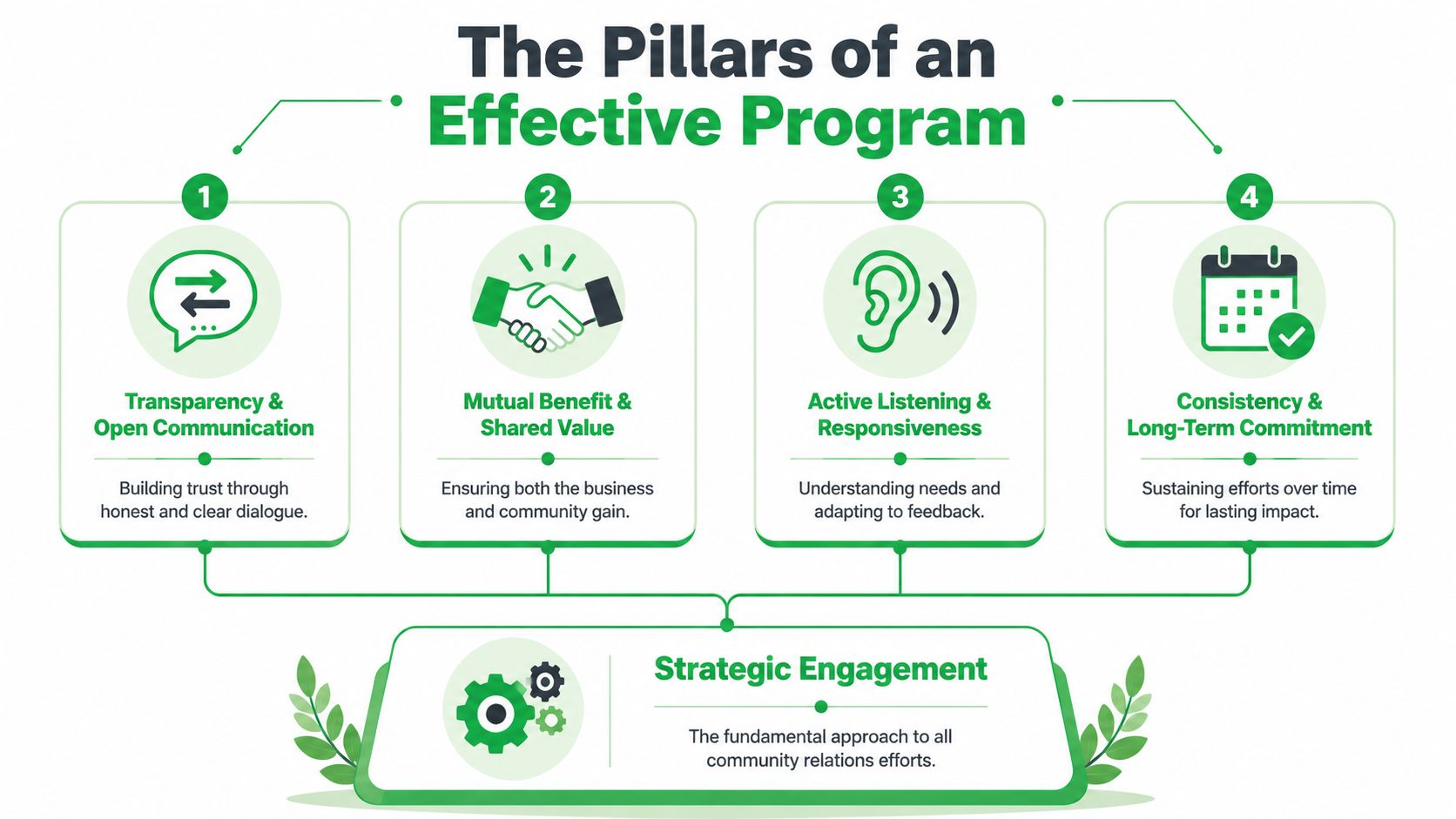
Active listening before action
A lot of businesses start with the idea they want to execute. That’s backwards.
A stronger operating definition comes from the view that community relations is ongoing relationship-building based on trust, dialogue, and shared problem-solving. The Vaia explanation of community relations also makes an important point: organizations sometimes need to “release control” to the community when appropriate. For business owners, that means not assuming you already know what people need.
You don’t need a giant research process. Start by asking:
- Who already influences local opinion? Think school leaders, neighborhood organizers, nonprofit directors, and long-time customers.
- What issue keeps coming up? Parking, hiring, affordability, access, noise, training, youth programs, small business support.
- Where are we guessing? That’s where listening should happen first.
Mutual benefit, not one-sided giving
The phrase “mutually beneficial” gets tossed around a lot. It shouldn’t be vague.
Good community relations creates value on both sides. The community gains support, access, opportunity, or problem-solving. Your business gains trust, relevance, and stronger local ties. If only one side benefits, people notice.
That can look different depending on your business:
- A contractor might host practical home maintenance workshops in a neighborhood it serves.
- A retailer might work with a local artist collective and create paid visibility, not just exposure.
- A B2B firm might donate staff expertise, not just money, to help a nonprofit improve operations.
Definition of Community Relations: Transparency and responsiveness
Many well-meaning efforts falter when a business launches something, posts polished photos, then goes quiet when feedback gets messy.
Community relations requires clearer communication than standard promotion. Tell people what you’re doing, why you chose it, what the limits are, and what you’ll do with feedback. If an initiative changes because the community pushed back, say so. That usually earns more respect, not less.
The point isn’t to control every reaction. The point is to stay credible when reactions are mixed.
Consistency over spikes
One annual splash doesn’t build much. Repetition does.
The strongest programs feel steady. Not loud. Steady. People know who to contact. They know your company will respond. They know your involvement isn’t tied only to a launch, a crisis, or the holiday season.
That’s what turns goodwill into legitimacy.
Definition of Community Relations: The Business Case for Community Relations
Community relations absolutely affects reputation. But if we stop there, we undersell it.
For a small business, the business case is that strong community ties lower friction and improve decision quality. Customers feel better buying from a company they trust. Potential hires get a clearer sense of what you stand for. Local partners are more willing to work with you. And if you need support during a setback, expansion, or public misunderstanding, you’re not starting from zero.
Trust now forms in public
This isn’t just about who sees your storefront. In the last decade, businesses have become more concerned with social responsibility, and 55% of consumers learn about businesses through social media, which makes community-facing communication part of trust-building in plain view, as noted in Red66 Marketing’s discussion of community relations and social media.
That means people often evaluate your business by watching how you engage, not only by what you sell. They notice whether your support looks consistent or convenient. They notice whether local people speak well of you. And they notice silence when a response is needed.
Where it shows up in the bottom line
You may not be able to draw a straight line from one local initiative to one sale. Business rarely works that neatly. But community relations can strengthen several business conditions at once:
- Customer preference: People often choose the business that feels connected, accountable, and familiar.
- Talent appeal: Employees want to work where values show up in behavior, not just career pages.
- Partnership access: Local organizations tend to work with businesses that are easy to trust.
- Operating resilience: A business with local credibility usually faces less resistance when making changes.
For founders and operators building a brand over time, this also overlaps with visibility strategy. If you’re trying to connect trust with market presence, this article on how to improve brand awareness helps frame the difference between being seen and being believed.
And for entrepreneurs building support networks, Women Listed insights for entrepreneurs offers a useful perspective on how communities create growth, accountability, and momentum. That same logic applies to how your business participates in its own ecosystem.
Definition of Community Relations: What doesn’t work
Three things usually backfire:
- Cause-hopping: Supporting whatever issue is popular this month without a clear connection.
- Over-branding: Making the business the hero of every community effort.
- Disappearing after the post: Treating the announcement as the finish line.
Those tactics can create awareness. They don’t build durable trust.
Definition of Community Relations: Practical Examples for Small Businesses
Most advice on community relations gets fuzzy right when you need specifics. It tells you to donate, volunteer, or post something local. Fine. But the stronger question is whether your action creates legitimacy and sustained reciprocity, which is the more useful frame in Indeed’s discussion of what community relations looks like in practice.

A local retail business
A neighborhood coffee shop wants stronger ties with nearby residents. The weak version is sponsoring a school flyer once and posting about it. The stronger version is hosting a monthly early-morning community table for teachers, nonprofit staff, and small business owners, then using what comes up in those conversations to shape offers, hours, or collaborations.
Why that works:
- It creates repeated contact
- It surfaces real needs
- It makes the business useful, not just visible
And no, it doesn’t need to be expensive. Community relations often depends more on consistency than budget.
A B2B service company
Let’s say you run a bookkeeping or marketing firm. You may think community relations is mostly for storefronts. It isn’t.
A service firm can offer practical value by teaching. A short workshop for local nonprofits, tradespeople, or women-owned businesses can do more for trust than a generic ad campaign because you’re solving a real problem in real time. That’s part of why niche guides like Bornbir’s advice to maximize your doula business potential are useful. They show how service businesses grow when expertise, trust, and local relevance work together.
Here’s another format worth considering:
In practice: The best small-business community initiatives usually answer one of two questions. “How can we help with something we actually know?” or “How can we make access easier for people we want long-term relationships with?”
This is also where communication support matters. A firm might handle outreach internally, or use outside help for social media, video, or messaging. One option in that mix is Mr. Green Marketing, LLC, which offers services like social media marketing, branding, and video production that can support community-facing communication if a business needs execution help.
Definition of Community Relations: An online business with no storefront
An e-commerce brand can still do community relations. It just has to define community more thoughtfully.
Your community may be local suppliers, creators, customers in a niche interest group, or an audience tied together online. A practical move might be spotlighting local makers, creating educational live sessions, or partnering with a nonprofit that fits your category in a way that includes actual participation rather than a sales-themed donation push.
A short video can help you think through the difference between promotion and relationship-building:
Authentic versus performative
A simple comparison helps:
| Looks authentic | Looks performative |
|---|---|
| Tied to a real local need | Tied only to a promotion cycle |
| Involves listening | Announced without input |
| Continues after launch | Ends once content is posted |
| Uses business strengths | Uses random gestures for optics |
Small businesses have an advantage here. You can move faster, listen more directly, and show up as real people. That’s not a minor edge. It’s often the whole game.
Definition of Community Relations: How to Measure Your Community Impact
Owners get skeptical, and they should. “Goodwill” is too soft to manage if you never define what changed.
A better approach separates activity from effect. The DINFOS community relations process model breaks measurement into output (what you produced), outtake (what people understood), and outcome (what changed). That’s a practical framework because it keeps you from mistaking motion for progress.
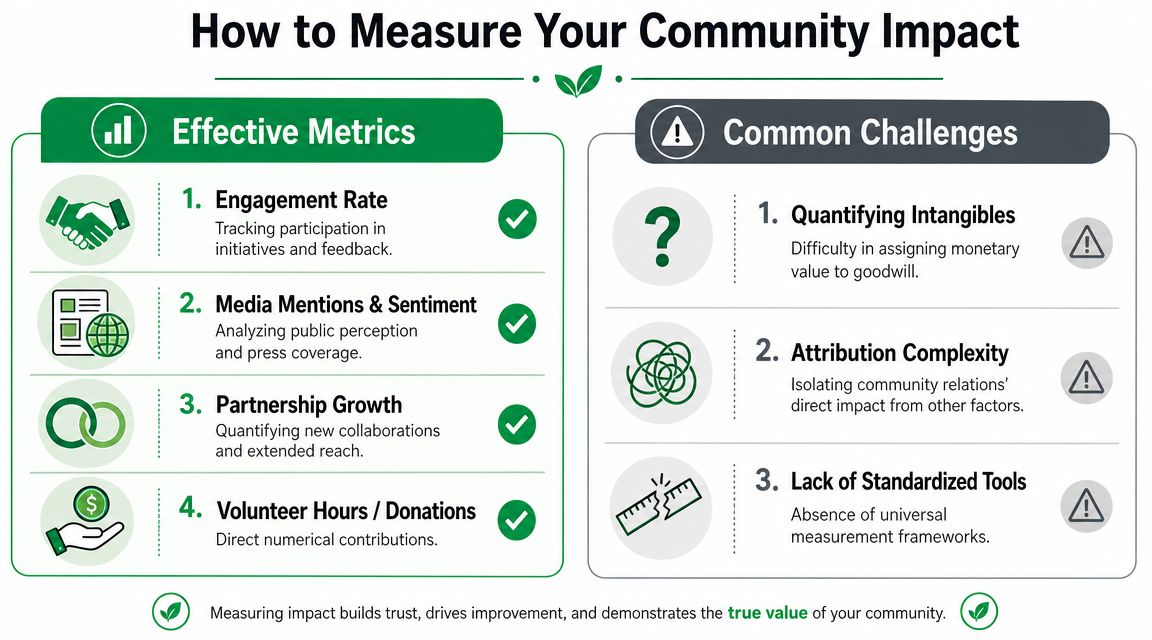
What to track at each level
Most small businesses can measure this without fancy software.
- Output: number of events held, meetings attended, partnerships started, videos published, volunteer sessions organized
- Outtake: feedback collected, comments showing understanding, direct responses from participants, survey themes
- Outcome: repeat participation, unsolicited partnership requests, positive local mentions, improved sentiment, smoother collaboration
The mistake is living only in the first bucket. Output is useful, but it doesn’t prove impact.
Definition of Community Relations: A simple measurement rhythm
Use one small scorecard each month. Nothing bloated.
| Level | Example question |
|---|---|
| Output | What did we do? |
| Outtake | What did people say they understood or valued? |
| Outcome | What changed in behavior, perception, or opportunity? |
A local workshop, for example, shouldn’t be judged only by attendance. Better questions are: did attendees understand what your business was trying to contribute, did anyone follow up, did new relationships begin, and did the initiative change how people talk about you?
You don’t need perfect attribution. You need enough evidence to see whether trust is strengthening or stalling.
Keep the metrics connected to business decisions
Community relations becomes a management function, not a feel-good side project. If your community work is producing better partner conversations, more warm introductions, or faster trust in new local settings, that’s operationally meaningful.
If you need a broader framework for tying softer signals to marketing performance, this guide on how to measure marketing campaign effectiveness can help you build a cleaner reporting habit.
And if nothing is changing, that’s useful too. It may mean the issue isn’t your effort level. It may mean your actions aren’t relevant, your communication isn’t clear, or your follow-through isn’t consistent.
Definition of Community Relations: Your First Steps in Community Relations
Most small businesses don’t need a massive program to begin. They need a disciplined start.
The strongest programs are built into how the business operates, with documented policies, clear responsibility, and continuous evaluation. The community relations governance guidance in this presentation makes the case for treating community relations like a performance system: define inputs, standardize execution, measure response, and compare outcomes against objectives.
Your first 30 days
Start small. But start on purpose.
Days 1 through 10: Listen
Identify the people and groups who shape opinion around your business. Customers, nearby businesses, local leaders, nonprofits, educators, property managers, or online community voices. Ask what they care about, where they see friction, and what kind of support would matter.
Days 11 through 20: Find the overlap
Look for the intersection between community need and business capability. A restaurant can convene people. A service company can teach. A retailer can spotlight local creators. A contractor can share practical know-how. Relevance beats generosity that feels random.
Days 21 through 30: Launch one focused effort
Choose one initiative you can repeat and improve. Assign ownership. Write down the goal. Decide what success looks like. Then communicate clearly before, during, and after.
Keep it manageable
A few operating rules help:
- Pick one lane first: It’s better to do one useful thing repeatedly than five things once.
- Name an owner: If community relations belongs to everyone, it usually belongs to no one.
- Write a short policy: Even a one-page internal guide helps your team stay consistent.
- Review after each initiative: What worked, what didn’t, what the community responded to.
That’s how the definition of community relations becomes real inside a business. Not as a slogan. As a habit.
And once that habit forms, the benefits tend to compound. More clarity. Better relationships. Less guesswork. Stronger trust when it matters most.
If you want help turning community relations into a measurable communications plan, Mr. Green Marketing, LLC can help you map the audience, messaging, content, and reporting side so your local trust-building efforts support broader business growth.
Leave a Comment
sing in to post your comment or sign-up if you dont have any account.