
Search Engine Optimization Vancouver: You’re probably in one of two spots right now. Your business is good offline, referrals still come in, customers like what you do, but Google barely seems aware you exist. Or you’re getting traffic and maybe even a few calls, yet the numbers don’t justify what you’re spending to stay visible in Vancouver.
That second part matters more than most SEO guides admit. In Vancouver, visibility isn’t the whole game. Profitable visibility is. Rent is high. Payroll is high. Margin pressure is real. So if someone pitches search engine optimization in Vancouver BC like it’s only about rankings, they’re skipping the part business owners care about, which is whether organic search earns more than it costs.
A lot of owners also underestimate how crowded the provider side has become. DesignRush lists 117 SEO companies in Vancouver and notes local hourly rates ranging from $25 to $500+, with its Vancouver rankings updated on June 1, 2026. That tells you two things fast. First, you have options. Second, you have to separate cheap activity from useful strategy.
If you want a broader market perspective outside Canada, this 2026 guide to Australian SEO is worth a skim because it helps frame what stays universal across local search markets and what needs to be adapted city by city.
Search Engine Optimization Vancouver: Your Vancouver Business Deserves to Be Seen
A Vancouver business can disappear online even when the business itself is solid. That happens all the time. A Mount Pleasant clinic with a decent reputation can lose map visibility to a chain with stronger location pages. A contractor in Kitsilano can get buried because the site has weak service structure, not because the work is bad. And a Gastown retailer can spend on ads every month because organic search never became dependable.
That’s why search engine optimization Vancouver BC has to be treated as an operating decision, not a branding experiment.
The real issue isn’t traffic
Most SEO conversations start too high up the funnel. More rankings. More impressions. More sessions. Fine. But if you’re paying Vancouver wages and Vancouver lease rates, you need to ask a more grounded question first.
Search Engine Optimization Vancouver: Which channel gives me the most durable customer acquisition for the kind of lead I want?
For some businesses, PPC deserves the first dollars because the buying window is short and the service is urgent. Think locksmiths, emergency plumbing, restoration. For others, SEO is the better long play because the customer does comparison shopping, reads service pages, checks reviews, and may return more than once before converting. Think clinics, law firms, higher-ticket home services, and specialty retail.
Practical rule: If you need leads this week, PPC can fill the gap. If you need lower dependency on ad spend over time, SEO has to be part of the plan.
The mistake is choosing one channel for ideological reasons. Owners hear “SEO is free traffic” and oversimplify it. It’s not free. It takes content, technical work, page improvements, reviews, citation cleanup, and consistent measurement. But once the work compounds, you’re no longer renting every click.
Vancouver makes weak SEO more expensive
In a cheaper market, sloppy execution can limp along. In Vancouver, it usually gets exposed. If your Google Business Profile is half-filled out, if your service pages are generic, if your calls-to-action are vague, that wasted visibility costs more because your underlying business costs are already high.
A lot of local companies would benefit from a simple reframing. Don’t ask, “How do I rank?” Ask, “Which searches are worth owning because they turn into booked jobs, consults, or store visits?”
That mindset also changes how you evaluate vendors. You stop buying generic monthly deliverables and start looking for a local growth system. If you want a useful primer on the local side of that process, this piece on the benefits of local SEO is a practical starting point.
Search Engine Optimization Vancouver: Build Your Digital Foundation First
Before you publish another blog post or spend more on ads, fix the basics. I mean the things customers touch before they ever call you. For local businesses, the two front doors are usually your Google Business Profile and your website.
And yes, both have to work together.
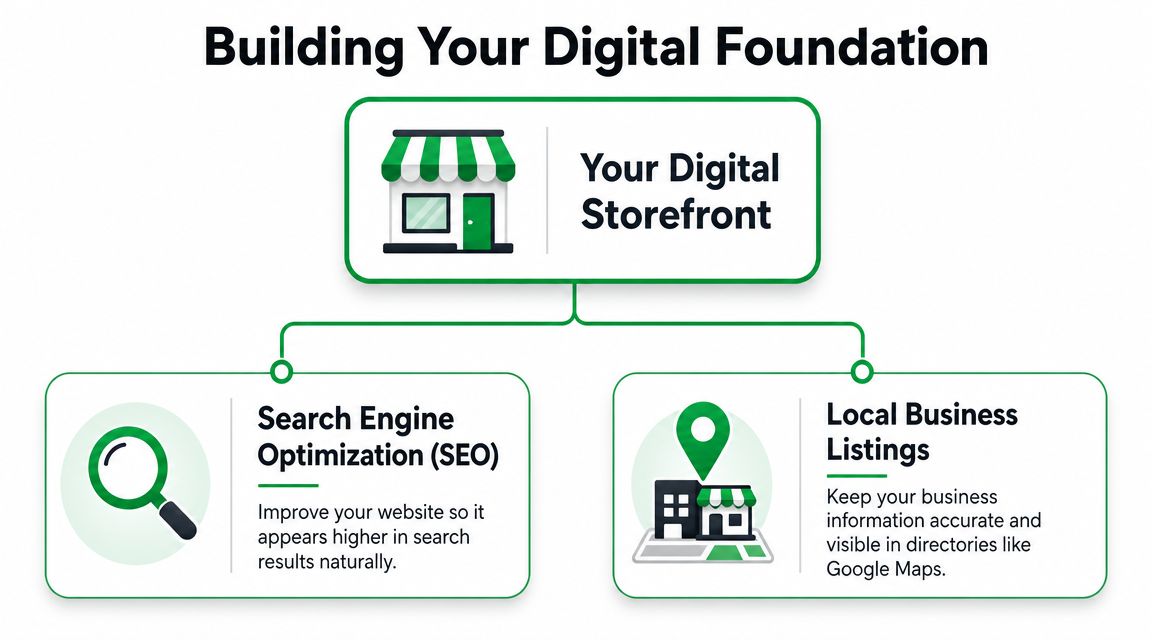
Start with your Google Business Profile
A lot of SMBs treat their profile like a listing. Google treats it more like a local trust signal. In practice, that means incomplete profiles underperform, especially in competitive parts of Vancouver where several businesses offer almost the same service in the same radius.
Take a fictional example. A coffee shop near Main Street has a profile with the wrong hours on holidays, a weak business description, no product photos worth clicking, and no answered questions. The shop might still show up now and then, but it won’t convert attention well. The improved version looks different:
- Services are clearly listed so Google and searchers understand what the business offers.
- Photos show the space and products instead of random dim interior shots.
- Questions and answers are filled out with useful info, not left blank for strangers to define.
- Posts reflect current offerings so the profile doesn’t look abandoned.
- Categories match reality instead of chasing every loosely related term.
That sounds basic because it is basic. Basic wins more often than clever.
Search Engine Optimization Vancouver: Your website has one job
Your website doesn’t need to impress other marketers. It needs to turn local intent into action. That means a fast mobile experience, clear service language, location cues, obvious calls-to-action, and no confusion about what to do next.
A weak local site usually has one or more of these problems:
| Common problem | What it causes |
|---|---|
| Thin service pages | Low relevance for high-intent searches |
| Mobile friction | Fewer calls and form fills |
| Generic copy | Poor differentiation from competitors |
| Hidden contact info | Lost conversions from ready-to-buy visitors |
If you’re not sure where the leaks are, run through a structured local SEO audit checklist before making bigger decisions.
What to fix first
You don’t need a giant rebuild to make progress. Most local sites improve when the owner handles a short list in the right order.
- Fix contact consistency. Phone, address, service area, and hours should be easy to find.
- Rewrite the homepage for buyers. Lead with service, location, and proof. Not vague slogans.
- Clean up service pages. One page per service if the service matters commercially.
- Tighten mobile UX. Tap targets, forms, click-to-call, and page layout need to work on a phone.
- Add real local cues. Neighborhoods served, real photos, team details, and specific service context.
A clean local foundation doesn’t feel exciting. It does make the rest of SEO work better.
Search Engine Optimization Vancouver: Find Customers with Vancouver Keyword Research
A Vancouver business can rank for the wrong terms and still stay quiet. I see that a lot with local companies paying high rent, high payroll, and high ad costs while chasing keywords that bring research traffic instead of calls. If SEO is going to earn its keep in this city, the keyword set has to match buying intent closely enough to compete with PPC on return.

Broad terms aren’t enough
“Vancouver plumber” has value. So does “dentist Vancouver.” But broad city terms are usually expensive to pursue, whether you pay per click or invest months trying to rank organically. They also hide intent. Someone searching a broad term may be comparing providers, checking hours, or just learning what service they need.
The better targets usually add context:
- Broad search like “dentist Vancouver”
- Neighborhood search like “dentist Yaletown”
- Need-based search like “emergency dentist downtown Vancouver”
- Problem-driven search like “broken crown repair Vancouver”
That last group often produces better leads because the search already describes the job. For a Vancouver SMB, that matters. You do not need traffic for the sake of traffic. You need search demand that can justify your acquisition cost.
Search Engine Optimization Vancouver: Choose keywords with ROI in mind
In this market, the SEO versus PPC decision should happen at the keyword level, not as a blanket channel decision.
If a term has immediate urgency and strong commercial intent, PPC can make sense because it puts you in front of buyers today. Emergency locksmith, same-day pest control, and after-hours plumbing are good examples. If the click cost is steep but the job value is higher, paid search can still work.
SEO is often the better long-term play for repeatable service searches where ad costs stay high month after month. A Vancouver physiotherapy clinic, family dentist, accountant, or landscaping company usually gets better returns by building durable rankings for service and neighborhood terms they can own over time. The practical model is simple: use PPC where speed matters and margin supports it, then use SEO to lower dependence on paid clicks in categories you plan to sell for years.
Think like a local buyer
A Kitsilano parent searching for a pediatric clinic uses different language than a downtown worker looking for a walk-in appointment. A homeowner in East Van searching for “heat pump installation” is not behaving like a condo owner in Coal Harbour searching “air conditioning repair near me.” Same city. Different context. Different page needed.
Use search language from places that reflect real demand:
- Google autocomplete for common phrasing
- People also ask for question-based intent
- Google Search Console for queries where you already have visibility
- GBP insights and sales call notes for the words customers use
- Paid keyword tools if you can filter out low-intent noise
If you want a clearer framework for turning local search intent into actual inquiries, this guide to local SEO lead generation covers the connection between keyword targeting, page structure, and lead quality.
Search Engine Optimization Vancouver: Cluster by service and intent
Keyword lists are easy to build. Useful keyword clusters take more judgment.
Group terms by what the searcher wants, what page should rank, and whether the traffic can produce revenue. That last part gets skipped too often. A page that ranks for informational terms with weak buying intent may look good in a report and still do little for the business.
A simple cluster might look like this:
| Cluster | Example searches | Best destination |
|---|---|---|
| Core service | Vancouver family dentist, dental clinic Vancouver | Main service page |
| Neighborhood intent | family dentist Kitsilano, dentist near Yaletown | Location page |
| Problem intent | tooth pain dentist Vancouver, emergency filling repair | Treatment page |
| Trust intent | best family dentist Vancouver, gentle dentist for kids | Review-rich supporting content |
This structure also helps you decide where PPC fills gaps. If your organic visibility is weak for “emergency dentist downtown Vancouver,” paid ads may cover that demand while your treatment and location pages mature. If you already rank well for “family dentist Kitsilano,” paying for every click there may be unnecessary.
One warning. Do not publish five near-identical pages for slight keyword variations. A page for “Vancouver dentist,” another for “dentist in Vancouver,” and another for “best dentist Vancouver BC” usually creates cannibalization, thin differentiation, and wasted effort. One strong page with clear intent usually beats a stack of duplicates.
A quick video like this can help if you want a simpler visual on local search behavior before building pages around your clusters.
Search Engine Optimization Vancouver: Become a Trusted Local Authority
Local SEO trust works a lot like reputation in a small town. If different people give different versions of your business details, confidence drops. If your name, address, and phone number are consistent, reviews look genuine, and local mentions line up, trust grows.
That’s why NAP consistency is not clerical busywork. It’s a credibility layer.
Clean records beat louder marketing
Independent rankings also show how established the local industry has become. Semrush Agency Partners lists 14 SEO companies in Vancouver in its 2026 roundup, while other 2026 directories and comparative reviews are also active. That concentration suggests Vancouver has become a recognized SEO hub with a mature provider market, as reflected in the Semrush Agency Partners Vancouver list.
For local businesses, that same maturity means Google has more data points and more comparables. It can cross-check your business identity across the web. If one directory has an old suite number, another has an outdated phone line, and your site lists a slightly different business name, you’ve introduced avoidable doubt.
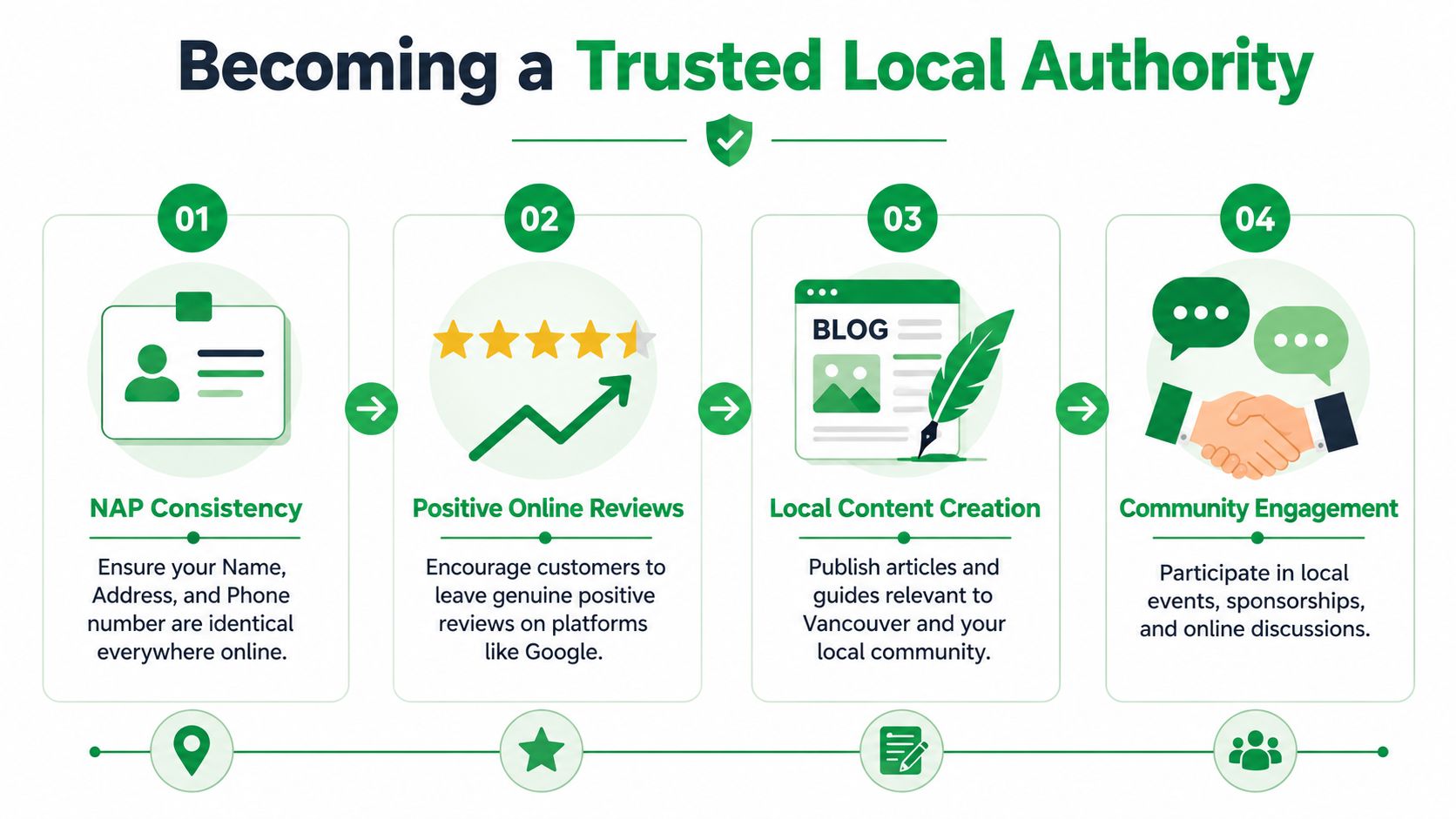
The trust stack that actually matters
Start with your core business identity, then move outward.
- NAP consistency across your site, Google Business Profile, and key directories
- Review management that asks happy customers at the right time and replies like a real business
- Local citations on reputable general and niche listings
- Community relevance through actual involvement, partnerships, or local content
If Google has to guess which version of your business is correct, you’ve already made local visibility harder than it needs to be.
Owners often go too wide here. They want hundreds of directory links. Usually that’s a waste. You need accurate listings in the places that carry local trust and buyer visibility. Yelp, Yellow Pages, Apple Business Connect, industry directories, local chambers, and relevant association listings matter more than obscure citation farms.
Search Engine Optimization Vancouver: Reviews and citations support lead generation
The businesses that win local search usually don’t look mysterious when you inspect them. They have consistent data, active reviews, useful pages, and signs of being part of the community they serve. That’s a straightforward trust pattern.
If you want the business case for why this matters beyond rankings, this overview of local SEO lead generation connects local trust signals back to pipeline quality.
A final note. Community engagement only helps if it’s real. Sponsoring something no one in your market cares about just for a link isn’t a strategy. It’s paperwork.
Search Engine Optimization Vancouver: Create On-Page Content That Converts
A lot of Vancouver SEO campaigns either start compounding or start wasting money. The difference usually comes down to page usefulness. Not page volume. Not word count. Usefulness.
I’ll use a service business example because it makes the point fast. Say you run a plumbing company that serves Vancouver, Burnaby, Richmond, and North Vancouver. The weak version of the site has one “Areas We Serve” page with a paragraph of generic copy and a list of cities. The stronger version creates distinct pages for each market, but only if each page earns its existence.
What makes a location page real
A Burnaby page shouldn’t be a Richmond page with the city name swapped out. Same for North Vancouver. Google sees through that, and so do customers.
A useful Burnaby plumbing page might talk about condo service calls, strata coordination, and common fixture issues in dense residential buildings. A Richmond page might address drainage, older piping in specific housing types, or service logistics in spread-out neighborhoods. A North Vancouver page could mention hillside properties, weather-related plumbing concerns, or response expectations for homes farther from the urban core.
That’s how local relevance gets built. Through context.
“Write the page a customer in that area wishes they had found before calling you.”
Search Engine Optimization Vancouver: Service pages should close the gap between interest and action
Your service pages need more than keywords. They need conversion structure. At minimum, most local service pages should include:
- A clear service promise in the opening section so visitors know they’re in the right place
- Specific problems solved because buyers often search by issue, not service category
- Local proof such as service areas, reviews, examples, or process detail
- Easy contact paths with click-to-call, short forms, and visible trust cues
And don’t bury your money pages under blog content. Blogs support. Service pages sell.
Blog content still matters, but only if it earns trust
Informational content works best when it helps buyers evaluate, not when it exists just to stuff keywords. A Vancouver contractor could publish a practical winter prep article for homes exposed to coastal rain and colder snaps. A café could publish a neighborhood guide tied to actual customer intent, like where remote workers look for Wi-Fi-friendly spots near transit.
If you need a clean reference for content structure, this guide on how to drive traffic with SEO articles is useful because it focuses on making articles readable and search-friendly without turning them into keyword sludge.
What doesn’t work anymore
Here’s the blunt version:
| Tactic | Why it fails |
|---|---|
| Near-duplicate city pages | Thin value and weak differentiation |
| Generic “SEO blogs” | No local relevance and little conversion impact |
| Homepage-only optimization | Too broad to rank for multiple services |
| Keyword stuffing | Bad reading experience and weak trust |
Some teams use agency support for this stage because content, structure, and conversion planning need to line up. For example, Mr. Green Marketing, LLC offers strategy-led SEO support that includes audits, on-page optimization, and content execution. That kind of support can help if the internal team doesn’t have the bandwidth, but the standard should stay the same. Every page should target a real buying scenario, not just a term in a spreadsheet.
Search Engine Optimization Vancouver: Track Your Growth and Plan Your Next Move
A Vancouver business can sit on page one for a few useful terms and still feel no relief on the P&L. Rent is high. Payroll is high. Click costs in competitive categories are high. SEO only deserves more budget if it lowers customer acquisition cost, improves lead quality, or reduces how much you need to spend on ads to keep the pipeline full.
That changes how measurement should work. Rankings matter, but they are an early signal. Owners need to know whether organic search is producing booked jobs, qualified calls, and revenue they can trace back to specific pages.
Measure the right things
Start with metrics tied to sales activity:
- Qualified phone calls from Google Business Profile and key website pages
- Form submissions from service and location pages
- Booked estimates, consultations, or jobs if your CRM can track source
- Click-through rate on high-intent searches such as service plus neighborhood terms
- Conversion rate by landing page so you can see which pages attract buyers, not just traffic
Impressions are useful for diagnosis. They do not cover payroll.
I usually tell Vancouver SMBs to review SEO in layers. First, check visibility. Second, check leads. Third, check sales quality. A page that brings in fewer visits but more estimate requests is often doing more useful work than a blog post with a nice traffic graph and no commercial impact.
Search Engine Optimization Vancouver: SEO versus PPC in a high-cost city
This is the trade-off many agencies avoid because the honest answer is not always “do more SEO.”
If you need leads next week, PPC is often the faster option. That can be the right call for an emergency plumber in East Van, a restoration company after heavy rain, or a clinic trying to fill a new practitioner’s schedule quickly. You pay for speed and control. You also keep paying every month to hold that position.
SEO tends to produce better long-term ROI when a buyer researches, compares, and does not convert on the first visit. That fits many Vancouver businesses: dentists, accountants, contractors, family lawyers, home service companies, and B2B firms with longer decision cycles. In those cases, organic search can reduce paid dependency over time, especially once service pages and local pages start converting consistently.
Use this filter:
- Choose PPC first if you need immediate demand, have strong close rates, and can afford paid traffic while you build organic visibility.
- Choose SEO first if your margins support upfront work, your services have steady local demand, and you want a lower blended acquisition cost six to twelve months from now.
- Choose both if PPC can cover short-term gaps while SEO builds an asset you own.
A key question in Vancouver is simple. How long can you afford to rent leads before owned visibility needs to carry more of the load?
Quick wins from a free SEO audit
Before committing to a full campaign, fix the issues that block conversions or local trust first.
| Action Item | Area of Impact | Estimated Time |
|---|---|---|
| Fix incorrect business hours and contact details | Local trust and conversions | Short |
| Rewrite title tags for top service pages | Organic click-through relevance | Short |
| Add clear calls to action above the fold | Lead conversion | Short |
| Clean up duplicate or thin location pages | On-page quality | Medium |
| Update Google Business Profile photos and services | Map pack engagement | Medium |
| Review mobile contact flow on key pages | Mobile conversion | Short |
| Check schema on local business pages | Search clarity | Medium |
A common Vancouver example is a trades company getting traffic on mobile but losing leads because the quote form is clumsy and the tap-to-call button is buried. Fix that before chasing another batch of keywords.
Reviews belong in your reporting
Reviews affect conversion rate, branded search behavior, and close rates after the click. A business with decent rankings and stale reviews often loses to a competitor with slightly weaker rankings and fresher proof.
Ask for reviews right after a successful service moment. Keep the request short. Respond consistently. Then use recurring review themes in your page copy if they match what buyers care about, such as punctuality, clear pricing, or cleanup quality.
If you want a structured second opinion before committing more budget, Mr. Green Marketing, LLC offers free audits and performance reviews that can help identify visibility gaps, local SEO quick wins, and whether your next dollar is better spent on SEO, PPC, or a hybrid approach.
Leave a Comment
sing in to post your comment or sign-up if you dont have any account.