
Social Media Lead Generation: You’re probably doing the work already. Posting a few times a week. Replying to comments. Maybe boosting the occasional post when something seems promising. And still, the inbox stays quiet.
That’s the frustration with social media lead generation for a lot of small and midsize businesses. The activity is there, but the system isn’t. So the result is noise, not pipeline.
The fix usually isn’t “post more.” It’s to stop treating social like a content treadmill and start treating it like an acquisition process with clear offers, capture points, follow-up, and handoff into sales. That’s where social starts earning its keep.
Social Media Lead Generation: Stop Posting into the Void
A familiar pattern shows up in almost every account review. The business owner says social “kind of works,” but can’t tie it to leads. The team posts promotions, company updates, behind-the-scenes photos, and the occasional educational tip. Some posts get likes. A few get comments. Then nothing.
That isn’t a content problem most of the time. It’s a system problem.
Social media lead generation became mainstream a while ago. 59% of marketers say they use social media platforms to generate leads, with Facebook used by 83% of them and LinkedIn by 78% according to lead generation stats compiled by Keywords Everywhere. So if your social effort feels disconnected from revenue, the issue usually isn’t whether social can generate leads. It’s whether your setup is built to do it.
Activity is not the same as lead generation
A post by itself is not a lead strategy.
A lead strategy answers a few practical questions:
- Who are you trying to reach: Not “small business owners.” More like founders of service businesses with inconsistent lead flow, or operations leaders trying to replace manual reporting.
- What action should they take: Book a consult, request a quote, download a checklist, start a DM conversation, join a webinar.
- Where does that lead go next: Into a CRM, an email sequence, a sales calendar, or at minimum a clean follow-up list.
If those pieces are missing, social turns into a branding chore. Useful sometimes, yes. Measurable, not really.
Practical rule: If a post can’t be traced to a next step, it’s content. If it can be traced to a capture path and follow-up, it’s lead generation.
Social Media Lead Generation: Start with what’s already there
Before changing platforms or launching ads, look at what your current presence is signaling. Most businesses have more leakage than they realize. Weak bios, unclear offers, old links, no pinned proof, no platform-specific CTA. Small misses, but they stack up.
A structured social media audit helps you spot those gaps fast. That’s usually where the first wins live, not in some magical posting hack.
And yes, sometimes the answer is to post less. Just with more intent.
Social Media Lead Generation: Build Your Lead Generation Blueprint First
The businesses that get steady results from social rarely begin with content ideas. They begin with constraints. Who exactly are we after? What counts as a qualified lead? What are we willing to offer in exchange for contact information?
That planning matters because social is now a discovery engine at scale. 58% of consumers report discovering new businesses through social media, and in B2B the channel mix is even more concentrated. 94% of B2B marketers use LinkedIn for lead generation efforts because it drives 80% of all B2B prospects from social media, according to Sprinklr’s social media marketing statistics roundup.
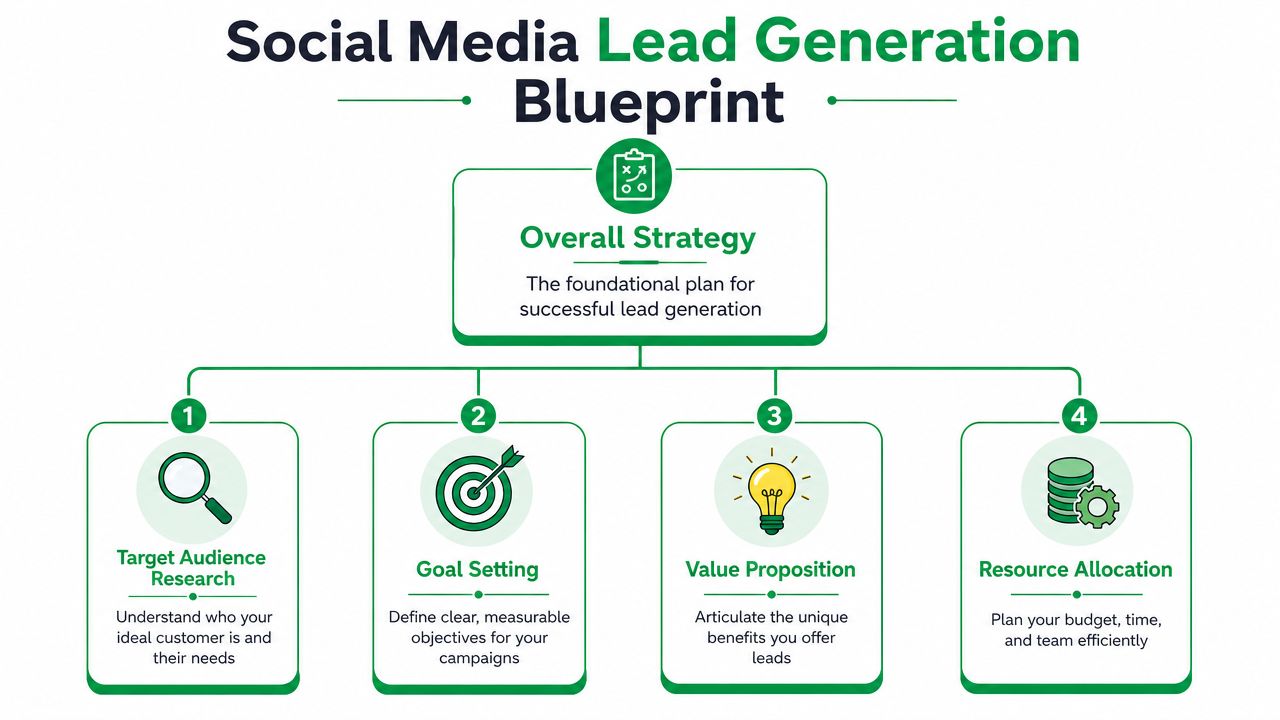
Nail the audience before the content
Most weak social campaigns are too broad. They target an industry, not a buying situation.
A better starting point looks like this:
- Define the trigger
What just happened in the prospect’s world that makes your offer relevant right now? A slow sales month. Hiring pressure. Rising ad costs. A site redesign that tanked conversions.
- Define the pain
What are they trying to stop, fix, or improve? More leads is too vague. Better-fit leads, lower follow-up drag, fewer no-shows, cleaner attribution. That’s more useful.
- Define the platform behavior
Where do they engage? B2B decision-makers often behave differently on LinkedIn than local consumers do on Facebook or Instagram. Same person, different intent.
Social Media Lead Generation: Pick a lead goal that sales will respect
A lot of social campaigns fail because marketing optimizes for form fills and sales overlooks them.
Set goals around lead quality first. Ask:
- Can the lead afford us
- Does the lead match our service area or buyer profile
- Did they request something meaningful, not just click a low-intent offer
- Can sales follow up quickly enough to make the lead useful
From this point, your offer begins its qualification work for you.
Better to get fewer leads with clear buying intent than a spreadsheet full of people who wanted something free and nothing else.
Build around one clear value exchange
Your social content should feed one primary conversion path per campaign. Not five.
That value exchange might be:
- A practical asset: checklist, buying guide, estimate worksheet
- A diagnostic offer: audit, consult, review, assessment
- A direct conversation: demo, quote request, discovery call
If you want another perspective on building a predictable pipeline on social media, that piece does a good job framing social as a process instead of a random pile of tactics. That’s the right lens.
Social Media Lead Generation: Choose Your Channels and Tactics
Organic and paid social do different jobs. When businesses treat them as interchangeable, performance slips.
Organic earns attention and trust over time. Paid creates faster capture paths and cleaner testing. You usually need both, but not in equal amounts, and not at the same stage.
The bigger shift is this. Social media lead generation is moving toward native-form capture. Instead of pushing everyone off-platform, more businesses are collecting and qualifying leads inside the app through forms, messaging flows, and chat-based follow-up, as discussed in Sprinklr’s overview of social media lead generation.
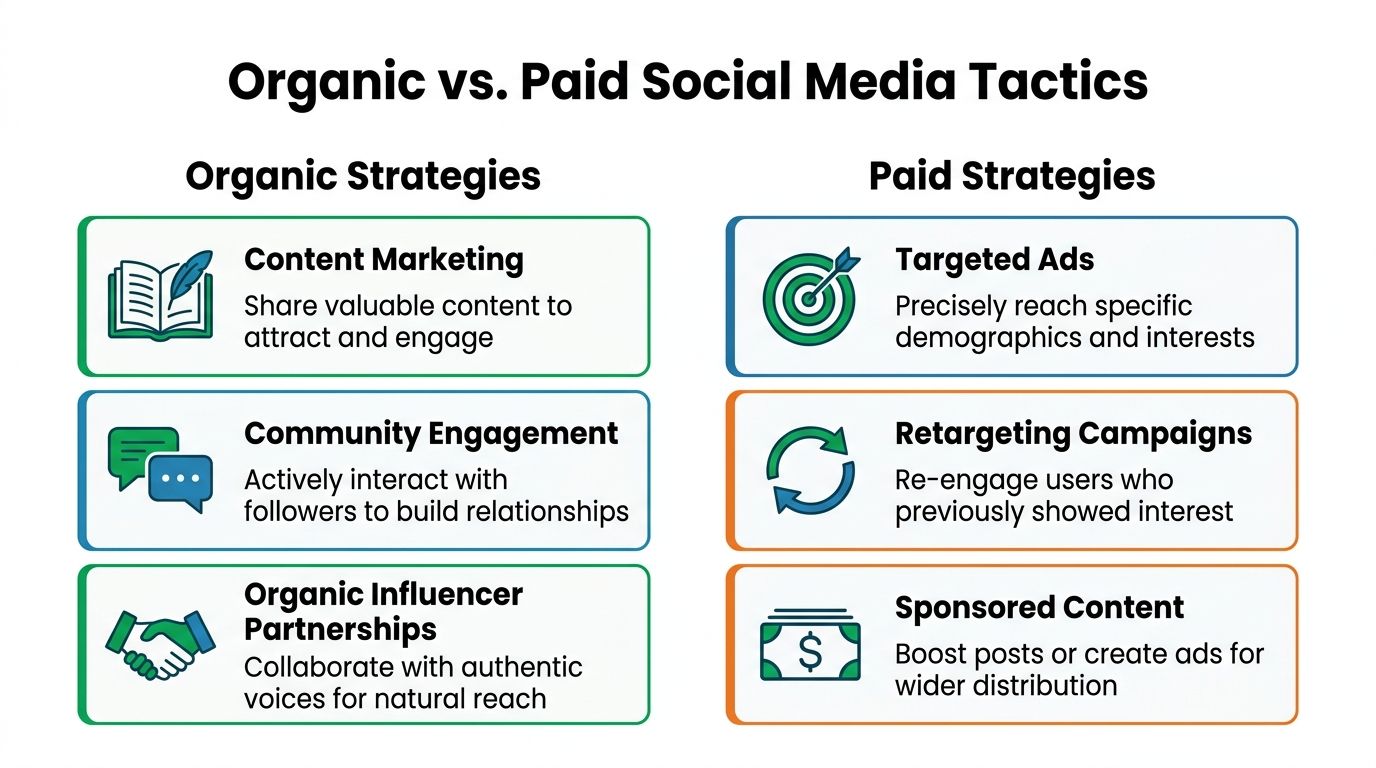
Organic tactics build demand and trust
Organic works best when the sales cycle needs credibility before contact. Think agencies, consultants, local services with higher consideration, B2B firms, and any offer where people want a feel for your expertise before they raise a hand.
What works:
- Content pillars tied to buying questions: Build recurring themes around pricing, mistakes, comparisons, outcomes, and process. Not random “tips.”
- Short-form video: Good for showing judgment, not just personality. Explain one problem clearly and point to a next step.
- Direct messages after intent signals: If someone comments with a real question or replies to a story, that’s often a better lead path than sending cold traffic to a generic page.
- Native educational posts: Break down part of the answer publicly, then invite the right people to continue privately.
If you need ideas for format variety, this roundup of types of content for social media is useful because it pushes beyond “just post consistently.”
Social Media Lead Generation: Paid tactics compress time
Paid social is the right move when you need speed, controlled targeting, and a direct response mechanism.
That usually means:
- Meta Lead Ads for broad-volume capture
- LinkedIn Lead Gen Forms for professional and B2B targeting
- Retargeting campaigns for warm visitors, video viewers, and partial engagers
- Click-to-message ads when a conversation is a better qualifier than a form
For owner-led B2B outreach, paid and organic can also support each other. Strong personal positioning plus thoughtful messaging often opens more doors than a hard-sell ad. If LinkedIn is central to your mix, this guide on how to generate sales conversations on LinkedIn is worth reading because it focuses on the actual message quality, not automation gimmicks.
Organic vs. Paid Lead Generation Tactics
| Attribute | Organic Tactics | Paid Tactics |
|---|---|---|
| Primary job | Build trust and familiarity | Capture leads faster |
| Time horizon | Longer | Shorter |
| Best use case | Thought leadership, community, education | Offers, forms, retargeting, direct response |
| Control over audience | Limited by platform reach and engagement | Stronger through targeting options |
| Conversion path | Often softer, such as DMs or profile links | More explicit, such as native forms or ad CTAs |
| Main trade-off | Slower to scale | Easier to waste budget with weak qualification |
Don’t spread effort across every platform
A common SMB mistake is trying to maintain Facebook, Instagram, LinkedIn, TikTok, X, and YouTube all at once. That creates thin content and messy attribution.
A tighter approach works better:
- Choose one core channel where your buyers already spend time
- Add one support channel for retargeting or repurposing
- Match tactics to intent instead of chasing every new feature
And if you’re using native lead forms, add qualification fields or a follow-up question fast. Easy submissions can bring in weak leads just as easily as strong ones.
Social Media Lead Generation: Craft Irresistible Lead Magnets and Landing Pages
Getting attention on social is only half the job. The true test starts when someone asks, “Is this worth giving my information for?”
That’s where most campaigns get shaky. The content is decent. The ad is fine. Then the click lands on a page with a vague headline, too many form fields, and no clear reason to continue.

A common execution pitfall is running ads or posting content without a clear landing-page path or CTA. To work, landing pages should be mobile-optimized, fast, and refined through split testing, as explained in Sopro’s social media lead generation guidance.
Make the offer specific enough to feel useful
A lead magnet doesn’t need to be long. It needs to solve a real problem that sits close to purchase intent.
Good examples:
- A local service business: “Get a free estimate” is fine. “Request a roof replacement cost review” is better because it frames the problem.
- A B2B agency: A generic ebook rarely pulls its weight. A short audit, benchmark worksheet, or planning template usually does more.
- An ecommerce brand: Early access, a buying guide, or product matching quiz can work better than a broad newsletter signup.
Three traits matter most:
- Urgency: The lead feels this problem now.
- Clarity: They know exactly what they’ll receive.
- Relevance: The offer matches the traffic source and message that got the click.
The closer the offer is to an active decision, the better your lead quality tends to be.
Social Media Lead Generation: Write landing pages for one action
Most landing pages lose leads because they ask people to process too much.
Keep it simple:
- Headline
State the result, not the format. People want the outcome of the checklist more than the fact that it’s a checklist.
- Support copy
Explain what they’ll get and why it matters in plain language.
- Proof
Add testimonials, outcomes, credentials, screenshots, or trust indicators if you have them. Don’t overdo it.
- Form
Ask for the minimum information you need to take the next step intelligently.
For inspiration, these examples of high-converting landing pages are useful because they show how strong pages reduce friction instead of trying to impress people with design tricks.
A short walkthrough helps here:
Match the page to the click
One of the easiest ways to tank conversion quality is message mismatch.
If your ad promises a free audit, the page should open with the audit. If your Reel talks about common pricing mistakes, the page should continue that exact conversation. Not send people into a generic services page and hope they figure it out.
That sounds obvious. Still gets missed all the time.
Social Media Lead Generation: Connect the Dots with a CRM and Automation
Most businesses don’t have a lead generation problem. They have a lead handling problem.
A form gets submitted. Someone sees it later. A spreadsheet gets updated when there’s time. Sales follows up the next day, or next week, or not at all because the source was buried in a platform notification. By then the prospect has moved on.
That’s why CRM integration matters. Social media lead generation only becomes reliable when capture, routing, nurturing, and handoff are connected.
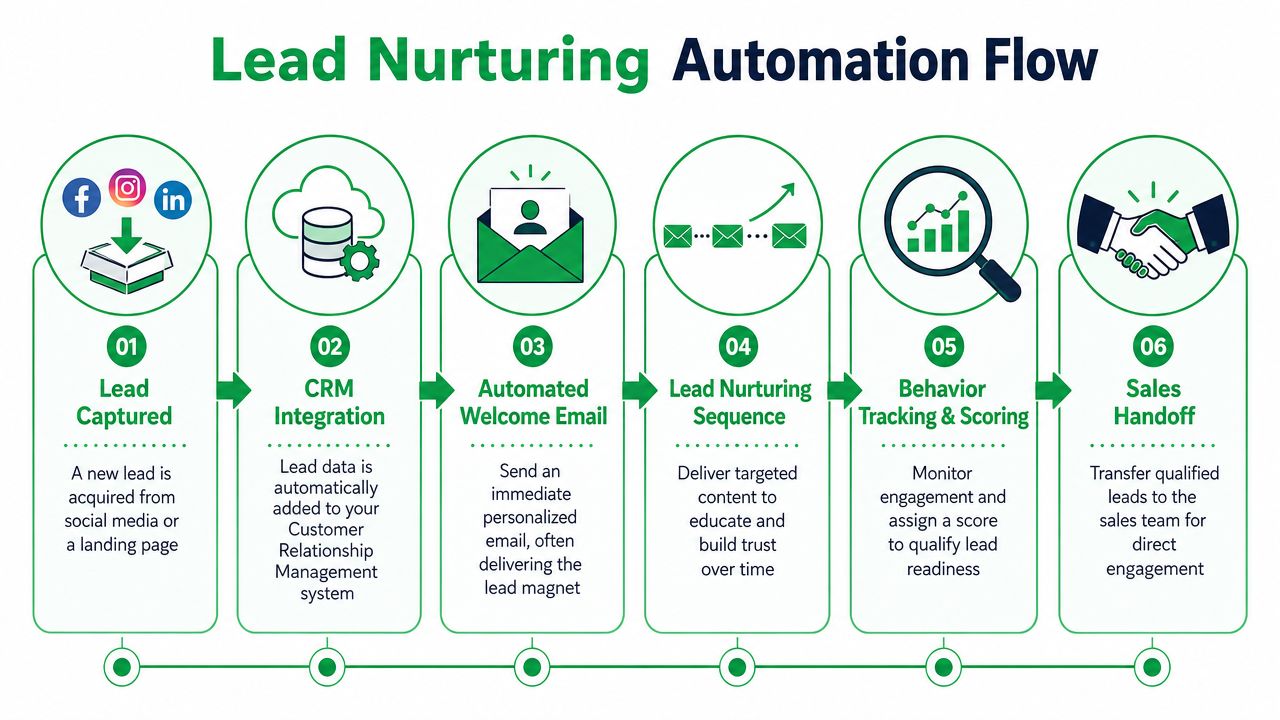
The operational mistake I see most is simple. Leads come in, but nobody nurtures or scores them. That’s expensive. It also ignores a practical benchmark from SalesHandy’s lead generation statistics roundup: 66% of marketers generate leads after spending only six hours per week on social media, which suggests disciplined workflow matters more than brute-force posting time.
Set up the basic plumbing first
This doesn’t need to be complicated.
A workable setup for many SMBs looks like:
- Lead source: LinkedIn Lead Gen Forms, Meta Lead Ads, website forms, click-to-message campaigns
- Connector: Zapier, native integrations, or platform automation
- Destination: HubSpot, Pipedrive, Salesforce, Zoho, or even a structured Google Sheet if that’s where you are right now
- Immediate response: confirmation email, asset delivery, or appointment prompt
- Ownership rule: assign the lead to a specific person, not “the team”
If you need implementation help, Mr. Green Marketing, LLC is one option among agencies that handle social media strategy and connected execution across lead capture, web, and paid channels. The important part isn’t the vendor. It’s that someone owns the workflow end to end.
Use automation for speed, not for pretending
Automation should do the boring parts fast.
Use it to:
- Push form submissions into your CRM immediately
- Tag the source and campaign clearly
- Send the promised asset without delay
- Trigger a simple welcome sequence
- Create a task for sales when the lead meets your criteria
Don’t use it to fake relationship building with robotic, overlong follow-up.
A fast, plainspoken response usually beats a clever sequence that arrives too late.
Track the few metrics that matter
If social is generating leads but you can’t tell which ones turn into real opportunities, you’re still flying blind.
Inside your CRM, track:
- Lead source: which platform and campaign brought them in
- Conversion rate: from lead to next meaningful step
- Lead-to-customer movement: which sources progress
- Sales readiness: which offers attract buyers versus browsers
You don’t need a giant dashboard on day one. You need clean source data and a process your team will maintain.
Optimize for Quality Not Just Quantity
More leads can feel like progress. Sometimes they are. Sometimes they’re just more admin work for your team and more noise for sales.
The smarter view is downstream. Did the lead book? Did they reply? Did they qualify? Did they buy?
That’s the gap in a lot of social media lead generation programs. They focus on capture and stop there. But more social leads are not necessarily better. Businesses need to optimize for downstream conversion and sales readiness, and one of the biggest misses is failing to measure whether social leads turn into revenue through proper attribution and CRM handoffs, as discussed by the Social Media Strategies Summit blog on generating leads using social media.
The best campaign is not always the busiest one
A campaign that produces a lot of cheap, low-intent leads can look strong in-platform and still underperform in the business.
A campaign with fewer submissions can be the better one if those leads:
- Match your buyer profile
- Respond to follow-up
- Show clearer intent
- Move through sales with less friction
That means your review process should include CRM outcomes, not just social metrics.
Clean data makes better decisions
There’s another practical issue here. Some leads are bad before sales even touches them. Typos, disposable emails, junk submissions, accidental form fills. That muddies attribution and wastes follow-up time.
If form quality is becoming a problem, it helps to compare top email verification services and choose one that fits your stack. Clean input data won’t fix weak offers, but it does protect your team from chasing garbage records.
Small tests beat big overhauls
You don’t need to rebuild the entire machine every month. Test one variable at a time:
- Offer angle: audit versus checklist
- Form friction: fewer fields versus stronger qualification
- CTA language: quote request versus consultation
- Audience slice: broad interest targeting versus retargeting
- Follow-up timing: instant response versus delayed outreach
And watch what happens in the CRM, not just in the ad manager.
The businesses that win with social don’t treat it like a guessing game. They treat it like an operating system. Tight audience. Clear offer. Clean capture. Fast follow-up. Revenue feedback loop. That’s what makes the channel useful.
If you want a practical outside view on where your current funnel is leaking, Mr. Green Marketing, LLC helps businesses connect social media, landing pages, CRM workflows, and lead follow-up into one measurable system. A focused audit is usually the fastest place to start.
Leave a Comment
sing in to post your comment or sign-up if you dont have any account.