
Digital Marketing Agency Definition: You’re probably doing some version of this right now.
One tab has Google Ads open. Another has your website analytics. You’ve got a half-finished social post queued up, someone mentioned SEO in a meeting, and now you’re wondering whether your site needs a redesign or just better copy. Meanwhile, the actual business still needs attention. Clients. Inventory. Hiring. Delivery. Cash flow.
That’s where the confusion starts. Digital marketing can look like a pile of disconnected tasks when you’re inside it. Post more. Run ads. Fix rankings. Send emails. Redesign landing pages. And if you hire one freelancer for ads, another for content, and a developer when something breaks, you often end up managing the gaps yourself.
A good agency changes that. Not by “doing marketing stuff” in the abstract, but by turning scattered activity into a coordinated system tied to outcomes. Traffic, leads, sales, retention. The work still includes channels like SEO, PPC, social media, content, email, and web design. But its core value is orchestration. One plan. One set of priorities. One reporting rhythm. One team accountable for movement.
That’s the practical digital marketing agency definition most business owners need.
Digital Marketing Agency Definition: The Overwhelmed Business Owner’s Dilemma
Most owners don’t wake up wanting to become part-time media buyers, SEO editors, analytics interpreters, and website project managers. But that’s exactly what happens when growth depends on digital channels and nobody owns the full picture.
A local service company might have a decent website, weak conversion tracking, inconsistent social content, and ad campaigns that generate clicks but not qualified calls. An e-commerce brand might have strong products and poor email automation. A B2B firm might publish blogs but have no serious distribution plan behind them. Different symptoms. Same issue. Fragmentation.
Why scattered marketing feels expensive
The problem usually isn’t a lack of effort. It’s that each tactic gets handled in isolation.
One person is focused on rankings. Another wants more leads this month. A designer is improving the homepage without insight into search intent. Paid campaigns are sending traffic to pages that were never built to convert. And suddenly your “marketing budget” is buying motion instead of progress.
Practical rule: If nobody is responsible for connecting traffic, conversion, and reporting, you don’t have a marketing system. You have marketing activity.
That distinction matters. A business can survive clunky execution for a while. It struggles when no one can explain what’s working, what isn’t, and what should happen next.
What an agency changes
A digital marketing agency steps in as the outside team that owns the digital growth layer. That means it doesn’t just complete tasks. It prioritizes them.
Instead of asking, “Do you want SEO or PPC?” a strong agency asks better questions. Where are leads leaking? Which channels fit buyer intent? Is the website helping close demand or blocking it? Are you trying to create awareness, capture existing demand, or both?
And yes, sometimes the answer is simpler than expected. You may not need more channels. You may need tighter tracking, sharper landing pages, and messaging that matches what buyers are already searching for. Small shifts. Big difference.
So What Is a Digital Marketing Agency Anyway?
At its simplest, a digital marketing agency is a specialized external firm that uses online channels like SEO, PPC, social media, content, email, and web design to promote brands and drive measurable business outcomes. That’s the plain-English digital marketing agency definition commonly sought.
But that basic description misses the part that matters in practice.
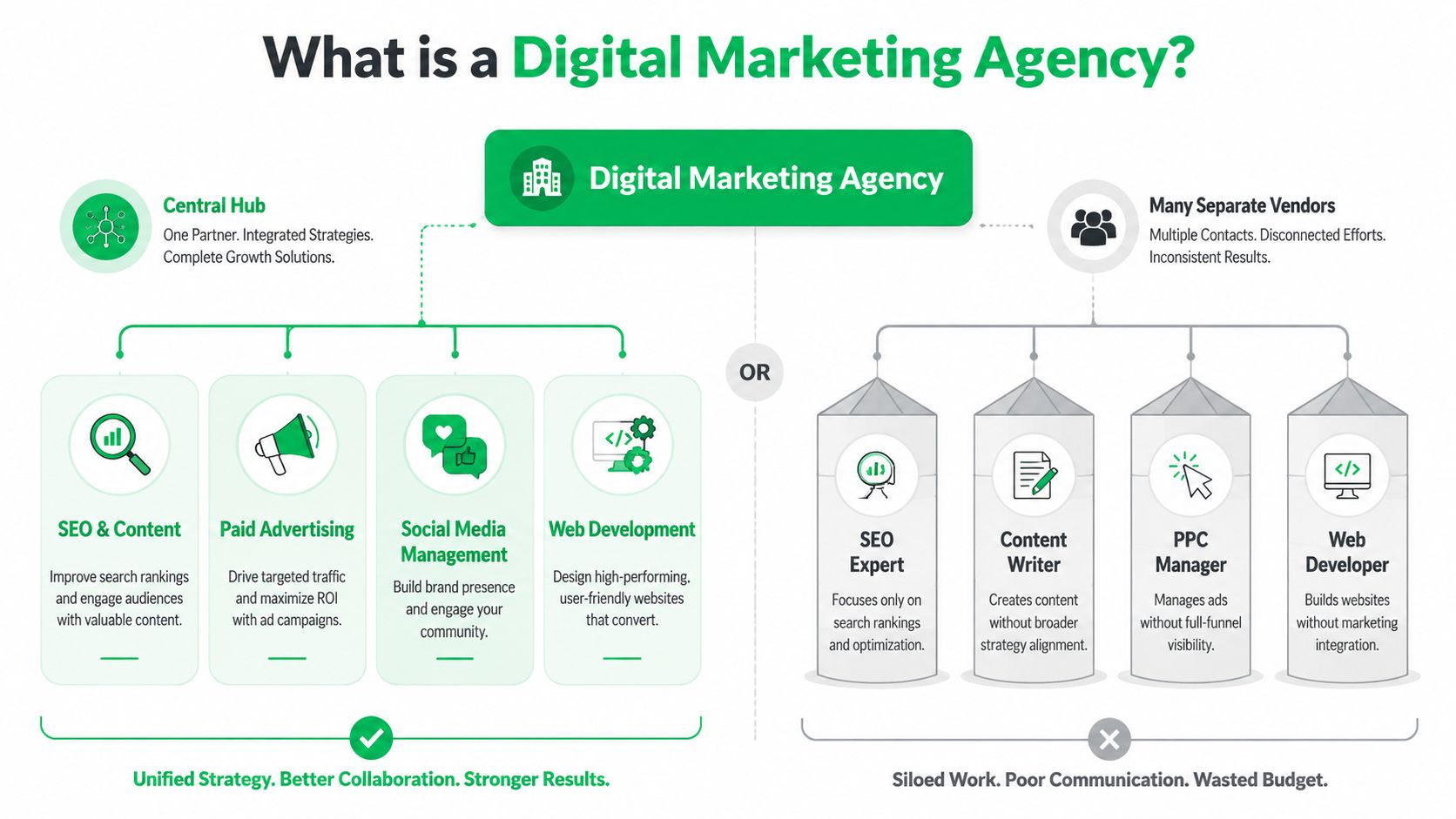
An agency isn’t just a collection of specialists for hire. The better way to think about it is as a business’s growth operating system. It combines strategy, execution, tools, measurement, and accountability under one roof so your digital presence behaves like one coordinated machine instead of six unrelated projects.
The general contractor analogy actually works
If you were renovating a building, you could hire a separate electrician, plumber, painter, and flooring installer. That can work. But if no one coordinates timing, budget, sequence, and quality, the project gets messy fast.
Marketing works the same way.
Your SEO specialist may want content updates. Your ad manager may need fresh landing pages. Your designer may need direction from conversion data. Your email strategy should reflect what paid and organic channels are attracting. Someone has to oversee the blueprint.
That “someone” is often the agency.
Why this is now a real business category
This isn’t a fringe service anymore. The digital marketing agency market is projected at USD 8.27 billion in 2026 and USD 27.57 billion by 2035, with a 14.32% CAGR. The same industry estimate notes that 87% of North American firms employ fewer than 50 people, which tells you something useful. A lot of agencies are not giant holding-company shops. They’re specialized teams built for integrated execution.
That matters for buyers because it explains why agencies come in different shapes. Some are broad and scaled. Some are compact and senior-led. Many are designed to function as an outsourced marketing department for companies that need capability without building every role in-house.
Digital Marketing Agency Definition: The operating-system definition
A stronger digital marketing agency definition looks like this:
- Strategy layer. The agency identifies where growth should come from and what to prioritize first.
- Specialist layer. Channel experts handle SEO, paid media, content, social, design, development, and email.
- Measurement layer. Reporting ties activity to business goals, not vanity metrics.
- Optimization layer. The team adjusts based on performance, not guesswork.
A good agency doesn’t just “do marketing.” It creates alignment between audience demand, channel execution, and business goals.
That’s why businesses hire agencies even when they have internal staff. Not always for extra hands. Often for integration, speed, and accountability.
Digital Marketing Agency Definition: The Toolkit What an Agency Actually Does
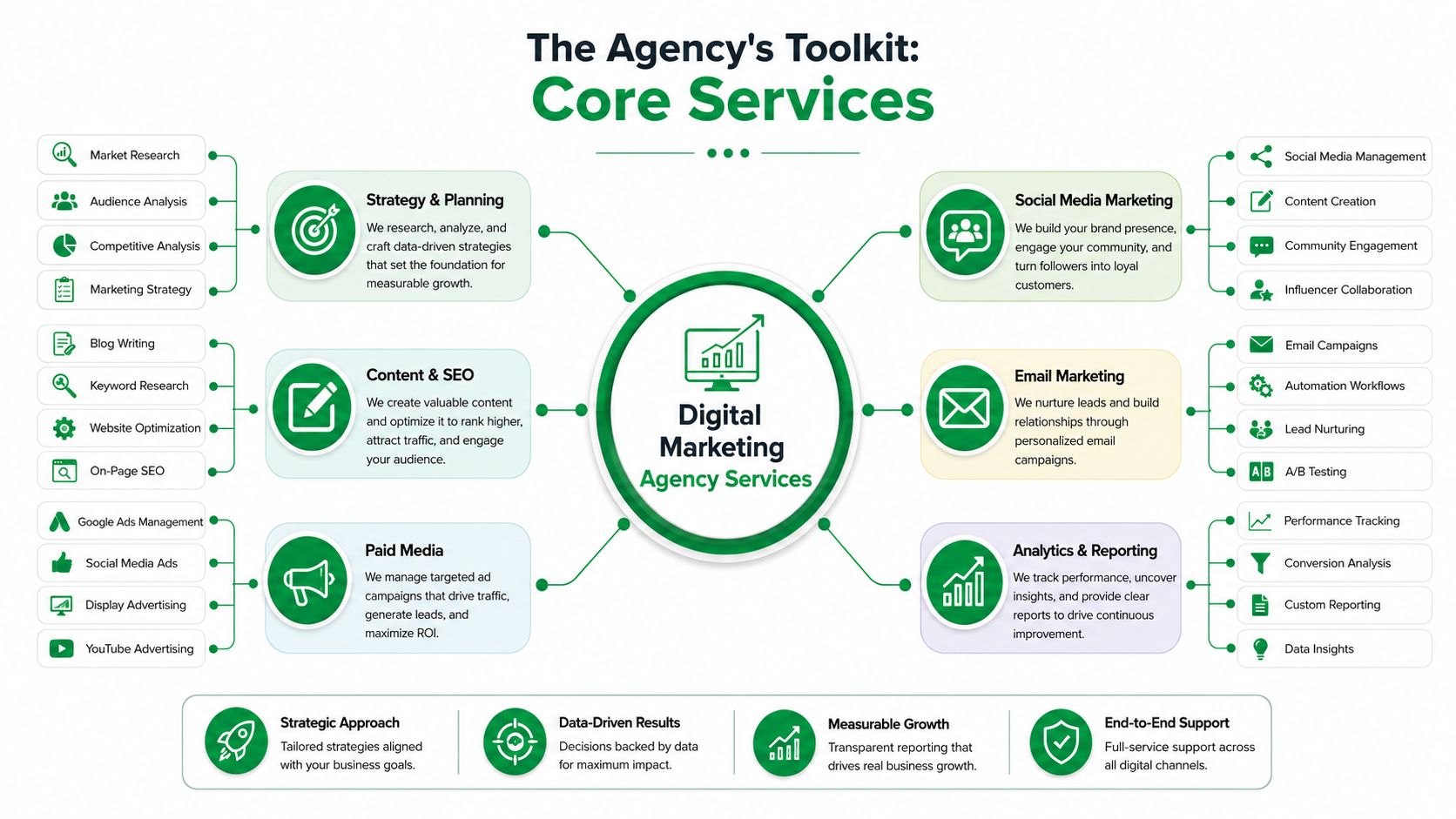
A lot of agency descriptions are too vague. “We help brands grow online” sounds polished, but it doesn’t tell you what happens on Tuesday morning. In reality, agencies spend their time diagnosing bottlenecks, building assets, launching campaigns, measuring response, and refining what’s underperforming.
A useful way to understand the work is to group it by function instead of by buzzword.
Foundation work that makes every channel perform better
Some services aren’t glamorous, but they affect everything else.
That includes positioning, messaging, branding, website structure, landing page design, analytics setup, and conversion-focused UX. If these pieces are weak, paid traffic gets wasted and organic traffic underperforms. The channel isn’t always the problem. The destination often is.
An agency should be able to look at your site and answer practical questions:
- Can visitors tell what you do fast?
- Is there a clear next step?
- Are forms, calls, purchases, or demos being tracked properly?
- Do pages match the intent behind the traffic source?
A proper audit earns its keep. If you need that kind of baseline review, a digital marketing audit service is often the cleanest place to start.
Digital Marketing Agency Definition: Growth engines that create demand and capture it
Once the foundation is solid enough, agencies work the channels that bring people in.
SEO helps capture intent from people already searching. PPC creates immediate visibility in places where speed matters. Paid social can introduce your offer to audiences who weren’t actively looking yet. For marketplace sellers, Amazon marketing plays a different but equally important role because search behavior inside marketplaces follows its own rules.
The important part isn’t the list of channels. It’s the fit between channel and business goal.
A company launching a new offer may need paid media and conversion pages first. A business with strong referral demand but weak search visibility may benefit more from SEO and content architecture. A brand with repeat purchase potential often leaves money on the table if email and lifecycle automation are ignored.
Amplification and nurturing work that compounds
Content marketing, social media management, email marketing, creative production, and ongoing optimization are core elements. These services strengthen trust, follow-up, and retention.
They also keep campaigns from becoming one-hit efforts. A blog post can support SEO. That insight can become a short video, a paid remarketing angle, an email sequence, or a social asset. An agency turns one idea into a system of touchpoints.
A separate industry report notes that the U.S. digital advertising agency industry is expected to generate USD 52.4 billion in revenue in 2024, and that a standard agency structure centers on Revenue Generation, Production, Support, and Leadership. That four-part structure reflects what happens behind the scenes. Someone drives pipeline. Someone builds and launches. Someone manages communication and operations. Someone steers direction.
Short version. Agencies don’t just sell services. They run an operating model.
Digital Marketing Agency Definition: Choosing Your Fighter Full-Service vs Boutique vs Niche Agencies
Not every business needs the same kind of partner. Some need broad capability and formal process. Others need senior thinking and tighter communication. Others just need a specialist to solve one clear problem.
The mistake is assuming one agency type is universally better. It isn’t. The right choice depends on your stage, internal team, complexity, and tolerance for managing vendors.
Full-service, boutique, and niche mean different things
A full-service agency usually offers a wide service menu under one brand. That can include paid media, SEO, content, design, development, social, analytics, and strategy. This model makes sense when you want one partner to cover a lot of ground.
A boutique agency usually has a smaller team and a narrower client roster, with more direct involvement from senior people. It may still provide integrated services, but with a more hands-on working style and a tighter strategic lens.
A niche or freelance specialist focuses on one discipline or one narrow slice of execution. Think Google Ads only. Technical SEO only. Email automation only. TikTok creative only.
Digital Marketing Agency Definition: Agency Type Comparison Which Is Right for You
| Attribute | Full-Service Agency | Boutique Agency | Niche/Freelance Specialist |
|---|---|---|---|
| Scope | Broad channel coverage across many services | Integrated support with a more focused team | Deep expertise in one area |
| Communication style | More structured, often with layers | Usually direct and high-touch | Often direct, but limited to their lane |
| Best fit | Businesses needing wide capability across many channels | SMBs and growth-stage firms that want strategy plus execution | Companies with one urgent, clearly defined problem |
| Potential trade-off | Can feel less personal or more process-heavy | May have selective capacity or narrower bandwidth | You may need to manage coordination across multiple vendors |
| What success depends on | Strong account management and cross-team alignment | Senior strategic involvement and fit | Clear scope and someone on your side to connect the work |
The real decision is about integration
One verified description from Upwork’s overview of digital marketing agencies gets to the heart of it. A key agency function is coordinating complementary channels, like SEO for long-term demand capture and PPC for immediate demand acceleration, under one measurement framework.
That point is easy to overlook.
If you hire a specialist for each channel, you still need someone to integrate them. Someone has to decide whether paid search should support high-intent terms while SEO builds depth elsewhere. Someone has to ensure landing pages reflect both. Someone has to interpret the data together, not channel by channel.
Hiring separate experts can work. But if no one owns the interaction between those experts, the business owner becomes the integrator by default.
For many small and midsize companies, that’s the hidden cost of going too fragmented. You don’t just buy services. You buy management overhead.
Digital Marketing Agency Definition: How to Choose the Right Agency and Avoid Red Flags
The selection process matters more than the pitch deck. Most agencies can assemble a polished proposal. Fewer can show how they think, how they prioritize, and how they’ll behave once the contract is signed.
That’s why the best discovery calls feel less like a sales performance and more like a diagnosis. The agency should be curious. Specific. Willing to say no to bad ideas. Willing to explain trade-offs.
Questions worth asking on a discovery call
You don’t need to interrogate people. You do need to test whether they think beyond deliverables.
Ask things like:
- How do you define success for an account like ours?
- What do you need from us to build a useful strategy?
- Which channels would you prioritize first, and why?
- What does reporting look like in plain English?
- Who does the work day to day?
- How do you handle situations where the website or offer is the bottleneck, not the traffic source?
- What happens in the first month?
The quality of the answers tells you a lot. Strong agencies talk about goals, baselines, constraints, messaging, conversion points, and measurement. Weak ones jump straight to packages.
A more detailed framework can help if you’re comparing several firms at once. This guide on how to choose a digital marketing agency is a useful companion to that process.
Digital Marketing Agency Definition: Green flags and red flags
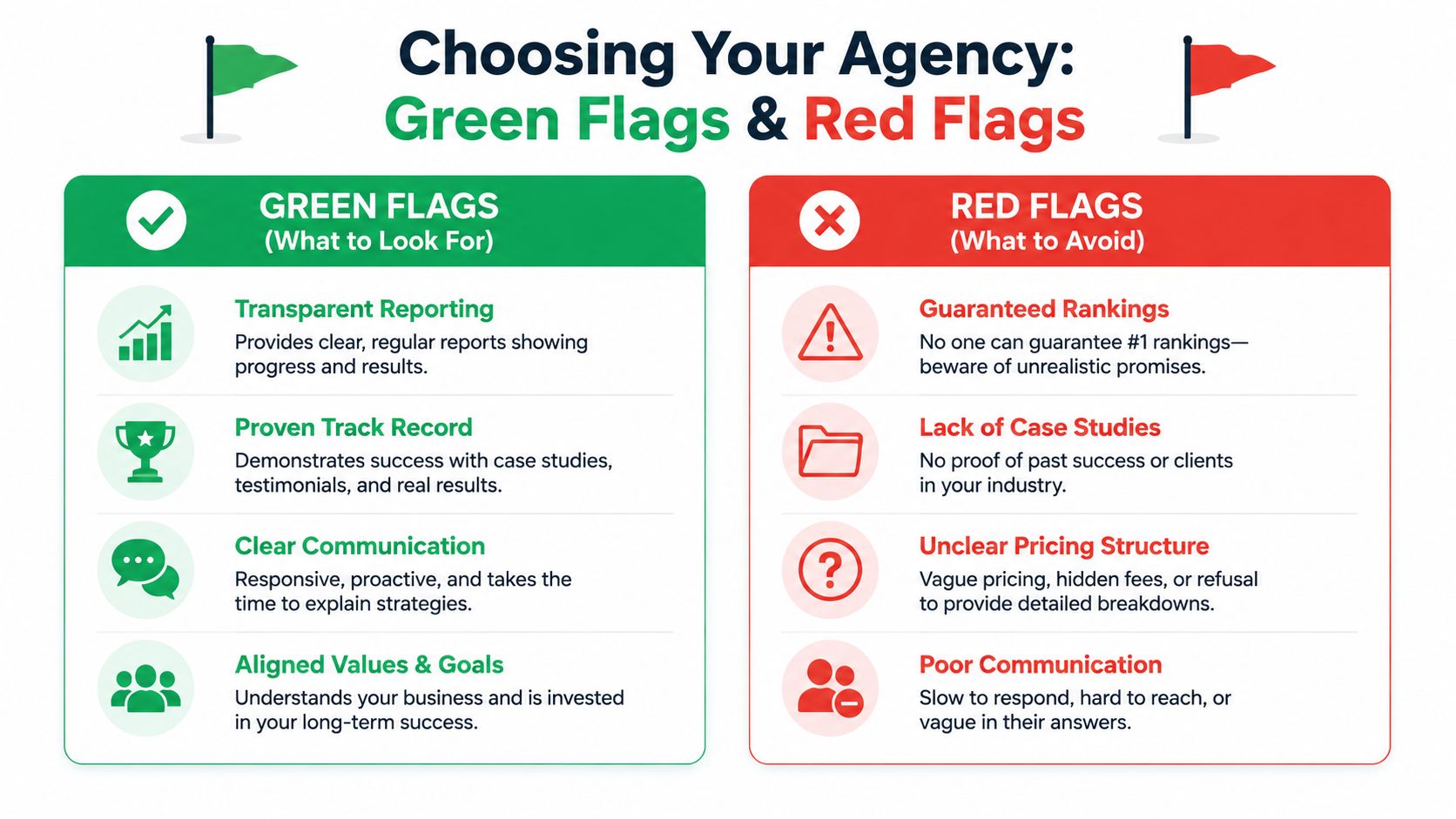
Green flags usually look boring in the best way. Clear scope. Clear reporting. Clear ownership. Real questions about your business model, not just your ad budget.
Red flags are often louder.
| What to look for | Why it matters |
|---|---|
| Green flag: They ask deep business questions | Strategy starts with goals, margins, sales cycle, and audience fit |
| Green flag: They explain trade-offs clearly | Honest partners know every channel has limits and timing realities |
| Green flag: They discuss reporting before tactics | Accountability should be built in from the start |
| Red flag: They guarantee rankings or instant results | Good marketing improves probability. It doesn’t promise outcomes nobody can control |
| Red flag: They push a standard package without diagnosis | Templated scope often ignores your actual bottlenecks |
| Red flag: They stay vague about who does the work | If ownership is fuzzy at the start, it usually gets worse later |
A quick visual breakdown can help when you’re screening options:
What good agency communication feels like
It feels grounded. You understand what’s happening, what the team is testing, what changed, and what they need from you.
It also includes pushback. Not constant friction. Useful pushback. If your agency agrees with everything, that’s not always a service mindset. Sometimes it’s a sign they’re avoiding hard conversations.
A partner worth keeping will tell you when the offer is weak, the landing page is muddy, or the timeline is unrealistic.
That honesty saves money.
Digital Marketing Agency Definition: Unpacking Agency Pricing and Expected ROI
Agency pricing confuses people because the invoice isn’t just buying outputs. It’s buying time, skill mix, tools, process, and judgment. Two agencies may both “do SEO,” but the actual work behind that label can be completely different.
The cleanest way to evaluate pricing is to understand the billing model first, then look at scope.
The common pricing models
A monthly retainer is the most common structure for ongoing work. This arrangement effectively reserves a dedicated portion of a team’s efforts each month. You’re paying for ongoing strategy, execution, reporting, and optimization.
A project fee is different. This works when the scope has a clear finish line, like a website build, a brand refresh, analytics setup, or a one-time audit.
A performance-based model sounds attractive because it ties payment to results, but it can get messy fast if attribution is unclear or the agency doesn’t control the full conversion path. These models work best when definitions are precise and both sides understand what can and can’t be controlled.
What actually drives cost
Three things usually shape agency pricing more than anything else:
- Scope of work. One channel with clear deliverables costs less than a multi-channel program with landing pages, creative, tracking, and reporting.
- Team experience. Senior strategic involvement usually costs more than purely junior execution.
- Tool stack and operational depth. Reporting systems, analytics setup, testing workflows, creative production, and account management all affect the workload.
This is why cheap proposals can become expensive later. If the initial scope excludes tracking, creative revisions, CRO input, or technical support, you often pay for the gaps somewhere else.
Digital Marketing Agency Definition: What ROI should look like in the real world
ROI usually doesn’t show up all at once. First you see signs of traction. Better traffic quality. Better click-through rates. Better conversion behavior. Better lead quality. Then revenue outcomes follow if the rest of the funnel is sound.
That’s why smart reporting separates leading indicators from lagging indicators. Leading indicators show whether the machine is improving. Lagging indicators show whether those improvements are turning into revenue.
If you want a plain-English refresher on how to calculate your Return on Investment, that resource lays out the basics clearly. For a marketing-specific approach, this guide on how to calculate marketing ROI helps connect channel performance to business outcomes.
One more practical note. ROI conversations break down when expectations and time horizon are vague. SEO, site improvements, content systems, and brand positioning often need time to compound. Paid media can move faster, but it still depends on audience fit, offer quality, and conversion infrastructure.
So yes, ask about ROI. But also ask what the agency expects to improve first, how they’ll measure that progress, and what assumptions their plan depends on.
Digital Marketing Agency Definition: Your Go-Forward Plan A Simple Checklist
You don’t need to become an expert in every channel to choose a good partner. You do need a clear buying process.
Start with your goals. Not “we need marketing,” but something tighter. More qualified calls. More demo requests. Better ecommerce conversion. Better visibility for a specific service line. Clear goals make agency conversations sharper immediately.
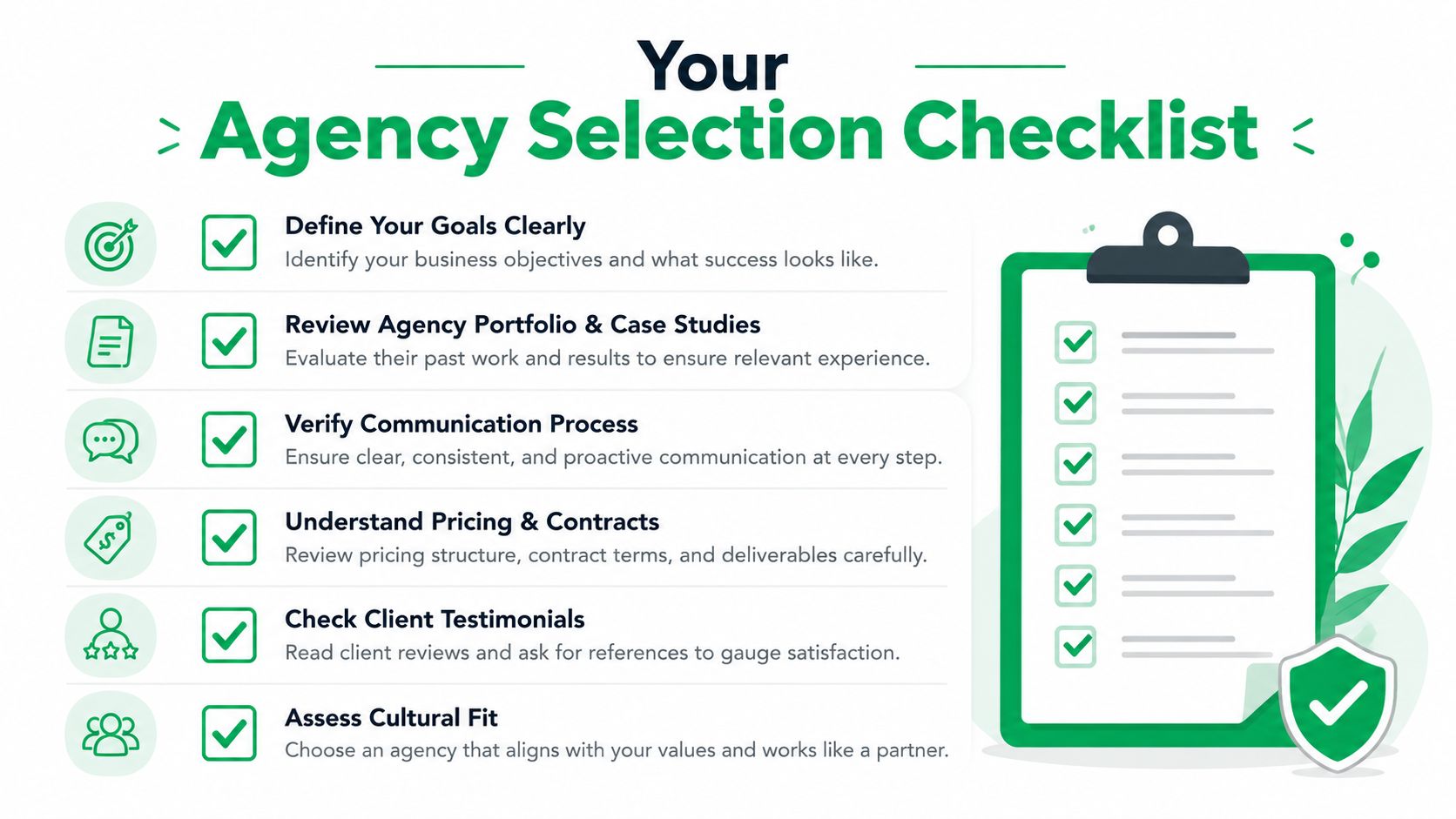
Then use a simple checklist.
- Define your business objective before you talk to agencies
- List your current bottlenecks such as traffic quality, weak conversion pages, poor follow-up, or unclear reporting
- Ask each agency how they would prioritize the first moves
- Review who will manage the account directly
- Look for reporting clarity, not flashy promises
- Request an audit or diagnostic before committing to a large scope
A good agency relationship should make your business feel less scattered, not more. You should leave meetings with clearer priorities, cleaner visibility into performance, and confidence about what happens next. That’s the difference between hiring a vendor and hiring a growth partner.
If you want a practical starting point, Mr. Green Marketing, LLC offers strategy-led support across web design, SEO, PPC, Amazon marketing, branding, social media, video, and related digital channels, with audits and performance reviews available for businesses that want to identify gaps before committing to a broader engagement.
Leave a Comment
sing in to post your comment or sign-up if you dont have any account.