
SEO and Facebook: You probably already feel the split.
One task list says fix title tags, publish service pages, improve internal links, watch Google Search Console, and clean up slow pages. The other says post on Facebook, answer comments, run ads, test creative, maybe try Reels, maybe boost something. Two channels. Two dashboards. Two different kinds of work.
That split is where a lot of small businesses lose momentum.
Facebook is not a search engine in the same way Google is. But it is absolutely a discovery engine. And that matters because discovery often happens before search, before a direct visit, and before a lead form. A marketer survey covering 2024 to 2026 reported that 83% of marketers worldwide use Facebook, making it the most-used social platform for marketing, and 39% of consumers use Facebook to find new products (Sprout Social social media statistics). That means Facebook can influence what people later search for, which pages they visit, and whether your brand feels familiar when they finally land on your site.
That is where SEO and Facebook connect.
If you treat Facebook as a dumping ground for blog links, it won’t do much. If you treat SEO as a silo that lives only inside your website, you miss how people really move through the web now. Social exposure shapes branded searches. Comments reveal language customers use. Paid and organic Facebook traffic can validate which landing pages deserve deeper SEO work.
And if you’re also distributing announcements, launches, or milestones through channels like press releases for SEO, the bigger lesson is the same. Visibility compounds when messaging, discovery, and search intent line up.
SEO and Facebook: Introduction
Monday morning. The phone is quiet, rankings are flat, and last week’s Facebook post pulled decent engagement but almost no tracked leads. That’s the point where a lot of business owners split the work into two buckets and judge each channel in isolation.
That approach hides the true opportunity.
SEO and Facebook work best as one system. Facebook creates familiarity, surfaces objections, and puts messages in front of people before they search. SEO captures that demand once intent sharpens. If you only ask which channel drove the last click, you miss how the two assist each other across multiple visits, devices, and time gaps.
The practical question is not whether Facebook is a ranking factor. The practical question is how Facebook activity changes the things SEO depends on: branded search, repeat visits, topic validation, stronger landing pages, and better audience language. That’s the level that matters to SMBs trying to turn limited time and budget into measurable growth.
And that requires process, not more posting.
What Facebook does for SEO
Facebook does not rank your service pages for competitive queries. It can, however, improve the conditions around SEO performance.
- Discovery: People encounter your brand before they search, which can increase branded queries later.
- Content distribution: A post can put a topic in front of customers, partners, journalists, or creators who may return to the site, mention the brand, or link later.
- Message testing: Facebook reactions, comments, and click patterns show which angles deserve a full SEO page or article.
- Demand creation: Repeated exposure makes the brand more familiar, and familiar brands tend to earn more clicks when they appear in search.
Facebook helps SEO most when it creates demand and clarifies messaging.
That distinction matters because weak attribution causes bad decisions. A business owner sees low last-click conversions from Facebook and cuts effort there, even though that traffic may be lifting branded search volume and improving conversion rates on later organic visits. I’ve seen that pattern often enough to treat Facebook as an upstream influence channel first, and a direct-response channel second.
SEO and Facebook: The foundation businesses skip
Before you publish more content, tighten the operating system underneath it. Your Facebook page, key landing pages, tracking setup, and conversion points need to line up around the same offers and audiences. If the page promises one thing, the ad or post pushes another, and the site converts on something else, performance gets muddy fast.
Start with four basics:
- Your Facebook presence should reflect the same services, products, and positioning as your site.
- Your website should have landing pages built for the traffic Facebook sends, not generic catch-all pages.
- Your campaign links should be tagged so GA4 can separate paid, organic social, and branded search behavior.
- Your SEO priorities should come from pages tied to leads or sales, not just impression counts.
Our recommended workflow is simple. Pull recent Google Search Console clicks and GA4 landing-page conversion data, match them by URL, then prioritize the pages that already show commercial value. Use Facebook posts, ads, and audience feedback to test angles before you invest in heavier SEO production. If more than one person touches the page, set access cleanly from the start with this guide on how to add a manager to a Facebook page.
And if you’re promoting launches, offers, or brand announcements beyond social, press releases for SEO can support that same workflow by expanding reach around the messages you want search demand to pick up later.
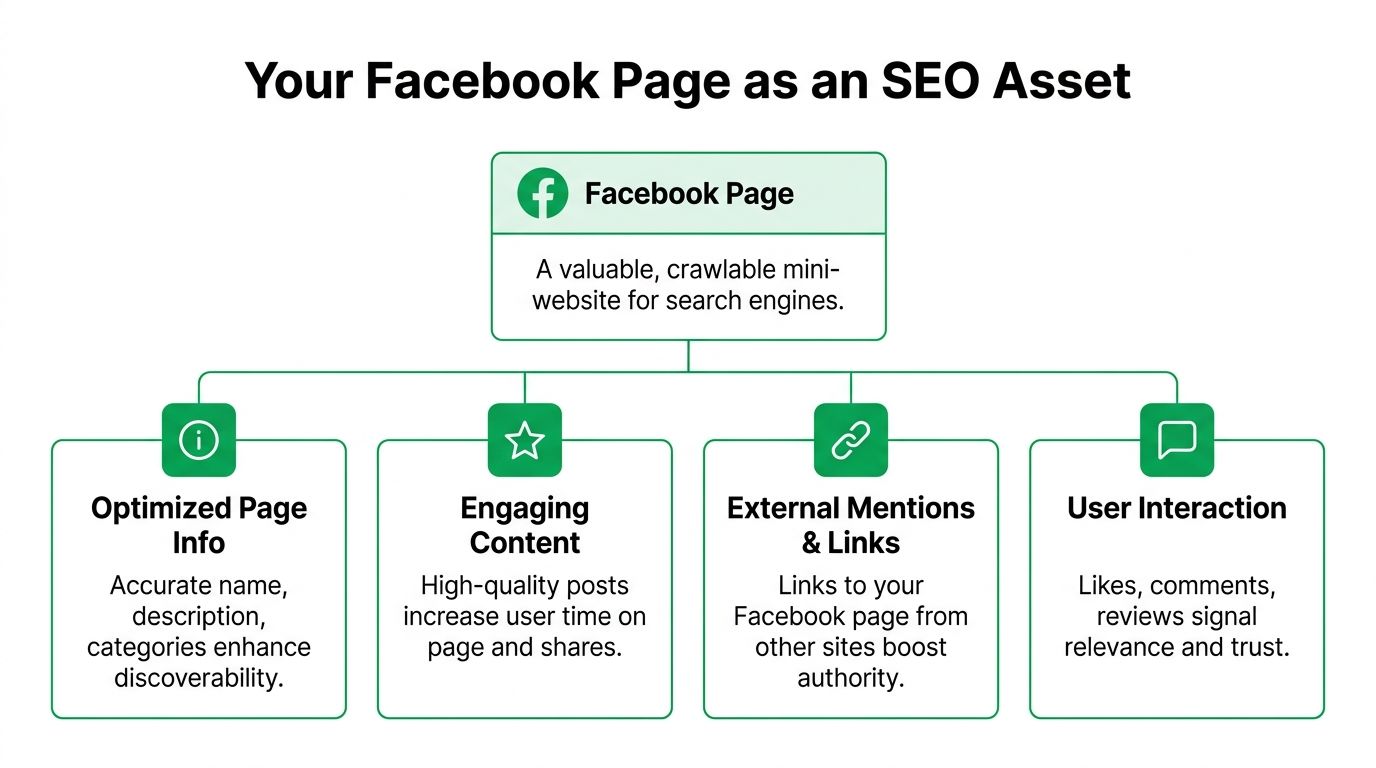
SEO and Facebook: Lay the Groundwork Your Facebook Presence as an SEO Asset
Most Facebook pages are half-finished brochures. A logo, a short bio, maybe an old cover photo, inconsistent business details, and a feed full of disconnected posts.
That setup wastes the page.
Facebook launched on 4 February 2004, surpassed MySpace in global traffic by 2007, and by 2024 business data showed just over 3 billion monthly active users. Meta’s ad planning tools indicated that by January 2025, Facebook ads could reach 2.28 billion people worldwide, equal to 41.1% of internet users (History of Facebook). At that scale, your page is not a side profile. It’s a visible brand asset.
Build the page like it matters
Your Facebook page should support the same search and conversion goals as your website. That starts with consistency.
If you’re a local business, your name, address, and phone number should match your website and Google Business Profile. Not mostly match. Match. Small inconsistencies create avoidable confusion for users and for the broader local search ecosystem.
Your page name and username should also be practical. Don’t stuff them with awkward extra terms. Use the business name people know and search for. Then use the About section to explain what you do, who you serve, and where you operate in plain language.
The checklist worth doing once, correctly
| Element | Optimization Tactic | Why It Matters |
|---|---|---|
| Page name | Use your real brand name with clear business context if needed | Helps users recognize the brand and supports search consistency |
| Username and URL | Claim a clean, branded vanity URL | Makes the page easier to share and reinforces brand identity |
| About section | Describe services, locations, and differentiators in natural language | Gives users and platforms better context |
| Category selection | Choose the closest business categories available | Improves relevance inside Facebook and for profile understanding |
| Contact details | Match NAP details with your site and local listings | Supports local trust and consistency |
| Website link | Send users to the most relevant page, not always the homepage | Improves user path and measurement |
| Visual branding | Align profile image and cover image with your site branding | Reduces friction between channels |
| Reviews and interactions | Encourage real customer engagement and respond promptly | Builds trust signals for new visitors |
SEO and Facebook: Treat content formats as connected, not separate
A useful page isn’t built only through profile fields. It’s built through content architecture.
Say you run a landscaping company. One strong website guide on drainage problems can turn into:
- a Facebook carousel showing common yard grading issues
- a short native video explaining what causes pooling water
- a text post answering a customer question pulled from comments
- a service page update using the same phrasing customers reacted to on Facebook
That is how Facebook starts helping SEO. Not by replacing website content, but by sharpening it.
And if Reels are part of your mix, timing and format matter more than people think. For teams trying to maximize Facebook Reels views, stronger posting habits can help the right content get early traction before you decide what to expand on-site.
One operational note. If more than one person touches your page, set permissions correctly from day one. This guide on adding a manager to a Facebook page is the kind of housekeeping task that prevents access headaches later.
Practical rule: Your Facebook page should answer the same three questions your homepage answers. Who are you, what do you do, and why should someone trust you?
SEO and Facebook: The Content Synergy Loop Repurposing for Both Platforms
The old model was simple. Write a blog post, paste the link into Facebook, hope for clicks.
That still happens. It just doesn’t produce much.
Discovery now depends more on freshness, relevance, and how well a piece of content fits the platform where someone encounters it. In the age of AI search, discovery is increasingly shaped by platform search, content freshness, and social relevance, and reporting tied to Hootsuite’s 2025 trends says Facebook remains a top ROI platform while Meta’s AI recommendations continue increasing content consumption (Elit-Web on Facebook SEO).
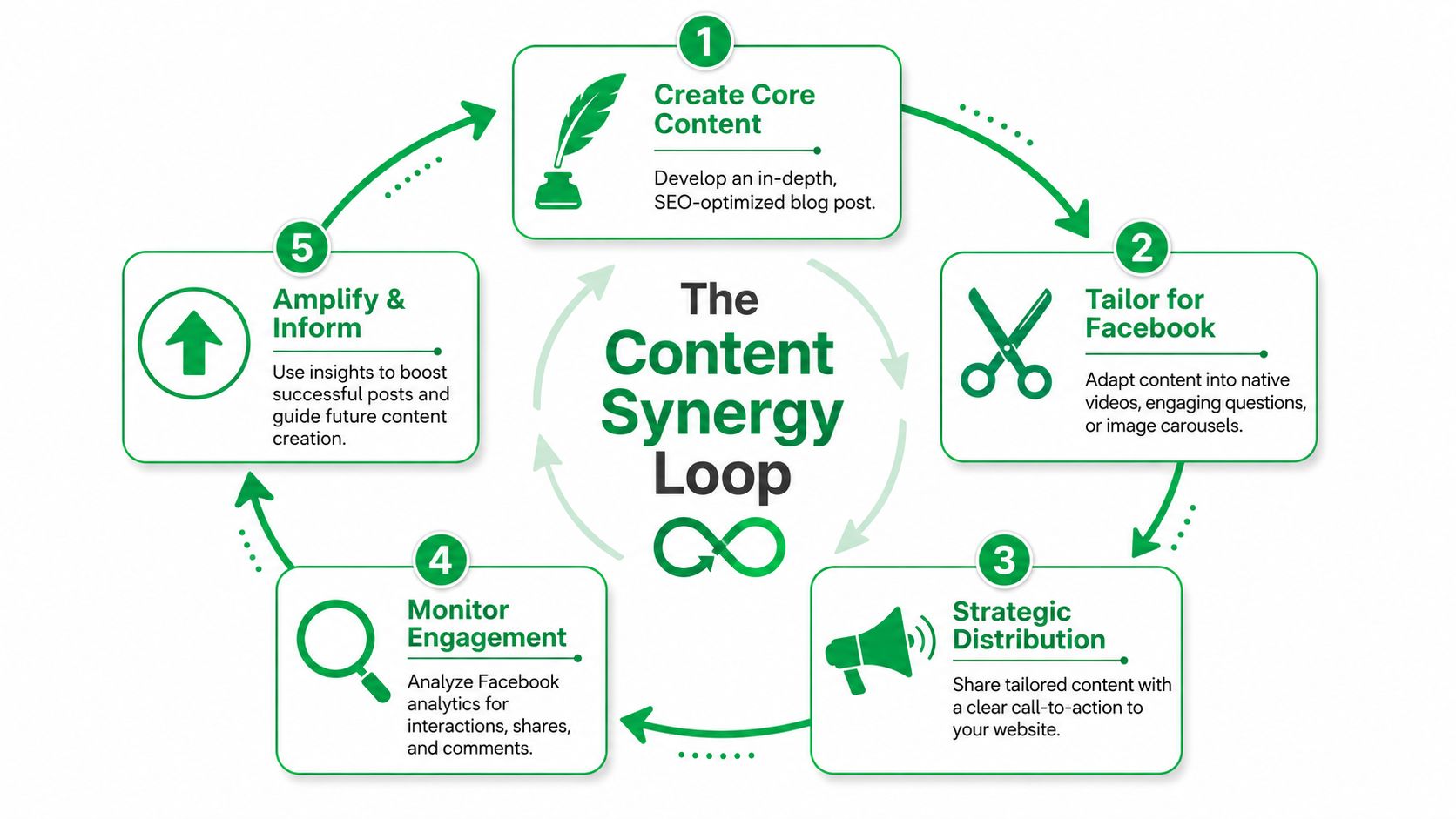
Start with one core idea
A strong content system doesn’t begin with five posts. It begins with one idea that has clear customer intent.
If a dental practice publishes a useful article about emergency tooth pain, that can become a week of Facebook assets:
- a short video on what counts as a dental emergency
- a myth-busting image post
- a poll about common symptoms people ignore
- a staff Q&A clip
- a direct link post to the booking page for urgent visits
The reverse works too. If people keep asking the same question in comments, that question deserves a page on your site.
For teams that need a practical workflow, a step-by-step content system for repurposing can help keep this process organized instead of improvisational.
SEO and Facebook: Make the shared link work harder
When you do share a website link on Facebook, the preview matters. That’s where Open Graph tags come in.
Open Graph tags tell Facebook what title, description, and image to pull into the preview. If they’re missing or sloppy, your post can show the wrong image, a weak headline, or no persuasive context at all. That hurts clicks before the user even thinks about your offer.
Check these basics on every important page:
- OG title: Keep it clear and human. It can match your SEO title, but doesn’t have to.
- OG description: Write for curiosity and clarity, not keyword stuffing.
- OG image: Use a clean branded image that still works on mobile.
- URL consistency: Make sure the canonical page is the one being shared.
Later in the month, review which Facebook posts earned comments and saves. Then compare that against what users searched, clicked, and converted on your site. That feedback loop is where ideas mature.
A documented calendar helps. This guide on how to create a content calendar is a useful framework if your team keeps publishing reactively.
Here’s a quick walkthrough if you want a visual explainer in the middle of planning:
Use UTMs or you’ll guess forever
Don’t share naked links if you’re trying to understand channel impact.
Use UTM parameters consistently so GA4 can separate traffic by source, medium, and campaign. A simple naming structure is enough:
- utm_source=facebook
- utm_medium=social
- utm_campaign=spring_service_promo
- utm_content=video_post or carousel_post
That last field matters. It lets you compare creative angles, not just campaigns.
SEO and Facebook: A Smart Link and Traffic Strategy
Facebook traffic only helps SEO when it lands on pages that deserve more visibility.
That sounds obvious, but plenty of SMBs still send paid and organic social traffic to whatever was published last. Then they judge Facebook by clicks and SEO by rankings, as if the two channels live in separate reports. They do not. The smarter approach is to pick landing pages that can do two jobs at once: convert visitors now and earn more search demand over time.

Scenario one, the local plumber
A plumber does not need broad reach for the sake of reach. The business needs nearby homeowners to trust the company fast enough to call, book, or request a quote.
That changes the traffic plan. Send Facebook visitors to pages tied to clear intent, such as water heater repair, emergency plumbing, drain cleaning, or financing. Pair those links with posts that show recent jobs, answer common homeowner questions, and handle objections before the click.
Useful destinations usually include:
- service pages for high-margin or urgent jobs
- review-focused pages or testimonial sections
- financing or estimate request pages
- blog posts that answer immediate local service questions
If the water heater repair page gets steady Facebook visits and those visitors convert, treat that as a page-level priority. Improve the copy. Add stronger FAQs. Tighten internal links from related service pages. Improve load speed on mobile. And make the page more locally specific, because now you know it can turn attention into revenue.
SEO and Facebook: Scenario two, the online boutique
An online boutique has a different job. It needs to create interest before search intent is fully formed.
Facebook works well higher up the funnel here, but the destination still matters. Category pages, new collection pages, gift guides, seasonal edits, and product education content usually outperform generic homepage links because they match what the post promised. That message match matters more than teams admit.
Good targets often include:
- category pages with clear filters and merchandising
- new collection landing pages
- seasonal gift guides
- product comparison or care content
- editorial pages that support branded and non-branded search demand
A teaser post for a new collection may not produce an immediate sale. It can still do useful work. People click, browse, leave, come back through branded search, and convert later through email or organic search. That is the overlap many attribution models miss.
Build the strategy around pages, not posts
Start with a short list of landing pages that already show one of two signals: they convert well, or they are close to ranking well in search. Those are the pages worth feeding from Facebook.
Then map Facebook content to those pages on purpose:
- trust-building posts to service pages
- problem-solution posts to educational pages
- product teasers to collection or category pages
- seasonal campaigns to gift guides or promotion pages
The workflow becomes practical. Review Google Search Console for pages earning impressions and clicks. Review GA4 for engagement and conversions on those same URLs. Then layer in your UTM-tagged Facebook sessions so you can see which pages attract qualified social traffic, not just traffic volume.
A page that gets Facebook visits, keeps people engaged, and converts deserves more SEO work. A page that gets social clicks and weak on-site behavior probably has a message-match problem, a weak offer, or the wrong audience behind the post.
That is a better operating model than chasing top-line traffic.
Use a simple set of questions:
- Which landing pages attract qualified Facebook visitors?
- Which of those pages produce leads or sales?
- Which pages are already close to stronger organic visibility?
- Where should the next round of SEO updates go?
The point is not perfect attribution. Small and mid-sized businesses rarely get that. The point is making better page decisions with incomplete data, because that is how real teams operate.
And yes, some of this is boring. Clean UTMs, disciplined landing-page selection, and regular page-level review are what let Facebook and SEO amplify each other instead of competing for attention.
SEO and Facebook: Special Tactics for Local and E-commerce Businesses
Local and e-commerce teams shouldn’t run the same playbook. They use the same platform, but the SEO benefit shows up differently.
For local businesses
Local service companies often underrate Facebook features that act like trust multipliers.
Reviews, comments, event activity, and neighborhood-level engagement can strengthen the overall visibility of the brand online. Not because Facebook interactions are a direct ranking shortcut, but because they improve credibility, increase repeat exposure, and often push more people to search the business name directly or compare it against competitors.
Look for signs like:
- more searches for your brand after a promoted local event
- stronger engagement on service pages visited from Facebook
- more calls or form fills after review-heavy post sequences
- recurring questions in comments that should become FAQ content on your site
A roofing company, for example, can turn storm-related Facebook updates into local landing-page visits, then use those patterns to refine service-area pages and emergency repair content.
For e-commerce brands
E-commerce brands tend to overfocus on referral traffic and underfocus on assisted discovery.
Facebook can introduce products, categories, and use cases long before someone searches Google, Amazon, or the brand name itself. Product tagging, collection-focused creative, and educational content can all push shoppers into a later search journey that traditional attribution won’t show cleanly.
What to watch instead:
- rising searches for your brand or product line names
- higher engagement on category pages that Facebook frequently supports
- repeat visits from people who first interacted socially
- stronger conversion behavior on landing pages tied to social campaigns
The importance of branded search lift becomes evident. If more people search your business name after a burst of Facebook activity, that is often more valuable than a small pile of direct social clicks.
And yes, attribution will stay messy. That’s normal. The goal isn’t perfect certainty. It’s better evidence.
SEO and Facebook: Don’t let last-click reporting call the whole game
If you’re only judging Facebook by referral sessions, you’ll undervalue it.
Facebook often assists. SEO often harvests. Those are different jobs. When a local customer sees your work on Facebook and later Googles your business name, or when a shopper discovers a product in-feed and returns through search later, the influence is real even when the analytics path looks incomplete.
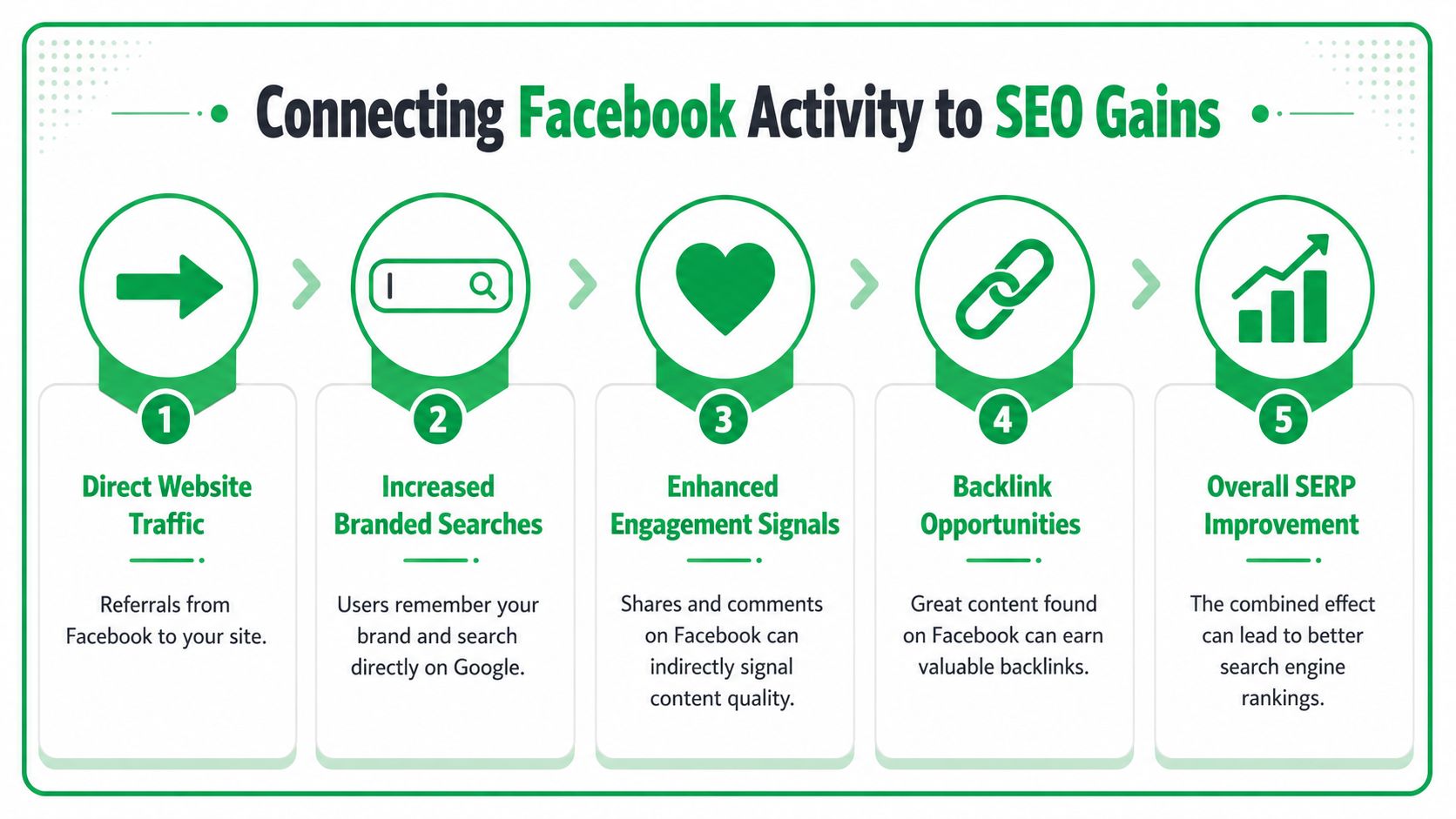
SEO and Facebook: Measuring What Matters Connecting Facebook Activity to SEO Gains
At this juncture, most businesses either get smarter or give up.
Facebook and SEO influence each other, but they rarely hand you a neat last-click report proving it. Privacy changes, zero-click behavior, and cross-device journeys all muddy the trail. The useful move is to build one decision framework that combines branded search lift, landing-page engagement, and platform-native metrics instead of expecting a single source to tell the whole story (Leadenforce on noisy attribution and social influence).
The reporting view that actually helps
Track performance at the page level, not just the channel level.
If Facebook repeatedly sends visitors to a specific service page or buying guide, compare that page’s behavior against pages that get search traffic without social support. You’re looking for patterns:
- higher engagement from socially introduced visitors
- more branded searches after a content push
- stronger conversion behavior on pages that receive both search and social visibility
- repeat assisted journeys, even if the final conversion arrives another way
SEO and Facebook: Five questions worth asking every month
- Which landing pages got Facebook traffic?
Not the homepage. The actual pages. - Did those pages convert or at least move users deeper?
If not, the page may be the problem, not the post. - Did branded search activity improve after the campaign window?
Search Console is useful here. - What kind of post created the best downstream behavior?
Native video, customer proof, educational clip, link post, and so on. - Which topics deserve more SEO investment now?
The answer should come from audience behavior, not editorial instinct alone.
Common implementation questions
One useful standard: Don’t optimize Facebook or SEO in isolation if both channels touch the same landing pages.
- Should I judge Facebook by CTR or CPC?
Not by themselves. Those are operational metrics, not business outcomes. - Should I optimize SEO for impressions first?
Not without conversion context. A page that attracts the wrong visitor can still look busy in reporting. - What if attribution is incomplete?
It always is. Use comparative evidence across branded search, landing-page behavior, and platform metrics. - How often should I review this?
Monthly is usually practical. Fast enough to catch trends, slow enough to avoid overreacting.
If your team needs a more structured reporting model, this resource on how to measure marketing campaign effectiveness is a practical starting point. Agencies like Mr. Green Marketing, LLC also build reporting across SEO, PPC, and social, which is useful when the same pages serve multiple channels and no single dashboard tells the full story.
Frequently Asked Questions on SEO and Facebook
A few questions always come up once businesses start trying to connect SEO and Facebook in one system.
Quick answers that save time
| Question | Short Answer |
|---|---|
| Does Facebook directly improve Google rankings? | Not in a simple one-to-one way. It helps most through discovery, demand creation, and content distribution. |
| Should I post every blog article on Facebook? | No. Repackage the strongest ideas first and tailor them to the platform. |
| Are Facebook page likes an SEO metric? | Not really. They can signal audience interest, but they aren’t a reliable SEO KPI on their own. |
| Should local businesses care more about reviews or posts? | Both matter, but review quality and consistency usually have longer-lasting trust value. |
| Can Facebook ads help SEO? | Indirectly, yes. They can increase reach, branded search, and landing-page data you can use for SEO prioritization. |
| What’s the biggest mistake with SEO and Facebook? | Treating them as separate teams, separate goals, and separate reports. |
| Should I send Facebook traffic to the homepage? | Usually no. Send it to the page that matches the post’s promise. |
| What content works best across both channels? | Content tied to clear customer questions, strong intent, and strong page-level relevance. |
A few direct answers
Is Facebook still worth it for SEO-minded businesses?
Yes, if you use it as a discovery and validation channel instead of a link dump.
What should I measure first?
Start with UTM-tagged landing-page traffic, page engagement, conversions, and any change in branded search behavior.
What if my Facebook traffic is low?
That doesn’t automatically mean Facebook has no value. Look for assisted influence, not just referral volume.
Do I need ads for this to work?
No. Paid social can accelerate testing and reach, but the operational logic is the same. Useful content, strong landing pages, and disciplined tracking.
What if I’m short on time?
Then simplify. Pick one high-intent page, one strong topic, one Facebook format, and one monthly review cycle. Small systems beat inconsistent ambition.
The practical takeaway is simple. SEO captures intent. Facebook can create and shape it. When you connect the two around real landing pages and real business outcomes, your reporting gets clearer and your content starts pulling in the same direction.
If you want help turning SEO and Facebook into one measurable growth system, Mr. Green Marketing, LLC can help map the channel overlap, audit your landing pages, and build a plan around search visibility, social distribution, and conversion tracking without treating them as separate silos.
Leave a Comment
sing in to post your comment or sign-up if you dont have any account.