
Best Digital Marketing Agency: You’re probably doing what most San Francisco buyers do first. Open a browser, search digital marketing agency san francisco, click a few “top agency” lists, and end up with fifteen tabs that all sound weirdly similar.
Every agency says it’s data-driven. Every agency says it’s focused on results. Every agency says it understands growth.
That doesn’t help much.
The main problem usually isn’t lack of options. It’s lack of a decision framework. A local service business that needs booked calls has a different definition of success than a startup trying to shape category awareness. An ecommerce brand trying to improve paid acquisition and marketplace sales needs a different operator than a company rebuilding a site and brand from the ground up.
And that’s where most articles miss. They answer “who’s top-rated?” when the better question is “who is built for the way my business grows?” That distinction matters even more now because specificity wins attention, and boutique, strategy-led agencies can outperform larger vendors when a business needs custom execution and faster iteration, as noted by Clutch’s San Francisco agency coverage. If you want a broader local selection lens too, this guide to the best digital marketing agency near me is a useful companion.
So You Need a Digital Marketing Agency in San Francisco. Now What?
Start by ignoring the word “best.”
That word pushes buyers into the wrong mindset. You don’t need the agency with the loudest profile. You need the one whose operating model fits your sales cycle, margin structure, traffic sources, and internal team.
Start with the business model, not the agency pitch
A lot of owners shop by service list. SEO, PPC, social, web design, branding, Amazon. Fine. But a long menu doesn’t tell you whether the agency knows how to solve your actual problem.
Use these questions first:
- Need leads fast: Are you trying to fill pipeline this quarter, not “someday”?
- Need a stronger organic base: Are you too dependent on paid traffic or referrals?
- Need better conversion from existing traffic: Is your site getting visits but not enough calls, forms, or purchases?
- Need channel expansion: Are you selling well in one place and trying to add search, social, or marketplace growth?
- Need brand clarity: Do prospects understand what you do and why you’re different?
An agency can be talented and still be wrong for you. That happens all the time.
Practical rule: Choose for fit under pressure. Ask who can operate well inside your current constraints, not who looks polished in a deck.
Best Digital Marketing Agency: Know what kind of partner you want
Some San Francisco agencies are built for large retainers, layered approvals, and multi-stakeholder reporting. Others move faster, test faster, and stay closer to execution. Neither is automatically better.
But they are different.
If you have a lean team, a complex approval-heavy agency can slow everything down. If you’re managing several channels and multiple business units, a tiny shop may struggle with workflow, reporting cadence, or specialization depth.
A useful shortlist usually includes agencies that match at least three things:
- Your growth stage
- Your primary revenue motion
- Your tolerance for testing and change
That last one gets overlooked. Some companies want aggressive iteration. Others need stable process and fewer moving parts. Be honest about that before the first call.
Don’t confuse visibility with fit
Directory visibility, awards, and polished branding can signal competence. They do not tell you how an agency thinks when performance stalls, tracking breaks, landing pages underperform, or leadership wants answers by Friday.
That’s the actual job.
Best Digital Marketing Agency: Decoding the San Francisco Digital Marketing Scene
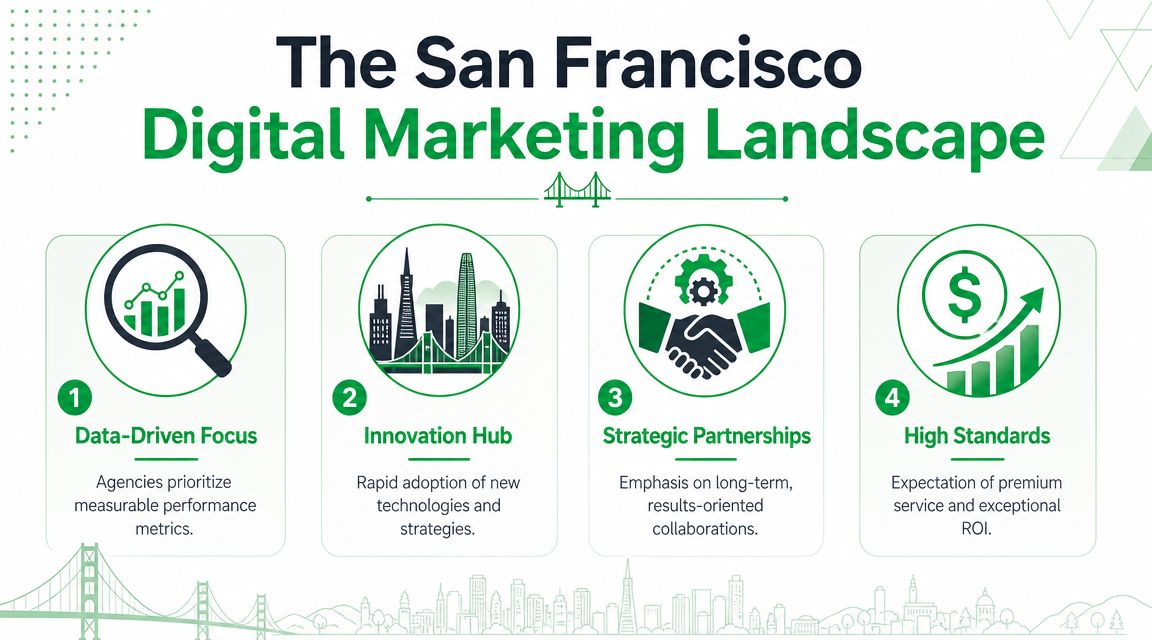
San Francisco isn’t just another agency market. Buyers here tend to expect stronger instrumentation, tighter attribution logic, and more fluency across channels.
That’s mostly a good thing for clients.
According to Alliance Interactive’s San Francisco digital marketing agency page, San Francisco is a recognized hub for data-driven digital marketing agencies, with many firms positioning themselves around measurable disciplines like SEO, PPC, and analytics. That reflects a market where agencies are judged less on creative theater alone and more on outcomes like lead generation and return on ad spend.
What that means for you as a buyer
In practical terms, the average serious agency conversation in San Francisco should get into details quickly. Not vague “awareness” talk for thirty minutes.
You should expect discussion around:
- Measurement: How conversions are defined, tracked, and attributed
- Channel interaction: How paid search, SEO, content, and paid social support each other
- Testing discipline: What gets prioritized first and why
- Commercial impact: How campaign work ties back to leads, sales, or efficiency
If an agency can’t talk clearly about those things, it’s out of step with the market it claims to serve.
Best Digital Marketing Agency: The market has range, and that changes the buying process
San Francisco has everything from boutique specialists to larger performance firms. That range is useful, but it also makes comparison harder because two agencies can both call themselves “full service” and mean very different things.
One might be excellent at paid media and passable at web strategy. Another might build strong websites and content systems but rely on partners for advanced media buying. Another might be integrated and able to connect creative, analytics, paid acquisition, and conversion work under one operating rhythm.
So don’t ask only, “What services do you offer?”
Ask better questions:
- Who owns strategy?
- Who executes?
- What happens when one channel underperforms?
- Do you solve issues inside the website too, or only buy traffic?
- Can your team connect reporting across search, social, landing pages, and analytics?
The strongest agency relationships in this market usually look less like outsourcing and more like shared operating cadence.
Why San Francisco buyers should use the market’s standards to their advantage
A data-heavy market creates advantage for clients who know what to ask. You can demand clearer reporting. You can ask for cleaner definitions of success. You can challenge vanity metrics early.
And you should.
A credible digital marketing agency san francisco partner doesn’t hide behind impressions, broad traffic charts, or “brand lift” language when the business goal is qualified pipeline. They should be able to explain what moved, why it moved, and what gets adjusted next.
That’s the standard here. Or it should be.
Best Digital Marketing Agency: What Services Do You Actually Need?
Most agency proposals get bloated because the buyer hasn’t isolated the problem. So the agency sells a bundle.
That’s expensive, slow, and often unnecessary.
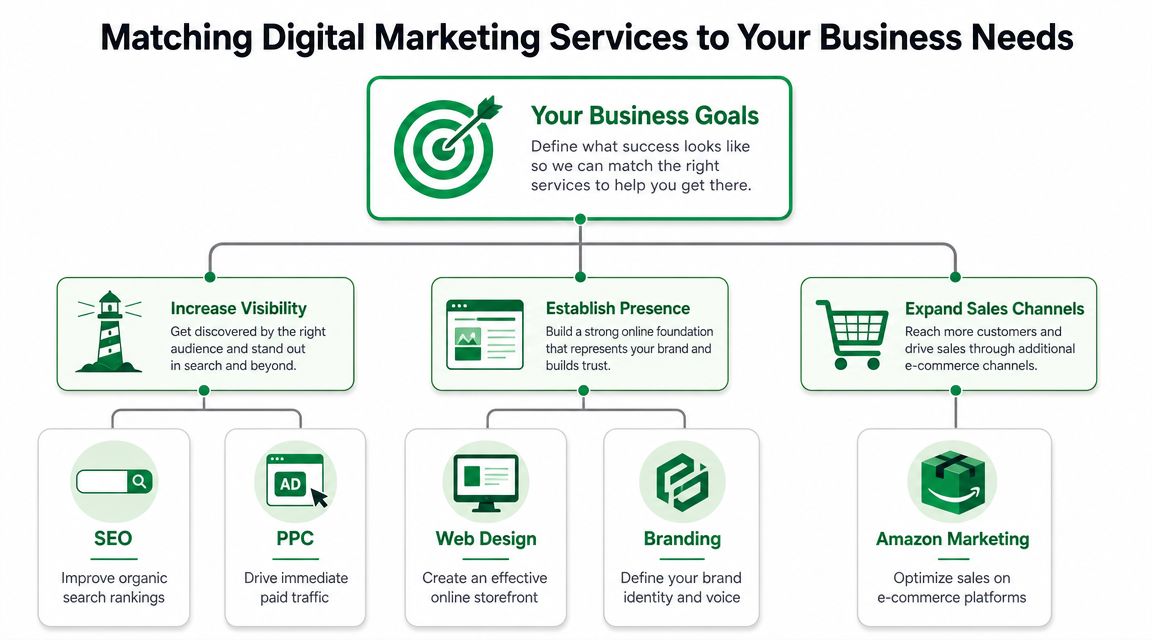
A better approach is simple. Match the service to the job that needs doing right now.
If the problem is demand now
Use PPC when you need immediate demand capture. That’s usually the right move when sales needs meetings quickly, seasonality matters, or you need to validate offers and landing pages before investing deeper elsewhere.
Per MacroHype’s San Francisco page, SEO typically takes 3 to 6 months to show significant ranking and traffic improvement, while PPC can produce results almost immediately. That’s one of the most important planning realities in digital marketing. If a buyer expects SEO to behave like paid media, the relationship starts with the wrong expectations.
PPC is especially useful for:
- Local service providers: High-intent search capture
- B2B firms: Controlled testing of offer pages and lead forms
- New sites: Traffic generation before organic visibility develops
Best Digital Marketing Agency: If the problem is long-term visibility
Use SEO when you want to build an asset, not just rent attention.
SEO makes sense when your buyers search consistently, your services have definable demand, and your site can support content, technical improvements, and conversion-focused page structure. It usually works best when paired with strong analytics, clean page targeting, and patience.
That last part matters. A lot.
Don’t judge SEO by week-one movement. Judge it by whether the site is getting technically healthier, pages are aligning better to intent, and qualified visibility is compounding over time.
If the problem is conversion, not traffic
Sometimes the issue isn’t acquisition. It’s what happens after the click.
That points to web design, landing page optimization, stronger messaging, cleaner forms, faster page flow, better calls to action, and less friction. Teams often waste money scaling media before they’ve fixed the page experience.
If your ads are driving traffic but conversion quality is poor, don’t buy more clicks yet.
Fix the path first.
If the problem is brand confusion
Use branding when the market doesn’t understand your offer, your visuals feel inconsistent, or sales conversations keep starting with basic clarification. Branding is not decoration. It affects ad performance, conversion rates, trust, and pricing power.
For younger companies and repositioning efforts, it can be foundational.
If the problem is channel expansion
For sellers moving into marketplaces, Amazon marketing or marketplace-specific management can matter more than another round of generic social content. Different channel, different mechanics.
And if outbound support is part of the plan, your team should also build a winning outreach strategy that complements paid and organic acquisition rather than running in a silo.
Best Digital Marketing Agency: A simple way to choose
Use this quick filter:
| Business situation | Primary service to discuss first | Why |
|---|---|---|
| Need inquiries quickly | PPC | Fast demand capture and testing |
| Need compounding visibility | SEO | Long-term search presence |
| Getting traffic but weak conversion | Web design or CRO work | Improves performance of existing traffic |
| Repositioning or launching | Branding plus website | Clarifies market perception |
| Expanding marketplace sales | Amazon marketing | Channel-specific optimization |
If an agency can’t help you narrow scope before selling more scope, be careful.
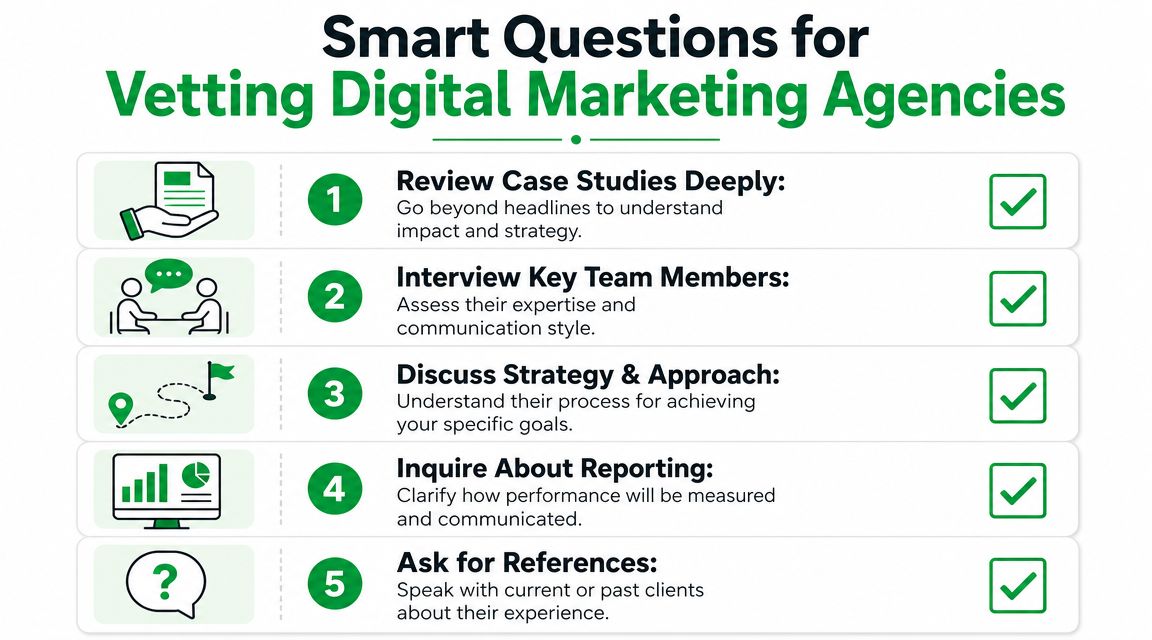
Best Digital Marketing Agency: Your Vetting Process A Checklist for Smart Questions
Once you’ve got a shortlist, stop judging mostly by portfolio screenshots.
A good-looking homepage mockup tells you almost nothing about the day-to-day quality of an agency relationship. What matters is how they diagnose, prioritize, report, and adapt.
According to Verbsz Marketing’s San Francisco agency page, a practical agency workflow starts with a diagnostic audit of infrastructure and existing data, then turns that into a customized plan. It also notes that some agencies provide clients with an online portal for project status and analytics, which is exactly the kind of transparency buyers should look for.
Ask how they start, not how they sell
If an agency jumps straight to tactics before reviewing your setup, that’s a problem. They’re prescribing before diagnosing.
Ask these directly:
- What do you review in the first audit?
- How do you establish a baseline before launching work?
- What data access do you need from us?
- How do you separate technical issues from messaging or media issues?
You want clear answers around analytics, ad history, technical site issues, conversion tracking, page performance, and campaign inheritance. Not hand-waving.
Ask what reporting actually looks like
A lot of agencies say they’re transparent. Fewer show you the actual reporting format before you sign.
Request a walkthrough. Better yet, ask them to narrate the report like they would on a client call.
Look for these things:
- Clarity: Can a non-specialist understand what changed?
- Attribution discipline: Do they explain what likely drove movement?
- Action orientation: Does the report lead to a next-step decision?
- Channel connection: Can they show how SEO, PPC, and landing page changes relate?
If you want a deeper framework for interview questions and evaluation criteria, this guide on how to choose a digital marketing agency is useful to keep open during discovery calls.
Good reporting doesn’t just summarize activity. It helps you decide what to do next.
Best Digital Marketing Agency: Ask who does the work
This one gets skipped too often.
The strategist in the sales call may not be the person touching your account. Ask who owns the relationship, who handles execution, who checks performance, and how often senior review happens.
Then ask one more thing. What happens when the initial plan doesn’t work?
That answer tells you a lot. Strong teams talk about iteration, hypotheses, prioritization, and trade-offs. Weak teams talk in generalities.
A shortlist checkpoint
Before moving forward, make sure you can answer yes to most of these:
- They insist on a baseline audit
- They can explain reporting in plain English
- They connect work to business outcomes
- They’ve defined who is accountable
- They sound specific under pressure
If those pieces aren’t in place, don’t count on the relationship getting clearer after the contract is signed.
Best Digital Marketing Agency: Understanding Pricing Models and Spotting Red Flags
Pricing feels murky because agencies package risk differently. One wraps it into a monthly retainer. Another prices a project. Another tries to tie fees to performance.
None of those models is automatically wrong. The issue is whether the model fits the work.

San Francisco is also not a beginner market. NevoLearn’s roundup of San Francisco agencies points to many notable firms founded around 2012, including Metric Theory and Barrett Hofherr, and ties the city’s agency growth to the rise of performance disciplines like SEM, paid social, and analytics-driven optimization. In a market that mature, sloppy reporting, vague process, or amateur execution should stand out immediately.
Common Digital Marketing Agency Pricing Models
| Pricing Model | Best For | Payment Structure | Pros | Cons |
|---|---|---|---|---|
| Monthly retainer | Ongoing SEO, PPC, multi-channel support | Recurring monthly fee | Predictable cadence, continuous optimization, easier planning | Can feel expensive if scope is vague |
| Project fee | Website redesigns, brand work, audits, one-time builds | Fixed fee for defined scope | Clear deliverables, easier budgeting, good for contained work | Less flexible when priorities shift |
| Performance-based compensation | Certain lead gen or tightly defined acquisition work | Fee tied to agreed performance outcome | Aligns incentives in theory | Can create reporting disputes or short-term decision making |
Best Digital Marketing Agency: What works and what doesn’t
A retainer works when the work is iterative. SEO, PPC, CRO, and analytics usually benefit from ongoing review because the inputs keep changing.
A project fee works when the deliverable is bounded. Site rebuild, tracking cleanup, messaging framework, visual identity. Cleaner. Easier to govern.
Performance pricing sounds attractive, but it can get messy fast. If tracking is weak, sales attribution is disputed, or lead quality is subjective, the model creates conflict instead of alignment.
And if video is part of your content mix, make sure the agency understands distribution mechanics too, not just production. A practical reference on optimizing YouTube videos for growth can help you separate teams that know video strategy from teams that just make assets.
Red flags that should slow you down
Not every bad fit looks dramatic. Some are subtle.
- Guaranteed rankings: No credible agency should guarantee a specific Google position.
- Vanity-heavy reports: Lots of charts, little commercial meaning.
- Instant certainty: They know the answer before seeing your accounts, site, or tracking.
- Pressure tactics: Discounts “if you sign today” or urgency without diagnosis.
- Black-box execution: They won’t explain methods, ownership, or reporting cadence.
- Channel siloing: Paid team blames the site, SEO team blames content, nobody owns the system.
A quick video can also help sharpen your instincts on agency evaluation:
One sanity check before signing
Ask the agency to explain, in plain language, what they’d do in the first month if they found:
- weak conversion tracking
- expensive paid traffic with poor lead quality
- decent traffic but weak form conversion
- technical SEO issues on key pages
If the answer sounds generic, the work probably will be too.
Next Steps From Audit to Action
By this point, the choice should feel less fuzzy.
You’re not hiring a logo, a ranking, or a directory listing. You’re hiring a team to diagnose the actual bottlenecks in your growth system and then act on them in the right order. Sometimes that means fixing tracking before traffic. Sometimes it means using paid search to capture demand while organic visibility develops. Sometimes it means rebuilding pages before scaling spend.
The sequence matters.
Start with diagnosis
The most practical first move is an audit. Not a fluffy “marketing review,” but a real baseline of what’s happening across site performance, conversion paths, search visibility, paid account structure, and messaging friction.
If you want to prep internally before talking to agencies, a step-by-step social audit is a useful example of how to review one channel methodically. The same discipline applies across search, paid media, and web conversion.
For businesses that want an outside review, digital marketing audit services are the logical place to begin. Mr. Green Marketing, LLC offers audits and performance reports focused on visibility gaps, quick wins, and channel-specific priorities across web, SEO, PPC, Amazon, and branding work.
The right first deliverable from any agency isn’t a promise. It’s a diagnosis you can use.
What to do this week
Keep it simple:
- Write down the main growth problem
- Choose the channel question that matters most right now
- Shortlist agencies by fit, not fame
- Ask for audit process, reporting examples, and team structure
- Don’t sign before you understand how success will be measured
That’s how you avoid buying motion instead of progress.
If you want a clearer starting point, Mr. Green Marketing, LLC can review your current digital presence and provide a free audit and performance report so you can see what’s holding back growth, what to fix first, and whether a strategy-led agency partnership makes sense for your business.
Leave a Comment
sing in to post your comment or sign-up if you dont have any account.