
Public Relations Strategy: You’ve built the business. The products are live, the site is working, the Amazon listings are dialed in, and paid traffic is bringing in some demand. But when buyers look around the market, your competitors keep showing up in articles, podcasts, roundup posts, and industry conversations. You know your brand belongs there too.
That gap usually isn’t a product problem. It’s a public relations strategy problem.
A lot of SMB owners treat PR like a one-off stunt. Send a press release, hope someone bites, move on. That’s not how it works when you need consistent visibility that also supports SEO, paid media, and marketplace sales. Good PR is a system. It gives your business a repeatable way to shape perception, earn trust, and create assets your whole marketing stack can use.
Public Relations Strategy: So You Know You Need PR But Where Do You Start
A typical starting point looks like this. A founder says, “We need press.” An ecommerce owner says, “Our competitors keep getting mentioned.” An Amazon seller says, “People buy the brand they recognize, and we’re not visible enough yet.” All true. Still too vague.
PR gets less mysterious when you stop thinking of it as publicity and start thinking of it as coordinated influence. That sounds lofty, but it’s been true for a long time. In 1917, President Woodrow Wilson’s Committee on Public Information used 20,000 posters and 75,000 volunteer speakers to shape public opinion at scale, a reminder that aligned messaging across channels can move perception in measurable ways, as documented by the PR Museum timeline on the CPI.

That historical example matters because the core lesson hasn’t changed. PR works when the message, audience, and channels match the business goal. Not when you blast generic news to everybody.
What PR looks like for a smaller business
For an SMB, a public relations strategy usually starts with a simpler question. What do you need the market to believe about you?
Maybe it’s that your product is the premium option. Maybe it’s that your local service business is the safest choice. Maybe it’s that your Amazon brand isn’t just another reseller and has expertise behind it. Those positioning choices shape everything that follows.
A useful way to frame this is alongside broader market planning. If you’re tightening your audience, offer, and launch path, this practical guide to GTM framework is a solid companion read because PR works best when it supports a clear go-to-market motion instead of floating off on its own.
Practical rule: If you can’t explain why a media mention should matter to revenue, trust, or search visibility, you’re not ready to pitch yet.
Public Relations Strategy: Start with a playbook, not a press release
The businesses that get traction usually do three things early:
- They define the narrative: They know the one or two themes they want associated with the brand.
- They choose the right proof: Customer patterns, founder expertise, product insight, and market observations all work better than chest-thumping.
- They build repeatability: They don’t rely on a single launch or announcement.
That’s the shift. PR stops feeling like a black box once you treat it as an operating system for attention and credibility. And when that system is built correctly, it doesn’t just earn coverage. It feeds search, remarketing, conversion copy, sales conversations, and Amazon trust signals too.
Public Relations Strategy: Define Your PR Goals and Tangible KPIs
“Get press” is not a strategy. It’s a wish.
If you start there, you’ll end up celebrating coverage that doesn’t help the business. A feature in the wrong publication might look nice in a deck and do almost nothing for qualified traffic, branded search, or buyer trust. That’s why the first real job is tying PR to a business outcome.
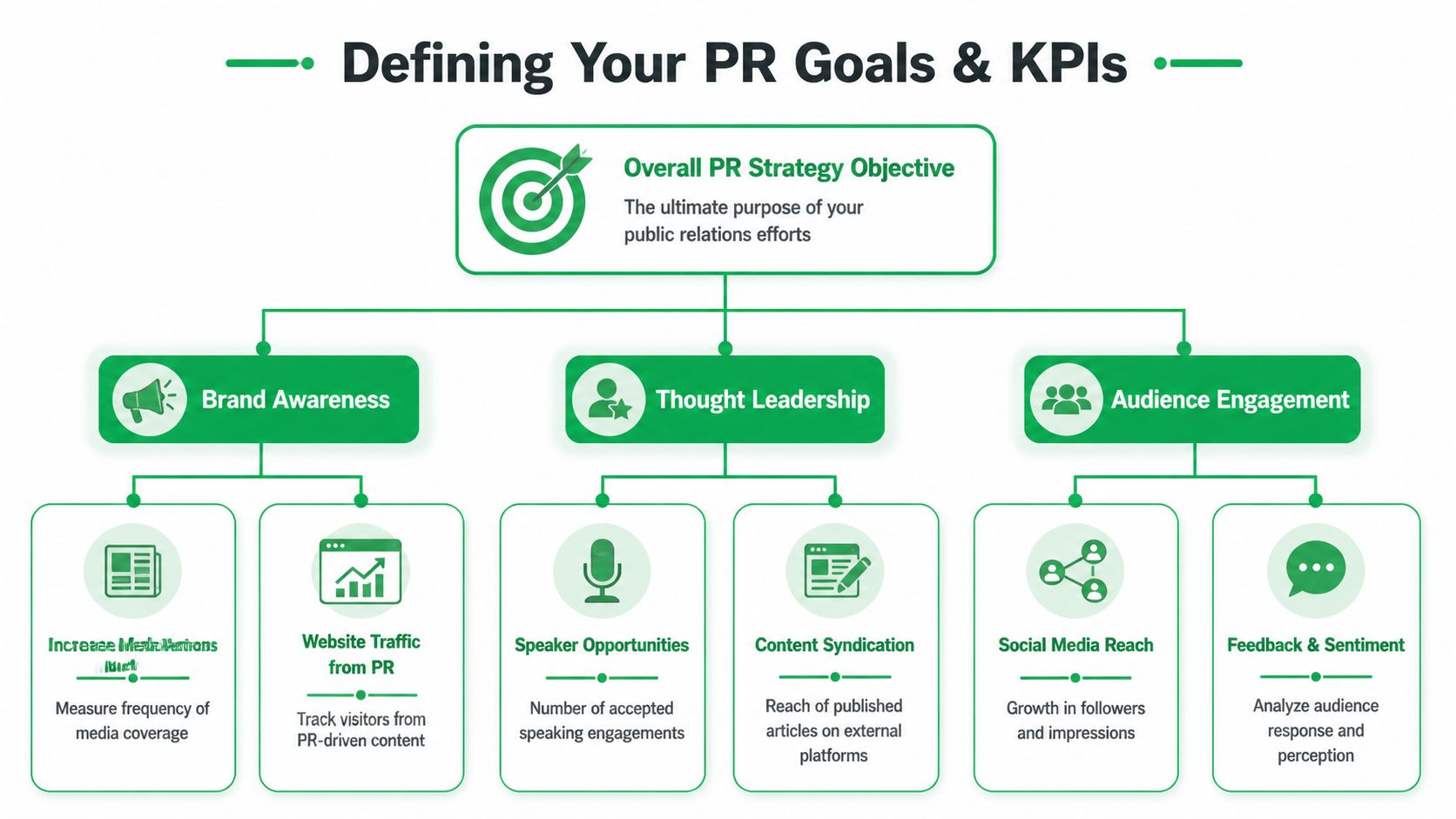
A better starting point sounds like this:
- We need more branded demand for our DTC store.
- We need stronger trust signals before shoppers convert on Amazon.
- We need earned mentions that support SEO and make paid traffic work harder.
- We need authority in a niche so sales calls start warmer.
Those are usable goals because they point to business impact.
Match PR goals to business outcomes
Here’s a practical way to consider it:
| Business priority | Strong PR goal | KPI direction to track |
|---|---|---|
| Ecommerce growth | Earn coverage that sends qualified visitors | Referral traffic, assisted conversions, product page visits |
| Amazon sales support | Build third-party trust around the brand | Branded search, conversion lift after placements, review quality trends |
| SEO authority | Earn relevant mentions and links | Referring domains, rankings for target topics, organic landing page performance |
| Founder-led growth | Position leadership as a reliable source | Podcast invites, interview requests, speaking opportunities |
Notice what’s missing. “Impressions.” “Buzz.” “Awareness” with no business context. Those can matter, but they’re supporting indicators, not the destination.
Public Relations Strategy: Use a data-first planning method
The strongest campaigns usually begin with internal evidence. Sales trends, customer service tickets, repeat buyer questions, and market patterns often contain better story material than a generic company announcement. Data-backed planning matters because PR campaigns that begin with specific data goals achieve 31% better results, while data-driven storytelling can boost engagement by 47% and secure 2.5x more media placements, according to the 2023 PRSA benchmarks summarized here.
That changes the workflow. Instead of asking, “What can we announce?” ask, “What can we prove?”
A practical framework looks like this:
- Audit what you already know. Pull sales patterns, customer objections, review themes, and category questions.
- Find the gap. If you need stronger proof, collect original data or organize existing data into a cleaner point of view.
- Define measurement early. Decide what success looks like before the first pitch goes out.
- Build story angles around the evidence. Journalists and hosts need a sharp angle, not a company brochure.
- Track what happens after exposure. Coverage is the start of measurement, not the end.
If you want a broader planning template to pressure-test your process, these strategic planning process steps are useful because they force discipline before execution.
The KPI should answer one question: did this attention move the business closer to trust, demand, or revenue?
Good KPIs for SMB PR
A small business doesn’t need a giant reporting stack. It needs a few metrics that connect visibility to action.
- Referral traffic quality: Not just visits. Look at time on site, landing page behavior, and whether visitors move toward product or contact pages.
- Branded search movement: If more people search your brand after coverage, your message is sticking.
- Assisted conversions: PR often helps buyers trust you before they purchase through another channel.
- Sales enablement value: A mention in a respected publication can improve close rates even when the click path is messy.
- Marketplace credibility: On Amazon, external authority can support conversion by reducing “Who is this brand?” hesitation.
Weak KPI setups usually fail for one of two reasons. Either the business never defined what PR was supposed to do, or the team measured vanity metrics because they were easier to report. Neither helps you decide what to repeat.
Public Relations Strategy: Know Your Audience and Craft Your Story
Most weak PR falls apart before the pitch is written. The brand doesn’t really know who it needs to influence, so it writes a broad message for “everyone” and gets ignored by almost everyone.
Your audience is rarely just customers. It may include editors, podcast hosts, newsletter writers, industry communities, local stakeholders, creators, and existing buyers who will repeat your message if it sounds credible. Different people need different proof.

One business can need several stories
Take an Amazon-focused brand selling in a crowded category. A journalist may care about a category trend. A podcast host may care about the founder’s contrarian view on margin pressure or marketplace complexity. A customer may care whether the product solves a real problem better than alternatives. A local news outlet may care about the company’s community angle or growth story.
Same business. Different story packaging.
That’s why generic key messages don’t travel well. You need story angles that fit the recipient.
A simple way to organize this is below:
| Audience | What they care about | Story angle that fits |
|---|---|---|
| Trade journalist | New information and category context | Original market insight or trend interpretation |
| Podcast host | Strong opinions and usable expertise | Founder perspective with examples and clear takeaways |
| Customer | Risk reduction and confidence | Proof, credibility, and why your approach is different |
| Local community | Trust and responsiveness | Transparency, involvement, and reputation management |
Public Relations Strategy: Find stories in the business you already run
Strong narratives usually come from places owners overlook:
- Customer friction: What keeps coming up in support tickets, reviews, or pre-sale questions?
- Operational insight: What have you learned from selling, fulfilling, or competing that others haven’t explained well?
- Category myths: What does your market keep getting wrong?
- Founder experience: Not the polished bio. The hard-earned perspective.
For digital founders and niche operators, this strategy for digital product entrepreneurs is useful because it pushes thought leadership beyond “post on LinkedIn more” and into actual market positioning.
There’s also a branding layer here. If you’re struggling to sharpen what the market should remember about you, this piece on how to improve brand awareness helps connect consistency, message repetition, and visibility.
Why audience depth matters in a crisis
This isn’t only about proactive pitching. It matters even more when something goes wrong.
A local service brand dealing with a review spiral has multiple audiences at once: unhappy customers, potential customers, local community members, staff, and maybe the platform where the backlash is spreading. For 68% of SMBs that face local reputation crises like review meltdowns, rapid-response playbooks and stakeholder micro-relationships can outperform traditional journalist outreach by 28% in containment speed, according to this report summary on SMB reputation response.
That’s a useful reality check. Sometimes the right PR move isn’t “contact the media.” It’s “address the people closest to the problem first.”
A short explainer on message discipline helps here:
If the audience has to work to understand why your story matters, they won’t do the work for you.
Build a story bank before you need it
Smart teams keep a small internal file with ready-to-use material:
- Three core themes the brand wants to own
- Proof points that support each theme
- Founder talking points for interviews and podcasts
- Fast-response statements for common objections or reputation hits
- Examples and mini case notes that don’t rely on hype
That way, when an opportunity appears, you’re shaping the conversation instead of scrambling to invent one.
Public Relations Strategy: Build Your Outreach and Content Machine
At this stage, public relations strategy either becomes a repeatable asset or dies as a pile of half-finished ideas.
Most SMBs don’t need a giant media list. They need a tight workflow. A handful of relevant contacts, strong pitch angles, and a small library of usable content will outperform random outreach every time. And yes, “spray and pray” still fails.

Build a focused contact list
Start small. If you sell into a niche, there are usually only a limited number of journalists, editors, podcasts, newsletter writers, and creators who matter.
Don’t build your list around fame alone. Build it around audience fit.
A practical contact list includes:
- Core media targets: The people who already cover your category, customer problem, or business model.
- Secondary amplifiers: Newsletter operators, niche podcasts, and creators with trusted audiences.
- Reactive opportunities: Publications or platforms that regularly seek expert commentary.
- Local or regional outlets: Especially useful for service businesses, retail, and founder stories with community relevance.
For each contact, keep notes on what they cover, the language they use, and which angles they seem to prefer. That’s more valuable than a huge spreadsheet with no context.
Public Relations Strategy: Create content that gives outreach a reason to exist
Outreach works better when it has fuel behind it. That fuel isn’t always a press release.
For SMBs and ecommerce brands, the most useful PR content formats often include:
| Format | Best use | Why it works |
|---|---|---|
| Byline article | Thought leadership in trade media | Lets you explain a point of view with more depth |
| Expert commentary | Reactive media opportunities | Fast to produce and easy for reporters to use |
| Podcast talking points | Founder visibility | Builds trust through voice and experience |
| Data summary or mini-report | Category authority | Gives media something concrete to reference |
| Press release | Actual news only | Useful when there is a real announcement |
That last point matters. Press releases still have a role. They just don’t deserve center stage unless you have actual news.
Build a weekly rhythm
A machine works because the parts repeat. One simple cadence is enough for most smaller teams.
- Early week: Review category news, customer feedback, and internal insights.
- Midweek: Draft one strong pitch angle and one owned content asset that supports it.
- Late week: Send targeted outreach, then repurpose the same core idea for blog, email, social, or sales enablement.
Content and PR cease to compete, instead beginning to reinforce each other. If you need a practical content foundation to support that loop, this guide to content marketing best practices pairs well with a PR workflow because it helps you turn earned-media ideas into reusable owned assets.
Field note: A weak pitch usually isn’t a writing problem. It’s an angle problem.
Public Relations Strategy: What works and what wastes time
Some patterns are worth repeating. Others just eat calendar space.
What usually works
- Specific angles: “What we’re seeing in returns data” beats “We’re excited to share our growth story.”
- Tight relevance: Pitching the person who already covers your space.
- Quoted expertise: Short, usable commentary that can be dropped into an article.
- Topic clusters: One insight turned into a pitch, a byline, a podcast topic, and a founder post.
What usually fails
- Mass outreach: Generic email blasts with no editorial fit.
- Company-first messaging: Long intros about your brand before getting to the point.
- Press release dependence: Treating every milestone as if it deserves media coverage.
- No follow-through: Winning a mention and never repurposing it.
Public Relations Strategy: The machine should be light enough to maintain
That’s the trap a lot of owners fall into. They build a PR process that only works for two weeks because it requires too much effort.
Keep the system lean:
- A living target list.
- A short story bank.
- Reusable founder talking points.
- One pitch cycle per week.
- One repurposing cycle after every win.
That’s enough to create consistency. And consistency beats bursts of activity followed by silence.
Public Relations Strategy: Measure Results Iterate and Prove Value
PR gets dismissed when teams report activity instead of outcomes.
A stack of placements might look impressive, but if nobody relevant visited the site, searched the brand later, booked a call, or converted after seeing that coverage, the business is right to ask hard questions. Measurement fixes that. It also keeps PR from becoming a vanity exercise.
Track the path, not just the placement
A media mention is an input. You care about what happened next.
Look at the behavior after a placement goes live:
- Referral traffic from the placement: Did the right visitors click through?
- Landing page behavior: Did they bounce, browse, or move deeper into commercial pages?
- Branded search movement: Are more people looking for your company by name?
- Assisted conversions: Did the placement contribute to later sales, even if it wasn’t the last click?
- Sales team usage: Are reps using coverage to reduce trust friction in deals?
Google Analytics is still useful here, especially when paired with disciplined UTM tagging and campaign notes. Keep a simple reporting sheet that logs the outlet, story angle, publication date, linked URL, traffic behavior, and downstream actions.
If you want a broader framework for tying channels back to outcomes, this guide on how to measure marketing campaign effectiveness is a practical way to avoid shallow reporting.
Read results like an operator
The interesting part isn’t only whether a placement “performed.” It’s why.
Sometimes a smaller niche feature drives better traffic than a well-known publication because the audience fit is tighter. Sometimes a podcast mention sends fewer visits but leads to better conversion because listeners arrive with more trust. Sometimes an article produces almost no direct clicks but boosts branded search and closes the loop later through paid search or Amazon.
That’s why context matters.
| Signal | What it may mean | Action to take |
|---|---|---|
| High traffic, low engagement | Good headline, weak audience match | Refine outlet targeting |
| Low traffic, high conversion | Smaller but qualified audience | Repeat similar placements |
| Strong branded search lift | Message is sticking | Reinforce with search and remarketing |
| No downstream movement | Weak angle or poor offer alignment | Rework narrative or landing page |
Coverage that doesn’t create a usable business asset is less valuable than coverage that helps search, sales, or conversion.
Iteration is where PR compounds
The best public relations strategy is not static. It changes as the market responds.
If founder commentary gets picked up more than product news, lean into commentary. If local media drives stronger action than national coverage, stop chasing prestige for its own sake. If your Amazon shoppers respond better after seeing outside validation, bake that proof into listing creative, storefront content, and off-Amazon campaigns.
Review patterns regularly. Keep what creates trust and action. Cut what only creates noise.
That’s how PR proves value. Not by saying, “Look how much coverage we got,” but by showing how earned attention improved the rest of the growth system.
Public Relations Strategy: Integrate PR into Your Entire Growth Engine
The biggest mistake I see is treating PR like a side project.
It isn’t separate from SEO, paid media, email, conversion work, or Amazon growth. It should feed all of them. Once you start treating earned media as a reusable business asset, the economics get much better and the results usually get sharper.
A strong mention in a trusted publication can do several jobs at once. It can support search visibility, improve retargeting creative, strengthen the About page, help sales teams answer credibility objections, and give marketplace shoppers extra confidence when they research your brand off-platform. Same win. Multiple uses.
One PR win should get reused across channels
Here’s what that looks like in practice:
- For SEO: Earned mentions can support authority, give you link opportunities, and reveal language your market uses.
- For PPC: “Featured in” proof often improves ad creative and landing page trust.
- For ecommerce conversion: Third-party validation helps reduce hesitation on product pages.
- For Amazon: External credibility can support brand searches, storefront traffic, and shopper confidence before purchase.
- For email and social: Coverage gives your audience a reason to pay attention without sounding self-promotional.
A public relations strategy begins to act like a growth engine instead of a cost center.
PR also needs to adapt to AI discovery
There’s another reason integration matters now. Discovery is changing.
According to the Priority Marketing summary of AI-driven PR trends, 52% of searches are projected to shift to AI tools by Q1 2026, and traditional SEO-PR combinations underperform by 35% in zero-click environments. That makes GEO, Generative Engine Optimization, an important addition to modern PR.
For SMBs and ecommerce sellers, the implication is straightforward. Your stories can’t just be “interesting.” They need to be clear, source-citable, and easy for AI-driven discovery systems to interpret. That usually means:
- Tighter claims: Say what you do with precision.
- Better proof structure: Use clean facts, not vague hype.
- Consistent entity signals: Align messaging across site content, media mentions, profiles, and marketplace assets.
- Stronger spokespeople: Train founders and experts to give concise, quotable answers.
The compounding model is the real advantage
When PR is integrated, every success gets a second and third life.
A founder interview becomes ad copy. A trade mention becomes an email trust block. A category insight becomes blog content and sales enablement. A podcast quote becomes Amazon brand storytelling. And because the message appears across channels, buyers start seeing the same signals in multiple places. That repetition builds confidence.
That’s the true win. Not attention for its own sake. Coordinated trust that improves performance across the entire system.
If your current PR effort isn’t doing that, it’s probably too isolated, too reactive, or too focused on appearances. Fix the integration, and PR starts pulling real weight.
If you want help turning PR into a working growth system, Mr. Green Marketing, LLC can help connect the dots across SEO, PPC, branding, GEO, content, and Amazon marketing. The team starts with a custom audit, finds visibility gaps, and builds a plan that ties earned attention to measurable business outcomes.
Leave a Comment
sing in to post your comment or sign-up if you dont have any account.