
FB Advertising Services: You’re probably in one of two spots right now. Either you’ve been running Facebook and Instagram ads yourself and the results feel erratic, or you’ve hired help before and still can’t clearly explain what you got for the money. Traffic comes in. Some leads look decent. Then performance slips, reporting gets fuzzy, and you’re back to asking the same question: is this working?
That frustration is normal. Facebook is massive, complex, and unforgiving when the setup is weak. It generated an estimated $118.96 billion in advertising revenue in 2023, a sign of just how central it remains for business growth across industries, according to DataAlly’s Facebook advertising statistics roundup. Businesses keep spending there because the platform can work extremely well. But scale doesn’t make it simple.
Professional fb advertising services exist to close that gap. Not just by launching campaigns, but by building a system around offer strategy, creative testing, audience structure, technical setup, and reporting that ties ad performance back to revenue. And yes, that last part matters a lot. If your reports still revolve around clicks and reach without showing lead quality, margin, or purchase behavior, a guide to smarter FB Ads reporting is worth reviewing before you hire anyone.
FB Advertising Services: So You Need Better Results from Facebook Ads
A boosted post can get attention. It rarely builds a dependable acquisition engine.
That’s the first disconnect many business owners run into. The platform makes it easy to spend money, but hard to understand why one campaign works while another stalls. A local service company might see a burst of leads and assume the setup is solid. An e-commerce brand might get a strong weekend and think it has found a winner. Then the cost shifts, creative tires out, or the wrong audience fills the pipeline.
Professional fb advertising services solve a different problem than DIY ad buying. They don’t just operate Ads Manager. They reduce volatility.
What most businesses are really paying for
The best agencies and operators bring four things a basic freelancer or internal generalist often can’t sustain:
- Strategic restraint: They know when not to launch. Weak offers, sloppy tracking, and vague conversion goals don’t improve because money gets pushed harder.
- Creative discipline: Good ad performance usually comes from testing variations, not betting everything on one polished brand asset.
- Operational consistency: Naming conventions, event setup, audience exclusions, QA checks, and placement-level analysis aren’t glamorous. They’re where waste gets cut.
- Commercial judgment: A lead at a higher cost can still be better if it closes at a stronger rate or produces larger orders.
Most underperforming Facebook accounts don’t fail because the platform stopped working. They fail because nobody is managing the relationship between targeting, creative, and economics closely enough.
That’s the lens smart buyers should use. Not “can this agency run Facebook ads?” Plenty can. The better question is whether they can turn ad spend into a repeatable growth process you can trust.
FB Advertising Services: The Five Pillars of Professional Facebook Ad Management
A business can spend real money on Facebook and still have no reliable system behind it. That is usually the turning point. Sales are inconsistent, reporting is fuzzy, and nobody can explain which part of the account is producing profit.
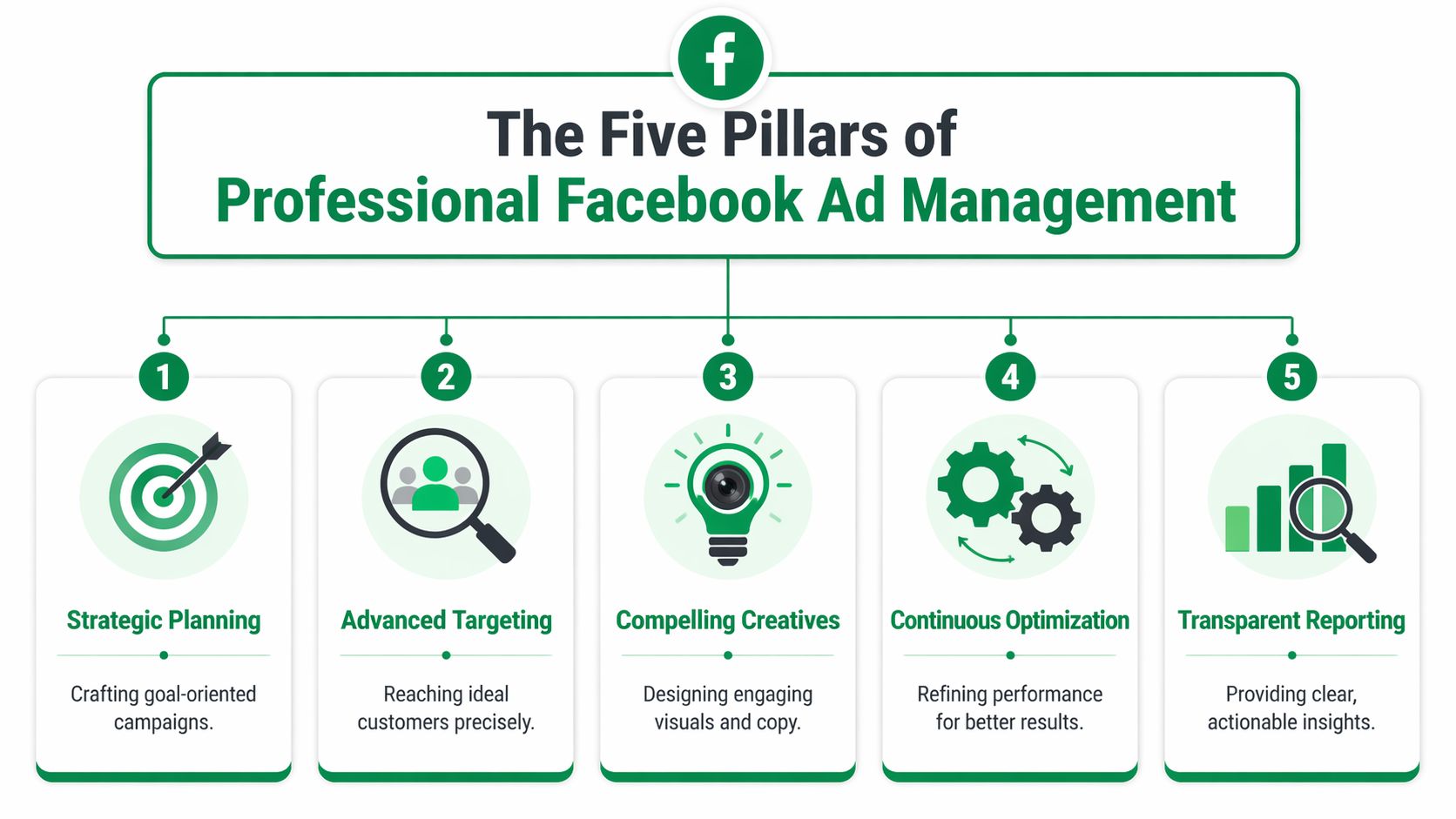
Professional fb advertising services fix that with five connected disciplines. Together, they answer the three questions owners should care about before they hire anyone: what work gets done, how the account gets managed day to day, and who is qualified to manage spend responsibly.
Strategic planning
Good Facebook performance starts before the first campaign is built.
Planning sets the objective, the offer, the funnel path, and the budget logic. If those inputs are weak, the account usually chases cheap clicks or low-quality leads instead of revenue. Agencies that know what they are doing will challenge assumptions here. They should ask which product or service deserves spend now, how long the sales cycle really is, what conversion event matters, and whether the landing experience can carry paid traffic.
That matters for hiring, too. Some agencies only want to execute inside Ads Manager. Others help shape the offer and funnel before launch. The second model usually costs more, but it often prevents expensive mistakes.
A solid strategy review should test:
- The offer: Discount, consultation, lead magnet, financing option, bundle, or trial
- The conversion path: Native lead form, landing page, quiz, product page, or booked-call flow
- The budget threshold: Enough spend to generate signal without forcing scale too early
- The success metric: Revenue, qualified pipeline, booked appointments, or customer acquisition cost
Advanced targeting
Targeting is audience control, not audience hoarding.
Strong account managers know when to run broad, when to segment, and when to exclude aggressively. Prospecting, retargeting, past purchasers, video viewers, and lead follow-up all need different treatment. If those groups overlap, costs rise and message frequency gets sloppy. If they are too fragmented, delivery stalls and the account never exits the learning phase.
This is one place where the agency engagement model matters. A junior media buyer working from a template may build audiences that look tidy but ignore sales reality. An experienced operator will align targeting with funnel stage, sales capacity, geography, and margin. That is a different level of management.
The practical question for a business owner is simple. Can this partner explain why each audience exists and what job it does?
Compelling creatives
Creative carries more weight than many businesses expect.
Media buying can improve an account, but weak creative caps performance fast. Good teams build ads around angles, objections, proof, and buying triggers. They test hooks, offers, first-frame visuals, headlines, body copy, and calls to action with a clear hypothesis behind each variation.
Format choice matters too. A single image, short-form video, testimonial edit, UGC-style clip, or carousel each solves a different job. Carousel ads, for example, work well when the business needs to show multiple products, walk through a process, or handle objections one card at a time. The point is fit, not novelty.
Ask agencies how they source and test creative. If the answer is vague, results usually are too.
Continuous optimization
Once campaigns launch, management shifts from setup to decision-making.
Useful optimization is controlled and commercial. Teams review performance by audience, creative, placement, landing page behavior, and conversion quality. Then they decide what deserves more budget, what needs a creative refresh, what should be consolidated, and what should be cut. That process should connect back to business economics, not just platform metrics. A lower cost per lead means very little if sales rejects half the leads.
Tools can help. Instapage’s overview of Facebook ad formats explains how Dynamic Creative Optimization can combine different assets and serve stronger combinations over time. The catch is straightforward. Automation improves testing efficiency, but it does not rescue a weak offer or poor messaging.
This is also where pricing and service quality start to separate. Low-fee management often covers basic maintenance. Higher-touch teams usually spend more time on testing cadence, creative feedback loops, and revenue analysis.
Transparent reporting
Reporting should help an owner decide what to do next.
That means showing spend, results, and what those results mean in plain English. It also means connecting ad metrics to sales outcomes. E-commerce brands may care about contribution margin and repeat purchase rate. Lead generation businesses may care more about qualification rate, close rate, and cost per booked opportunity. If you need a clearer framework for that side of the equation, use this guide on how to calculate marketing ROI.
Good reporting also exposes trade-offs. Scaling volume can raise acquisition cost. Tighter qualification can reduce lead count while improving close rate. Those are normal outcomes. A capable agency explains them early and ties them back to your growth goals, billing model, and operating constraints.
That is what separates real management from routine account maintenance.
FB Advertising Services: The Real ROI What to Expect from Professional Management
Most businesses don’t need more ad activity. They need cleaner economics.
That’s the value of professional fb advertising services when they’re done well. The account stops being a mystery and starts behaving like a measurable acquisition channel. Not perfectly. No paid platform works that way. But with disciplined management, the business can make decisions based on margin, lead quality, repeat purchase behavior, and sales velocity instead of chasing random spikes.
What the benchmarks actually tell you
There’s useful context in the current market data. AdBacklog’s 2025 Facebook ads benchmark report shows average CTRs of 1.5% to 1.8%, CPC of $0.50 to $0.60, and CVR of 5% to 10% globally, with B2B campaigns reaching a 10.6% conversion rate. Those numbers are helpful, but only if you interpret them correctly.
A lower click-through rate doesn’t automatically mean the campaign is weak. The audience may be narrow and high-intent. A higher cost per click isn’t always a problem either if the traffic converts into valuable customers. Inexperienced managers often stumble at this point. They optimize toward the cheapest visible metric, then wonder why revenue lags.
FB Advertising Services: Different business models care about different KPIs
A local service business usually cares about lead quality first. If quote requests come in but the phones are filled with low-intent prospects, the account isn’t healthy. A direct-to-consumer brand cares more about purchase rate, average order economics, and whether creative can keep scaling without falling apart. B2B often accepts a higher cost per action because one qualified opportunity can justify the spend.
A professional manager should talk through these trade-offs early, then document them in reporting. If you need a practical framework for this, a guide on how to calculate marketing ROI helps connect campaign metrics to actual business returns.
What changes when management improves
Good management usually creates improvement in a few predictable ways:
- Waste gets identified faster: Underperforming audiences, bloated placements, and weak creatives are caught earlier.
- Creative decisions get sharper: The team learns what hooks attract the right buyer, not just the cheapest click.
- Conversion data gets cleaner: Better event tracking improves optimization and reporting confidence.
- Scaling becomes less reckless: Spend increases happen with more control because the account has a stronger baseline.
That process takes judgment. It also takes patience during testing windows.
Here’s a useful walk-through on the topic from a practitioner angle:
Better Facebook ROI usually comes from fewer bad decisions repeated less often. That sounds simple. In practice, it’s the whole job.
The best agencies won’t promise perfect consistency. They’ll show you how they reduce uncertainty and turn the account into something you can forecast with more confidence.
FB Advertising Services: Unpacking the Price Tag How Agencies Bill for FB Ads
A business owner gets two proposals for fb advertising services. One quotes $1,500 a month. The other quotes 12% of ad spend plus creative fees. On paper, the cheaper option looks safer. In practice, the right choice depends on what work gets done, who does it, and whether the fee structure fits your stage of growth.
That is where pricing gets misunderstood.
Agency pricing is really an operating model. It determines how much strategic attention your account receives, how often creative gets refreshed, how reporting is handled, and whether anyone is actively fixing performance issues before they become expensive. A local lead gen account spending $4,000 a month has a very different labor profile from an ecommerce brand spending $80,000 and testing new offers every week.
What you’re actually paying for
You are paying for time, judgment, and execution. Usually that includes some mix of account strategy, campaign builds, audience testing, pixel and event setup, creative direction, reporting, calls, and ongoing optimization.
The biggest pricing mistake is comparing fees without comparing scope.
A low retainer can be perfectly fair for a stable account with proven creative and modest spend. The same fee becomes a problem when the business needs fresh ads, landing page feedback, faster testing cycles, and senior oversight. Agencies also package creative work differently. Some include concepting and iteration. Some expect your team to hand over finished assets. That detail changes the economics quickly.
Creative matters here because better ad formats and better execution often improve results. Carousel optimization, for example, is often sold as a value-add because stronger product sequencing and messaging can lift purchase efficiency. As noted earlier in the article, that is not cosmetic work. It can affect revenue. If you want a broader comparison of what a managed Facebook advertising service can include, that overview is a useful reference point.
Common pricing models
| Pricing Model | How It Works | Best For | Pros & Cons |
|---|---|---|---|
| Monthly retainer | You pay a fixed monthly fee for an agreed scope of management. | Businesses that want predictable costs and a defined level of support. | Pros: Easy to budget, clear scope. Cons: If the account suddenly needs extra creative or technical work, the contract can get tight fast. |
| Percentage of ad spend | The agency charges a percentage of monthly media spend. | Brands increasing budget and wanting fees to scale with account size. | Pros: Common structure, simple to understand. Cons: More spend can mean higher fees even when performance is flat. |
| Hybrid model | A base retainer is combined with a spend percentage or performance incentive. | Companies that want a middle ground between fixed support and scale-based pricing. | Pros: Can match effort more closely. Cons: Contracts need precise definitions around targets, attribution, and payout terms. |
| Project fee | A one-time fee covers an audit, rebuild, launch, or short engagement. | Businesses with a specific problem to solve before committing to ongoing management. | Pros: Clear deliverable, useful for resets. Cons: Day-to-day optimization is usually outside scope. |
FB Advertising Services: The trade-offs that matter more than the fee
Retainers usually work best when the account needs steady management and the workload is fairly predictable. Percentage-of-spend models tend to fit accounts where budget increases usually create more complexity. More campaigns, more audiences, more creative turnover, more reporting pressure. Hybrid models can work well when both sides want flexibility, but only if the agreement is written clearly enough to prevent arguments later.
This is also where engagement model and pricing connect. If an agency says it offers senior strategy but the fee barely covers junior maintenance, believe the math, not the pitch.
A few checks make proposals easier to compare:
- Ask what creative support is included. Strategy without new ads usually stalls.
- Ask who is managing the account week to week. Senior oversight and junior execution are priced differently.
- Ask what happens outside normal optimization. Tracking fixes, landing page issues, and account recoveries take real time.
- Ask how success is measured. ROAS, CPA, qualified leads, contribution margin, and pipeline value are not interchangeable.
- Ask how the agreement changes if you scale. Good contracts explain that before spend doubles.
For a helpful framework on evaluating agencies beyond the fee alone, this guide on how to choose a digital marketing agency gives useful buying criteria.
Cheap management often costs more once weak testing, slow response times, and shallow reporting start eating into your ad budget.
Price matters. Fit matters more. The right billing model supports the amount of strategy, execution, and accountability your business needs right now.
FB Advertising Services: How to Choose the Right FB Advertising Partner
Hiring an agency for fb advertising services is less about finding a vendor and more about choosing an operator. You’re giving someone influence over budget, message, data quality, and often a meaningful slice of your growth engine. That decision deserves more rigor than a flashy deck and a few screenshots.

What strong partners do early
Good agencies ask hard questions before they make promises. They want to know your margins, close rates, average order economics, sales cycle, creative resources, and operational constraints. That’s a positive sign. It means they understand Facebook ads are only one part of the system.
Weak agencies usually do the opposite. They jump to tactics, show generic wins, and speak confidently about scale without understanding what your business can support.
If you want a second perspective on the category itself, this overview of Facebook advertising service options gives useful context on what businesses should expect from managed support.
Questions worth asking in the sales process
Use the conversation to test how the agency thinks, not just what it sells.
Ask questions like these:
- How do you decide whether the problem is creative, offer, targeting, or landing page?
- What does your reporting look like when performance is flat or declining?
- How do you structure testing without constantly resetting the account?
- Who handles strategy and who handles day-to-day execution?
- What do you need from us to make the engagement successful?
Then ask a more advanced question. How they answer tells you a lot.
- How do you use the Meta Ads Library in real account strategy?
The best teams won’t say they use it just to spy on competitors. They’ll talk about angle saturation, message fatigue, geography-based variations, offer patterns, and how they identify gaps in the market. That matters because The Ardor’s analysis of Meta Ads Library workflows notes that agencies using it strategically to find underserved niches and avoid tired ad angles can see 20% to 30% higher engagement.
A smart buyer looks for diagnostic thinking. If every answer sounds like a canned process, expect canned work.
Red flags that should slow you down
Some warning signs are obvious. Others are subtle.
- Guaranteed outcomes: Facebook is an auction-driven system. Serious operators don’t promise exact returns before reviewing the account and business model.
- No discussion of tracking: If they don’t ask about pixels, conversion events, CRM feedback, or checkout behavior, they’re not serious about measurement.
- Little curiosity about your business: An agency that doesn’t ask about margins or lead quality can’t make intelligent optimization decisions.
- Reporting framed around vanity metrics: Reach, likes, and video views can matter, but not in isolation.
- No point of view on creative fatigue: Creative decay is part of the job. Agencies should have a process for refreshing ads before performance slides too far.
A practical vetting checklist
A simple decision framework helps keep the process grounded:
| What to Evaluate | What a Good Answer Sounds Like | What a Weak Answer Sounds Like |
|---|---|---|
| Business understanding | They ask about sales process, economics, customer quality, and capacity. | They jump straight into ad tactics. |
| Creative process | They explain testing angles, formats, and refresh cadence. | They say they can “make ads” without explaining how. |
| Reporting style | They connect spend to leads, purchases, or qualified pipeline. | They emphasize dashboards without interpretation. |
| Research depth | They use tools like the Ads Library to find openings, not copy trends blindly. | They talk mainly about competitor spying. |
| Communication | They define cadence, approvals, responsibilities, and escalation paths. | They stay vague and “flexible” on everything. |
A broader checklist on how to choose a digital marketing agency can help if you’re comparing paid social support with full-service partners.
The right agency won’t feel slick. It’ll feel sharp.
FB Advertising Services: The Onboarding Process What to Expect After You Sign
Once you sign, actual work starts. And no, a good onboarding process doesn’t look like someone asking for your login and launching ads the next morning.
Professional fb advertising services begin with alignment. The agency needs to understand the business well enough to build campaigns that fit your actual goals, not generic platform best practices. That means a kickoff conversation around priorities, target audiences, offer focus, approval workflows, and what counts as success.
FB Advertising Services: Step one is access and asset collection
Most agencies will request access to your Meta Business Manager, ad account, page, pixel or event setup, product catalog if you have one, and any analytics or CRM platforms tied to conversion reporting. They’ll also ask for brand assets. Logos, images, videos, product details, customer reviews, landing pages, past campaign history.
This phase feels administrative, but it sets the speed of everything that follows. Missing permissions and scattered files delay launches more than most clients expect.
FB Advertising Services: Step two is technical validation
This is essential. Before budget ramps, the agency should verify that your tracking is usable.
That usually includes checking event firing, matching conversion actions to business priorities, reviewing attribution paths, confirming landing page behavior, and identifying breaks between ad platform data and downstream sales data. If this step gets rushed, the whole engagement gets noisier.
Strong onboarding feels methodical. Weak onboarding feels fast.
FB Advertising Services: Step three is initial strategy and creative direction
After access and validation, the agency should present a first-pass plan. That may include campaign structure, audience approach, creative concepts, landing page recommendations, and an early testing roadmap.
If video is part of the mix, it helps to understand how the team thinks about scale across formats and placements. This article on choosing a video ads agency that scales is a useful complement because Facebook performance often improves when video production and paid media management are aligned from the beginning.
FB Advertising Services: Step four is launch and learning
Once campaigns go live, there’s usually a period where the system collects data and the agency evaluates early signals. This is not the time for constant panic edits. It’s the time for measured observation.
Clients should expect communication around:
- What launched and why
- Which metrics matter first
- What the team is watching
- When meaningful changes will be made
The cleanest onboarding experiences are the ones where nobody is guessing about responsibilities.
FB Advertising Services: Case Study Snapshots Success in Action
The mechanics matter, but business owners usually want one thing answered. What does good Facebook management look like in practice?
Here are three realistic snapshots. Not inflated success stories. Just how the work tends to show up when the service is matched to the business.

Local service company
A roofing or home service business often starts with a common issue. The owner has run lead ads before, got some volume, but too many inquiries were low quality or outside the service area.
A strong agency response usually looks like tighter geography controls, better exclusions, sharper qualification in the ad copy, and landing pages that filter casual prospects. The result isn’t always more leads. Sometimes it’s fewer, better ones. For a local operator, that’s often the right trade.
E-commerce brand
A consumer brand usually struggles with a different bottleneck. The store can get traffic, but the economics start wobbling when spend rises.
Creative testing, catalog structure, and offer sequencing are most important. Carousel ads can help when multiple products or product benefits need to be shown in one unit. Dynamic creative can help surface stronger combinations of headline, visual, and copy. The best accounts treat the ad account like merchandising plus media buying, not just traffic acquisition.
B2B company
B2B on Facebook can work well when expectations are grounded. The platform may not produce instant sales, but it can generate qualified hand-raisers when the offer and follow-up process are built correctly.
For these companies, a good campaign usually uses value-first creative, a clean lead path, and a retargeting sequence that speaks to objections over time. The visible ad metric is only part of the story. Sales acceptance matters more.
Good Facebook ad management adapts to the business model. Same platform, different economics, different funnel, different definition of success.
That’s the throughline. Effective fb advertising services aren’t about forcing every company into the same account structure. They work because the operator understands the business first and the platform second.
FB Advertising Services: Your Next Step Get Your Free Facebook Ads Audit
If your current Facebook ads feel noisy, inconsistent, or hard to trust, that usually isn’t a sign to spend blindly and hope the algorithm saves you. It’s a sign to get a clearer diagnosis.
A proper audit can show where the core problem lies. Creative fatigue. Weak offer positioning. Poor event setup. Messy campaign structure. Reporting that hides what’s happening. Once you know that, the next move gets easier.
If you want an outside view, a practical starting point is a review of digital marketing audit services so you can see what a useful audit should include and what questions it should answer. The right partner won’t start by pushing spend. They’ll start by identifying what’s blocking performance and where the quick wins are.
If you want a grounded second opinion on your account, Mr. Green Marketing, LLC offers a free Facebook Ads audit and performance report. The team starts by listening, reviewing the setup, and identifying the clearest opportunities to improve lead quality, conversion tracking, creative performance, and return on ad spend.
Leave a Comment
sing in to post your comment or sign-up if you dont have any account.