
SEO SEM Services: You’re probably here because you need more leads, more sales, or more qualified traffic, and someone just handed you a proposal packed with acronyms.
SEO. SEM. PPC. Technical audits. Landing pages. Structured data.
It can feel like you need a decoder ring before you can make a smart decision.
Most business owners don’t need more jargon. They need a clear way to decide where to put budget now, what can wait, and what will turn into revenue. That’s what seo sem services should do. Not create more confusion. Solve it.
SEO SEM Services: Your Business Needs to Be Found Online Now What
A customer searches for your service. They have intent. They’re comparing options. And if your business doesn’t appear in the right place, your competitor gets the call, the form fill, or the sale.
That’s why this category keeps growing. The SEO services market was valued at USD 74.9 billion in 2025 and is projected to reach USD 83.98 billion in 2026, with a 12.12% projected CAGR through 2031, according to Mordor Intelligence’s SEO market analysis. Businesses keep investing because search visibility still drives buying decisions.
Why this gets confusing fast
Part of the problem is that people use SEM in two different ways.
Sometimes they use it as a broad label for all search marketing. Other times they use it as shorthand for paid search ads only. That small language gap causes a lot of bad conversations and even worse budget decisions.
Here’s the practical version:
- SEO helps you earn visibility in organic search results.
- SEM, in the broad sense, includes both organic search and paid search.
- PPC is the paid advertising piece inside search marketing.
If that sounds annoyingly messy, it is. And it matters because each one solves a different business problem.
The real business question
Most owners aren’t asking, “What’s the textbook definition of SEO?”
They’re asking things like:
- Need leads this month: Should I run ads?
- Need lower acquisition costs over time: Should I invest in SEO?
- Need both speed and stability: How do I split budget without guessing?
Practical rule: Use search marketing to match the job you need done. Speed points to paid search. Durability points to SEO. Growth usually needs both.
That’s the frame to keep in mind as you read the rest of this guide. Not which acronym sounds better. Which mix gives your business the strongest return for where you are right now.
SEO SEM Services: Defining SEO and SEM The Big Picture
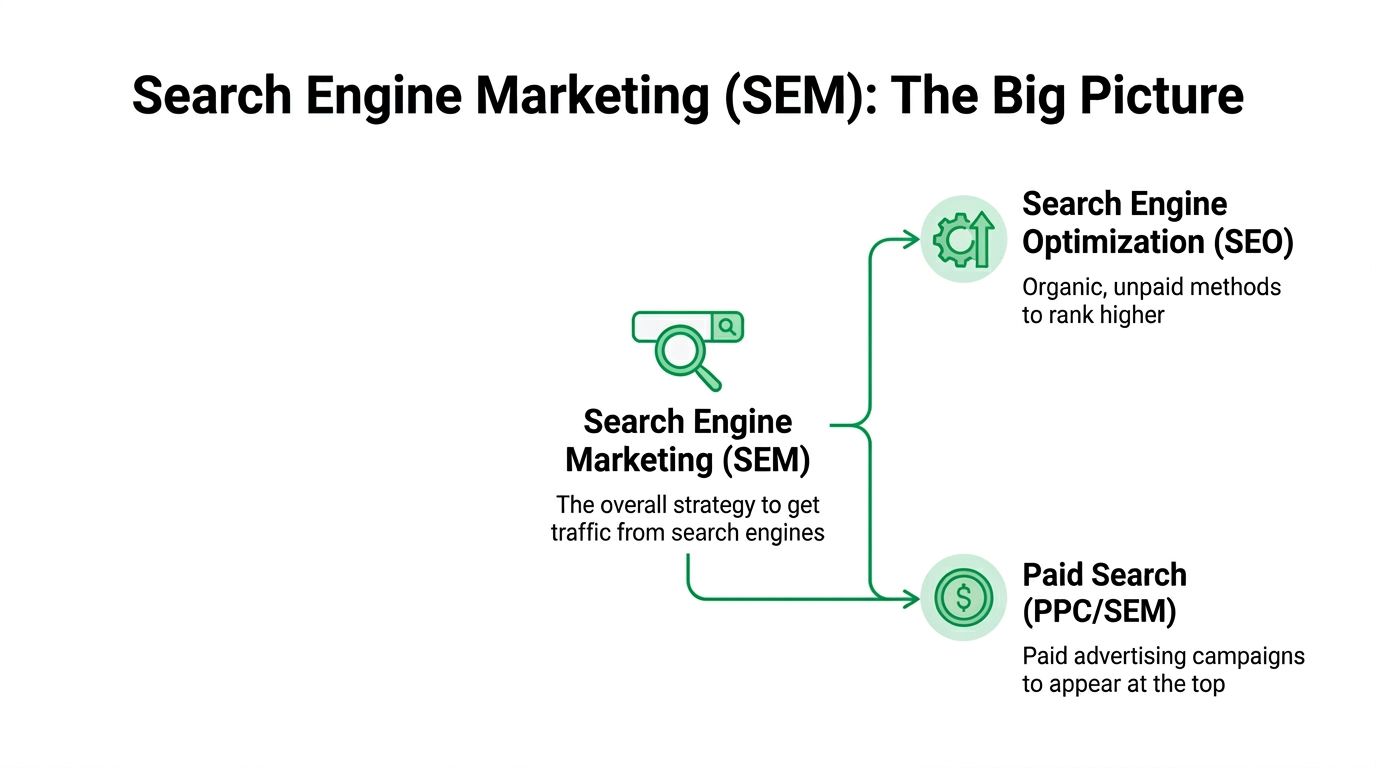
Think of search engine marketing as the whole property. Inside it, you have two ways to occupy prime space on the search results page.
SEO is like owning. You build assets that can keep producing traffic after the initial work is done.
Paid search is like renting. You can move in fast, get visibility right away, and control placement, but the traffic stops when the spend stops.
What SEO services usually include
SEO isn’t one task. It’s a stack of work that helps search engines understand your site and helps users trust it enough to act.
Common SEO services include:
- On-page optimization. Improving page titles, headings, internal links, service page copy, and content relevance.
- Technical SEO. Fixing crawl issues, indexing problems, site architecture, duplicate content, and page performance issues.
- Content strategy. Building pages around actual search intent, not just stuffing keywords into blogs.
- Local SEO. Improving visibility for map results and location-based searches.
- Conversion support. Aligning forms, calls to action, and landing page structure so traffic has somewhere useful to go.
A lot of owners hear “technical SEO” and assume it’s mysterious developer-only work. Sometimes it is. Often it’s just disciplined cleanup.
What technical SEO actually means
A concrete example is structured data.
Structured data, often implemented as JSON-LD, gives search engines clearer context about what’s on a page. Product details, reviews, FAQs, events, and other page elements become easier to interpret. According to Delante’s technical SEO overview, implementing or correcting structured data can boost click-through rates by 20% to 30% on average, while misstructured data can lead to 15% to 25% lower indexing rates.
That sounds technical because it is. But the business takeaway is simple. If search engines misunderstand your pages, fewer of them get indexed properly and fewer searchers click when they do appear.
Search engines can’t reward pages they can’t interpret clearly.
What paid search services usually include
Paid search is the faster-moving side of seo sem services. It’s campaign management, not site architecture.
Typical SEM or PPC services include:
- Keyword targeting for high-intent searches
- Ad copywriting for search ads
- Bid management to control cost and placement
- Landing page alignment so ad traffic reaches the right destination
- Negative keyword filtering to reduce wasted spend
- Conversion tracking inside tools like Google Ads and Google Analytics
- Ongoing testing of messaging, offers, and search intent patterns
And many businesses get tripped up. They think they’re buying “traffic.” What they’re really buying is a controlled testing environment.
Paid search tells you, quickly, which offers attract clicks, which messages generate conversions, and which search terms waste money.
What you’re actually paying for
A good agency isn’t charging you just to “do SEO” or “run ads.” You’re paying for judgment.
That means deciding:
| Service type | What the work focuses on | Why it matters |
|---|---|---|
| SEO | Site quality, content relevance, crawlability, authority | Builds long-term visibility and a stronger organic presence |
| Paid search | Immediate placement, bidding, ad testing, lead capture | Produces fast visibility and faster market feedback |
If you remember one thing, remember this: SEO builds the asset. PPC rents attention. Most growing companies need both at different points, but they should never confuse one for the other.
SEO SEM Services: SEO vs SEM Key Differences in Cost and Timelines
A business owner calls on Monday with a familiar problem. Leads are slow. Sales wants demand now. But the owner also knows they cannot afford to overpay for every new customer forever.
That tension is the core SEO versus SEM decision.
Business owners usually compare these channels on four points. Cost, speed, staying power, and control. That framework works because SEO and SEM solve different timing problems. One helps you capture demand quickly. The other helps you reduce acquisition costs over time.
The clearest side by side view
As noted in First Page Sage’s SEO vs. SEM comparison, organic search often converts at a higher rate and can produce a lower customer acquisition cost than paid search over time. The practical takeaway is simple. Paid search usually costs more per customer, while SEO often becomes more efficient as your site earns stronger visibility.
For a small or midsize business, that changes how you budget. If cash flow is tight and you need leads this month, SEM can justify the higher cost. If you already have a stable sales process and want better margins six to twelve months from now, SEO usually deserves a larger share of investment.
SEO vs. SEM At a Glance
| Factor | SEO (Search Engine Optimization) | SEM (Pay-Per-Click Ads) |
|---|---|---|
| Primary goal | Earn unpaid visibility in organic results | Buy visibility in sponsored placements |
| Speed to traction | Slower build, better for compounding results | Faster launch, useful for immediate demand capture |
| Cost structure | Investment in content, technical fixes, and optimization work | Ongoing payment for clicks and campaign management |
| Conversion pattern | Often improves as content, trust, and rankings improve | Often depends on bid strategy, offer strength, and landing page quality |
| Customer acquisition cost trend | Often becomes more efficient as authority grows | Usually stays tied to media spend and competition |
| Efficiency over time | Strong fit for compounding returns | Strong fit for immediate visibility and testing |
| Asset value | Builds owned marketing equity on your site | Functions more like rented distribution |
| Best fit | Businesses investing in sustained growth | Businesses that need immediate testing or lead flow |
Where owners misread the timeline
The biggest mistake is expecting SEO to behave on a weekly clock.
It usually does not.
Early SEO work often happens behind the scenes. Page structure gets cleaned up. Internal links get tightened. weak service pages get rewritten. Technical issues get fixed. Content gets built around user intent. None of that creates instant gratification, but it does improve the odds that future traffic turns into leads instead of drifting away.
SEM runs on a much shorter loop. Campaigns can go live fast, and conversion data can start coming in within days. That speed is useful, especially if you need answers fast. It is also dangerous if the account is set up poorly, because wasted spend can pile up before anyone notices. Tools connected through Google Ads mcp can help teams monitor performance and keep decision-making grounded in current campaign data.
How I explain it to clients
Your website works like a store you own.
SEO improves the property itself. Better signage, clearer aisles, stronger product pages, and a location people can find without paying rent every time they walk in. SEM pays to place more people at the front door right now.
That distinction matters for ROI. SEO usually asks for patience up front and rewards you later. SEM usually gives speed up front and sends you the bill every month. Neither model is wrong. The question is which one matches the business problem in front of you.
A practical budget filter for SMBs
Here is the framework many smaller businesses need and few guides explain clearly.
Start by separating your budget into two jobs. Demand capture and asset building.
- Put more into SEM if you need leads in the next 30 to 60 days, you are testing a new offer, or you do not yet know which keywords produce qualified opportunities.
- Put more into SEO if your sales process already works, your close rates are solid, and your goal is to lower customer acquisition cost over the next two to four quarters.
- Split the budget when you need both short-term pipeline and long-term efficiency. In that case, paid search buys speed while SEO fixes the foundation that improves returns later.
A simple example. If a local service company has a weak website and no reliable lead flow, putting every dollar into SEO can be too slow. Putting every dollar into ads can get expensive fast. A better approach is often to use SEM to learn which services and queries convert, then shift part of that budget into the pages and content that can rank organically later. If you want a clearer view of how campaign planning works in practice, this guide on search engine marketing strategies for growth-focused businesses gives useful context.
What this means for budget decisions
Do not ask which channel is cheaper in isolation. Ask which channel reduces risk for the decision you need to make now.
Sometimes the right move is paid search because you need immediate demand and fast feedback. Sometimes the right move is SEO because your site is weak and every click is underperforming. And sometimes the smartest move is to fund both, but with different expectations and different time horizons.
That is when seo sem services stop being a list of tasks and start acting like a growth investment.
SEO SEM Services: How SEO and SEM Work Together in Practice
A common SMB scenario looks like this. You launch Google Ads on Monday, calls start coming in by Friday, and by the end of the month you know which services people want. But your cost per lead is uneven, and every click disappears the moment you stop paying for it. That is the point where SEO and SEM should start informing each other, not run as separate projects.
PPC gives SEO faster feedback
SEO takes time because pages need to be built, indexed, improved, and trusted. Paid search compresses that learning cycle.
With ads, you can see patterns faster:
- Which keywords bring qualified leads
- Which offers get ignored
- Which headlines earn clicks
- Which landing pages convert and which ones lose demand
That matters because SEO is expensive when it is based on guesswork. If paid search shows that one service line produces strong leads and another draws low-intent traffic, your SEO roadmap gets clearer. You build out the pages that match proven demand first. You fix weak messaging before investing months into content around it.
For an SMB, that is the practical win. SEM helps you buy information quickly. SEO turns that information into an asset you can keep using.
SEO makes paid search more efficient
The relationship runs both ways.
Strong SEO work improves page quality, internal linking, site structure, and match between search intent and page content. Those changes help organic visibility, but they also help ad traffic convert because visitors reach pages that answer the question they searched, load without friction, and make the next step obvious.
A useful comparison is a storefront. SEM gets people to the door fast. SEO improves what they see once they walk in. If the shelves are messy, the signs are confusing, or checkout is slow, paying for more foot traffic does not fix the problem.
If your team is refining campaign workflow inside tools like Google Ads mcp, the advantage becomes easier to see. Better campaign inputs are only valuable if the site experience is strong enough to convert that traffic into leads or sales.
Use PPC as a testing system. Use SEO to turn the winners into durable traffic and lower-cost conversions over time.
A Practical Budget Split for SMBs
Many guides stop at “use both channels.” That is not enough. Owners need a budget model tied to speed, risk, and return.
A practical starting point for many SMBs is this:
| Business situation | SEO share | SEM share | Why this mix often works |
|---|---|---|---|
| New campaign, weak data, need leads soon | 30 to 40% | 60 to 70% | Paid search generates demand and gives you fast keyword and message feedback |
| Early traction, some winning services identified | 40 to 50% | 50 to 60% | You keep lead flow active while building organic pages around proven intent |
| Stable lead flow, strong close rates, solid site foundation | 50 to 70% | 30 to 50% | SEO starts lowering acquisition cost while SEM stays focused on high-value terms and testing |
This is a framework, not a rulebook. A local roofer in peak season may keep more budget in paid search for a while. A law firm with expensive clicks may shift harder into SEO once it knows which case types and cities produce profitable leads.
The key is to allocate budget by job, not by channel loyalty. SEM handles speed, testing, and immediate demand capture. SEO handles compounding visibility, stronger conversion paths, and lower dependence on paid traffic over time.
How the two channels should share data
Here is where many campaigns lose money. The SEO team publishes content based on keyword volume. The paid search team optimizes bids based on conversions. Nobody connects the two.
A better system is simpler than it sounds.
Use SEM search term reports to identify high-intent queries. Use SEO to build or improve pages around those themes. Then send paid traffic back to the improved pages and compare conversion rates. If performance improves, you have a stronger page for both channels. If it does not, the issue may be the offer, the page layout, or the lead form rather than the keyword itself.
And this is why reporting needs to go beyond rankings and clicks. You want to know which terms produce revenue, which landing pages assist conversions, and where paid testing should guide organic investment next.
If you want a broader planning model, this guide on search engine marketing strategies for growth-focused businesses adds useful context.
Here’s a good visual explainer for teams that need to align around the bigger picture before changing budgets:
Where a boutique partner fits
An agency earns its keep by connecting these decisions. Not by selling one team for SEO and another for PPC with separate goals, but by helping you decide where each next dollar should go based on lead quality, conversion data, and time horizon.
Mr. Green Marketing is one example of that model. The firm handles SEO, PPC, web design, GEO, and related search work under one strategy. The value is not the channel list. The value is having one plan for testing demand, improving the site, and shifting budget as the numbers become clearer.
Good seo sem services should do more than produce activity. They should help you spend with more confidence, reduce wasted clicks, and build traffic assets that keep paying back after the ad spend slows.
SEO SEM Services: How to Choose the Right SEO SEM Services Agency
A good agency helps you make better decisions.
A weak one sells mystery, floods you with dashboards, and keeps the strategy vague enough that you can’t tell what’s working. That’s expensive. Not just in dollars, but in lost time.
When you’re evaluating seo sem services, don’t start with promises. Start with how the agency thinks.

Green flags worth paying attention to
Some signs show up early when an agency knows what it’s doing.
- They ask about business goals before tactics. If the first conversation centers on revenue targets, margins, lead quality, seasonality, and sales capacity, that’s a good sign.
- They audit the site before proposing a full plan. Strong agencies want to see the baseline first.
- They explain tradeoffs clearly. Not every page should be optimized first. Not every ad campaign should launch at once.
- They talk about the website experience, not just rankings and clicks. Search performance depends on what happens after the visit.
- They can discuss technical issues in plain English. If they mention crawlability, indexing, page speed, or schema, they should also explain the business consequence.
A practical example is Core Web Vitals. According to Upwork’s SEO expert overview, optimizing metrics like LCP, FID or INP, and CLS can produce 15% to 35% faster load times, while resolving issues like 404 errors can lead to 18% higher indexed pages. An agency doesn’t need to turn that into a science lecture. They just need to explain how site speed and site health affect visibility and conversions.
Red flags that should slow you down
Some warning signs are subtle. Others are loud.
- Guaranteed rankings. No credible agency controls search results that way.
- Secret methods. If they hide behind “proprietary tactics,” be careful.
- Vanity-metric obsession. More impressions mean little if lead quality is poor.
- No clear reporting rhythm. If they can’t show how they’ll explain progress, the relationship will get murky fast.
- One-size-fits-all packages. A local service business and a national e-commerce brand should not get the same playbook.
If an agency can’t explain what they’re doing in language a business owner can understand, they probably don’t understand it deeply enough themselves.
Questions to ask before you sign
Use the meeting to pressure-test how the team thinks, not just what they sell.
Ask things like:
- How do you decide what to work on first?
- What do you need from us to measure lead quality accurately?
- How do SEO and paid search inform each other in your process?
- What technical issues on our site might hold back both channels?
- How will you report wins, losses, and next actions?
- What happens if the first strategy doesn’t perform as expected?
The best answers won’t sound polished for the sake of sounding polished. They’ll sound specific.
What a healthy engagement feels like
A strong partner gives you clarity, not dependency.
You should know what they’re prioritizing, why those tasks matter, and how success will be judged. You shouldn’t feel like reports are being translated from another language every month.
If you want a deeper checklist before hiring anyone, this article on how to choose a digital marketing agency is worth reviewing.
The short version is simple. Hire the agency that makes the work easier to understand, not the one that makes itself sound more complicated.
SEO SEM Services: Measuring Success KPIs and Reporting You Should Expect
A report should answer one question clearly. Is this work producing better business outcomes?
Too many reports fail that test. They dump charts into a PDF, label everything “up” or “down,” and leave the owner to guess what matters.
That’s not reporting. That’s data storage.
SEO KPIs that actually matter
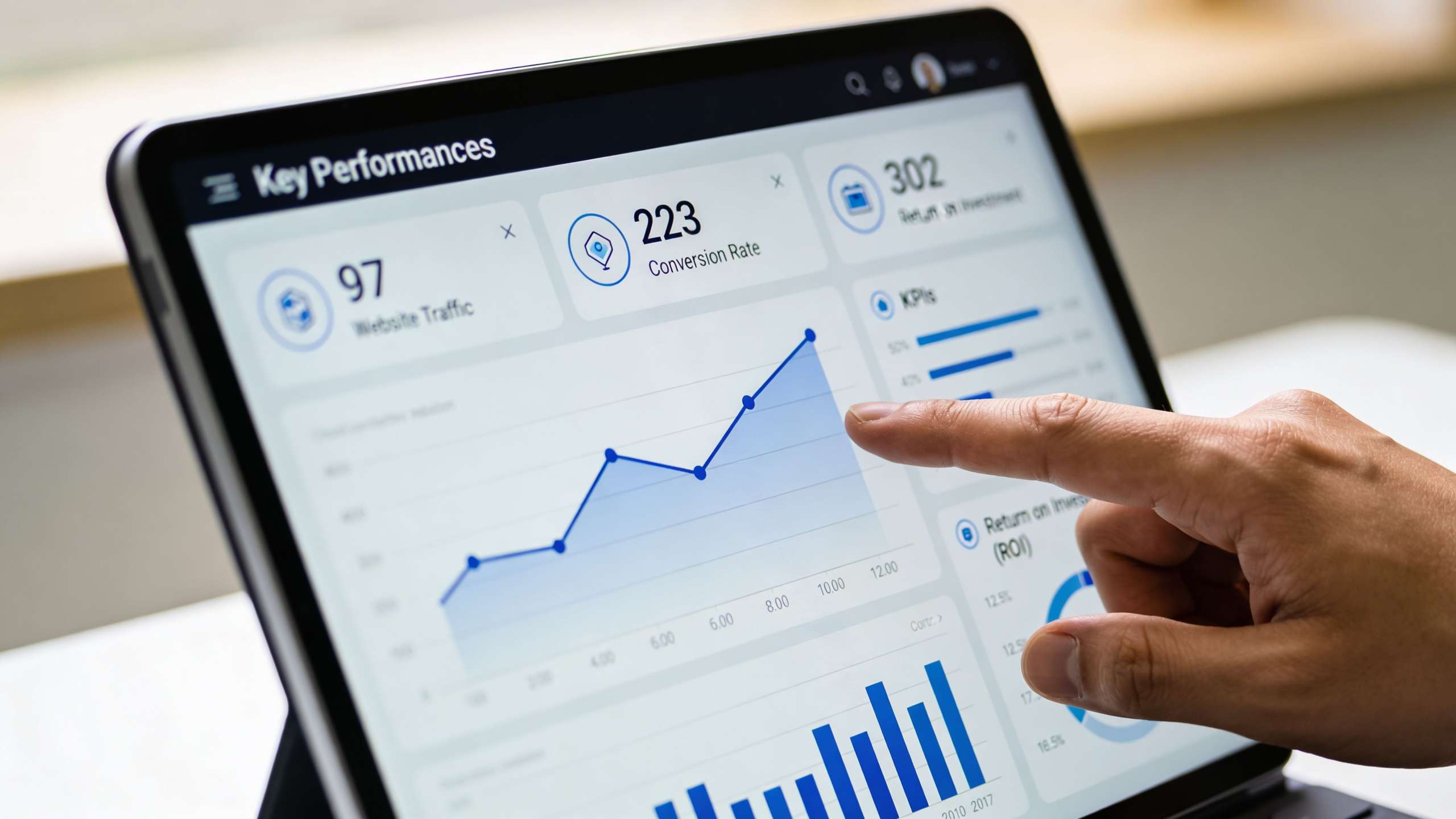
For SEO, useful reporting usually centers on business relevance, not just raw traffic.
Watch for:
- Organic conversions. Are form fills, calls, bookings, or sales increasing from organic sessions?
- High-intent keyword movement. Not every ranking matters equally. Service and product intent matters more than vanity terms.
- Landing page performance. Which pages are attracting traffic and turning visitors into action?
- Indexing and technical health. Pages can’t perform if they aren’t being understood or indexed properly.
- Engagement quality. Are visitors finding the page useful enough to continue deeper into the site?
A good SEO report ties these together. It doesn’t just say a page gained visibility. It explains whether that visibility is attracting the right audience.
SEM KPIs that deserve executive attention
Paid search reporting should be tighter and more commercial.
Useful SEM metrics include:
- Conversion volume. How many tracked leads or sales came from campaigns?
- Cost per conversion. What are you paying to acquire those outcomes?
- Search term quality. Which queries are driving relevant demand and which are burning budget?
- Landing page alignment. Are clicks turning into action or dropping off?
- Campaign efficiency trends. Which ad groups deserve expansion, revision, or pause?
If your team needs a plain-language reference for this one metric, this guide on how to compute conversion costs can help clarify the underlying math.
The best reports don’t just describe movement. They explain what action the business should take next.
What a strong monthly report looks like
A useful report usually includes three layers:
| Reporting layer | What it should show | Why it matters |
|---|---|---|
| Performance summary | Clear view of what improved, declined, or stalled | Lets leadership see the signal quickly |
| Business interpretation | Explanation of why the numbers moved | Connects activity to outcomes |
| Next-step priorities | Specific actions for the coming period | Keeps the work strategic, not reactive |
That format is far more useful than a long export from Google Ads or Search Console with no commentary.
What to push back on
If an agency sends reports that focus mostly on impressions, broad traffic spikes, or keyword counts without tying them to lead quality, ask harder questions.
You want to know:
- Which pages or campaigns are driving actual inquiries
- Which traffic sources are inefficient
- What was changed during the reporting period
- What the team learned
- What they’ll do next because of that learning
For a practical reference point, this example of an SEO monthly reporting format shows the level of clarity business owners should expect.
That’s the standard. Less noise. More explanation. Better decisions.
SEO SEM Services: Your Next Steps to Real Digital Growth
At this point, the choice probably looks less like a rivalry and more like sequencing.
If you need immediate demand, paid search can help you learn fast and capture active buyers. If you need stronger efficiency over time, SEO builds the underlying asset. If you need both, the budget has to reflect both jobs.
That’s why the smartest move usually isn’t picking a side. It’s diagnosing the bottleneck.
Start with the gap, not the tactic
Ask yourself a few blunt questions:
- Are we invisible for searches that should already be producing leads?
- Are we paying for traffic that our site can’t convert well?
- Are we creating content without knowing what drives revenue?
The answers usually reveal the next move faster than another marketing pitch deck will.
The most practical first step
A serious audit is often the right place to begin. Not because audits are glamorous. They aren’t. But they show where your visibility is weak, where technical issues are slowing you down, and where fast paid testing could guide longer-term SEO investments.
And search behavior is changing beyond classic Google blue links. If your team is also thinking about AI visibility, this guide on how to rank in ChatGPT is a useful next read because it broadens the conversation beyond traditional search alone.
The goal isn’t to do everything at once.
It’s to make the next dollar smarter than the last one.
Frequently Asked Questions About SEO and SEM Services
Some questions come up in almost every sales call. Fair enough. Here are direct answers.
Common SEO & SEM Questions
| Question | Answer |
|---|---|
| Should a small business start with SEO or paid search first? | Start with the constraint. If you need leads quickly, paid search often makes sense first. If your site is weak or you need stronger long-term acquisition efficiency, SEO may need attention right away. Many SMBs do best with a mix rather than an either-or choice. |
| Can I run ads without doing SEO? | You can. But it often gets more expensive than it needs to be if the website experience is poor. Weak landing pages, unclear service messaging, and technical issues can hurt performance even when ad targeting is solid. |
| How do I know if an agency is focused on revenue and not vanity metrics? | Ask what they report on, how they define a conversion, how they connect leads to campaigns or pages, and what decisions they make from the data. If they mostly talk about rankings, impressions, and traffic without discussing lead quality, keep looking. |
If you want a clearer picture of where your search visibility stands today, Mr. Green Marketing, LLC is one option to explore. A focused audit can reveal where SEO, paid search, technical fixes, and conversion improvements should happen first so your next marketing decision is based on evidence, not guesswork.
Leave a Comment
sing in to post your comment or sign-up if you dont have any account.