
Improve online visibility and dominate your market – Want to get found online? It’s not about shouting into the void anymore. And it’s definitely not about luck. It’s about a smart, repeatable strategy for showing up exactly where your customers are looking, right when they need you.
With so many channels and tactics, it’s easy to feel overwhelmed. Before you spend a dime on ads or an hour creating content, you need a baseline—a clear, honest snapshot of where your business stands today. This isn’t about drowning in spreadsheets; it’s about getting a roadmap that points directly to the gaps you can exploit for some quick wins.
1. Improve Online Visibility and Dominate Your Market – Find Out Where You Stand Right Now
First things first. You need to see what your customers see. Open an incognito browser window (this stops your personal search history from skewing the results) and start searching. Type in your most important products or services.
Do you show up on the first page? The second? Or are you nowhere to be found? This simple test gives you a raw, unfiltered look at your current keyword performance. It’s the ground truth.
Beyond just a general search, you need to check your local footprint. A few things to look for:
- Local Search: Try searching for “your service near me” or “your product in [your city].” Do you pop up in the Google Map Pack? This is prime real estate.
- Brand Search: Google your exact business name. Your website should be the top result, followed by your social profiles and key business listings. If not – that’s an immediate red flag.
- Reputation Check: What are people saying? Check your reviews on Google, Yelp, and other industry-specific sites. A poor online reputation can make you invisible, even if you rank well.
This quick, manual check costs nothing. And it’s incredibly revealing. It gives you an immediate feel for your digital health.
To truly improve online visibility, you need to understand what is Answer Engine Optimization (AEO). The game is shifting from just ranking links to providing direct answers in search results. It’s a concept you can’t afford to ignore.
2. Improve Online Visibility and Dominate Your Market – Size Up the Competition
You don’t exist in a bubble. Your visibility is always relative to your competitors’. Pick two or three of your top rivals—the ones who always seem to be where you want to be—and run the same searches for them.
What are they doing that you aren’t? Maybe their Google Business Profile is loaded with recent photos and 5-star reviews. Or perhaps they have a blog full of genuinely helpful articles that you know your customers are searching for. This isn’t about blindly copying them. It’s about identifying the standard you need to beat.
This simple three-step audit is your starting point.
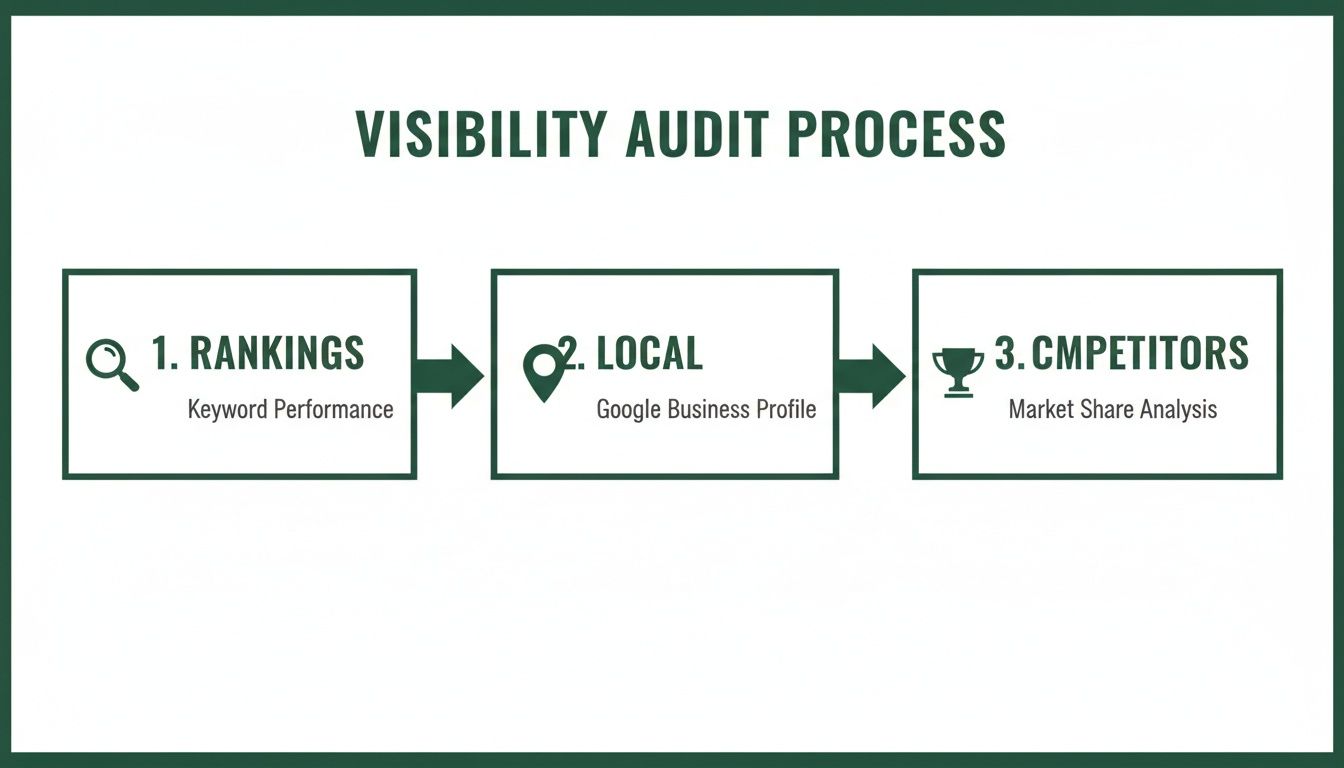
Moving from your rankings to your local presence and finally to a competitor analysis gives you a complete picture. This isn’t just data—it’s direction for your marketing efforts.
3. Improve Online Visibility and Dominate Your Market – Find Your Quick Wins
After your initial audit, you’ll likely have a long list of things to fix. The key is to prioritize the low-hanging fruit—the quick fixes that can deliver immediate results.
Use this checklist to pinpoint opportunities for fast improvement.
Quick Wins Visibility Checklist
| Visibility Area | What to Check | Quick Win Action |
|---|---|---|
| Google Business Profile | Is all info complete and accurate? (Address, hours, phone) | Fill out every section, add new high-quality photos, and start responding to all reviews. |
| On-Page SEO | Do your main pages have clear, descriptive titles and headings? | Rewrite the page titles for your top 3 service/product pages to include your main keyword and location. |
| Local Listings | Are your business details consistent across major directories like Yelp? | Correct any inconsistencies in your Name, Address, and Phone Number (NAP) on your top 3 directory listings. |
| Website Performance | Does your website load slowly on mobile? (Use Google’s PageSpeed Insights) | Compress the images on your homepage to improve load time. |
| Content Gaps | Do competitors answer a key customer question that you don’t? | Write a simple blog post or FAQ page that directly answers that question. |
This checklist isn’t exhaustive, but it will get the ball rolling. Tackling these items first can build momentum and start driving more traffic while you plan your longer-term strategy.
Think about it: digital ad spend exploded to an estimated $601.8 billion in 2023. That figure is projected to soar past $730 billion in 2025 and top $807 billion by 2026. This isn’t just a trend; it’s a gold rush for businesses trying to capture attention. Your audit is the first step to claiming your share.
Improve Online Visibility and Dominate Your Market – Mastering Your Ground Game with Technical and Local SEO
With your audit complete, it’s time to fix the foundational issues that hold your business back. This is where we get into the nuts and bolts of technical and local SEO—the absolute bedrock of your online visibility.
You can have the most beautiful website and compelling content, but if search engines can’t crawl it or local customers can’t find you, you’re invisible. Getting these two areas right isn’t optional. It’s the price of admission for ranking in today’s market.
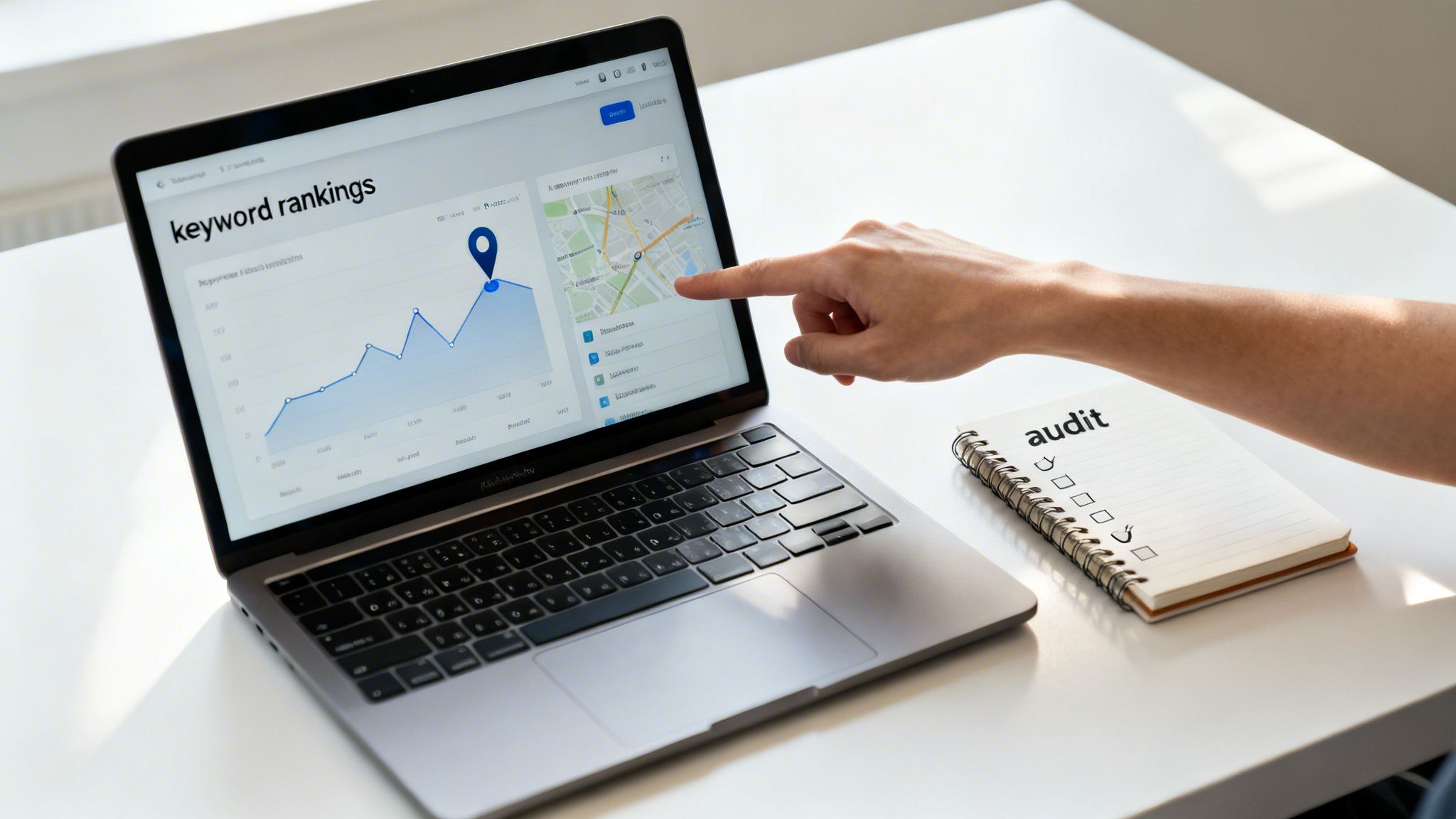
Fortifying Your Website’s Foundation
Technical SEO is all about making sure your site is built correctly for both users and search engine crawlers. A technically sound site is a trustworthy one in Google’s eyes, leading to better rankings and a smoother customer experience. You don’t need to be a developer, but you must address these core elements. A short list to get started:
- Site Speed: If your site takes longer than 3 seconds to load, you’re losing customers. Use Google’s PageSpeed Insights to get a performance score. Simple fixes like compressing images, using a good hosting provider, and enabling browser caching can provide an immediate boost.
- Mobile-Friendliness: With over 50% of web traffic coming from mobile, your site must be responsive. If users have to pinch and zoom to read your content, they will leave. A total non-negotiable ranking factor.
- Clean Site Structure: A logical site with clear navigation helps both people and search engines find what they need. A confusing site structure directly hurts your ability to rank for important keywords because Google’s crawlers can’t make sense of your content hierarchy.
These aren’t just best practices; they are baseline requirements. A slow, clunky, or broken site tells Google that you don’t offer a quality user experience, and your rankings will suffer for it.
Improve Online Visibility and Dominate Your Market – Winning the Neighborhood with Local SEO
For any business serving a specific geographic area—from plumbers and dentists to coffee shops and consultants—local SEO is everything. When a customer searches “emergency plumber near me” or “best tacos in Austin,” you have to be the result they see.
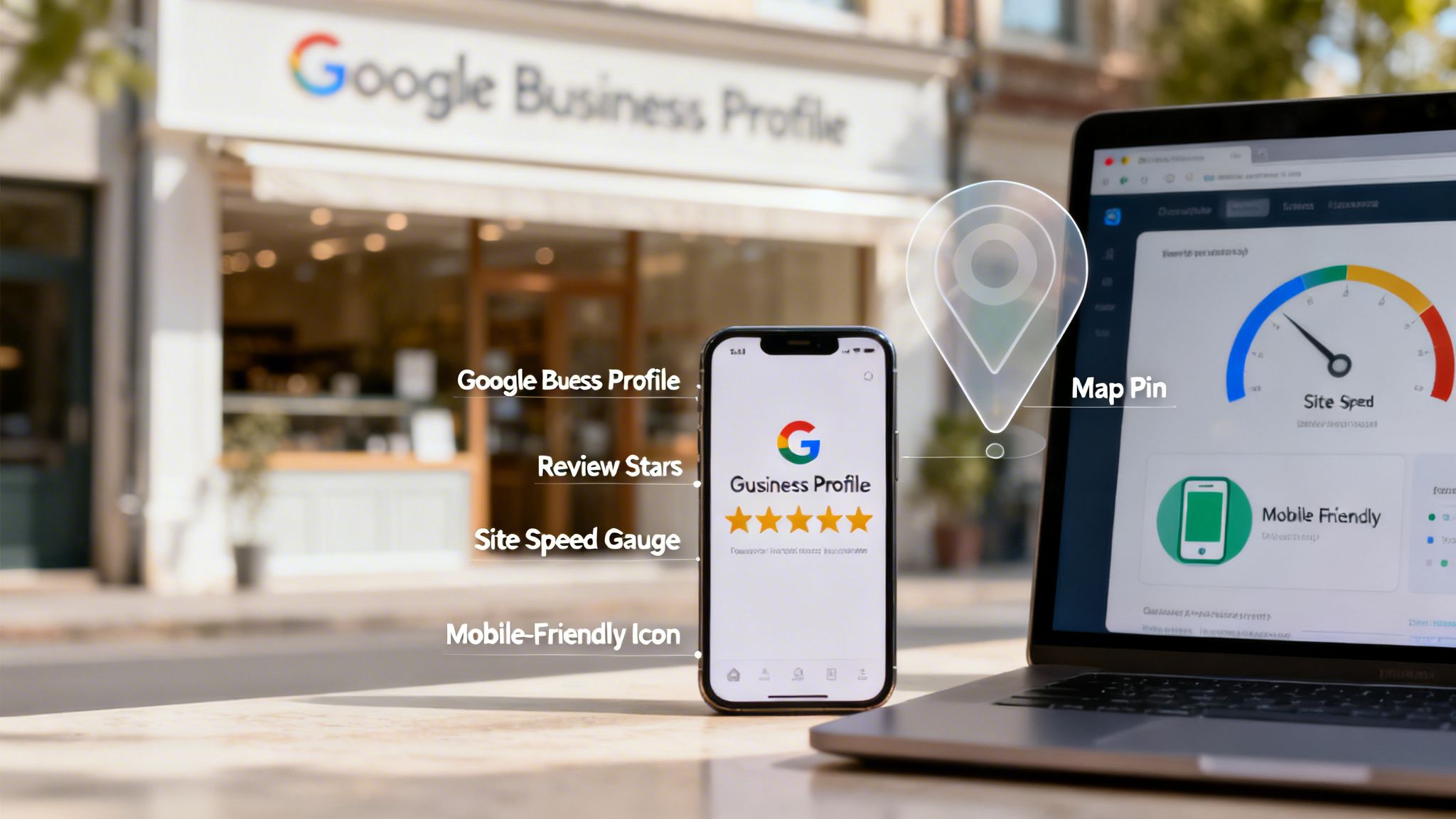
And your Google Business Profile (GBP) is your single most important local SEO asset. It’s your digital storefront.
An incomplete or neglected Google Business Profile is like having a storefront with a broken sign and boarded-up windows. It signals that you might not be open for business, sending potential customers straight to your competitors.
Your GBP needs to be 100% complete and consistently active. This means:
- Verifying your exact business name, address, and phone number (NAP).
- Setting correct business hours, including any holiday adjustments.
- Uploading high-quality, recent photos of your work, team, and location.
- Responding to every single review, both positive and negative.
Beyond your GBP, you need to build local citations. These are mentions of your business NAP on other relevant online directories like Yelp, Apple Maps, and industry-specific portals. The key is consistency. Every single citation must match your GBP information exactly. This consistency proves your legitimacy and geographic relevance to search engines.
This has become even more critical with the rise of voice search. When someone asks Siri or Alexa for a local recommendation, these AI assistants pull data directly from these verified local listings. A strong, consistent presence ensures you’re the answer they give. Our guide on SEO strategies for small businesses offers a deeper dive into these essential tactics.
The data is clear. A staggering 93% of online experiences begin with a search engine. It’s no surprise the SEO market is set to reach nearly $107 billion by 2025. For businesses that master it, organic search delivers the highest ROI, with 49% of marketers calling it their most effective channel, as highlighted in this digital marketing industry analysis on Entrepreneurshq.com.
Improve Online Visibility and Dominate Your Market – Creating Content That Actually Gets Seen
You’ve heard it a million times: “content is king.” And it’s true. But what most people won’t tell you is that the vast majority of content is just noise. It gets published and then fades away, seen by almost no one. We need to fix that.
This isn’t about hitting a blog post quota. To really move the needle on your online visibility, you need to create strategic content assets—pieces designed from the ground up to attract, engage, and convert your ideal customers.
Improve Online Visibility and Dominate Your Market – Find Out What Your Audience Really Wants
The first step isn’t opening a blank document; it’s listening. You have to uncover what your audience is actually searching for. What are the problems keeping them up at night, and what questions are they typing into Google at 11 PM? It’s time to stop guessing.
Getting this intel is easier than you think. Start with your own customer interactions. What are the top ten questions your sales team gets on calls or that come through your contact form? That’s pure content gold right there.
Google itself is your next best friend. Type a question related to your business into the search bar and pay close attention to the “People Also Ask” box. This is a direct look into what real people are curious about.
The goal is to move from creating content you think people want to creating content you know they need. This shift from guesswork to data-backed topics is the foundation of a content strategy that drives real visibility.
Once you have a list of topics, the mission is simple: create the single best, most helpful answer on the internet for that query. This isn’t about word count. It’s about value.
Improve Online Visibility and Dominate Your Market – Build Content That Attracts and Converts
Not all content is created equal. A short, generic blog post simply won’t cut it anymore. To stand out, you need to create “pillar content”—these are the comprehensive, authoritative hubs of information that you can build an entire topic cluster around.
Think about using these powerful formats:
- Long-Form Guides: We’re talking ultimate guides, detailed how-to articles, or deep dives into a complex subject. These pieces establish you as an expert and are magnets for valuable backlinks.
- Helpful Video Tutorials: Sometimes, showing is way better than telling. A simple screen recording or a product demo can answer a question far more effectively than thousands of words.
- Local Landing Pages: If you’re a local business, this is a must. Create dedicated pages for each service in each city you cover. A page for “roof repair in Pensacola” will always outperform a generic “services” page.
But great content is more than just text on a screen. You have to think about the user experience. Break up long paragraphs. Use compelling images. Add bullet points for scannability and embed videos where they make sense. For a deeper dive, check out our guide on content marketing best practices.
Improve Online Visibility and Dominate Your Market – Get Your Content in Front of the Right People
And now for the part everyone seems to forget: distribution. Hitting “publish” is only half the battle. If you don’t have a plan to get your content seen, you’ve wasted your time.
This is where you need to put on your marketer hat. A good distribution plan isn’t an afterthought. It’s baked into the process from day one.
Here’s a simple checklist to get you rolling:
- Share on Social Media: Post your new content on all your relevant social channels. But don’t just drop a link and run—pull out an interesting quote, a key stat, or a great image to hook people in.
- Email Your Subscribers: Your email list is one of your most powerful assets. Send a broadcast to your subscribers letting them know you’ve published something new that will help them.
- Find Relevant Communities: Are there forums, Facebook groups, or Reddit communities where your audience gathers? Share your content there, but only when it’s genuinely helpful and adds to the conversation.
- Look for Guest Opportunities: Appearing on a podcast or writing a guest post for another industry blog is an incredible way to tap into a new, relevant audience and build your authority.
This full-circle approach—from ideation to creation to distribution—is how you make every single piece of content work hard for your business. It’s not about being the loudest. It’s about being the most helpful.
Improve Online Visibility and Dominate Your Market – Expanding Your Reach with Paid Ads and Social Media

Organic growth is the foundation, and it’s powerful. But let’s be honest—sometimes you need to get in front of customers right now. That’s when it’s time to pour a little gasoline on the fire with paid advertising and a smart social media presence.
This isn’t about burning cash for vanity metrics. It’s about a surgical approach to put your message exactly where your ideal customers are looking, interrupting their scroll with something they actually want to see. Let’s make it happen.
Improve Online Visibility and Dominate Your Market – Get Immediate Traction with Paid Ads
Paid advertising, especially Pay-Per-Click (PPC), is a direct line to your audience. Unlike SEO, which can take months to build momentum, a well-structured ad campaign can start driving traffic and leads within hours. And you don’t need a massive budget to see results—you just need to be smart.
The key is focusing on high-intent keywords. These are the search terms people use when they’re ready to buy, not just browse. For instance, instead of a broad keyword like “roofing,” a high-intent keyword would be “emergency roof leak repair in Dallas.” This small shift makes your ad spend incredibly efficient.
To really dial it in, you’ll want to:
- Hunt for ‘Long-Tail’ Keywords: These are longer, more specific phrases of 3+ words that have less competition and much higher conversion rates. Think “buy waterproof hiking boots for women” instead of just “hiking boots.”
- Use Negative Keywords Aggressively: What you don’t target is just as important. If you sell premium leather shoes, add terms like “cheap,” “discount,” and “free” to your negative keyword list. This stops you from paying for clicks from unqualified searchers.
- Craft Compelling Ad Copy: Your ad has one job: grab attention and offer a clear solution. Speak directly to the searcher’s problem and include a strong call to action like “Get a Free Quote Now” or “Shop Our 24-Hour Sale.”
If you’re just getting your feet wet, our beginner’s guide to PPC marketing breaks down the entire process step-by-step.
PPC isn’t about outspending your competition; it’s about outsmarting them. I’ve seen small, highly-targeted campaigns focused on high-intent keywords outperform huge, generic ones every time. The goal is profitability, not just clicks.
Improve Online Visibility and Dominate Your Market – Dominate Your Niche on Social Media
Social media is not just a megaphone for your brand. It’s a place to build a community, establish yourself as an authority, and drive real traffic back to your website. And look, you don’t need to be on every single platform—that’s a recipe for burnout. The trick is to find out where your customers actually spend their time and create a presence there that connects.
This is less about “going viral” and more about consistent, valuable engagement. What does that actually look like?
- Humanize Your Brand: Stop posting just product shots. Share behind-the-scenes content, introduce your team, and talk about why you started the company. People connect with people, not logos.
- Embrace Video: Whether it’s short-form clips on TikTok and Reels or helpful tutorials on YouTube, video is king. It’s the most engaging format out there and helps you build a genuine connection with your audience. A simple “how-to” video can do more for your visibility than a dozen static posts.
- Engage, Don’t Just Broadcast: Ask questions. Run polls. Respond to comments and messages quickly. Your social media presence should be a two-way conversation.
The real edge comes from blending creative content with hard data. As North America is projected to lead with $350 billion in digital ad spend by 2026, the brands that win will be those that master both. To truly expand your reach, you need a scalable paid social media strategy that delivers a measurable return on your investment.
Improve Online Visibility and Dominate Your Market – Measuring Success and Knowing When to Call for Backup
So you’ve put in the hours. You’ve tweaked your SEO, started pumping out content, and maybe even experimented with some paid ads. Great. But here’s the real question: is any of it actually working?
If you can’t answer that with cold, hard numbers, you’re flying blind. This is where measurement comes in. It’s how you turn all your effort into data that tells a story—a story about what’s driving real growth and what’s just burning through your time and budget.
What to Track to Measure Your Visibility
You don’t need to track every metric known to man. That’s a fast track to analysis paralysis. Instead, focus on a handful of Key Performance Indicators (KPIs) that directly show whether you’re succeeding in your goal to improve online visibility.
These are the numbers that truly matter:
- Organic Traffic: This is the lifeblood of your SEO. It’s the total number of visitors finding you through a search engine without you paying for a click. A steady climb here is the clearest sign your SEO and content strategies are hitting the mark.
- Keyword Rankings: Are you climbing the search results for the terms your customers use? Grab a rank tracking tool and watch your position for 5-10 of your most critical keywords. Moving from page two to page one is a game-changer.
- Click-Through Rate (CTR): You can find this goldmine of a metric in your Google Search Console. It shows the percentage of people who see you in the search results and actually click. A low CTR often means your page titles and meta descriptions aren’t doing their job.
- Conversion Rate: This is the ultimate bottom-line metric. It’s the percentage of visitors who do what you want them to do—fill out a form, make a purchase, or pick up the phone. Traffic is nice, but conversions are what pay the bills.
Think of these metrics as the dashboard for your digital marketing. They tell you what’s working so you can double down, and what’s failing so you can pivot. It’s all about making smarter, data-driven decisions.
When to Bring in the Experts
Sometimes, the data tells you something else entirely: you’re in over your head. And that’s perfectly okay.
Running a business is already a full-time job—or three. Trying to become an expert in the constantly shifting world of digital marketing on top of that is a recipe for burnout and mediocre results. It’s about knowing when to DIY and when it’s time to call for backup.
Here are a few signs it might be time to partner with an agency:
- You’re Spending Too Much Time for Too Little Return: If you’re sinking 10+ hours a week into marketing with barely anything to show for it, that’s valuable time you could have spent serving customers or developing products. An agency can often get more done in less time, freeing you up to focus on your strengths.
- You’ve Hit a Plateau: Maybe you saw some initial wins, but now your traffic has gone flat and your rankings are stuck in a rut. A strategic partner can bring a fresh set of eyes and advanced tactics to smash through that plateau.
- The Technical Side is Overwhelming: If terms like “schema markup,” “site speed optimization,” or “log file analysis” make your eyes glaze over, you’re not alone. Technical SEO is a beast, and getting it wrong can actively hurt your site.
- You Lack the Tools and Resources: Professional agencies invest tens of thousands of dollars a year in enterprise-level tools for analytics, research, and competitive intelligence. This gives them a data advantage that’s almost impossible to match on a small business budget.
An expert agency doesn’t just execute tasks; they build a comprehensive strategy. They connect the dots between all your marketing channels—SEO, PPC, social, content—to create a unified plan where every piece works together to create compounding results.
For Mr. Green Marketing’s clients, this often starts with a free audit that uncovers major visibility gaps, turning quick wins into compounding revenue. It proves that strategic digital visibility isn’t just an option; it’s the engine that accelerates growth. You can discover more about how data-driven strategies are shaping success by exploring these digital marketing industry statistics on entrepreneurshq.com.
Hiring an agency isn’t giving up. It’s making a strategic business decision to fast-track your growth by bringing in a dedicated team of specialists. It’s about choosing to invest in expertise so you can get back to what you do best—running your business.
Common Questions About Improving Online Visibility
After diving into the details of digital marketing, it’s normal to have a few questions. In fact, most business owners we talk to ask the same things. The world of online visibility is full of nuance, and you deserve straight answers based on real-world experience, not just theory.
Let’s tackle some of the most common questions we hear from businesses trying to get seen online.
How Long Does It Really Take to See SEO Results?
This is always the first question, and the honest answer is—it depends on your starting point. But we can give you some solid benchmarks based on what we see every day.
For a brand-new website starting from scratch, you’re typically looking at a 6-12 month journey to see significant, consistent organic traffic. For an established site with some history, you can often see movement on “quick win” keywords in as little as 4-6 weeks by fixing technical issues or optimizing existing content.
Think of SEO as a flywheel, not a light switch. It takes a massive effort to get it spinning, but once it has momentum, it produces compounding returns with far less effort. Patience is non-negotiable.
Should I Focus on SEO or Social Media First?
This isn’t an either/or question. The real question is: what’s your primary business goal right now?
- Choose SEO first if: Your customers are actively searching for solutions you provide. Think services like “emergency roof repair” or products like “ergonomic office chairs.” SEO is designed to capture existing demand.
- Choose social media first if: Your product is highly visual, community-focused, or something people don’t know they need yet. Think new fashion lines, innovative gadgets, or local restaurants. Social media is brilliant for creating demand.
Ultimately, these two channels are most powerful when they work together. You use social media to build a brand and engage a community, and SEO to capture the demand that community (and everyone else) generates in search engines.
The global digital advertising market is projected to reach $786.2 billion by 2026. This incredible scale means competition is everywhere. Businesses must use every tool—from SEO to social media and paid ads—to stand out. You can explore more on how these trends impact business strategy by reviewing these insights into the digital marketing industry from Entrepreneurshq.com.
Do I Need to Blog to Improve My Online Visibility?
“Need to” is a strong phrase, but should you? Absolutely. However, you need to stop thinking of it as “blogging” and start thinking of it as building a library of resources.
Don’t write a daily diary. Build a collection of helpful, authoritative articles that answer your customers’ biggest questions.
Each high-quality post acts as another “door” into your website from Google. A single, well-researched article targeting a specific customer problem can bring in qualified traffic and leads for years. It’s one of the highest-ROI marketing activities you can invest in.
Is It Better to Have More Backlinks or Better Content?
This is the classic chicken-or-the-egg debate in the SEO world. The answer is you absolutely need both, but the order you pursue them in is critical.
Start with exceptional content. Period.
Great content is the foundation for everything else. It naturally attracts backlinks because other websites will want to cite your work as an authoritative resource. It’s nearly impossible to build high-quality, relevant links to thin or unhelpful pages. Once that pillar content is in place, you can shift focus to proactively building links.
Feeling like you’re spending more time on marketing than you are on running your actual business? That’s a common signal that it might be time to bring in a partner.
At Mr. Green Marketing, LLC, we build the strategies and do the hands-on work to get your business seen, so you can get back to what you do best. Let’s find your quick wins together—request your free audit and performance report today.
Leave a Comment
sing in to post your comment or sign-up if you dont have any account.