
PPC Bid Strategy: You’re probably in the same spot a lot of advertisers hit after a few months of spend. Clicks are coming in. The dashboards look busy. But the account still feels slippery. One week you raise bids and volume improves but lead quality drops. The next week you pull back and traffic dries up.
That usually isn’t a creative problem. It isn’t even a budget problem, at least not first. It’s a PPC bid strategy problem.
Good bidding tells the platform what outcome matters most and what that outcome is worth. Bad bidding creates mixed signals. And when Google Ads, Microsoft Ads, or Amazon PPC get mixed signals, they don’t pause politely and ask for clarification. They keep spending.
PPC Bid Strategy: Why Your PPC Campaigns Are Leaking Money
Most wasted spend doesn’t come from one dramatic mistake. It comes from dozens of small bidding mismatches. A lead gen campaign gets pushed on click volume instead of cost per lead. An ecommerce campaign uses a conversion strategy before revenue tracking is clean. A branded campaign gets the same treatment as a cold prospecting campaign. Small leaks. Constant leaks.
And automation has changed the stakes. Smart Bidding now manages 78% of all Google Ads spend as of 2026, which shows just how far PPC management has shifted toward algorithmic bidding and real-time signal use such as device, location, time of day, and audience behavior, according to Digital Applied’s PPC statistics roundup. That’s useful, but it also means weak strategy gets scaled faster than it used to.
Where the money usually slips out
- Wrong goal selection: A traffic-focused strategy can flood the site with cheap clicks that never turn into pipeline or sales.
- Poor signal quality: If conversion tracking is messy, the platform optimizes toward noise.
- Premature automation: Automated bidding can work well, but only when the campaign feeds it enough clean data.
- Overreaction: Teams change targets, budgets, and bids too quickly, which resets learning and keeps performance unstable.
Practical rule: If you can’t clearly explain what a click is worth to the business, the platform will make expensive guesses on your behalf.
One of the fastest ways to get clarity is to diagnose ad account waste with AI before making bid changes. That kind of review helps separate actual bidding issues from tracking errors, search term waste, and structural problems that bidding alone won’t fix.
What Is a PPC Bid Strategy Really
A bid strategy is the rule set that controls how a platform bids in each auction. That’s the clean definition. In practice, it’s your translation layer between business goals and auction behavior.
If that sounds abstract, use a driving analogy. Manual bidding is driving stick. You choose the gear, react to the road, and control every shift. Automated bidding is automatic transmission. The system handles the micro-adjustments while you focus on direction, destination, and whether the car is even on the right road.
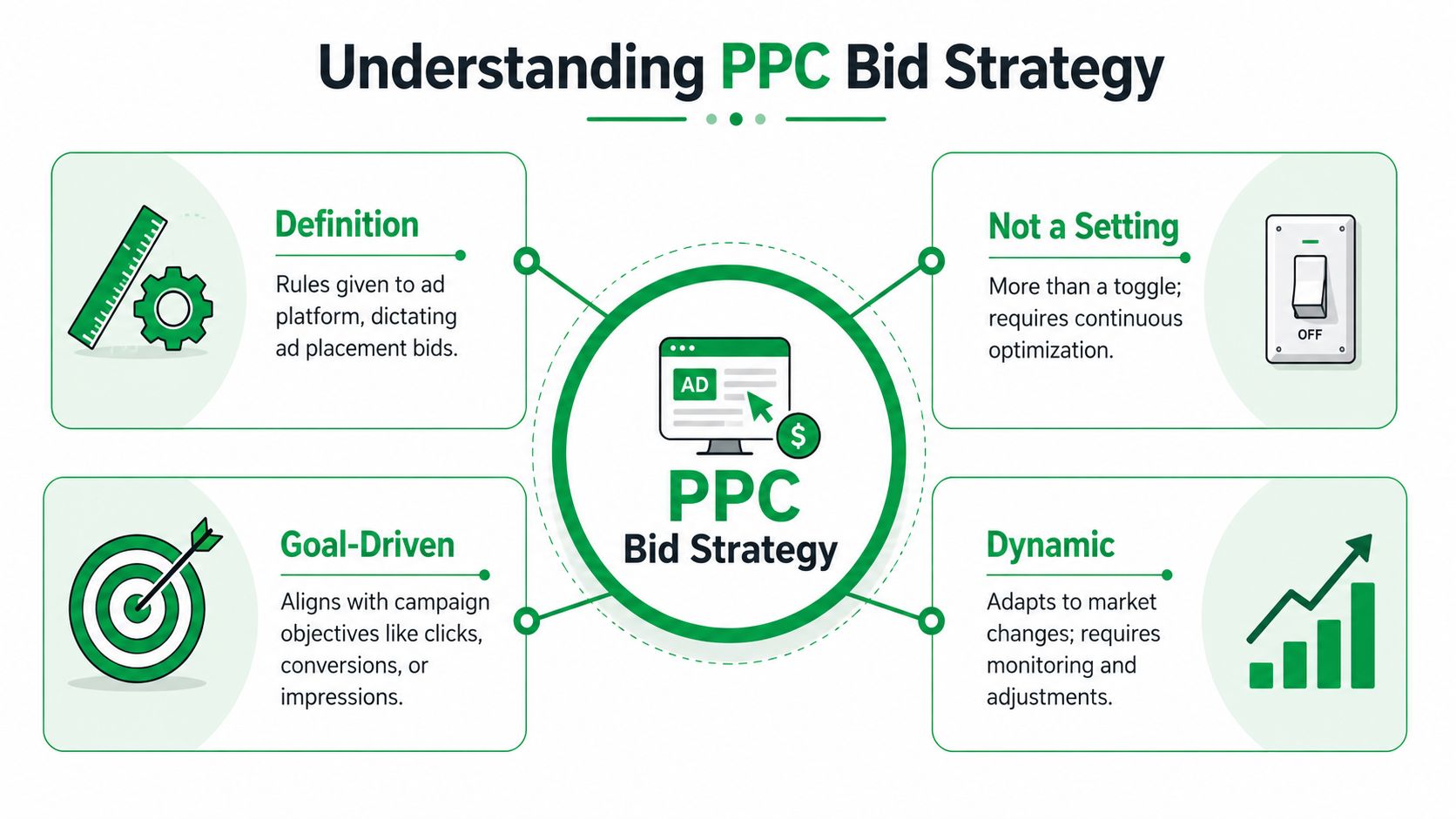
PPC Bid Strategy: It’s not just a setting
Many managers often get tripped up. They treat bid strategy like a toggle. Switch from Manual CPC to Target CPA. Done. But that’s not how it behaves in a live account.
A real PPC bid strategy includes:
- The campaign objective: traffic, leads, visibility, revenue, or profit efficiency
- The success metric: clicks, conversions, CPA, ROAS, impression share
- The data inputs: conversion tracking, audience signals, device performance, query intent
- The operating rules: targets, budget tolerance, when to intervene, and when to leave it alone
That’s why “automated” never means hands-off. It means the platform manages auction-time decisions while you manage the business logic.
Manual control versus machine control
Manual bidding still has a place. It’s useful when you need close control over keyword-level behavior, when volume is thin, or when you’re validating early demand. But it becomes hard to scale because a person can’t evaluate every auction signal in real time.
Automated strategies shine when the account has enough conversion history and the goal is clear. The platform can adjust faster than a human across device, time, audience, and contextual signals. Still, if the goal is fuzzy, automation just gets better at being wrong.
For heavily regulated or high-intent verticals, the basics matter even more. A comprehensive guide to legal marketing is a good reminder that bid strategy has to follow the economics of the business, not just platform defaults. If you want a broader primer before tightening bidding logic, this PPC marketing demystified guide gives the wider paid search context.
A bid strategy doesn’t create demand. It decides how aggressively you compete for the demand that already exists.
PPC Bid Strategy: Comparing the Major Automated Bid Strategies
Once you move into automation, the menu gets crowded fast. Some strategies optimize for volume. Some optimize for efficiency. Some are best for top-of-funnel visibility. Others are built for hard economics.
The easiest way to choose is to stop thinking in platform language and start thinking in operating intent.
Automated bid strategy comparison
| Bid Strategy | Primary Goal | Best For | Main KPI |
|---|---|---|---|
| Maximize Clicks | Drive as many visits as possible within budget | Traffic campaigns, early data gathering, awareness support | Click volume |
| Maximize Conversions | Generate the highest number of conversions within budget | Lead gen or ecommerce campaigns with solid tracking and flexible efficiency targets | Conversion volume |
| Target CPA | Hold acquisition costs around a defined target | Lead generation, appointment booking, demo requests, form fills | Cost per acquisition |
| Target ROAS | Optimize toward revenue efficiency | Ecommerce, catalog sales, accounts with reliable conversion value tracking | Return on ad spend |
| Target Impression Share | Increase visibility in search results | Brand defense, competitor conquesting, awareness campaigns | Impression share / top-of-page presence |
| Enhanced CPC | Blend manual bids with automated adjustment | Accounts that want a middle ground between control and machine assistance | Conversion efficiency from manual baseline |
What each one actually does in the field
Maximize Clicks is blunt by design. It’s useful when traffic is the outcome, or when you need to generate enough site activity to learn which queries, ad groups, or landing pages deserve more investment. It’s not ideal when low-quality traffic can overwhelm sales teams or distort reporting.
Maximize Conversions works well when you care more about total conversion volume than a fixed efficiency target. This often fits accounts in growth mode, especially when the business can tolerate some fluctuation while the system finds conversion pockets.
Target CPA is usually the cleanest fit for lead generation. If a qualified form fill or phone call has a relatively stable value, CPA-based bidding gives the system a concrete target. The trap is obvious. Set the target too low and the campaign can choke off delivery.
Target ROAS belongs in revenue-led accounts. Retailers, DTC brands, and catalog advertisers use it when conversion value tracking is dependable and margin discipline matters. If revenue data is incomplete, this strategy becomes guesswork with better branding.
Target Impression Share is strategic, not glamorous. It’s useful when showing up matters more than direct response. Brand campaigns, new market entry, reputation defense. Different job, different metric.
Enhanced CPC sits in the middle. You keep more baseline control, but the platform can still push bids up or down when it sees stronger or weaker conversion likelihood.
PPC Bid Strategy: The trade-offs most teams miss
A lot of articles present these strategies like clean buckets. Real accounts are messier. Maximize Conversions can outperform Target CPA when your targets are too restrictive. Target ROAS can underdeliver if the catalog has uneven pricing and weak value signals. Enhanced CPC can feel safer, but it can also preserve too much manual baggage from an account that really needs a reset.
If you want a bigger-picture take on how machine learning is reshaping this decision, The AI CMO on PPC automation is worth reading alongside your platform docs.
Pick the strategy for the KPI you’re judged on, not the metric that makes the dashboard look busiest.
PPC Bid Strategy: How to Choose the Right Bid Strategy for Your Goals
The right bidding choice starts with the business model. Not with what Google recommends. Not with what worked in another account. The question is simple. What outcome are you buying?
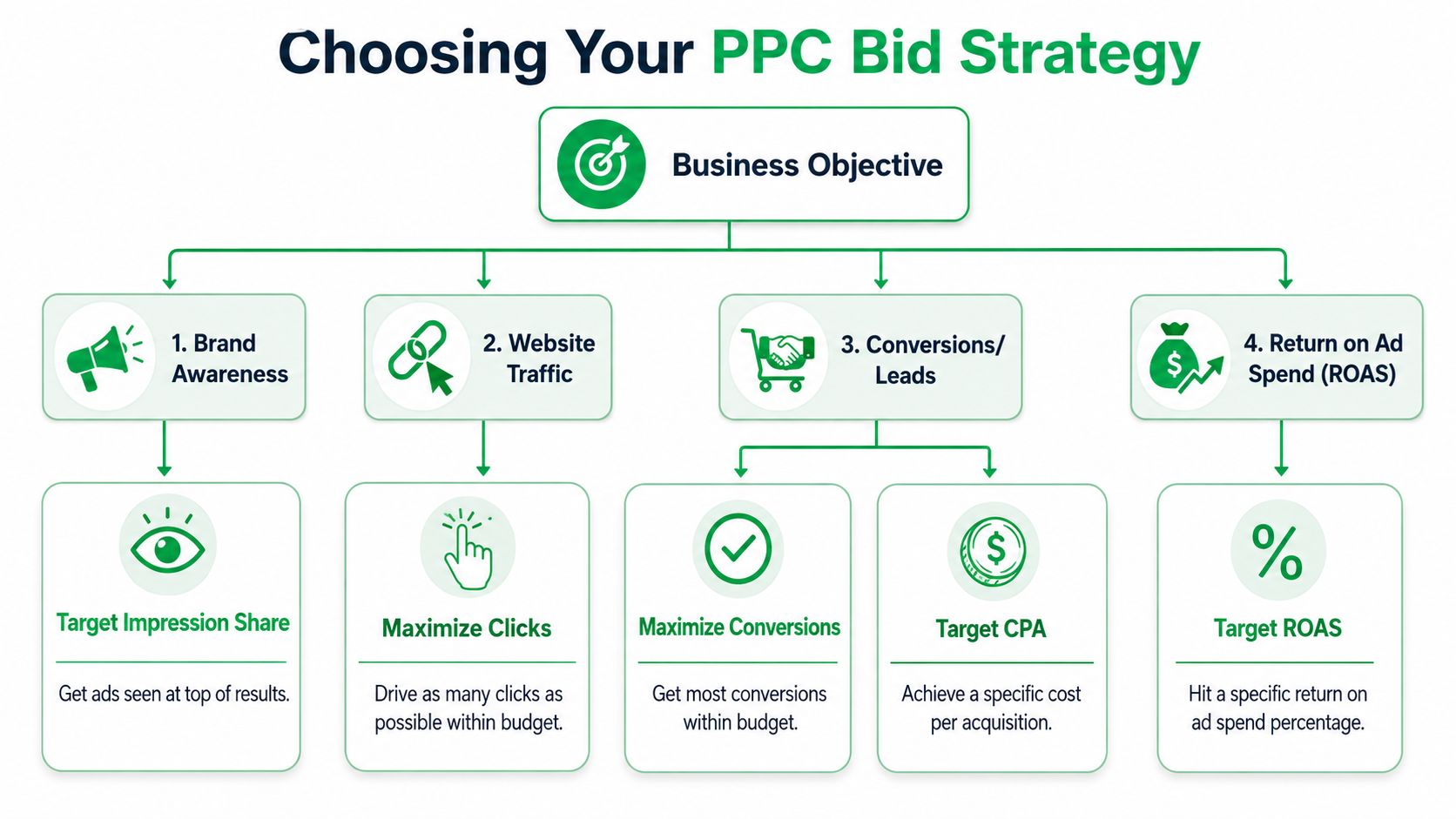
Match the strategy to the business objective
If the goal is brand awareness, visibility matters more than direct response. Target Impression Share makes sense when you need top-of-page presence for brand terms, category terms, or location-based dominance.
If the goal is website traffic, use Maximize Clicks carefully. It’s useful when you’re testing new markets, filling remarketing pools, or learning which search themes attract viable visitors. It is not a lead quality strategy.
If the goal is leads or booked consultations, look first at Maximize Conversions or Target CPA. Maximize Conversions is often the better starting point when the account needs to discover where conversion volume exists. Target CPA is stronger when you already know the rough acquisition cost the business can sustain.
If the goal is revenue efficiency, Target ROAS is the natural fit. That applies to ecommerce, subscription plans with assigned conversion value, and multi-product accounts where order values vary.
Here’s a helpful visual reference before you choose:
PPC Bid Strategy: The learning phase can punish bad timing
The biggest mistake isn’t choosing the wrong strategy on paper. It’s choosing the right strategy too early.
Smart Bidding in Google Ads delivers 14–18% more conversions only when a campaign hits 100+ monthly conversions, but below 50 monthly conversions you’ll see 20–30% CPA volatility because the algorithm has no training data to optimize from, based on Improvado’s PPC analysis. That’s the part many teams skip. They hear “automation works” and ignore the data threshold behind it.
A practical decision framework
Use this sequence instead of picking by gut:
- Start with the true business outcome
A law firm usually wants qualified consultations. A plumbing company wants calls. A retailer wants profitable orders. Different economics. Different bid logic. - Check whether conversion tracking matches that outcome
If the account treats every micro-action as equal, Target CPA and Target ROAS won’t behave well. - Assess data depth before moving to tighter automation
Thin conversion history usually calls for simpler bidding first. Gather signal. Then get more specific. - Choose the strategy that matches decision quality, not just ambition
A mature ecommerce account can push into ROAS bidding. A fresh local service campaign may need to begin with clicks or broad conversion gathering. - Separate campaign types
Brand, non-brand, remarketing, and product-specific campaigns often need different bidding approaches. Mixing them muddies performance.
Decision shortcut: If you don’t yet trust the conversion data, don’t trust an efficiency-based automated strategy.
PPC Bid Strategy: Implementing and Testing Your New Strategy
Changing a bid strategy takes about ten seconds in the platform. Cleaning up the consequences can take weeks if you do it badly.
The first check is mechanical. Tracking has to be accurate. Conversion actions need to reflect outcomes the business values. Budgets need enough room for the strategy to gather data. If any of that is off, the system starts learning from broken signals.
What to lock down before launch
Tracking first. A Target CPA campaign without reliable lead tracking is just automated drift. The same goes for Target ROAS without conversion values.
Campaign structure second. Keep campaign intent clean. Don’t mix brand and non-brand. Don’t dump wildly different product categories into one budget if purchase behavior differs.
Targets third. Start with targets the account can realistically reach based on recent history. Ambition is good. Fantasy targets aren’t.
For smaller advertisers, a lot of problems begin with this. A practical reference point is this overview of PPC management for small business, especially if budget constraints are already shaping every decision.
PPC Bid Strategy: Respect the learning period
Automated bidding needs room to observe, test, and recalibrate. Early swings are normal. What kills performance is constant intervention during that phase.
For Target CPA or Target ROAS to function with statistical reliability, a campaign must generate a minimum of 15–20 conversion events per month; below that, the algorithm can misclassify bid opportunities, as noted by Straight North’s foundational PPC strategy guide. That threshold matters because low-event campaigns produce unstable patterns. The system sees random noise and treats it like instruction.
A clean testing method
Don’t test three things at once. That’s where teams lose the plot.
- Change one primary variable: If you’re testing a new bid strategy, leave ads and landing pages stable if possible.
- Define the success lens in advance: Lead volume, lead quality, CPA consistency, revenue efficiency. Pick the one that matters most.
- Avoid daily panic edits: Repeated target changes can keep the campaign in a permanent relearning loop.
- Document context: Seasonality, promo windows, sales team changes, and inventory issues all affect perceived bidding performance.
A good test is boring. Controlled inputs. Clear objective. Enough time to collect signal. Then a decision.
PPC Bid Strategy: Common Pitfalls and Pro Optimization Tips
Most bidding problems aren’t technical. They’re behavioral. Teams push too hard, react too fast, or expect the platform to overcome weak fundamentals.
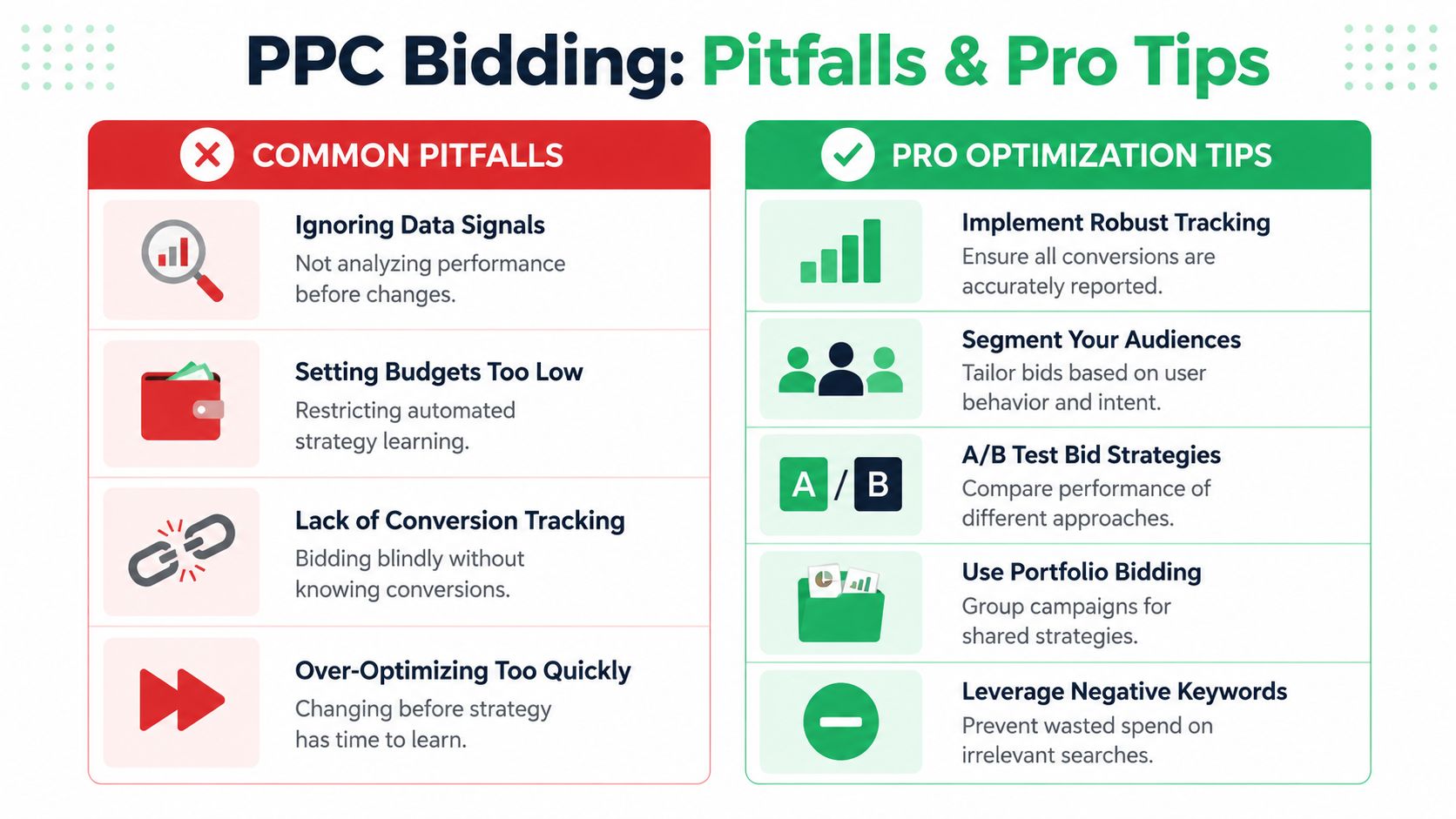
PPC Bid Strategy: What most people get wrong
- They set targets the market can’t support
A very low CPA target can starve a campaign. A very high ROAS target can suppress traffic until the account barely serves. - They optimize before the system has learned enough
A few bad days don’t always mean the strategy is broken. Sometimes the account is just unstable because the inputs keep changing. - They assume automation replaces account hygiene
It doesn’t. Negative keywords, search term review, campaign segmentation, audience quality, and landing page alignment still matter. A lot. - They ignore platform-specific bid mechanics
This is especially costly in Amazon PPC, where bid movement can affect visibility abruptly.
The Amazon caution that saves impressions
One of the more useful Amazon rules is also one of the simplest. You should never decrease your bid by more than 5 cents at once, because a 10-cent or 50-cent drop can cause a huge traffic collapse, based on this Amazon PPC expert discussion on YouTube. That kind of hard threshold sounds minor until you kill momentum on a term that was still driving useful placements.
That principle matters beyond Amazon. Big bid swings often create false readouts. You think you’re optimizing. You’re in fact shocking the system.
Small bid moves teach you something. Large bid moves erase the lesson.
Better habits that actually improve bidding
Use negative keywords aggressively. This reduces wasted spend and gives automated strategies cleaner search intent to work with.
Segment by intent. Don’t ask one campaign to solve awareness, lead generation, and remarketing at the same time.
Adjust slower than your instincts want to. Fragment. Especially after a rough day. That’s when bad edits happen.
Tie bidding reviews to business outcomes. If lead quantity rises but close rates fall, the bid strategy may be optimizing for the wrong conversion event.
Your PPC Bid Strategy Audit Checklist
A strong audit doesn’t ask whether the account is “using automation.” It asks whether the current strategy fits the job, has the right inputs, and has enough room to work.
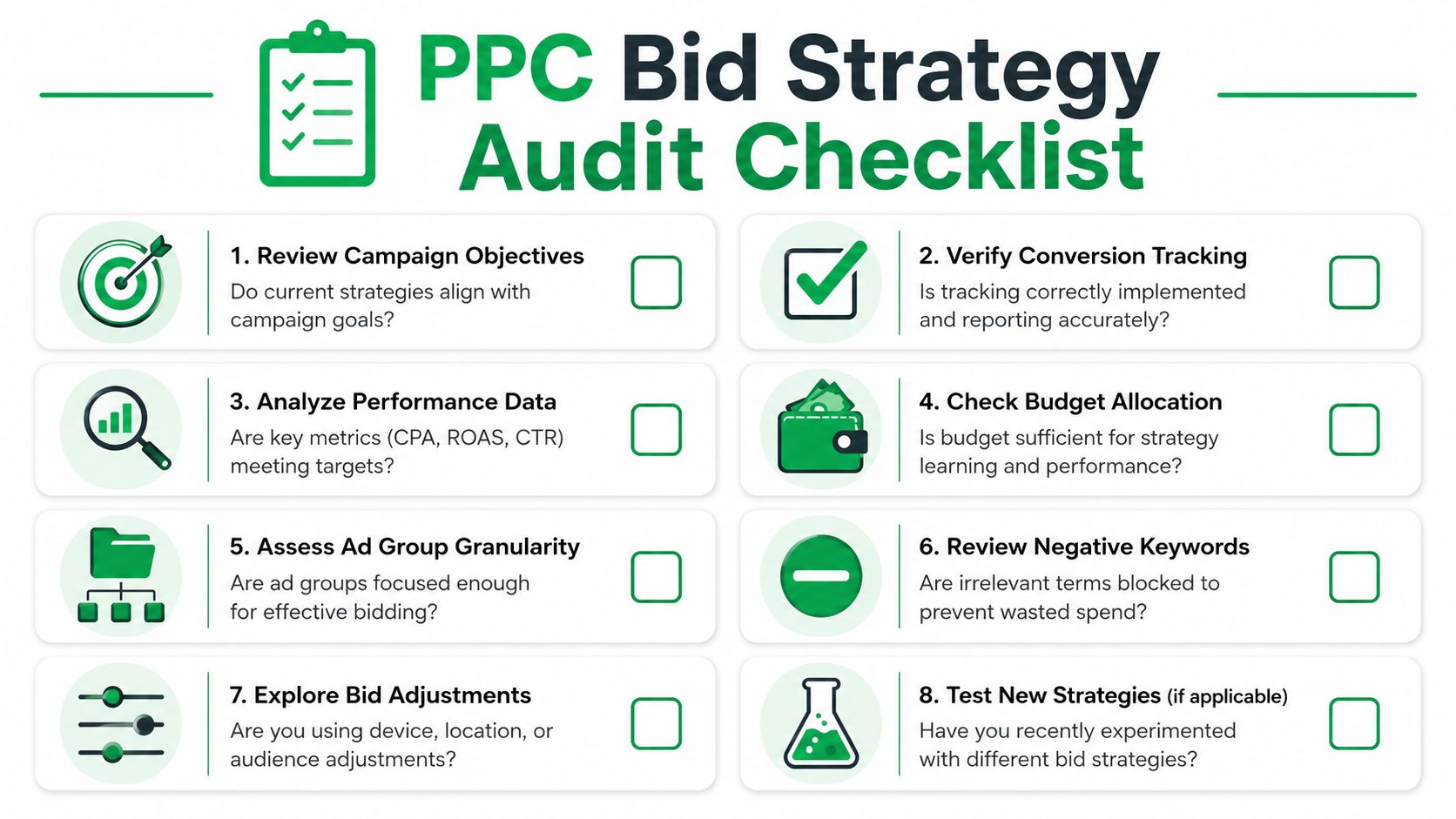
Run through these questions campaign by campaign
- Objective fit
Does the campaign goal match the bid strategy, or are you chasing clicks in a campaign that should be judged on leads or revenue? - Tracking integrity
Are primary conversions recorded accurately, and are low-value actions separated from real business outcomes? - Data sufficiency
Does this campaign produce enough meaningful conversion history for the strategy you’ve assigned to it? - Target realism
Is your CPA or ROAS target grounded in recent account behavior, or is it aspirational to the point of suppressing delivery? - Budget support
Can the campaign gather enough signal at its current budget, or are you starving the strategy? - Search quality controls
Are negative keywords updated and intent segmentation clean? - Auction nuance
Are you using bid adjustments, placement logic, or campaign separation where the platform warrants it?
One Amazon checkpoint worth keeping
For Amazon PPC launches, a practical starting point is to begin bids at the lower end of the suggested range and apply a 50% Top of Search multiplier, then raise the multiplier every couple days if impressions don’t come through, adjusting based on clicks and conversions, as outlined in this Amazon seller discussion on bid setup. It’s a disciplined way to buy visibility without blindly overbidding from day one.
Don’t audit in isolation
Bidding is only one part of performance. If you’re reviewing campaign health properly, fold in conversion quality, landing page behavior, and the broader measurement setup too. This guide on how to measure marketing campaign effectiveness is useful for connecting bidding decisions to actual business results instead of platform-only metrics.
If you can answer every question in this checklist with confidence, the account is probably in decent shape. If several answers are fuzzy, that’s your signal. Not to tinker randomly. To audit deeper.
If you want a second set of expert eyes on your bidding logic, tracking, and wasted spend, Mr. Green Marketing, LLC can help. The team audits PPC accounts with a strategy-first lens, identifies where automation is helping or hurting, and maps out the quickest path to cleaner performance.
Leave a Comment
sing in to post your comment or sign-up if you dont have any account.