
SEO PPC Services: You’re probably in the same spot a lot of owners land in.
You need leads now. Sales calls. Demo requests. Form fills. Revenue this quarter. But you also know you can’t rent attention forever, so you start looking at SEO. Then PPC. Then agency pitches. Then conflicting advice. One person says SEO is the long game. Another says PPC is the only way to scale fast.
And that’s where the confusion starts.
The mistake isn’t choosing the wrong channel. It’s treating seo ppc services like two separate purchases instead of one search growth system. When they run in silos, you waste data, duplicate effort, and miss the chance to turn search into a compounding lead engine.
SEO PPC Services: The False Choice Between SEO and PPC
A common scenario looks like this. A business launches a new site, traffic is thin, and the pipeline is soft. The team hears SEO takes time, so they hesitate. Then they hear PPC can generate demand immediately, so they shift budget there. A few months later, paid leads arrive, but costs keep showing up every month, and organic visibility still hasn’t moved.
That’s not a channel problem. It’s a strategy problem.

Why the choice feels harder than it should
Most owners get handed a false binary.
SEO gets positioned as the patient, disciplined option. PPC gets framed as the fast, expensive option. Both descriptions are partly true, but neither tells you how a real search program should run. Search isn’t a philosophy debate. It’s a visibility problem tied directly to pipeline.
And on Google, visibility is concentrated. Nearly 91% of the global search market is owned by Google, and less than 1% of searchers click through to the second page, according to WebFX’s SEO statistics roundup. That means page-one presence matters whether it comes from ads, organic listings, or both.
SEO PPC Services: What integrated search actually does
Think peanut butter and jelly. Fine on their own. Better together.
SEO builds the durable layer. It earns trust, compounds over time, and gives you a traffic asset you don’t have to rebuy every day. PPC gives you speed. It puts offers in front of buyers quickly, helps you test intent, and gives your team immediate readouts on what people click and convert on.
Practical rule: If your SEO and PPC teams can’t tell you which keywords, landing pages, and offers overlap, you don’t have an integrated search strategy. You have two channels spending money separately.
That’s why “SEO or PPC?” is usually the wrong question. The better question is, “What job should each channel do right now to produce more leads and better long-term margin?”
For most businesses, the answer isn’t either-or. It’s role clarity.
SEO PPC Services Explained Without The Jargon
SEO and PPC get overcomplicated fast. They don’t need to be.
SEO is like owning a storefront on a busy street. It takes time to build, maintain, and improve. But once it’s established, people keep finding you without you paying for every single visit. PPC is like renting the biggest sign at the intersection. You can be visible quickly, target specific searches, and change the message fast. But when you stop paying, that visibility disappears.
If you want a cleaner foundation before you evaluate vendors or budgets, this short guide on understanding SEO and SEM is useful because it separates the terms without agency jargon.
What SEO actually includes
SEO work usually covers things like:
- Keyword targeting: Choosing the terms that match buying intent, not just search volume.
- Content development: Building service pages, product pages, comparison pages, and educational content that answers real searches.
- On-page optimization: Tightening titles, headings, internal links, and page structure so search engines and users both understand the page.
- Technical health: Making sure the site is crawlable, fast enough, organized well, and not full of preventable issues.
The business outcome is straightforward. Better non-paid visibility for the searches that matter.
SEO PPC Services: What PPC actually includes
PPC is more immediate and more controlled.
You choose the keywords, geography, audiences, budgets, offers, and landing pages. You write the ad, launch the campaign, and start seeing click and conversion behavior quickly. That speed is the big advantage. You’re not waiting for rankings to settle before learning what message works.
And the economics reflect that trade-off. In 2026, PPC typically delivers about a 200% ROI, or about $2 in revenue for every $1 spent, while SEO is reported to deliver an 8x ROI, according to WordStream’s digital marketing statistics. That doesn’t mean PPC is bad and SEO is good. It means they solve different problems.
The simple difference that matters
Use SEO when you want to build a durable acquisition asset.
Use PPC when you need speed, validation, or controlled testing.
Use both when you want search to produce leads now and lower acquisition pressure later.
PPC rents attention. SEO builds equity.
That’s the cleanest way to explain seo ppc services to a business owner who just wants to know where the next qualified lead is coming from.
SEO PPC Services: The Real Power The SEO and PPC Flywheel
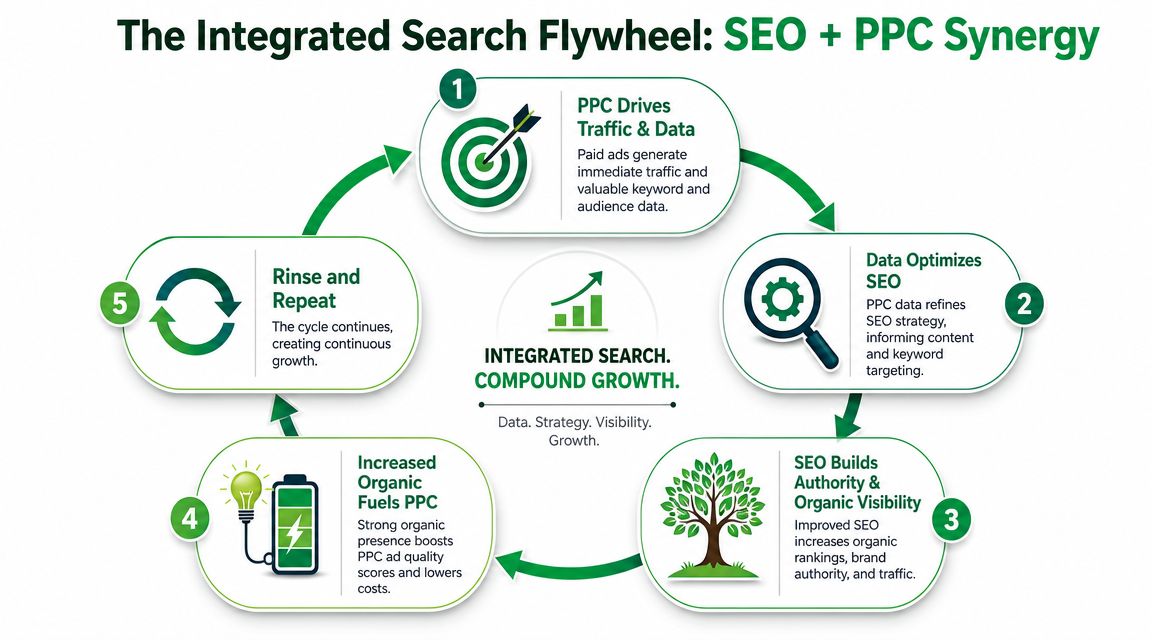
A good PPC campaign can tell you what buyers respond to. A good SEO campaign can turn that insight into a long-term traffic asset. Put them together and you get a flywheel, not two disconnected tactics.
That’s the part most businesses miss.
Start with one keyword universe
The strongest operating model uses a shared keyword universe, not one keyword list for SEO and another for paid. That means both teams work from the same commercial search environment, then assign roles based on speed, intent, and cost.
The tactical loop is simple. Mine PPC search-term reports for converting queries, then move those terms into SEO page targeting and content creation, as explained in Orange Monk’s guide to integrating SEO and PPC services.
That one habit changes the quality of SEO planning. Instead of guessing which topics might matter, you promote the terms that have already shown commercial value.
SEO PPC Services: How the flywheel works in practice
Here’s the working sequence:
- PPC launches first on priority terms.
You buy fast visibility for high-intent searches and gather CTR, CVR, and search-term data. - Winning queries move into SEO.
Those proven terms get mapped to service pages, collection pages, FAQs, blog content, title tags, headings, and internal links. - Organic pages mature over time.
As those pages improve, they start capturing demand without needing a click-by-click ad payment. - Paid gets sharper.
PPC budgets can stay focused on the terms, geographies, and offers where paid placement still does the most work.
And then you repeat it.
For teams trying to tighten campaign structure and reporting, tools that streamline Google Ads performance can help organize the paid side of that loop so SEO decisions are based on cleaner data.
A broader search planning framework helps too. This article on search engine marketing strategies is useful if you need to map integrated search into the rest of your acquisition mix.
What doesn’t work
A few patterns consistently break the flywheel:
- Separate teams with separate KPIs: SEO chases rankings while PPC chases clicks, and nobody owns revenue from search as a whole.
- Duplicate landing pages with mixed messaging: The ad promise says one thing, the organic page says another, and conversion suffers.
- PPC used only for lead generation: Valuable keyword and message data stays trapped in the ad account instead of shaping organic growth.
- SEO built from guesswork: Content gets published around assumptions, not validated demand.
Here’s a useful watch if you want a visual explanation of integrated search mechanics:
The best SEO content ideas often come from paid search terms that have already proven buyer intent.
That’s the flywheel. PPC de-risks what SEO should build. SEO reduces your dependence on paying for every visit forever.
SEO PPC Services: When to Prioritize One Channel Over The Other
Integration is the target. But budgets, timing, and business stage still matter. Sometimes one channel needs to take the lead for a while.
That’s normal.
The practical question isn’t whether you should combine seo ppc services eventually. It’s when combining them creates better economics than running one alone. Recent guidance around this trade-off points to a useful pattern: for many mid-market firms, PPC works best when used selectively for high-intent queries or tests, while SEO absorbs durable demand, which helps avoid wasted spend as ad competition rises, as discussed in this search strategy video about SEO and PPC ROI thresholds.
Situations where SEO should lead
SEO should usually take priority when:
- You need long-term acquisition efficiency: The business wants a stronger non-paid lead source over time.
- You already have subject-matter depth: There’s real expertise to turn into service pages, guides, FAQs, and product content.
- Paid costs are squeezing margin: You can’t keep expanding ad spend without pressure on profitability.
- Your category has repeat informational demand: Buyers search before they buy, compare providers, and revisit options.
Situations where PPC should lead
PPC should usually lead when:
- You need leads quickly: A new market launch, a sales drought, or a time-sensitive promotion needs immediate demand capture.
- You’re testing a new offer: Paid search lets you validate messaging and landing pages before investing heavily in long-term content.
- Your site has little authority today: Organic traction may take time, so paid can bridge the gap.
- Geographic precision matters: You want to test specific cities, service areas, or local offers before broader expansion.
SEO PPC Services: SEO vs. PPC Prioritization by Business Goal
| Business Goal | Prioritize SEO When… | Prioritize PPC When… | Go Fully Integrated When… |
|---|---|---|---|
| Speed to market | you can wait for content and page improvements to build momentum | you need immediate visibility for active searches | you need leads now but also want to reduce paid dependence later |
| Long-term asset building | your focus is durable visibility and trust | the business only needs short-term campaign support | you want paid testing to guide which assets deserve SEO investment |
| Limited budget | you need to build a channel that compounds over time | a narrow set of high-intent terms can produce near-term value | you can keep PPC tightly scoped while SEO captures broader durable demand |
| New website or new market | you’re prepared for a slower ramp and have strong content resources | you need immediate market feedback and faster validation | you want paid search data to shape your first organic pages |
| Product or service launch | the offer has long buying cycles and educational demand | the launch needs immediate controlled exposure | you need launch speed plus a content base that keeps working after the launch window |
| Conversion improvement | your site already earns relevant organic traffic but needs better page intent matching | you want to test headlines, offers, and landing page angles quickly | you want PPC lessons applied to SEO pages and SEO insights applied to paid campaigns |
And yes, there are times when PPC should stay selective for a long time. Especially in categories where broad keyword expansion attracts weak clicks. More traffic isn’t the goal. Better buyers are.
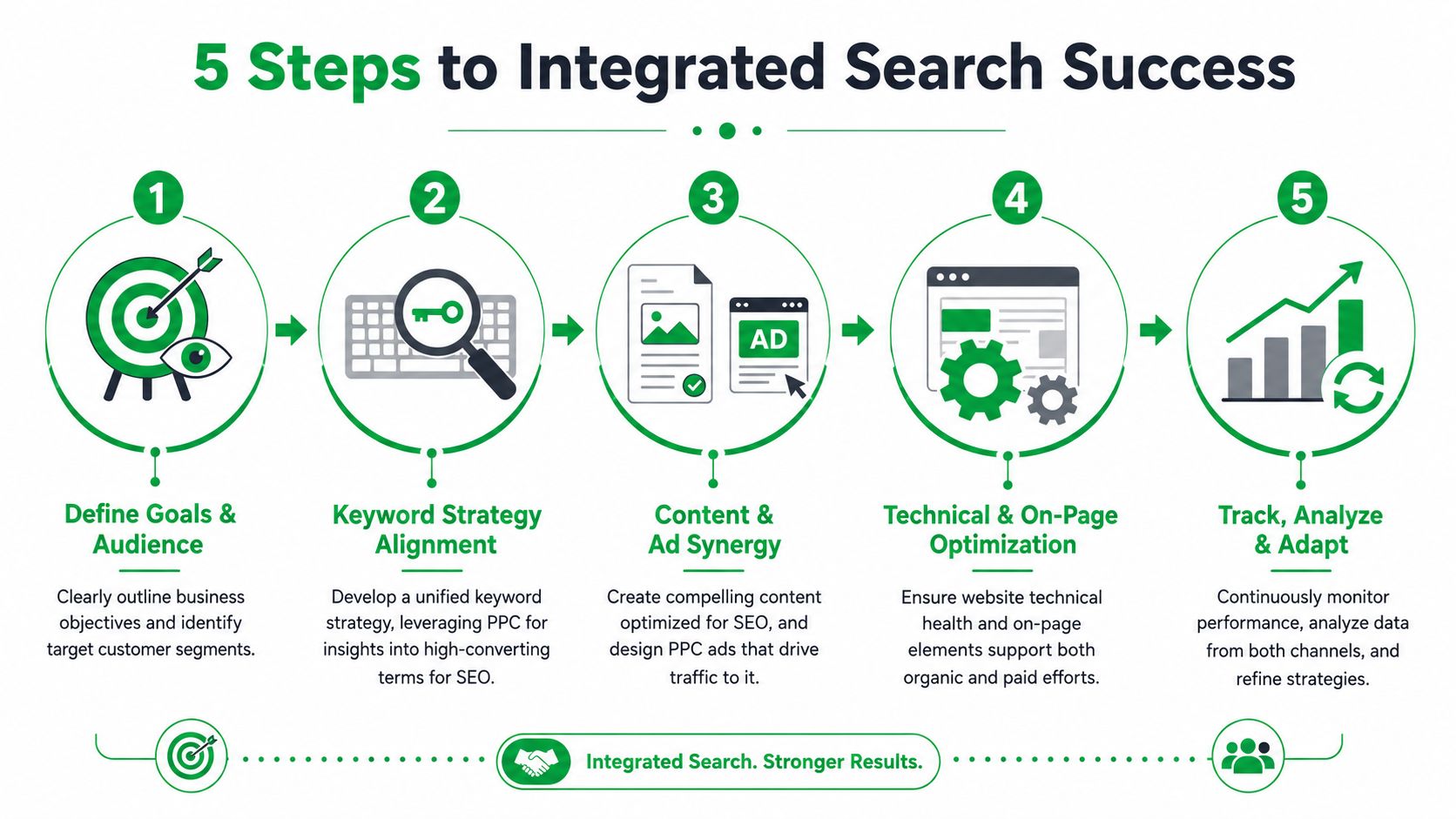
SEO PPC Services: A 5-Step Roadmap to Integrated Search Success
A common scenario. A company spends months waiting for SEO pages to rank while paid search burns budget on terms nobody turns into revenue from. Two teams. Two reports. No shared learning.
Integrated search fixes that with one operating system. In an AI-shaped search environment where clicks are harder to win and attribution is less clean, PPC does more than capture demand. It pressure-tests demand fast. SEO turns those findings into assets that keep producing leads after the click is gone. That closed loop matters more now because search behavior changes faster than static keyword plans do. Google touches on the changing roles of both channels in this Google Business discussion of SEO vs. PPC.
SEO PPC Services: Step 1 Build one keyword map
Start with a single source of truth.
SEO and PPC should work from the same keyword map, grouped by intent and business value. Brand terms. High-intent service terms. Comparisons. Problem-aware searches. Local modifiers. Question queries. Then assign each cluster a role. Paid search tests the terms that can produce leads quickly. SEO builds pages around the themes that deserve long-term ownership.
That sounds simple. It is. And it prevents a costly mistake. Paying for one message while publishing a different one organically.
SEO PPC Services: Step 2 Launch paid tests where buyer intent is clearest
Start narrow. Small campaigns. Tight match types. Strong negatives. Landing pages built for one job.
The goal is not to buy as much traffic as possible. The goal is to learn which searches produce the right kind of lead and which message gets that person to act. PPC is the fast-feedback layer of the system. It tells you whether buyers respond to “emergency repair,” “same-day service,” “free consultation,” or something else entirely.
And in such circumstances, a lot of wasted spend hides. Businesses keep paying for clicks without turning search-term reports into strategy. That is tuition without a lesson.
SEO PPC Services: Step 3 Move paid insights into SEO decisions
Use winning PPC signals to shape organic pages.
If a query drives qualified calls in paid search, it belongs in SEO planning. Put it where it matters. Title tags, H1s, page copy, FAQs, internal links, comparison pages, and supporting content. If one offer angle gets better form fills than another, carry that language into organic landing pages.
This is the peanut butter and jelly part. PPC supplies fast taste tests. SEO turns the best combinations into something durable.
And the loop runs both ways. Organic search data often surfaces long-tail questions, objections, and informational intent that paid campaigns can use for new ad groups, audience exclusions, and landing page variants.
SEO PPC Services: Step 4 Build pages that deserve to rank and convert
Now build around proven demand, not hunches.
That usually means service pages, location pages, product category pages, comparison pages, and decision-stage resources. Pages tied to revenue. Pages sales teams can point prospects to. Pages that answer the exact questions buyers ask before they call or book.
Some teams also model the payoff before expanding content production. A tool like the BlazeHive SEO calculator can help estimate whether a term cluster is worth turning into a full SEO asset set.
SEO PPC Services: Step 5 Run the flywheel every month
At this point, integrated search either compounds or stalls.
Review paid search terms and isolate converting queries, weak clicks, and message patterns. Check organic query reports for emerging questions and page gaps. Update landing pages based on what real prospects respond to. Shift budget away from terms SEO now covers well and keep paid spend on the queries where speed, coverage, or testing still matter.
And keep the review tied to business outcomes. Which searches produce qualified calls. Which pages create booked meetings. Which campaigns bring in revenue at a sane cost. If your reporting does not connect channel activity to those outcomes, fix the measurement setup before scaling. This guide on how to measure marketing campaign effectiveness is a useful framework.
That is the flywheel. PPC validates demand and messaging. SEO turns those wins into durable visibility. SEO uncovers new topics and intent patterns. PPC tests them faster. And each cycle gets sharper because both channels are learning from the same buyers, not operating in separate silos.
SEO PPC Services: Measuring What Matters True KPIs for Integrated Search
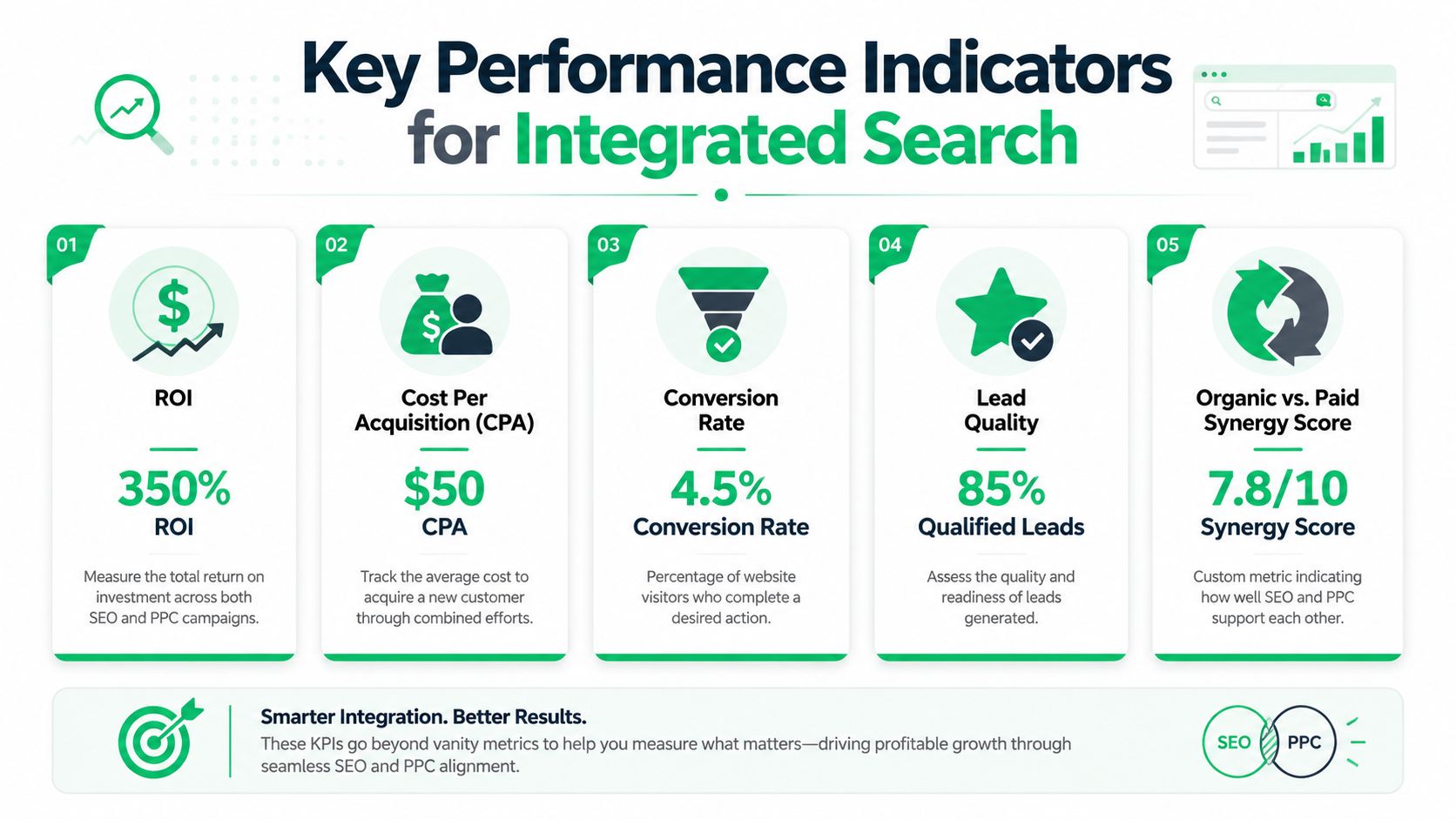
A lot of reporting still overvalues the easy stuff. Clicks. Impressions. Average position screenshots. They’re not useless, but they don’t tell a business owner what matters most.
Revenue does. Qualified leads do. Sales pipeline does.
Track channel KPIs, but don’t stop there
For SEO, useful KPIs usually include:
- Organic conversions: Not just traffic. Actions tied to calls, forms, demos, or purchases.
- Qualified organic leads: The leads sales wants.
- Revenue from organic landing pages: Which pages influence real business outcomes.
- Query-to-page alignment: Whether the right searches land on the right pages.
For PPC, the core list usually includes:
- Cost per lead or acquisition: Are you buying customers at a sustainable cost?
- Conversion rate by campaign and landing page: Which combinations produce action.
- Search-term quality: Which queries deserve expansion and which need negatives.
- Return from ad spend: Whether paid search is a growth lever or just a bill.
The blended KPIs are where the truth lives
The true test of integrated seo ppc services is the combined view.
Track metrics like:
- Total search-driven revenue: Organic plus paid together.
- Blended cost per lead: What it costs across the full search program, not by one silo.
- Lead quality by channel mix: Whether integrated search produces better opportunities than either channel alone.
- Search coverage on priority terms: Whether your brand shows up consistently across the searches that matter most.
A calculator can help sanity-check assumptions before you commit to targets. The BlazeHive SEO calculator is a practical example for modeling SEO return scenarios against business inputs.
If you’re tightening reporting with stakeholders, this guide on how to measure marketing campaign effectiveness is a useful companion because it pushes the conversation past vanity metrics.
If reporting doesn’t connect search activity to leads, sales opportunities, or revenue, it’s operational theater.
SEO PPC Services: What a healthy reporting cadence looks like
Keep reporting simple enough to use.
A monthly integrated review should answer:
- Which queries are generating qualified actions?
- Which landing pages are converting across both channels?
- Where is paid buying insight that SEO can turn into a durable asset?
- Where is SEO expanding visibility that lets paid stay more selective?
That kind of reporting changes decisions. And decisions are what improve performance.
How to Choose an Agency and What to Expect
You hire an agency to grow leads. Six months later, the SEO team is celebrating higher rankings, the PPC team is reporting more clicks, and nobody can show which work improved pipeline. I see that pattern a lot. It usually comes from one problem. The agency runs two channels, but not one search system.
That matters because the true upside sits in the connection points. PPC should tell SEO which queries convert, which offers pull in qualified buyers, and which landing page messages deserve permanent organic content. SEO should tell PPC where the site already has authority, where paid spend can stay selective, and where new content can lower acquisition costs over time. Peanut butter and jelly. Useful on their own. Better together.
A good agency has an operating model for that loop. Not just separate specialists under the same roof.
SEO PPC Services: What to ask before you sign
Start with process, not promises. Ask how search data moves from one team to the other, who owns that handoff, and how often decisions get made from shared reporting. If the answer sounds improvised, expect channel silos and slow progress.
Then get specific:
- How do your SEO and PPC teams share data each month? You want a defined workflow, not occasional Slack messages.
- How do you decide which terms belong in paid, organic, or both? Good agencies have rules based on speed, competition, conversion intent, and margin.
- How does PPC search-term data shape the SEO content calendar? This should be standard practice.
- How do SEO insights change paid strategy? For example, pausing spend on low-value terms once organic visibility improves, or shifting budget to high-intent gaps.
- What do you report beyond traffic and clicks? Look for lead quality, cost per qualified lead, close rate trends, and revenue contribution.
- Who owns landing page testing and message match? If nobody owns it, performance stalls fast.
Commercial structure matters too. Some agencies charge one retainer and manage integrated search as a single program. Others split SEO and PPC into separate scopes, separate meetings, and separate goals. That can work, but only if one person is clearly responsible for the combined result. Otherwise you get polite updates and weak coordination.
And ask what the first 90 days look like. A serious partner should be able to explain the sequence. Audit paid search terms. Map them to existing pages. Find content gaps tied to real buying intent. Tighten landing pages. Test offers and headlines in PPC first. Then roll winning themes into SEO pages that can keep producing leads after the ad spend is gone. That is the flywheel in practice.
A useful gut-check is this guide on how to choose a digital marketing agency. It helps separate polished sales language from an agency that can run the work.
Expect realism.
No credible partner should promise instant dominance, guaranteed rankings, or endlessly cheap leads. Good seo ppc services involve trade-offs. Paid search gives speed, but costs rise fast in competitive auctions. SEO builds durable visibility, but takes time and operational discipline. And in AI-driven search, that coordination matters even more because search behavior changes quickly. The agencies worth hiring adjust fast, test constantly, and keep tying every decision back to leads and revenue.
Next Steps
If you want a clearer view of where your search strategy is leaking budget or missing demand, Mr. Green Marketing, LLC offers a free, no-obligation audit and performance review. It’s a practical starting point for businesses that want SEO and PPC working as one growth engine instead of two disconnected tactics.
Leave a Comment
sing in to post your comment or sign-up if you dont have any account.