
Best Technical SEO Agency: You’re probably here because the website looks good, the team shipped the redesign, and organic growth still feels stuck. Pages exist. Content exists. The brand story is clear. Yet rankings drift, important pages don’t show up, and sales or lead volume from search never quite matches the effort.
That’s usually when the conversation shifts from marketing surface work to website infrastructure. Not glamorous. Very important.
A technical SEO agency sits in that layer between your site, your developers, and search engines. It fixes the things that keep strong content from performing. And if you hire the right one, the result isn’t just a cleaner audit. It’s a site that gets crawled properly, indexed correctly, and trusted enough to compete.
Best Technical SEO Agency: When Your Website’s Foundation is Cracked
A common scenario goes like this. The redesign is finished. The site looks better than the old one. Paid campaigns produce leads. Organic search stays flat.
That gap usually points to a foundation problem, not a content volume problem.
I see this most often after a platform migration, a template overhaul, or a rush to add tracking, chat tools, review widgets, and other third-party scripts. Nothing looks obviously broken to the business owner. The site loads. Forms work. Pages are live. But search performance weakens because key pages are harder to crawl, slower to render, or split across conflicting technical signals.
The business impact is straightforward. If search engines cannot reliably access and process your important pages, those pages earn less visibility. Less visibility means fewer qualified visits. Fewer qualified visits means fewer demos, calls, purchases, or pipeline opportunities.
What this looks like in the real world
The pattern shows up in ways leadership can measure:
- Traffic stalls after a redesign: branded demand stays steady, but non-branded rankings and landing page sessions decline.
- New pages sit unnoticed: service pages, product pages, or location pages are published, yet they take too long to get indexed or never gain traction.
- High-value pages compete with each other: duplicate URLs, weak canonical handling, faceted navigation, or poor internal linking dilute authority.
- Mobile leads soften first: slow templates, layout instability, or JavaScript-heavy elements create friction before a visitor even sees the offer.
Some sites fail loudly. More often, they underperform unnoticed.
A technically weak site can still rank for a few terms. It usually struggles to scale organic growth in a predictable way.
That distinction matters when a company is deciding where to invest next. Publishing more content on top of a weak technical setup often produces disappointing returns. The better decision is to fix the constraints first, then judge content, links, and paid support on a cleaner foundation.
Best Technical SEO Agency: Why this problem keeps getting more expensive
Modern websites carry more technical baggage than they did a few years ago. More scripts. More app integrations. More dynamic content. More chances for crawl waste, rendering issues, and performance regressions.
That complexity creates a decision problem for non-technical stakeholders. Which issues are minor annoyances, and which ones are costing revenue? A strong technical SEO agency answers that in business terms. It separates cosmetic warnings from issues that block indexation, slow down revenue pages, or distort attribution. That same discipline also supports cleaner reporting and better budget decisions, which is part of how agencies leverage data for campaigns.
The point is not to chase a perfect audit score. The point is to remove the structural problems that suppress search visibility and make customer acquisition harder than it should be.
Best Technical SEO Agency: What a Technical SEO Agency Actually Does
A technical SEO agency is hired to answer a practical question. What is stopping this site from turning search demand into traffic and revenue?
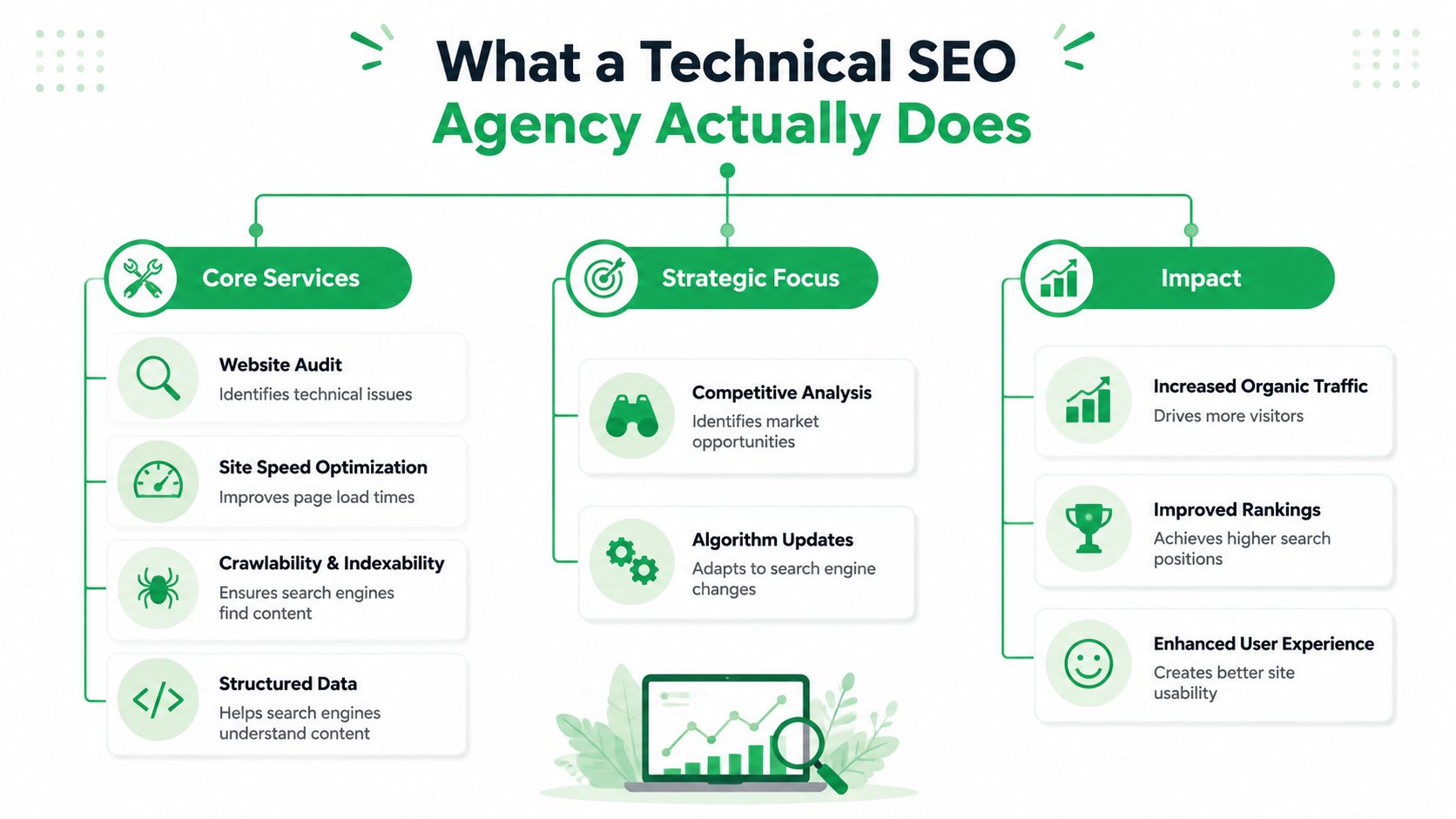
At its best, the work sits between SEO strategy, web development, analytics, and QA. The agency finds the technical constraints, ranks them by business impact, and turns them into changes your team can ship. That last part matters. A long audit with no implementation path rarely changes results.
It starts with access, understanding, and control
The first job is usually a real technical audit. That means reviewing crawl paths, indexation patterns, status codes, canonicals, sitemap quality, internal linking, duplicate signals, rendering behavior, template bloat, and server responses.
Three ideas matter more than the jargon suggests.
- Crawlability is whether search engines can reach your important pages without wasting time on junk URLs.
- Indexability is whether the pages you want to rank are eligible to appear in search.
- Renderability is whether search engines can process the page content, links, and key elements, especially on JavaScript-heavy builds.
If one of those breaks, content production gets less efficient. You keep publishing, but the return on that investment drops.
The work usually falls into four operating areas
1. Best Technical SEO Agency: Performance and page experience
This is not just a speed exercise.
A technical SEO agency reviews Core Web Vitals, script weight, image handling, caching, mobile rendering, and server behavior. The goal is to reduce friction on the pages that matter most, usually service pages, category pages, and high-intent landing pages. On many sites, there is a trade-off. The same script that powers a useful feature can also slow the page and hurt mobile engagement. Good agencies do not chase perfect lab scores. They decide which changes improve speed without breaking attribution, CRO testing, or site functionality.
2. Best Technical SEO Agency: Crawl efficiency and site architecture
Search engines do not spend equal attention on every URL. Large sites often create waste through faceted navigation, parameters, duplicate paths, thin archive pages, orphan pages, and weak internal linking.
A capable agency fixes that by tightening site structure, improving link paths to priority pages, consolidating duplicate signals, and reducing low-value URLs that absorb crawl activity. The business benefit is straightforward. Important pages are discovered faster, updated faster, and given a clearer place in the site hierarchy.
3. Best Technical SEO Agency: Structured data and search result presentation
Schema markup helps search engines classify a page correctly. It can clarify whether a URL is a product, service, article, FAQ, review, or breadcrumb trail. That improves how consistently your pages are interpreted, and in some cases how they appear in search results.
The point is not to add markup everywhere because a checklist says so. The point is to apply it where it supports visibility for commercially relevant pages and aligns with the actual content on the page.
4. Best Technical SEO Agency: Migrations, redesigns, and technical change control
Agencies often save a business from avoidable losses in these situations.
Redesigns, CMS migrations, domain changes, and URL restructuring can erase years of search equity if they are handled late. A technical SEO agency maps redirects, checks canonicals, reviews staging environments, validates internal links, compares pre-launch and post-launch templates, and watches Search Console closely after release. I have seen traffic drops caused by basic launch mistakes, noindex tags left in place, broken redirect logic, or navigation changes that buried high-value pages three clicks deeper than before.
Strong agencies turn findings into implementation plans
The difference between average and useful work is prioritization.
A good agency does not hand over 120 issues with no context. It groups problems by likely commercial effect, development effort, and dependency. A broken canonical on a revenue page matters more than a low-priority warning on a blog tag page. A rendering issue that blocks product content deserves faster action than a minor schema cleanup. This is also why clean reporting matters. Teams need a format that connects issue, owner, fix, status, and business outcome. A practical SEO monthly reporting format helps keep that work visible to both marketers and stakeholders.
The best agencies also use analytics and measurement to decide what gets fixed first. This piece on how agencies leverage data for campaigns is useful because it shows the operating principle behind good agency work. Measurement should shape decisions, not just document them after the fact.
That is what a technical SEO agency does. It removes the technical drag that keeps a site from earning more from the demand that already exists.
Best Technical SEO Agency: The Business Case and Tangible KPIs to Track
A lot of technical SEO work dies in the boardroom for one reason. It gets framed as site maintenance instead of growth.
“Redirects fixed” does not help a CEO decide on budget. “Category pages recovered visibility and organic demos increased” does. That is the business case. Technical SEO matters when it improves how often high-intent pages get crawled, indexed, clicked, and converted.

Focus on the outcome, not the fix
A fix only matters if it changes a business result.
If Google is missing new service pages because internal links are weak or faceted URLs are wasting crawl attention, publication does not turn into traffic fast enough. If mobile pages load poorly, more visitors drop before they reach a form or product view. If structured data improves how a result appears in search, click-through rate can improve without a ranking jump.
This is why good reporting ties technical work to revenue paths. It shows which pages were affected, what changed, and whether those pages produced more qualified visits, leads, or sales after the fix.
Best Technical SEO Agency: What to ask for in reporting
Useful reporting works on two levels at the same time. One level shows whether the site is becoming easier for search engines to process. The other shows whether that improvement is changing commercial performance.
| KPI layer | What to track | Why it matters |
|---|---|---|
| Technical health | crawl errors, indexation status, page speed trends, schema validity, internal linking issues | shows whether the site foundation is improving |
| Business impact | organic traffic to priority pages, rankings for commercial queries, lead volume, revenue from organic landing pages | shows whether technical work is producing business results |
A strong monthly report makes those connections obvious. It should not leave stakeholders guessing why a resolved issue mattered. If you want a practical benchmark, this SEO monthly reporting format for business-facing teams shows how to connect technical progress to outcomes executives care about.
Which metrics deserve the most attention
Not every metric should carry equal weight. Some help diagnose problems. Others help decide where to invest next.
Prioritize metrics that affect revenue decisions:
- Organic traffic to key templates: service pages, product pages, category pages, and location pages
- Indexation quality: whether priority pages are indexable, indexed, and kept out of duplication traps
- Time to visibility for new pages: how quickly new inventory, services, or content starts appearing in search
- Ranking movement for commercial queries: terms tied to buying intent, not vanity traffic
- Lead quality from organic search: qualified forms, calls, booked meetings, purchases
- Conversion path performance: whether technical fixes reduce friction between landing and conversion
If reporting stops at “errors fixed,” you are measuring output, not business value.
Best Technical SEO Agency: What successful engagement looks like
Successful technical SEO usually shows up in sequence.
First, priority pages become easier to crawl and index. Then those pages gain steadier visibility for the terms that matter. After that, traffic quality improves because search engines are surfacing the right URLs to the right searchers. Leads often improve with it, not because technical SEO writes better copy, but because it removes the barriers that kept strong pages from doing their job.
That sequence matters when evaluating an agency. A serious team should be able to explain which leading indicators will move first, which lagging indicators should follow, and how long each stage typically takes based on your site size, release cycle, and development constraints. That is how non-technical decision-makers separate meaningful technical work from a list of cleaned-up errors.
Best Technical SEO Agency: A Look Inside Deliverables and Engagement Models
Once you decide to hire a technical SEO agency, the next question is practical. What are you buying?
The answer depends on whether you need a focused project or ongoing technical support. Both can work. They solve different problems.
Project work versus ongoing retainer
A project is usually the right fit when something specific is happening. A migration. A redesign. A technical audit before a development sprint. A diagnosis after traffic loss.
A retainer makes more sense when the site keeps changing and someone needs to watch technical health over time.
Here’s the side-by-side view.
| Model | Best For | Typical Scope | Example Deliverable |
|---|---|---|---|
| Audit project | Businesses that know something is wrong but need diagnosis first | technical audit, prioritization, issue documentation | prioritized audit with implementation roadmap |
| Migration project | Sites changing platform, CMS, templates, or URL structure | redirect mapping, staging review, launch QA | migration checklist and redirect brief |
| Implementation sprint | Teams with dev capacity but limited SEO direction | ticket creation, QA, validation after fixes | developer-ready task list with acceptance notes |
| Ongoing retainer | Growing sites with continuous publishing and releases | monitoring, recurring audits, reporting, strategy support | monthly technical health dashboard and recommendations |
What useful deliverables look like
Deliverables should be specific enough that a developer can act on them without translating vague SEO language into technical requirements.
Look for outputs like these:
- A prioritized audit document: not a raw export. It should separate critical, important, and lower-priority issues.
- Developer-ready recommendations: screenshots, affected page types, expected outcome, and validation steps.
- Template-level analysis: especially for ecommerce, SaaS, multi-location, and content-heavy sites.
- Change logs and QA notes: so everyone knows what was fixed, what’s pending, and what needs validation.
- Performance dashboards: not just rankings. Crawl, indexation, and page experience trends should be visible.
Best Technical SEO Agency: What doesn’t work well
The weak version of technical SEO is easy to spot.
You get a huge spreadsheet, a generic Loom video, and a lot of jargon. No prioritization. No link to business impact. No implementation support. The development team ignores half of it because the tickets aren’t usable.
That’s not strategy. That’s document production.
A technical SEO deliverable is only valuable if marketing, development, and leadership can all use it.
Which model fits most SMBs
For many small and mid-sized businesses, the strongest pattern is an audit first, then a lighter ongoing engagement. That keeps the initial diagnosis focused and gives the business room to decide whether the work requires recurring support, internal implementation, or a larger redesign plan.
And if your site is stable, smaller, and not changing often, you may not need a large retainer at all. You may need one serious cleanup and a periodic check-in. That’s a better spend than paying monthly for passive monitoring you don’t use.
Best Technical SEO Agency: The Hiring Checklist How to Choose the Right Agency
A common failure point looks like this. The agency pitch sounds polished, the proposal looks organized, and six months later your developers still have no clear tickets, organic traffic is flat, and leadership cannot tell what was fixed or what it changed.
That usually starts with vague buying criteria. If you ask, “Do you do technical SEO?” every agency says yes. A better hiring process tests whether they can diagnose your specific problem, explain the trade-offs, and turn findings into work your team can ship.

Start with the business problem, not the service label
The right agency for a redesign is not always the right agency for an indexation mess, a JavaScript-heavy site, or a bloated ecommerce catalog. The first filter is your situation.
Pin down the problem in plain language:
- Revenue-driving pages are not getting indexed
- A redesign or migration is coming and search risk needs to be controlled
- The site is slow enough to hurt conversions
- Google is wasting crawl activity on low-value URLs
- Important content depends on JavaScript and may not be rendered well
- Multi-location, international, or faceted navigation rules are creating complexity
- Traffic exists, but key templates are underperforming as lead generators
That framing changes the conversation. Instead of buying “technical SEO,” you are buying a fix for a visibility or conversion problem with measurable business impact.
Best Technical SEO Agency: Check proof of execution early
Brand polish is easy to fake. Process quality is harder to fake.
Ask for evidence tied to work like yours:
- A redacted audit for a similar site type or CMS
- Developer-facing recommendations, not just executive summaries
- Examples of how they prioritized fixes by impact and effort
- QA or validation notes that show what happened after implementation
- Reporting that connects technical changes to indexation, traffic, leads, or revenue
- A clear view on how search is changing, including AI-driven discovery
That last point matters because some firms can speak well about classic SEO but have not updated their thinking. If you want context on how agencies are positioning search work beyond standard rankings, this overview of the modern AI SEO agency model is a useful comparison point.
Ask questions that expose judgment
Good agencies do not just know terminology. They make sound decisions under constraints.
Use questions like these in the sales process:
- Show me an audit example for a site with similar technical complexity.
- How do you decide which fixes matter this quarter and which can wait?
- How do you work with developers when a recommendation touches templates, scripts, or platform constraints?
- What is your process for redesigns or migrations where rankings could drop after launch?
- How do you test JavaScript-dependent content and confirm search engines can access it?
- What do you report monthly besides rankings?
- How do you explain a technical issue to a marketing lead, a developer, and an executive sponsor?
Listen closely to how they answer. Strong teams explain trade-offs. They will tell you that some fixes are high-impact but slow to implement, while others are quick wins with limited upside. That is a good sign. It means they are thinking like operators, not salespeople.
A broader buying framework can help if this decision includes other channels or services. This guide on how to choose a digital marketing agency is useful if you are weighing SEO alongside web, PPC, or creative support.
Best Technical SEO Agency: Prefer plain English over jargon density
A capable technical SEO agency should be able to explain canonicals, crawl traps, render issues, internal linking, and page experience in terms a business owner can use. Which pages are affected? What revenue risk exists? What gets fixed first? What should wait?
If they default to jargon, expect friction later. Marketing will not know what was approved. Developers will not know what matters. Leadership will not know whether the investment is paying off.
Here’s a helpful reference point before you jump into calls.
The right agency makes technical SEO understandable, actionable, and tied to business outcomes.
Best Technical SEO Agency: Pricing Pitfalls and Common Red Flags
A common buying mistake starts like this. The agency quotes a low monthly fee, the proposal sounds reasonable, and six weeks later the actual costs show up through extra audits, added QA, developer hand-holding, and reporting that was never included. Technical SEO is rarely expensive because of the spreadsheet. It gets expensive when scope is vague and implementation turns into a series of change orders.

What realistic pricing looks like
Pricing varies because the work varies. A local service business with 30 pages may need an audit, a short cleanup project, and light monitoring. A SaaS site with rendering issues, template sprawl, and multiple stakeholders may need ongoing technical oversight, developer coordination, and recurring QA after releases.
Industry coverage from Passionfruit puts agency retainers across the SEO market on a very wide spectrum and also notes that unclear costs are a frequent reason smaller businesses walk away from the buying process (Passionfruit on top B2B SEO agencies). The useful takeaway is not the headline number. It is whether the proposed scope matches the actual problem on your site.
That is the decision to make.
If your site has not been diagnosed yet, start with a technical SEO audit service that maps issues to implementation priorities. That usually saves money because it separates real blockers from nice-to-have fixes before you commit to a retainer.
Best Technical SEO Agency: Why vague pricing creates bad engagements
A weak proposal hides effort in broad labels like “technical optimization” or “ongoing support.” A strong proposal names the work. Audit depth. Ticket writing. Dev QA. Log file analysis if needed. Monitoring cadence. Reporting format. Meeting schedule. What happens after recommendations are delivered.
Ask four direct questions on every call:
- What is included in the base fee?
- What work triggers added cost?
- Who handles implementation support?
- How will you prioritize fixes against revenue impact?
Clear answers usually signal a team that has done this before. Vague answers usually mean you will pay to define the process after the contract starts.
Red flags that usually waste budget
Some warning signs show up in sales, not delivery.
- Guaranteed rankings: serious technical SEO teams do not control search results, competitors, or algorithm changes.
- No implementation path: they can surface issues but cannot convert findings into developer-ready tickets or QA steps.
- Reporting with no business meaning: charts go up or down, but nobody explains how that affects qualified traffic, lead flow, or revenue.
- Identical audits for every business model: local services, ecommerce, publishers, and SaaS platforms do not share the same technical risk profile.
- No collaboration with developers or product teams: recommendations stall when nobody owns implementation details.
- Heavy dependence on tool exports: software helps agencies work faster, but judgment still matters.
If you want a clearer view of how agencies use software for scaling client results with SEO platforms, that overview is useful. The trade-off is straightforward. Better tooling improves speed and visibility. It does not fix weak prioritization.
Value is clarity
The best pricing conversations are specific enough that finance, marketing, and development would all describe the engagement the same way. You know what gets reviewed, what gets fixed, what support is available during implementation, and how progress will be measured.
A boutique team like Mr. Green Marketing, LLC can make sense when technical SEO needs to connect with broader growth work such as site performance, conversion-focused design, paid media alignment, or marketplace visibility. That is not automatically better than a specialist shop. It is a scope and integration decision.
Your Next Step From Audit to Action
By the time most companies look for a technical SEO agency, they already know something’s off. The site feels harder to grow than it should. Content underperforms. Important pages don’t rank. Reporting shows symptoms, not causes.
The next move shouldn’t be guesswork.
Start with diagnosis, not assumptions
A technical SEO decision gets easier when you can see the actual problems in front of you. Crawl waste, indexation gaps, poor internal linking, template issues, schema problems, page experience weaknesses. Once those are clear, you can decide whether you need a project, a retainer, internal dev support, or a deeper rebuild.
That’s why the audit matters first. It reduces uncertainty.
What a good first step should produce
A useful audit should give you three things:
- A clear picture of technical blockers
- A prioritized list of fixes
- A practical path to implementation
Not theory. Not generic advice. Action.
If you’re ready to get that baseline, reviewing professional website SEO audit services is a logical place to start. It helps you move from “something is wrong” to “here’s what needs fixing first.”
The businesses that win with SEO usually don’t have perfect websites. They have websites with fewer unresolved technical barriers.
That’s the point. You don’t need flawless infrastructure before growth starts. You need a site that search engines can access, understand, and trust. Then your content, brand, and offers have room to work.
If you want a practical next step, Mr. Green Marketing, LLC offers a no-pressure way to evaluate your site’s technical health. A focused audit can surface hidden visibility issues, show where performance is holding back rankings or conversions, and give you a roadmap your team can put to use.
Leave a Comment
sing in to post your comment or sign-up if you dont have any account.