
Plumbing SEO Services: Your trucks are clean. Your crew knows what they’re doing. Customers who hire you usually stick with you. And yet some weeks the phone feels too quiet.
That gap usually isn’t about the quality of your plumbing work. It’s about visibility. Homeowners don’t always ask a neighbor first anymore. They pull out a phone, type the problem, and call one of the businesses they see first. If your company isn’t there, a worse plumber with better search visibility gets the job.
That’s why plumbing seo services matter in 2026. Not as a vanity project. Not as “more traffic” in the abstract. As a system for turning urgent searches into booked calls, estimates, and repeat customers.
Plumbing SEO Services: Why Your Plumbing Business Is Invisible Without SEO
A common situation looks like this. A plumbing owner has a decent website, a Google Business Profile that was set up years ago, a few scattered reviews, and service pages that say almost the same thing. The company is legitimate. Search visibility isn’t.

That hurts more now because search changed. Google’s rollout of AI Overviews reshaped how plumbing companies need to earn visibility, and 71% of clicks still go to the first page, mainly the top map listings and early organic results, according to TryWebTec’s breakdown of SEO for plumbers. If you’re buried below that, you’re not just “ranking lower.” You’re missing calls from people ready to hire.
Plumbing SEO Services: Good plumbers disappear online for ordinary reasons
Most invisible plumbing companies aren’t making one huge mistake. They’re making a pile of small ones.
- Weak local signals: The business name, address, and phone number don’t match everywhere.
- Thin service pages: One page tries to rank for drain cleaning, sewer repair, leak detection, repiping, and water heaters all at once.
- Slow mobile experience: A homeowner on a phone taps your site, waits, and leaves.
- No clear service area structure: You serve multiple cities, but your site barely says where.
And then there’s AI search. Search engines increasingly summarize answers before a user even clicks. So if your content doesn’t clearly answer common plumbing problems, define service areas, and reinforce trust, you can vanish from both classic and AI-assisted results.
Your best tech can still sit idle if the homeowner never sees your name.
Local service businesses in other categories are dealing with the same shift. If you want a useful comparison from a nearby industry, this guide to cleaning business SEO shows how local intent, reviews, and service pages shape lead flow for service operators, not just online retailers.
What fixes the invisibility problem
SEO isn’t magic. It’s alignment.
Your website has to match how real people search. Your Google Business Profile has to support that. Your reviews, local citations, page speed, and service pages all have to point in the same direction.
For a small business owner, the practical benefit is simple. You stop relying on luck and referrals alone. If you want a broader small-business view of that compounding effect, this piece on the benefits of SEO for small business gives useful context.
When plumbing seo services are done right, you become easier to find at the exact moment someone needs help. That’s the whole game.
Plumbing SEO Services: Breaking Down Plumbing SEO From Clicks to Calls
Think of your online presence like your shop, trucks, dispatcher, and reputation all rolled into one digital system.
Your website is the work truck. It carries the tools.
Your Google Business Profile is the sign people see from the road.
Your reviews are neighborhood word of mouth at scale.
Your SEO work is what makes all of that show up in front of the right homeowner.
If that system is built well, a person searching for a plumber moves from problem to phone call fast. If it’s built poorly, they bounce to a competitor.
Ranking isn’t the goal. Calls are.
Plumbers sometimes get sold on broad rankings because they sound impressive. “We’ll rank you for plumbing.” That’s usually not the win it sounds like.
A homeowner with a burst pipe doesn’t search like a marketer. They search with urgency, location, and the actual problem in mind. Terms tied to specific services and places bring better leads because they line up with intent. That’s also why SEO now has to account for AI-led search behavior. 87% of consumers use search engines for plumbing services, while AI answers directly handle 60% to 70% of local service queries and reduce website clicks by 25% to 40%, according to Connectica’s analysis of SEO for plumbers.
That changes the job. You aren’t only trying to win the click anymore. You’re trying to become the answer.
What that means in plain English
A modern plumbing SEO campaign has to do three things at once:
- Show local relevance
Your business has to look like a strong match for the city, neighborhood, and service searched. - Show problem relevance
Your pages need to answer actual customer issues like clogged drains, water heater failure, slab leaks, or sewer backups. - Show trust fast
Searchers and search engines both look for proof. Reviews, clear service descriptions, good page experience, and consistent business info matter.
Here’s the practical test. If someone lands on your site at 9:30 p.m. with a leak under the slab, can they instantly tell:
- you handle that exact issue,
- you service their area,
- you’re reachable now,
- and you’re a safe call to make?
If not, rankings won’t help much.
Practical rule: A page that attracts the wrong visitor is not an SEO win. It’s just extra bounce.
SEO also has to fit how you run the business
Owners sometimes find themselves frustrated. They get traffic, but dispatch still says lead quality is mixed. Usually the problem isn’t “SEO failed.” It’s that the campaign wasn’t aligned with your operation.
If your best-margin work is water heaters, sewer line repair, or repipes, your SEO strategy should reflect that. If your estimators need cleaner job details before they roll a truck, your pages and forms should ask better questions. Tools outside marketing can help tighten that handoff too. For example, teams that want cleaner quoting workflows often look at software like Exayard plumbing estimating software to connect lead flow with estimating discipline.
That matters because clicks are cheap to chase. Qualified calls are harder. And far more valuable.
Plumbing SEO Services: The Engine Room of Plumbing SEO Services
Plumbing seo services work best when they run like a system, not a random checklist. A good agency or in-house team doesn’t just “do SEO.” They tune several connected parts so Google can understand your business and homeowners can trust it fast.
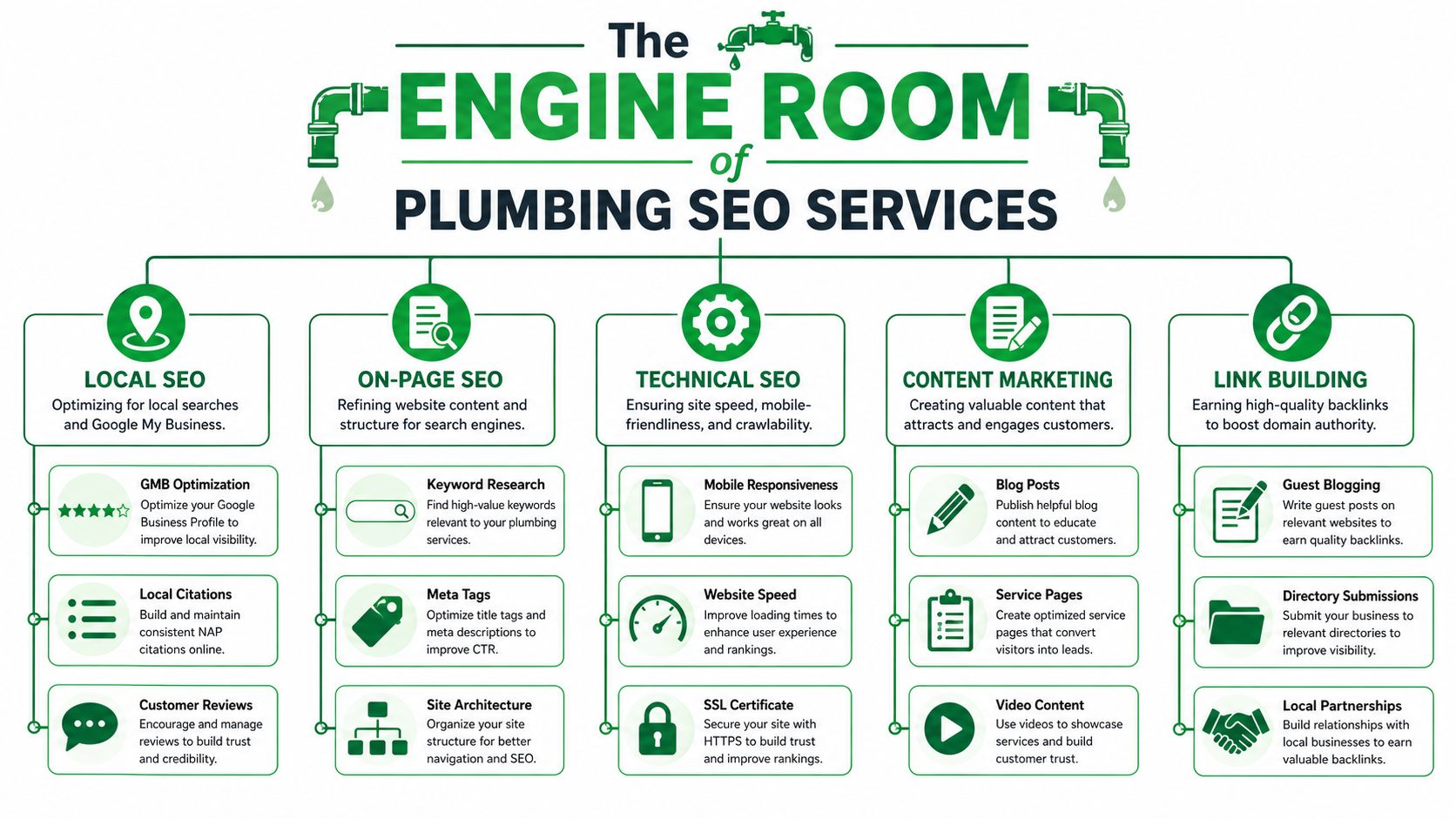
Local SEO is your digital storefront
For most plumbers, local SEO carries the heaviest weight because jobs come from a defined service area.
That includes your Google Business Profile, service area setup, categories, photos, hours, business description, and local citations across platforms like Yelp, Apple Maps, Bing Places, industry directories, and chamber listings. It also includes review generation and review response habits.
A lot of owners underestimate this piece because it feels basic. It isn’t. Local SEO is how Google decides whether your company looks established in the market you say you serve.
A strong local setup should include:
- Accurate business details: Your name, address, phone number, and hours should match everywhere they appear.
- Real service alignment: Categories and services should reflect your actual high-value work, not a generic home services label.
- Geographic clarity: Your website should clearly support the cities and neighborhoods you want to rank in.
If you want a deeper look at how this ties directly to lead flow, this article on local SEO lead generation is worth a read.
Plumbing SEO Services: On-page SEO tells search engines what you actually do
On-page SEO is the language layer. It’s how your pages explain your services, your locations, and your trust signals.
For plumbers, that usually means dedicated pages for major services, city-specific pages where appropriate, strong page titles, useful headings, internal links, FAQs, and calls to action that don’t make the user hunt. A page about drain cleaning should be about drain cleaning. Not every service under the sun with a city name sprinkled in.
The pages that perform best usually do a few things well:
- answer the customer’s immediate problem,
- explain the service clearly,
- reinforce location relevance,
- and make the next step obvious.
Fragments matter here. Too many plumbing sites hide the phone number, bury the service area, or write like a brochure. Customers don’t read those pages for fun. They scan.
Technical SEO keeps the site from leaking leads
Technical SEO isn’t glamorous, but it decides whether the rest of your work can perform.
Core Web Vitals are a useful benchmark. Largest Contentful Paint should stay under 2.5 seconds, and slow LCP from unoptimized images can delay Google’s crawling by up to 32%. Fixing these issues can produce a 15% conversion uplift from a 2-second load time improvement, based on Plerdy’s plumbing SEO analysis.
That means page speed isn’t an IT vanity metric. It’s a lead quality issue.
What technical SEO usually includes
| Component | What it affects | Why a plumber should care |
|---|---|---|
| Page speed | Load time and user patience | Slower pages lose emergency leads fast |
| Mobile usability | Tap targets, readability, calls | Most urgent searches happen on phones |
| Crawlability | Indexing and discoverability | If Google can’t parse the site well, rankings stall |
| HTTPS security | Trust and browser confidence | Users hesitate on sites that look unsafe |
| Site structure | Navigation and relevance | Better structure helps users and search engines find key services |
A plumbing website should feel frictionless on a phone. Fast load, clear buttons, click-to-call, and no weird popups covering the screen.
If your site loads like a parts catalog from 2014, searchers won’t wait for your brand story.
Plumbing SEO Services: Content marketing isn’t blogging for the sake of blogging
A lot of agencies still publish filler posts because “content is good for SEO.” Not automatically.
Content should support buying intent and AI visibility. That means service pages, problem-solution pages, FAQs, comparison content, and seasonal pieces that connect to real plumbing demand. Think frozen pipes in winter, sump pump concerns during heavy rain, or water heater replacement questions when units fail.
And because AI systems increasingly summarize rather than merely list links, content should be structured clearly. Short answers, clean headings, direct explanations, and schema all help. For teams trying to understand how conversational search is changing optimization, this piece on implementing conversational AI for SEO is a useful companion read.
Reviews, citations, and links build trust outside your site
Google doesn’t judge your website in isolation. It checks whether the rest of the web confirms your legitimacy.
That includes:
- local directory citations,
- review profiles,
- mentions from local organizations,
- partnerships,
- and backlinks from relevant sites.
Link building for plumbers should stay boring in the best way. Sponsorships, supplier relationships, local associations, community sites, and earned mentions beat junk backlinks every time. If someone promises hundreds of links fast, that’s usually trouble.
What works and what doesn’t
- Works: Earning mentions from local groups, maintaining consistent listings, collecting real reviews, publishing useful service content.
- Doesn’t work: Buying spam links, copying city pages with minor word swaps, stuffing keywords into every heading, using fake reviews.
Schema gives search engines the cheat sheet
Schema markup is structured data. It helps search engines understand your business details, services, service area, reviews, and page type more clearly.
For a plumbing company, useful schema often includes LocalBusiness details and service-level context. It won’t rescue a weak website on its own, but it can strengthen how your pages are interpreted in standard results and AI-shaped search experiences.
This is one of those details owners rarely ask about. Fair enough. But if you’re paying for plumbing seo services, schema should be part of the build, not an afterthought.
Plumbing SEO Services: How Much Should You Pay and What Should You Expect
Most plumbing owners ask the price question first. That’s reasonable. SEO isn’t free, and you’ve probably heard every pitch in the book.

The better question is this. What are you buying?
If you’re buying vague activity reports, keyword screenshots, and recycled blog posts, any monthly fee is too high. If you’re buying better local visibility, stronger service pages, technical cleanup, lead tracking, and a growing stream of qualified calls, the conversation changes.
The realistic budget range
There are cheap SEO offers in the market. Most plumbers who buy them end up buying twice.
The more realistic range for professional plumbing SEO services is $1,000 to $2,500 per month, and those campaigns can generate 50 to 100 qualified leads after six months according to Nova Advertising’s local SEO analysis for plumbers. That same source describes a plumbing company investing $2,000 monthly that reached a 9.4x ROI within six months and a 15x ROI by month twelve as rankings matured.
Those numbers matter for one reason. They show why SEO should be judged as an investment with a ramp, not a one-month expense.
What should happen first
The first stretch of an SEO engagement should not look like “wait and hope.”
Early work usually includes:
- technical cleanup,
- Google Business Profile improvements,
- citation consistency fixes,
- service page rewrites,
- conversion fixes on mobile,
- and tracking setup so you know which calls and forms came from organic search.
Those are the quick wins. They don’t always produce instant domination, but they should create visible movement. Better call experience. Better page clarity. Better local relevance.
Field-tested advice: If an agency can’t explain what will change in the first few months, they probably don’t have a plan.
What takes longer
Compounding work takes more time. That’s normal.
Building authority in a competitive plumbing market often means creating better location pages, earning stronger backlinks, improving review velocity, expanding service content, refining internal links, and continuously tuning pages based on Google Search Console and lead behavior. These actions allow SEO to differentiate from paid ads. Ads stop when the budget stops. Organic visibility can keep producing.
A short explainer can help if you want a visual overview of how businesses think about SEO investment over time.
Plumbing SEO Services: What a fair engagement should include
Not every retainer is structured the same, but a fair plumbing SEO package usually covers a mix of strategy, implementation, and reporting.
| Area | What you should expect |
|---|---|
| Local SEO | Google Business Profile work, citations, review strategy |
| On-page work | Service pages, title tags, internal linking, conversion-focused copy |
| Technical work | Speed fixes, mobile issues, crawl/indexing checks |
| Content | Useful pages tied to service demand and search behavior |
| Reporting | Rankings in context, call tracking, form leads, business impact |
If a provider talks only about rankings, that’s incomplete. Rankings matter because they can drive calls. They are not the final product.
Plumbing SEO Services: Finding a Partner Not Just a Provider
Hiring SEO help for a plumbing company shouldn’t feel like buying a mystery box. But for a lot of owners, it does.
One agency says they have a secret system. Another promises page-one rankings in no time. A third floods the proposal with jargon and hopes you won’t ask hard questions. And that’s exactly where expensive mistakes start.
The risk isn’t just wasting money
A bad SEO partner can do more than underperform. They can create cleanup work.
According to the benchmark cited by Housecall Pro’s overview of local SEO companies for plumbers, 28% of small plumbers report no ROI after six months, often because agencies used risky black-hat tactics. The same source notes 2026 E-E-A-T updates penalizing 22% of home service sites, which is a blunt reminder that shortcuts can backfire.
That changes how you should vet agencies. You’re not only hiring for upside. You’re hiring to avoid damage.
Green flags and red flags
A useful way to evaluate plumbing seo services is to compare behavior, not promises.
| Green flags | Red flags |
|---|---|
| They ask about your margins, service areas, and best job types | They talk only about traffic |
| They explain deliverables in plain English | They hide behind jargon |
| They discuss tracking calls and forms | They report only rankings |
| They recommend service pages, local optimization, and technical fixes | They push mass directory spam or bulk backlinks |
| They set expectations around momentum and compounding | They guarantee instant results |
A real partner usually sounds calmer. Less hype. More process.
Questions worth asking before you sign
You don’t need to be an SEO expert to ask sharp questions. You just need to listen for direct answers.
Ask things like:
- How will you decide which services and cities to prioritize?
They should tie this to business value, not generic search volume talk. - What will you change first on my site and Google Business Profile?
A serious team can name specific first actions. - How do you measure success beyond rankings?
You want call tracking, form tracking, and clear lead context. - What link building do you do?
If the answer sounds mass-produced or evasive, walk away. - Who writes and approves content?
Plumbing content should reflect real service knowledge, not recycled paragraphs.
An agency that can’t explain its work clearly probably can’t execute it cleanly.
What white-hat work looks like in practice
White-hat SEO isn’t flashy. That’s one reason some owners overlook it.
It usually looks like:
- cleaning up citations,
- improving page structure,
- expanding real service content,
- marking up pages with schema,
- fixing speed and mobile issues,
- earning legitimate local links,
- and building trust signals over time.
No tricks. No “private network” nonsense. No fake reviews. No city-page factory.
That slower, steadier approach tends to fit plumbing businesses better anyway because you’re building an asset you want to keep for years. A bad SEO campaign can stain your domain and force a rebuild. A good one gets stronger with age.
Plumbing SEO Services: The best relationship feels operational
This part matters more than most people think. SEO should connect with dispatch, estimating, and service priorities.
If your team wants more sewer inspections and fewer low-ticket nuisance calls, your SEO partner should hear that and adapt. If a location is booked out but another market needs help, strategy should adjust. If call quality drops, the agency should look at page messaging and search intent, not just celebrate more impressions.
That’s a partner. Not just a provider sending reports.
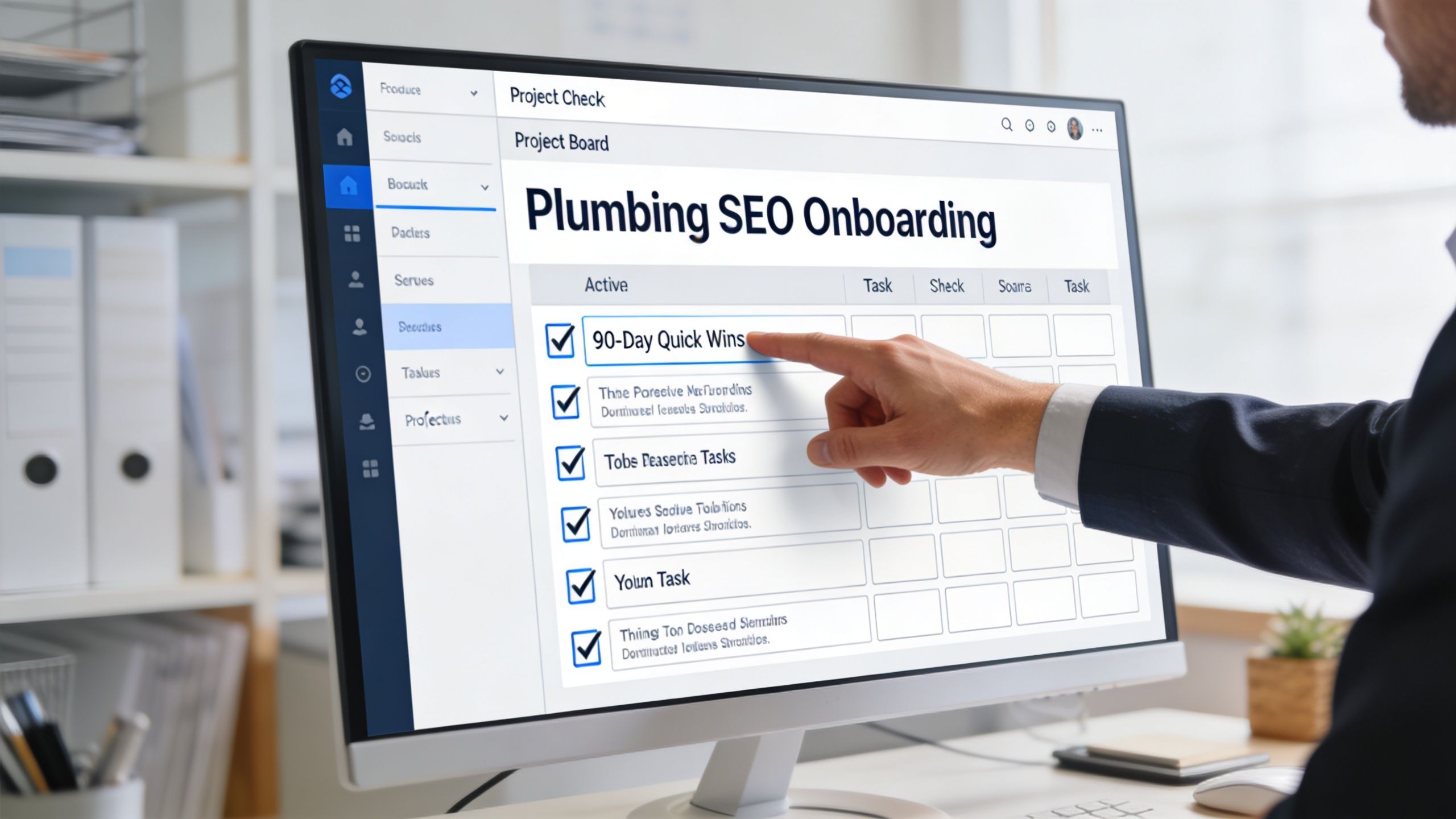
Plumbing SEO Services: Your Onboarding and Quick Win Checklist
The first months after signing an SEO agreement set the tone for everything that follows. Good onboarding feels organized, practical, and a little boring. That’s a compliment.
Bad onboarding feels fuzzy. Requests come late. Access isn’t sorted. Reporting starts before tracking is trustworthy. Then everyone debates results from messy data.
What you should have ready
Before strategy work starts, the business owner or office manager should gather the basics.
- Platform access: Website login, domain access, analytics access, Google Business Profile access, and Google Search Console access.
- Business clarity: Core services, highest-margin jobs, priority cities, emergency availability, financing options, and anything you don’t want promoted.
- Real-world input: What customers ask on the phone, what jobs close best, and what service lines are most profitable or easiest to scale.
Many campaigns improve, not because of some fancy tactic, but because the agency finally gets enough context to target the right work.
The first wave of work
A solid onboarding sequence usually follows a sensible order.
- Audit the foundation
The agency checks technical health, page structure, current rankings, Google Business Profile condition, citation consistency, and conversion points. - Set tracking before celebrating anything
Call tracking, forms, and source attribution need to make sense early. Otherwise, reporting becomes guesswork. - Prioritize the money pages
Not every page deserves equal attention. Core service pages and top-priority service areas come first. - Fix obvious friction
Missing calls to action, weak titles, slow mobile pages, duplicate service copy, and inaccurate listings should get attention quickly.
For owners who want a practical reference point, this local SEO audit checklist helps you see what should be reviewed before and during rollout.
What quick wins actually look like
Quick wins don’t always mean dramatic ranking jumps. Often they show up as cleaner lead flow.
That can look like:
- better call button visibility on mobile,
- clearer service-area language,
- improved page titles for high-intent services,
- fixed duplicate listings,
- stronger Google Business Profile categories,
- and more useful service copy for urgent jobs.
A lot of SEO value comes from removing confusion. Search engines understand the business better. Customers do too.
Clean onboarding prevents months of bad reporting and muddled priorities.
What you should expect from communication
You shouldn’t need to chase your SEO partner for basic updates.
A useful communication rhythm often includes:
- a kickoff meeting with goals and priorities,
- a summary of audit findings,
- an implementation roadmap,
- regular updates tied to completed work,
- and reporting that connects organic performance to calls, forms, and service demand.
And yes, you should ask questions. Interrupt. Push back if the plan doesn’t line up with the business you run. Good SEO gets stronger when the operator and strategist talk openly.
Common Plumbing SEO Questions Answered
How long does plumbing SEO take?
You can see early improvements from cleanup work, page fixes, and local optimization before a campaign fully matures. Bigger gains usually take longer because authority, relevance, and trust build over time.
Is Google Ads better than SEO for plumbers?
They do different jobs. Ads can drive immediate visibility. SEO builds longer-term organic lead flow. Most plumbing companies benefit from treating them as complementary, not interchangeable.
Do I need a separate page for every service?
Usually yes, for major services. A dedicated page helps search engines and customers understand exactly what you offer. It also improves conversion because the visitor lands on a page that matches the problem they searched.
Are city pages worth creating?
They can be, if each page delivers real value and is tied to a real service area. Thin duplicate city pages with swapped place names usually don’t help much.
Should I care about AI search if I mostly want phone calls?
Yes. AI-assisted search is changing how people discover local businesses and how search engines present answers. If your content isn’t built to support direct answers and strong local signals, you can lose visibility even before the click happens.
What’s the biggest mistake plumbing companies make with SEO?
Chasing activity instead of outcomes. More blogs, more keywords, more backlinks, more reports. None of that matters if the campaign isn’t producing better calls and better jobs.
Mr. Green Marketing, LLC helps service businesses build practical, measurable digital growth through SEO, GEO, PPC, websites, and transparent reporting. If you want a clearer view of where your plumbing company is losing visibility and what to fix first, reach out to Mr. Green Marketing, LLC for a free audit and performance report.
Leave a Comment
sing in to post your comment or sign-up if you dont have any account.