
Mastering branding in India: You’re probably staring at India from the outside and seeing the obvious part first. Huge population. Fast digital adoption. Rising consumer demand. A market that looks too big to ignore.
That instinct is right. But the shortcut many Western brands take is wrong.
They treat India like one market with one message, one language mix, one creative system, one audience profile. Then they wonder why a polished campaign underperforms, why click-throughs look soft outside the biggest metros, or why brand recall never quite sticks. Branding in India isn’t just market entry work. It’s translation in the deeper sense. Cultural, regional, emotional, commercial.
Mastering branding in India: Why Branding in India is Your Next Big Opportunity
India rewards brands that earn relevance, not brands that buy visibility.
That matters because the upside is enormous. The Kantar BrandZ Top 100 Most Valuable Indian Brands in 2025 reached a combined brand value of $524 billion, or about 13% of India’s GDP, according to Kantar’s India BrandZ data. In that same ranking, HDFC Bank returned to the top at nearly $45 billion, while Zomato was the fastest riser, climbing 10 places with a 69% increase.
Those numbers tell you two things.
First, strong brands in India create serious enterprise value. Second, local competition is not immature. You are not entering a blank slate. You are entering a market where buyers already know how to compare, judge, and discard brands fast.
Mastering branding in India: What foreign brands often get wrong
The usual mistake isn’t product quality. It’s framing.
A business enters India with messaging built for London, New York, or Sydney and assumes a little copy localization will do the job. It won’t. Buyers in India often evaluate a brand through trust, familiarity, usefulness, language fit, and social context all at once. If your positioning feels imported rather than adapted, people notice.
Common failure patterns look like this:
- Single-message rollout that assumes metro audiences and non-metro audiences respond the same way.
- Visual identity without cultural reading so the brand looks polished but emotionally flat.
- Performance-first acquisition with no effort to build memory or trust.
- Over-centralized campaigns managed from abroad with little regional feedback.
Why the opportunity is still worth it
India is difficult in a productive way. It forces sharper brand thinking.
Brands that get branding in India right usually understand that growth comes from fit, not just spend. If you need a good primer on understanding the role of branding in growth, that’s a useful starting point because it frames branding as a commercial asset rather than a design exercise.
Practical rule: In India, the brand that feels locally legible often beats the brand that merely looks globally premium.
That’s the opportunity. Not to impose a global brand unchanged, but to build a version of it that people in India can adopt.
Mastering branding in India: Understanding Branding in the Indian Context
Branding in India starts with a question many companies skip. Why should someone trust you enough to bring you into daily life?
That’s a different standard from “Will this ad convert?” It’s closer to, “Would I choose this brand again, recommend it, and feel comfortable attaching my reputation to it?” In many categories, especially those tied to family decisions, health, finance, education, food, or personal care, that standard is high.
Brand identity is not the brand
A logo matters. Packaging matters. Typography matters.
But none of those things are the brand on their own.
The brand is the accumulated perception people carry after repeated contact. It’s your tone in a WhatsApp inquiry, your claims on a product page, the confidence of your after-sales support, the restraint in your festive campaigns, the consistency of your packaging, the way your website handles local concerns, and the emotional signal your name sends.
A useful distinction:
| Element | What it is | What buyers actually feel |
|---|---|---|
| Identity | Logo, colors, website, packaging, type | “This looks a certain way.” |
| Positioning | Why you exist and how you differ | “This brand is for people like me.” |
| Trust | Proof, consistency, service, clarity | “I believe this brand will deliver.” |
| Story | Meaning around the product | “This brand stands for something I value.” |
In branding in India, many businesses overinvest in the first row and underinvest in the other three.
Mastering branding in India: Trust has to be designed into the experience
Indian buyers often read brands through signals that Western teams underestimate.
They notice whether your message respects family decision-making. They notice whether your promise sounds grounded or inflated. They notice whether your product story is practical, aspirational, or both. And they notice whether your brand voice sounds human.
Fragments matter. Small cues. The FAQ page. Shipping clarity. How your founder story is told. Whether your claims feel too slick.
That’s why “premium” is not enough as a brand strategy. Neither is “affordable.” Those are market positions, not emotional anchors.
What usually works better
A stronger approach is to build the brand around a promise that combines utility and credibility.
Try pressure-testing your brand on these questions:
- What anxiety are you reducing?
In many Indian categories, reassurance sells as much as aspiration. - What social identity are you supporting?
Some buyers want upward mobility. Others want prudence, ethics, or modern practicality. - What tone earns trust in your category?
A D2C skincare brand can be clear and conversational. A financial product may need restraint and authority. - What proof can you show early?
Reviews, ingredient clarity, delivery expectations, and support responsiveness often matter more than clever slogans.
A good Indian brand story doesn’t shout, “Look at us.” It says, “You can rely on us, and here’s why.”
Storytelling has to feel lived-in
The most effective brand stories in India tend to connect with community, progress, quality, care, aspiration, or transparency. Not as abstract values. As signals embedded in the buying experience.
That means your story should be visible in places like:
- Packaging language that feels direct rather than overwritten
- Product naming that doesn’t confuse local pronunciation or meaning
- Customer support scripts that sound respectful and calm
- Website copy that removes doubt instead of adding hype
If your brand only looks good in a pitch deck, it isn’t ready. If it can survive a regional landing page, a marketplace listing, a customer complaint, and a family recommendation chain, now you’re getting somewhere.
Mastering branding in India: Decoding India’s Diverse Consumer Segments
There is no single Indian consumer. Treating the market that way is one of the fastest ways to waste budget.
The divide isn’t just urban versus rural. It’s also linguistic, economic, digital, social, and aspirational. Two households with similar income can respond to completely different messages depending on geography, education, family structure, and what buying the product means to them.
Tier 1 is visible. Tier 2 and Tier 3 are where many brands miss the plot
A lot of foreign companies begin in Mumbai, Bengaluru, Delhi, Pune, Hyderabad, or Chennai and assume those markets explain the country. They don’t.
According to the Economic Times Brand Equity discussion cited here, 60% of India’s $3.5 trillion consumer market growth by 2025 stems from Tier-2 and Tier-3 cities, where many global SMBs still underuse region-specific storytelling for e-commerce and lead generation in practice, as noted in this analysis on Indian-by-design branding.
That doesn’t mean “smaller city equals lower sophistication.” That assumption backfires. Buyers in those markets may be highly digital, value conscious, and brand aware, but they often respond to different proof points than upper-income metro consumers.
Mastering branding in India: A more useful segmentation lens
Start with behavior and motivation, not just age or income.
The metro convenience buyer
This buyer is often fluent in comparison shopping. They care about usability, service quality, delivery speed, design, and status fit.
They may respond well to:
- clean digital experiences
- stronger UX and app flow
- premium positioning with practical proof
- product benefits stated quickly
The aspirational value seeker
This segment often shows up strongly in Tier 2 markets. They want quality and upward movement, but they won’t tolerate brand fluff.
They tend to reward:
- visible product value
- trustworthy reviews
- local language clarity
- brands that feel modern without feeling alien
The family-influenced decision maker
One person may click the ad, but several people shape the purchase. This matters in categories like education, household products, finance, home, wellness, and durable goods.
For them, branding has to answer:
- Is this safe?
- Is it worth the money?
- Will this last?
- What kind of choice does this say I’m making?
Mastering branding in India: Psychographics matter more than most teams expect
Demographics tell you who can buy. Psychographics tell you why they choose.
In branding in India, some buyers are drawn to modernity. Others to tradition with a fresh wrapper. Others to ethics, ingredient honesty, craftsmanship, or long-term value. The same category can contain all of those motivations at once.
A useful working model is to segment around these kinds of drivers:
| Segment driver | What the buyer is really seeking | Branding implication |
|---|---|---|
| Status and progress | A signal of upward movement | Refined design, aspiration, proof of quality |
| Practical trust | Reliability without drama | Clear language, support, guarantees, sensible pricing |
| Cultural familiarity | A brand that “gets” them | Regional cues, local references, respectful tone |
| Ethical alignment | Values reflected in the purchase | Transparency, sourcing clarity, honest content |
Don’t build for India. Build for a starting market inside India
That’s the discipline most SMEs need.
Pick one region, one language priority, one audience type, one channel mix, and one conversion event. Then learn. A smaller, sharper brand system usually performs better than a grand national rollout based on assumptions.
If your first brief says “target all of India,” the brief is the problem.
The brands that scale well in India usually earn the right to expand. They don’t begin by pretending they already understand everyone.
Mastering branding in India: Walking the Cultural Tightrope of Indian Branding
Branding in India is tightrope work. Go too generic and people ignore you. Go too specific without understanding context and you can look performative, careless, or worse.
The balance is not impossible. It just requires discipline.
India has 22 official languages and hundreds of dialects, and localization failures are expensive. Brands that use pan-India Hindi-English creative in non-Hindi dominant South Indian states can see up to 40 to 50% lower engagement rates on digital platforms, while regional languages account for 70% of state-level communications, according to this localization analysis on building a brand in India.
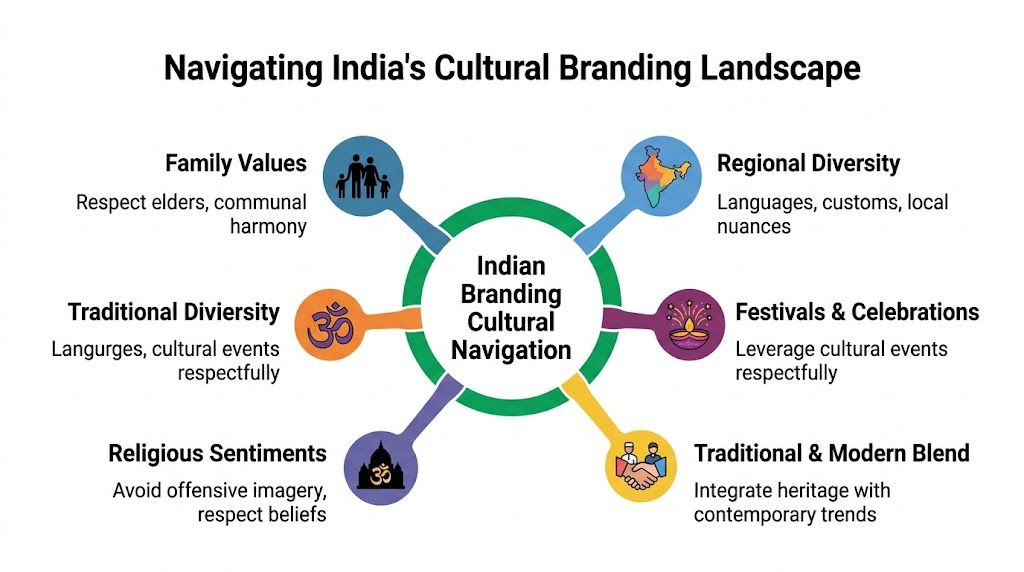
That stat is the practical version of the warning. You can’t walk this market with one national script and expect equal traction everywhere.
Language is not a decoration
Many foreign brands treat language adaptation like a final production step. That’s backward.
Language shapes trust, tone, and category comprehension. Machine-translated slogans, awkward idioms, and mixed-language copy that sounds imported all create distance. Even when people understand the words, they may reject the framing.
A better hierarchy looks like this:
- Choose the audience first
- Choose the language behavior of that audience
- Write for how they speak and decide
- Design around that reality
That can mean English-first in one context, bilingual messaging in another, and region-first creative somewhere else.
Festivals are high-opportunity and high-risk
Western teams often see Indian festivals as ready-made campaign moments. They are. But they’re not interchangeable.
Diwali, Onam, Pongal, Navratri, Eid, Durga Puja, and regional harvest or local cultural moments carry different meanings and visual codes. If your festive calendar is built from a national marketing sheet with no regional judgment, errors creep in fast.
Here’s the trade-off:
- Generic festive creative is safe, but forgettable.
- Regionally adapted festive creative is stronger, but only if the team understands the context.
Do this, not that
- Do adapt your message to the specific celebration and audience.
- Don’t repurpose one visual set and swap the headline.
- Do review symbolism, color use, and imagery with local eyes.
- Don’t assume a global design team will catch subtle issues.
- Do keep your core promise consistent.
- Don’t let every regional campaign become a different brand.
Field note: A glocal brand system works best when the center controls principles and the regions control expression.
Color, imagery, and symbolism need local reading
Color choices in India carry meaning beyond aesthetics. So do materials, attire, gestures, and settings.
A brand book built only around Western design logic can feel sterile in one region and tonally off in another. That doesn’t mean every Indian brand needs maximalism. It means your visuals should be tested against local interpretation, not just global trend decks.
Consider these questions before rollout:
| Brand element | Risk if handled lazily | Better approach |
|---|---|---|
| Color palette | Unintended symbolism or weak resonance | Validate by region and campaign type |
| People in imagery | Feels generic or socially detached | Reflect real customer context |
| Tagline translation | Correct words, wrong tone | Local copywriting, not direct translation |
| Festival creative | Looks opportunistic | Tie message to product truth and respect |
Build one brand core and many regional expressions
The safest scalable model is not “one campaign for all” and not “different brand for every state.” It’s a controlled modular system.
Keep these fixed:
- your core promise
- your product truth
- your quality signals
- your design logic at the brand level
Allow these to flex:
- language
- examples
- seasonal references
- social tone
- regional landing pages
- selected visual cues
That’s how you stay recognizable without becoming rigid. Tightrope work. But worth it.
Mastering branding in India: Protecting Your Brand with Indian Trademark Law
If you’re investing in branding in India, protect the name before you grow attached to it.
This part isn’t glamorous, but it saves expensive cleanup later. A brand can spend months refining positioning, packaging, marketplace listings, ad creative, and domain assets, then discover the name is too close to an existing mark or already registered in a relevant class. By then, the cost is not just legal. It’s operational.
Start with clearance, not confidence
A name that feels original to your team may still create conflict.
Before launch, run a proper trademark search in India for:
- the brand name
- spelling variations
- similar-sounding names
- logo marks, if the logo is distinctive
- relevant product and service categories
Don’t only search for exact matches. Buyers often confuse phonetic lookalikes, and enforcement issues often arise from similarity, not identity.
If you’re entering via Amazon, Flipkart, distributors, or franchise-style expansion, this gets even more important. Your commercial footprint can grow faster than your legal footing if you’re not careful.
Choose the right trademark classes
Trademark protection in India is organized by class. In plain English, that means your protection depends in part on what you sell and where the brand is used.
A skincare company, software company, restaurant, training firm, and apparel label may all need different class strategies. Some businesses also need more than one filing because they operate across products, retail services, software, education, or media.
A few practical checks help:
| Question | Why it matters |
|---|---|
| What are you selling today? | This affects the immediate filing scope. |
| What will you likely sell soon? | Expansion plans can affect class choices. |
| Will the brand appear on goods, services, or both? | You may need broader coverage. |
| Are you licensing or franchising? | The brand itself becomes a larger asset to protect. |
Understand the symbols
Businesses often use ™ before registration and ® after registration is granted.
That distinction matters because one signals a claimed mark, while the other signals a registered one. Don’t use them casually, and don’t assume social usage gives you legal protection. It doesn’t.
Mastering branding in India: Registration is not bureaucracy for its own sake
A registered trademark does practical work for you.
It gives you a stronger basis to challenge imitators, defend marketplace listings, support distributor relationships, and preserve brand equity as awareness grows. It also makes future diligence cleaner if you seek investment, partnerships, or acquisition.
Register early. Rebranding after traction is harder than filing before traction.
A good rule for SMEs is simple. If the brand name matters enough to print, advertise, optimize, package, or franchise, it matters enough to protect.
Mastering branding in India: Choosing Your Battlefield Digital and Physical Channels
A lot of businesses ask the wrong channel question. They ask, “What works in India?” The better question is, “Where does my audience first trust, compare, and buy?”
That answer changes by product, region, and category.
For some brands, search drives the first serious inquiry. For others, social video creates familiarity first, while marketplaces close the sale. And in many categories, physical presence still sharpens credibility even when the conversion happens online.
Search, social, marketplaces, and the street all do different jobs
Treating channels as interchangeable is a budgeting mistake.
Hyper-local SEO
Best when the customer already has intent and is looking for a nearby provider, category expert, or local solution. This is especially useful for clinics, home services, education centers, hospitality, and multi-location businesses.
If you’re evaluating partners for this kind of work, a practical guide on choosing the best SEO company in India can help you pressure-test local capability, especially around regional execution rather than generic rankings talk.
Vernacular social media
Useful when your audience discovers through feeds, shares, creators, or short-form content and responds better to native-language or culturally tuned creative. This is often strong for D2C, food, beauty, lifestyle, education, and local retail brands.
The trade-off is speed versus consistency. Social can scale reach quickly, but if the brand voice is vague, the attention won’t mature into trust.
Marketplaces like Amazon or Flipkart
These are efficient when purchase intent is already there and the category is comparison heavy. But marketplace branding is compressed branding. You have fewer tools, less room for story, and more pressure on titles, images, reviews, and perceived trust.
Physical channels
Retail signage, shelf presence, packaging, distributor relationships, local events, and offline referral networks still matter. A digital-first brand can underperform if the physical experience feels disconnected or absent.
A simple channel decision framework
Use this table before you split budget:
| Situation | Prioritize first | Why |
|---|---|---|
| People search with urgency | Local SEO and conversion pages | Capture active demand |
| People need education first | Social content and landing pages | Build familiarity before asking for conversion |
| People compare many sellers | Marketplace optimization | Reduce friction at decision point |
| Trust depends on touch or presence | Packaging, retail, local partnerships | Physical proof supports the brand |
Don’t let digital strategy erase physical reality
In India, brand trust is often cumulative. A buyer may see a reel, search the brand later, check reviews, visit a marketplace listing, ask a friend, and notice the packaging in a local store before buying. That’s normal.
For a grounded walkthrough of digital brand-building principles, this piece on how to build a brand online is useful because it keeps the focus on consistency across touchpoints rather than isolated tactics.
A short example helps. Watch how digital behavior and platform choice shape modern visibility:
What works versus what doesn’t
- Works: one region, one audience, one core offer, then channel selection based on buying behavior
- Doesn’t: launching on every platform at once because the market feels big
- Works: matching creative format to the channel’s job
- Doesn’t: using the same asset pack for search, social, packaging, and marketplace images
- Works: treating packaging and offline cues as part of branding
- Doesn’t: assuming digital impressions alone create durable memory
And yes, that restraint can feel slow. It usually saves money.
Mastering branding in India: Real-World Examples of Winning Indian Brands
The best examples in branding in India don’t all look alike. That’s the point.
Some win through trust built over decades. Some through operational clarity and consistency. Some through transparent content that makes younger buyers lower their guard. Different playbooks, same principle. They know what trust should look like in their category.
Tata and LIC show the power of institutional trust
According to Brand Finance’s 2025 Indian brands release, Tata Group retained its position as India’s most valuable brand, surpassing $30 billion, while LIC was the fastest-growing with a 36% surge. The same release notes that Infosys led IT services with the highest five-year CAGR of 18%.
Tata is the classic lesson in brand inheritance used well. The group has something many brands want and few truly possess. A durable trust reserve. That allows it to extend into modern categories without feeling opportunistic, because the parent signal is reliability.
LIC’s rise points to a related truth. In categories where security and reassurance matter, a stable brand story can outperform more fashionable messaging. People don’t always want novelty. Often they want confidence.
Infosys shows what sustained investment looks like
Infosys is a useful counterpoint because the product isn’t consumer packaged excitement. It’s service capability and enterprise confidence.
That makes the lesson sharper. A strong brand isn’t only for emotional B2C categories. Repetition, delivery, and strategic consistency also build value in complex service sectors. Quiet brands can become powerful brands if the market keeps seeing proof.
New-age D2C brands win by sounding less scripted
Brands like The Whole Truth, Minimalist, Wakefit, Paper Boat, Traya, Bombay Shaving Company, and FoodPharmer get discussed so often for one reason. They removed a lot of the old varnish.
Their messaging tends to feel clearer, more direct, and less ceremonial than legacy advertising. They explain products plainly. They lean on storytelling that sounds like a person talking rather than a campaign committee polishing adjectives. And they often build loyalty by saying what the product is, what it isn’t, and why that matters.
That style works especially well with younger audiences who’ve learned to filter out overproduced brand language.
The winning move is often not “be louder.” It’s “be easier to believe.”
If you want more pattern recognition on how these ideas translate into execution, this collection of examples of brand strategy is a useful companion.
The common thread
The common thread across old giants and newer D2C players is not aesthetics. It’s coherence.
- Tata feels dependable.
- LIC feels secure.
- Infosys feels disciplined.
- Newer D2C winners feel honest and legible.
Different sectors. Different tones. Same discipline. Their market-facing behavior matches their promise.
That’s why they stick.
Mastering branding in India: Measuring Brand Success and Your First Steps
A lot of businesses say they care about branding, then measure only what performance media reports back in a week.
That’s how teams convince themselves a weak brand is working.
According to this analysis of branding ROI challenges in India, 60 to 70% of branding initiatives fail because research and measurement are inadequate, and brands neglect metrics such as Customer Lifetime Value and brand perception. The same source says that this can lead to 2 to 3 times lower lifetime revenue even when short-term performance signals look strong.
What to track instead of vanity metrics
Likes are not useless. Reach isn’t meaningless. But neither tells you much about whether branding in India is becoming an asset.
Track a tighter set of indicators:
- Customer Lifetime Value
This tells you whether the brand is improving the quality of customer relationships, not just generating first purchases. - Brand perception feedback
Ask what people think you stand for, not just whether they saw the ad. - Repeat purchase behavior
Especially important in D2C, service businesses, and marketplaces. - Search behavior around your brand
Branded search often reflects growing memory and trust. - Regional performance differences
If one state, city cluster, or language variant performs far better, the brand may be resonating unevenly.
A practical first 90-day plan
Not grand. Focused.
- Run a market-specific audit
Check whether your brand, offer, and messaging fit a defined region and customer type. - Choose one launch geography
Don’t spread creative across the whole country before you have signal. - Localize one landing page and one campaign set well
Better one sharp deployment than five diluted ones. - Collect direct feedback early
Reviews, objections, confusion points, and support transcripts all reveal brand friction. - Refine the system before scaling
Fix messaging gaps, packaging issues, copy tone, and trust signals before adding spend.
For businesses trying to sharpen visibility while building a durable identity, this guide on how to improve brand awareness is a practical next read.
The main argument is simple. Don’t judge your brand by how busy your dashboard looks. Judge it by whether customers remember you, trust you, and come back at a lower persuasion cost.
If your business is preparing for India or trying to fix a brand that isn’t landing, Mr. Green Marketing, LLC can help you pressure-test the strategy before you waste budget on the wrong message, wrong market, or wrong channel mix. The team handles branding, SEO, PPC, web design, marketplace growth, video, and creative execution with a strong bias toward measurable outcomes. Start with a free audit and performance report, identify the gaps, and build from there.
Leave a Comment
sing in to post your comment or sign-up if you dont have any account.