
What is magento software? Let’s just get right into it. When someone asks “what is Magento software?”, don’t think of some simple website builder. Think of it as a professional-grade workshop for building a serious online store. It’s a powerful e-commerce platform built for businesses that refuse to be limited by out-of-the-box solutions and demand complete control.
So What Is Magento Software?
Unlike simpler platforms that corner you with fixed templates and a limited feature set, Magento gives you the architectural blueprints to the entire building.
Here’s a good way to look at it: it’s the difference between leasing a pre-furnished office and constructing your own custom headquarters. A leased office gets you started fast, but you’re stuck with the layout. With a custom build, you decide on every wall, every workflow, and every integration to perfectly match your business operations. And Magento is that custom-built headquarters for your e-commerce ambitions.
Unpacking the Core Concept
At its heart, Magento is an open-source platform. A critical point. It means the source code is publicly available, giving developers the freedom to modify, customize, and extend its capabilities in almost any way imaginable.
This is exactly why businesses with serious growth plans gravitate toward it. They aren’t just building a store for today; they’re laying the foundation for a complex, multi-brand, international operation for tomorrow.
Magento’s true power is its scalability. A small business can start on the free version and grow into a global enterprise on the exact same core technology, without ever being forced to replatform.
The platform first hit the e-commerce scene back in 2007, and its journey has been impressive. In May 2018, Adobe acquired it for a massive $1.68 billion—a move that cemented Magento’s place in the enterprise market. Since then, its market share has reportedly exploded by over 300%, proving its dominance. You can see more about its growth in these recent e-commerce statistics.
The Two Flavors of Magento software
This power comes in two main versions, and it’s vital to understand the difference right from the start. A bit of a listicle to make it clear:
- Magento Open Source: The free one. This is the community-driven edition, a powerful, do-it-yourself toolkit perfect for small-to-medium businesses that have access to development talent and want total control.
- Adobe Commerce: The premium one. This is the enterprise-grade solution (formerly Magento Commerce) that includes everything in Open Source, plus a massive suite of advanced tools for B2B, business intelligence, and enhanced performance, all backed by official Adobe support. A very powerful—and very expensive—option.
Grasping this fundamental split is the key to understanding everything else about Magento. It’s not just a single product; it’s a complete ecosystem designed to support e-commerce businesses of every size and ambition.
Magento Open Source Vs Adobe Commerce Explained
So you’ve decided Magento might be the right platform for your business. This is where you face your first major strategic crossroad, because Magento isn’t a single product—it’s a platform with two very different paths.
Think of it this way: you can get a powerful, bare-bones truck chassis that you can build into anything you want, or you can buy a fully-loaded tour bus with every amenity included and a dedicated support team on standby. One gives you a rock-solid foundation for a completely custom build. The other delivers an all-inclusive, enterprise-grade experience right out of the box.
And this decision between Magento Open Source and Adobe Commerce will shape everything—your budget, your team’s responsibilities, your store’s future capabilities.
Magento Software Open Source: The Powerful DIY Toolkit
First up is Magento Open Source. This is the free, community-supported version of the platform. And when we say free, we mean there’s no annual licensing fee to download the core software. But make no mistake, running a professional store on it is far from free.
Its main draw is the incredible flexibility. You get a robust e-commerce engine that serves as the perfect starting point for small-to-medium businesses or ambitious brands with access to skilled developers. This path gives you total freedom to customize every pixel and line of code. No limits.
However, that freedom comes with responsibility. You and your team are on the hook for everything:
- Hosting: You have to find, configure, and pay for your own server environment that can handle Magento’s demands.
- Security: You’re in charge of applying security patches, monitoring for threats, and keeping your store and customer data safe.
- Feature Extensions: Need advanced B2B quoting or a sophisticated loyalty program? You’ll be sourcing third-party extensions or building features from scratch.
- Support: When something breaks—and things will break—your only lifeline is community forums or your own development team.
This flowchart helps visualize the fork in the road between a simple, pre-built solution and a custom, growth-oriented platform like Magento.
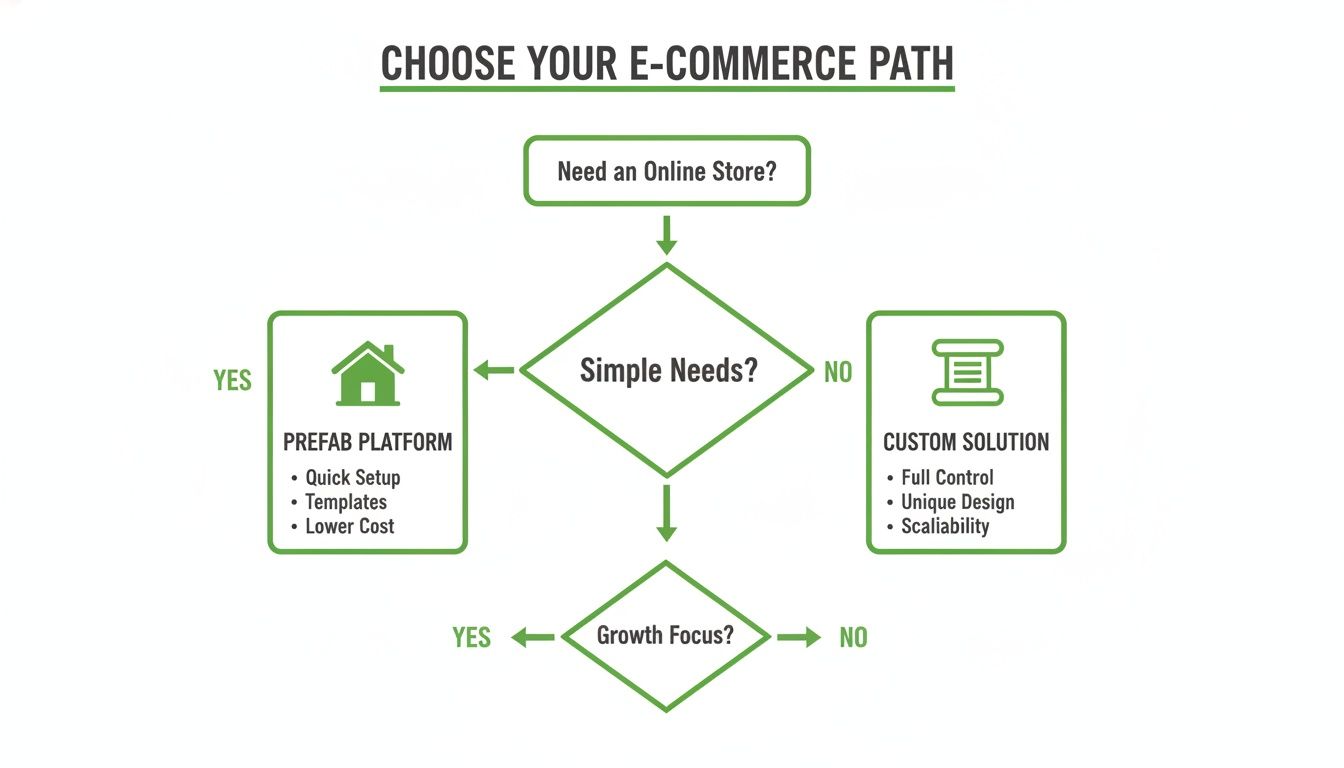
For businesses anticipating complex needs and custom growth, the path naturally leads toward a flexible, blueprint-style platform over a simpler, prefab model.
Adobe Commerce: The All-Inclusive Enterprise Powerhouse
On the other side, you have Adobe Commerce. This is the premium, paid, and fully-supported enterprise version. It takes everything from Open Source and adds a massive suite of advanced, out-of-the-box functionalities designed for large businesses managing complex operations at scale.
With Adobe Commerce, you’re not just buying software; you’re investing in a complete commercial ecosystem. For a bit of historical context on how the platform evolved to this point, our article on The End of Magento 1 offers some valuable insights. It’s truly built for global enterprises that need to manage intricate B2B sales channels, global inventories, and personalized customer experiences without stitching together dozens of separate extensions.
Adobe Commerce is for businesses that measure downtime in thousands of dollars per minute. It’s a solution where peak performance, ironclad security, and advanced business tooling are non-negotiable from day one.
Magento Software Open Source vs. Adobe Commerce at a Glance
Choosing the right version is one of the most critical decisions you’ll make for your e-commerce operations. This table breaks down the key differences to help you see where you fit.
| Feature | Magento Open Source | Adobe Commerce (and Commerce Cloud) |
|---|---|---|
| Cost | Free license. Costs are for hosting, development, maintenance, and extensions. | Annual license fee based on revenue, starting around $22,000/year. |
| Target Audience | Small-to-medium businesses with strong development resources or partners. | Large businesses, complex B2B sellers, and global enterprises. |
| Key Features | Core e-commerce functionality, basic CMS, and access to a vast marketplace of extensions. | Everything in Open Source, plus a native B2B suite, business intelligence dashboards, AI-powered product recommendations, and visual merchandising tools. |
| Hosting | Self-hosted. You choose and manage the entire server environment. | Can be self-hosted or hosted on Adobe’s optimized Cloud platform (Adobe Commerce Cloud). |
| Support | Community forums, official documentation, and your own development partners. | 24/7 dedicated technical support directly from Adobe’s expert team. |
Ultimately, the choice comes down to a trade-off: budget and control versus features and support. Open Source offers unparalleled freedom if you have the technical resources, while Adobe Commerce provides an end-to-end, enterprise-ready solution for businesses ready to invest in scalable growth.
Core Features That Make Magento Software a True Powerhouse

So, why do so many established brands and fast-growing businesses bet their entire online operation on Magento? What is Magento software really like to work with day-to-day? The answer isn’t a single feature, but a suite of powerful, connected tools that form a complete commerce engine.
This isn’t just about having a shopping cart. It’s about having an entire operational toolkit designed for serious scale, complexity, and control. This is where Magento really pulls away from simpler, one-size-fits-all platforms.
Let’s pull back the curtain on the core capabilities that make it such a force in e-commerce. These aren’t just bells and whistles; they’re the pillars for building a resilient and adaptable online business.
Built for Complex Catalogs and Product Management
Imagine managing a catalog not with hundreds of products, but with hundreds of thousands—or even millions. Now, what if each of those products has its own unique variations like size, color, material, and custom configurations? This is precisely where Magento’s catalog management shines.
It was built from the ground up to handle extreme complexity without breaking a sweat. It natively supports a huge variety of product types right out of the box. A few examples:
- Simple Products: Your standard, single-SKU items, like a specific book or a single bottle of shampoo.
- Configurable Products: A single product page for an item with options, like a t-shirt available in multiple sizes and colors. Each variation can have its own SKU, price, and inventory level.
- Grouped Products: A collection of simple products you want to sell together, like a camera, lens, and memory card package where customers can choose quantities of each.
- Bundle Products: Products where the customer literally builds their own item from a list of options, like a custom-built computer or a gift basket.
- Virtual and Downloadable Products: Perfect for selling services, subscriptions, warranties, or digital goods like software and ebooks.
This built-in flexibility means you can sell almost anything without needing clunky workarounds or a dozen expensive add-ons. You can manage intricate pricing rules, inventory across multiple warehouses, and detailed product attributes all from one backend.
Total Control Over the Checkout and Cart Experience
The checkout is where the sale is won or lost. A clunky, confusing, or restrictive checkout is a guaranteed way to send your cart abandonment rate through the roof. Magento gets this, giving you almost complete control over the entire experience.
You can modify every single step, from the mini-cart to the final “thank you” page. Want to implement a streamlined one-page checkout? No problem. Need to add custom fields to collect specific information for B2B orders? Easily done.
This level of control allows you to A/B test and fine-tune the flow based on real customer behavior. A few key checkout features include:
- Guest Checkout: Letting customers buy without creating an account is a proven way to reduce friction and boost conversions.
- Saved Carts: Customers can save their shopping carts and come back later to finish their purchase, an essential feature for higher-priced items.
- Shipping and Tax Calculation: Instantly calculate shipping costs to multiple addresses and handle complex tax rules based on the customer’s location.
The real power here isn’t just about the features themselves—it’s about the ability to completely tailor the checkout journey to match your business model and customer expectations, a critical factor in maximizing conversion rates.
Endless Possibilities with the Magento Software Marketplace
Perhaps Magento’s single most powerful asset is its extensibility. And no, that’s not just an industry buzzword. Think of your Magento store like a new smartphone—it’s powerful on its own, but the real magic comes from the app store.
The Magento Marketplace is the official app store for your e-commerce site, offering thousands of third-party extensions. These “apps” let you add just about any functionality you can dream up.
Need to integrate an advanced order tracking system? There’s an extension for that. Want to connect your blog directly to your store for better content marketing? You have dozens of options. In fact, studies show that “Where is my order?” (WISMO) inquiries are a major drain on support teams; a good order tracking extension can slash these requests by over 40%.
Go Global with Multi-Store Architecture with Magento Software
Finally, Magento is built for global ambition. Its core architecture lets you run multiple, distinct storefronts from a single backend installation.
This means you can operate several different brands, separate B2B and B2C sites, or regional stores for different countries—all managed from one central dashboard. Each store can have its own unique design, product catalog, pricing, and language while sharing a common customer database and core settings.
For any business looking to expand internationally or serve diverse market segments, this is a massive advantage that saves an incredible amount of administrative work.
Magento software: Understanding Magento Costs And Implementation

Now for the big question everyone wants to know: what does it actually cost to run a Magento store? This is where a lot of businesses get sticker shock because the true answer isn’t a simple number.
It’s a classic “it depends” situation. But don’t worry, we won’t leave you hanging. We’ll give you a transparent look at the Total Cost of Ownership (TCO), which goes way beyond the software license itself.
No sugarcoating here. Let’s break down the realistic financial and time investments required to do Magento right.
Deconstructing the Total Cost of Ownership
The biggest mistake we see businesses make is equating Magento Open Source’s “free” license with a “free” website. That’s like getting a free engine but forgetting you still need to buy the car, insure it, and pay for gas and maintenance. And for Adobe Commerce, the license fee is just the starting line.
Your real budget is a mix of several critical components.
- Licensing Fees (For Adobe Commerce): This is your most straightforward cost. The annual license for Adobe Commerce is based on your store’s Gross Merchandise Value (GMV). This typically starts at around $22,000 per year and scales up as your revenue grows.
- Hosting Costs: Because Magento is self-hosted, your store needs a server to live on. This isn’t your standard $10/month shared hosting. Magento is a beast that demands a powerful, optimized environment to run smoothly. Expect to budget anywhere from $100 to over $1,000+ per month for quality managed Magento hosting.
- Development and Customization: This is usually the largest upfront expense. A proper Magento build involves significant hours from experienced developers to set up the store, customize the theme, integrate your other systems (like an ERP), and build any unique features your business needs. This can easily range from $25,000 to well over $100,000.
- Themes and Extensions: While free options exist, most serious businesses invest in a premium theme ($50-$200) for a better design foundation. You’ll also need paid extensions for critical functions like advanced SEO, loyalty programs, or specific payment gateways, which often run $100-$500 each.
- Ongoing Maintenance: Your Magento store is a living asset, not a one-and-done project. Budgeting for ongoing maintenance is non-negotiable. This covers applying security patches, updating extensions, and fixing bugs to keep your site secure and fast. You’ll want to plan for a monthly retainer or hourly rate with a development partner.
A Typical Magento Software Implementation Workflow
So, how does a Magento project actually go from an idea to a live, selling store? The process is a structured journey that requires careful planning and tight collaboration between your team and your development partner. A solid background in e-commerce website development methodologies is absolutely essential.
Here’s the project lifecycle in a nutshell:
- Discovery and Planning: It all starts here. Your team and developers do a deep dive into your business goals, technical requirements, and target audience. This is where you map out features, define integrations, and create a detailed project roadmap.
- Design and UX/UI: Next, designers create wireframes and mockups. This isn’t just about making it look pretty—it’s about engineering a seamless user journey that guides customers from the homepage to checkout as efficiently as possible.
- Development and Customization: This is the heavy lifting. Developers set up the server, install Magento, configure the theme, install all the necessary extensions, and custom-code any unique features you planned for.
- Testing and Quality Assurance (QA): Before you even think about launching, the entire site is put through its paces. Testers check everything from product pages and the checkout flow to mobile responsiveness and site speed to ensure a bug-free customer experience.
- Deployment and Launch: This is the big day. The site is migrated to the live server, and the digital doors are officially opened for business.
- Post-Launch Support and Marketing: The journey doesn’t end at launch. Ongoing maintenance, performance monitoring, and smart marketing are crucial for growth. Don’t forget to calculate marketing ROI to ensure your promotional budget is delivering real profit for your new store.
Understanding these steps and their costs gives you a realistic picture of what it truly takes to build and scale a business on Magento.
When to Choose Magento Software Over Other Platforms
So, let’s get to the big question: with huge names like Shopify and BigCommerce out there, when does it actually make sense to choose Magento? This isn’t just about picking software; it’s about committing to an entire business ecosystem.
Here’s the thing: Magento isn’t for everyone. And honestly, that’s a feature, not a bug. It’s a powerhouse built for a certain kind of business with serious, ambitious goals.
Picking the wrong platform leads to major headaches and wasted money. But making the right call can unlock incredible growth. Let’s break down the scenarios where Magento isn’t just an option—it’s the clear winner.
You Have a Large or Complex Product Catalog
This is one of Magento’s biggest strengths. If your business sells thousands—or even hundreds of thousands—of products with all sorts of complex variations, Magento was built for you from the ground up.
Think about a store selling auto parts, industrial equipment, or highly customizable furniture. These businesses need to manage products with countless attributes and configurations. Magento handles this natively.
- Configurable Products: A single page for a shirt that comes in 5 sizes and 10 colors.
- Bundle Products: A “build your own PC” page where customers pick the CPU, RAM, and hard drive themselves.
- Grouped Products: A “complete skincare set” where customers can buy items together or individually.
Simpler platforms often choke on this level of complexity, forcing you into clunky workarounds or expensive custom coding. If your catalog is your core asset, Magento gives you the robust tools you need to manage it properly.
You Plan for Serious International Expansion
If you have global ambitions, Magento’s multi-store capability is a total game-changer. It lets you run multiple storefronts for different countries, languages, and currencies—all from a single backend installation.
This means you can have a U.S. store in dollars, a U.K. store in pounds, and a German store in euros. Each one can have its own localized content and product selection, and you manage it all from one central dashboard.
Magento’s global footprint is a strategic advantage. It currently holds a significant 8% global e-commerce market share, with strong adoption in key European markets. This includes an 18% share among top platforms in Europe, led by the UK with 9,097 stores. Learn more about Magento’s position in modern e-commerce to see why it’s a top pick for international growth.
You Demand Total Functional and Creative Control
This might be the most important reason of all. You should choose Magento when you refuse to be boxed in by a platform’s built-in limits.
SaaS platforms like Shopify are fantastic for getting a store up and running quickly, but you have to play within their rules. You can’t fundamentally change the core checkout process or alter how the platform works. For many businesses, that’s fine. For others, it’s a dealbreaker. For a quick look at different platforms, check out our summary of WordPress and Shopify website design services.
With Magento, you own the code. You have the keys to the kingdom. If you want to build a completely unique customer experience, integrate with a proprietary ERP system, or create a custom B2B quoting workflow, you can.
It’s the go-to platform for businesses that need their software to adapt to their operations—not the other way around.
Your Next Steps With Magento Software

Feeling a mix of excitement and maybe a little overwhelm? Good. That’s a normal reaction to a platform this powerful. It means you’re starting to grasp the true scope of what Magento can do—and the strategic thinking it demands.
The big question now is, “Okay, what’s next?” The answer isn’t to dive headfirst into code. The real work starts with a smart, deliberate plan. And forgetting to plan is the fastest way to blow your budget and miss your launch date. Your next steps are all about strategy, not just technology.
This final section is your roadmap for moving forward, whether you’re considering a brand-new build or migrating from another platform.
Create Your Action Plan
Before you talk to a single developer or look at a single extension, the journey begins with some serious internal homework. This foundation is what separates successful projects from the ones that fail. Get these steps right, and you’re already ahead of the game.
Here’s your initial checklist:
- Audit Your Business Needs: What specific problems are you trying to solve? List out the biggest pain points with your current setup, from clunky backend processes to poor SEO performance.
- Define Your Non-Negotiables: What features are absolute must-haves for your business to operate and scale? This could be complex product configurations, specific integrations with your ERP or CRM, or B2B functionality.
- Establish a Realistic Budget: Based on our earlier breakdown of costs, what is your genuine budget for the build, hosting, and ongoing maintenance? Knowing your numbers upfront is non-negotiable.
Finding the Right Magento Software Partner
Here is the single most important piece of advice you’ll get: do not go on this journey alone.
Magento is not a DIY project for a business looking to scale. Trying to manage a complex build without expert guidance is—and I say this from years of experience—a recipe for disaster. You need a development partner who understands the code and your business goals.
A great Magento partner doesn’t just build what you ask for. They challenge your assumptions, suggest better solutions, and act as a strategic guide to ensure your investment delivers a real return.
This relationship is crucial. Your partner is the one who connects the platform’s power to your real-world goals—like scaling your SEO, integrating with marketplaces, and ultimately driving more revenue. A strong background in e-commerce strategy consulting is just as important as technical skill.
If you’re ready to see how Magento’s capabilities could align with your growth strategy, the next logical step is a professional assessment. We offer a free audit to help businesses like yours explore if this platform is the right fit. It’s a no-pressure way to get expert insights and make a truly informed decision.
Frequently Asked Questions About Magento Software
Alright, let’s get down to the nitty-gritty. By now, you have a solid grasp of what Magento is, but a few practical questions always come up when you’re on the verge of making a big platform decision. Here are the straight answers to the most common ones we hear from business owners.
Is Magento Good for Small Businesses?
Yes, but with a major caveat. While Magento Open Source is technically free to download, it’s not a simple DIY solution for a brand-new entrepreneur. It demands technical expertise and a real budget for development and hosting.
However, if your “small business” has a clear vision for rapid growth, Magento is an incredible investment. It’s for businesses that anticipate needing complex features, multiple stores, or custom integrations down the road. It’s less about your current size and more about your ambition. For one-person shops needing something simple, a platform like Shopify is often a better starting point.
Can Magento Do B2B and B2C at the Same Time?
Absolutely. In fact, this is one of Magento’s defining strengths. Its architecture was designed from the ground up to manage both Business-to-Consumer (B2C) and Business-to-Business (B2B) operations from a single dashboard.
This isn’t a workaround; it’s a core capability. You can run completely separate storefronts for your retail and wholesale customers, each with its own:
- Custom Catalogs: Display different products or even hide entire categories from certain customer groups.
- Tiered Pricing: Automatically apply unique pricing based on a customer’s account or order volume.
- Unique Checkout Rules: Offer purchase orders and net terms to your B2B clients while sticking to standard credit card payments for B2C.
This unified approach saves an enormous amount of administrative work by preventing you from juggling two entirely different e-commerce systems.
How Long Does It Take to Build a Magento Store?
This is the classic “it depends” question, and for good reason. The timeline is directly tied to complexity. A basic Magento Open Source site using a pre-built theme with minor tweaks could be launched in 2-4 months.
On the other end of the spectrum, a complex Adobe Commerce build involving custom features, third-party system integrations (like an ERP), and a bespoke design can easily take 6-12 months or even longer. The project’s scope, the quality of your development partner, and the clarity of your initial requirements will determine the final timeline.
Ready to see if Magento’s power aligns with your business goals? The team at Mr. Green Marketing, LLC can help you navigate the complexities and build a strategy-led e-commerce presence. Get your free audit and performance report today.
Leave a Comment
sing in to post your comment or sign-up if you dont have any account.