
Increase ecommerce sales – Want to increase ecommerce sales? And you first have to figure out what’s stopping you from getting them in the first place. The best way to do that is with a quick audit of your product pages, site speed, and checkout process. This will help you find the high-impact, low-effort wins that can immediately stop the bleeding.
Finding Your Starting Point for Quick Sales Wins
So, you need to boost sales, and you need to do it fast. The pressure’s on. But diving headfirst into expensive ad campaigns or complicated new strategies without a solid plan is a great way to waste your budget. I get it, it’s overwhelming. Let’s cut through the noise.
Before you spend another dime, you need a baseline. Think of this as the diagnostic phase—a quick, high-impact review of your existing store. Exploring comprehensive strategies to increase Shopify sales is a great starting point, but our immediate goal is to find the 20% of issues causing 80% of your problems.
This isn’t about a total website overhaul overnight. It’s about being smart and strategic right from the start.
Uncovering Product Page Problems
Your product page is your digital salesperson. If it’s confusing, unconvincing, or untrustworthy, you’re losing customers right at the finish line. A mind-boggling 93% of customers say images are the single most important factor when they’re deciding whether to buy. Are your photos pulling their weight?
Start by asking yourself a few honest questions:
- Are your images high-resolution and compelling? Show the product from multiple angles. Show it in use. Even better – include a video.
- Does your copy sell the benefit, not just list features? You need to connect with your customer’s pain points and clearly explain how your product solves their problem.
- Is social proof front and center? Customer reviews and star ratings are non-negotiable in today’s world. Make sure they are impossible to miss.
Think of it this way: your product page is the final interview for the job of “getting purchased.” Make sure it’s dressed for success. If you’re looking for a deeper dive, our team offers a complete digital marketing audit to uncover these exact opportunities.
Battling Site Speed: The Silent Sales Killer
Site speed isn’t just a nice-to-have; it’s a fundamental part of the customer experience. Just a one-second delay in page load time can cause a 7% drop in conversions. That might not sound like much, but it adds up to thousands of dollars in lost revenue over a year. A slow site is frustrating, and frustrated visitors don’t turn into customers. They just leave. Simple as that.
Use a free tool like Google’s PageSpeed Insights to get a quick report card on your site’s performance. Don’t get lost in the technical jargon. Just look for the big, obvious recommendations like compressing your images or cutting down on the number of apps running on your site. Fixing just one or two of these issues can make a noticeable difference.
The goal is to get your core pages loading in under three seconds. Anything more, and you’re actively handing sales to your faster competitors. It’s one of the most direct ways to increase your sales without changing a single thing about your product.
This flowchart breaks down the simple, three-part process for auditing your site to find these quick wins.
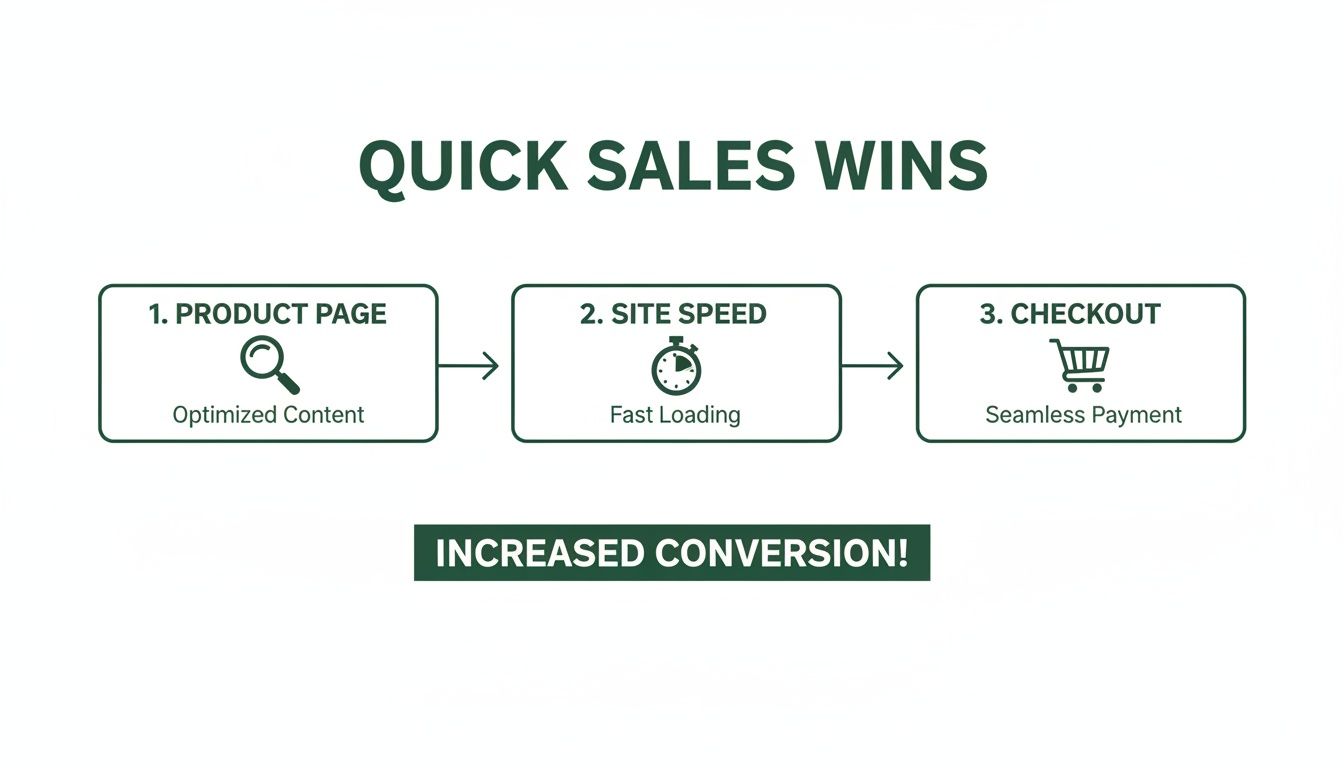
This process shows how a quick win audit begins by scrutinizing your product pages, moves to checking site speed, and wraps up by analyzing your checkout process for any friction.
Increase Ecommerce Sales – Streamlining Your Checkout for More Conversions
You’ve done all the hard work to get someone to the checkout. And then… they leave. It happens a lot. The average cart abandonment rate is nearly 70%. One of the biggest culprits is a long, complicated checkout process.
Your mission here is simple: remove every possible point of friction.
- Get rid of unnecessary form fields. Do you really need their phone number right now?
- Offer a guest checkout option. Forcing people to create an account is a notorious conversion killer.
- Display all shipping costs, taxes, and fees upfront. Surprise costs at the final step are the #1 reason for cart abandonment.
Go through your own checkout process as if you were a brand-new customer. Was it effortless? Or was it a pain? Be honest. Every click you can eliminate is a potential sale you can save.
Driving Targeted Traffic That Actually Buys

Alright, you’ve plugged the biggest leaks in your boat. Now it’s time to open the floodgates—but only for the right kind of traffic.
Let’s be honest: traffic for the sake of traffic is a vanity metric. It’s the classic rookie mistake. You want a store filled with people who have their wallets out, not just a crowd of window-shoppers.
The opportunity is massive. The global ecommerce market is projected to hit $6.42 trillion in 2025 and swell to $6.88 trillion in 2026. This growth means more customers are out there, actively searching for what you sell. For SMBs, grabbing a slice of this pie is everything, especially as US Amazon sales alone are forecasted to hit $540.29 billion in 2025. You can dig deeper into these numbers in this detailed ecommerce stats report.
This is your playbook for attracting shoppers, not just browsers.
Increase Ecommerce Sales – Winning with SEO and Purchase-Intent Keywords
Search Engine Optimization isn’t about trying to trick Google. It’s about making sure that when someone is ready to buy what you sell, your store is the first one they see. A long-term play. But the effects are compounding and incredibly powerful.
The key is to stop chasing broad, popular keywords and start focusing on the ones that scream “I’m ready to buy.”
Think like a customer who’s done their research. They aren’t just searching for “running shoes.” They’re searching for “best trail running shoes for wide feet under $150.” See the difference? That’s a long-tail keyword. It gets fewer searches, but the person behind that search is a much, much hotter lead.
Don’t just optimize for what your product is. Optimize for the problem your product solves. Your customer isn’t just buying a drill; they’re buying a hole in the wall.
Start brainstorming these specific, bottom-of-funnel phrases. Weave them into your product titles, descriptions, and blog content. For instance, instead of a blog post titled “Our New Skincare Line,” try “The Best Morning Skincare Routine for Dry, Sensitive Skin.” It directly answers a customer’s real problem and positions your product as the obvious solution.
Increase Ecommerce Sales – Dominating PPC with Laser-Focused Ads
Pay-per-click advertising is the fastest way to get in front of your target audience. But without a sharp strategy, it’s also the fastest way to burn through your marketing budget. The goal isn’t to get the most clicks—it’s to get the most profitable clicks.
This means your ad copy needs to speak directly to a customer’s problem, and the landing page they hit must continue that conversation seamlessly.
Here’s a real-world example:
- Weak Ad: “Premium Dog Food For Sale – 10% Off!”
- Strong Ad: “Is Your Dog a Picky Eater? Our Grain-Free Lamb Recipe is Loved by Fussy Pups. Try It Risk-Free.”
The second ad doesn’t just sell a product. It identifies a pain point (“picky eater”), offers a specific solution (“grain-free lamb recipe”), and lowers the barrier to purchase (“try it risk-free”). That’s how you get the right person to click. If you’re just starting out, our beginner’s guide to paid advertising can help you build this foundation correctly from day one.
Increase Ecommerce Sales – Conquering the Amazon Marketplace
You can’t have a serious conversation about how to increase ecommerce sales without talking about Amazon. It’s a product search engine, and showing up on the first page is non-negotiable. It’s a self-contained ecosystem with its own rules, and your product listing is your home base.
Your two biggest levers here are keywords and presentation.
- Keywords: Just like with your own site’s SEO, you need to uncover the exact terms customers are typing into the Amazon search bar. Embed these naturally in your title, bullet points, and the often-overlooked backend search term fields.
- A+ Content: This is your chance to go beyond basic text and images. Use A+ Content (or Premium A+ for brand-registered sellers) to tell a visual story about your brand and product. We build out comparison charts, high-quality lifestyle images, and graphics that highlight key benefits.
A listing with sparse details and one blurry photo feels untrustworthy. A listing with rich A+ Content, multiple high-res images, and video feels like a legitimate, professional brand. That trust translates directly into sales.
Increase Ecommerce Sales – Mastering Conversion Rate Optimization (CRO)
So you’ve managed to get traffic flowing to your site. That’s a huge win, but honestly, it’s only half the battle.
The real magic—the part that actually moves the needle on your revenue—is turning those visitors into paying customers. This is Conversion Rate Optimization (CRO), and it’s the single most powerful lever you can pull to grow your business without just pouring more money into ads.
Think of your website as your star salesperson, one that works 24/7 without a single complaint. CRO is how you train that salesperson for peak performance. And we’re not talking about guesswork here; this is the art and science of turning casual browsers into loyal buyers through small, strategic changes that yield massive returns.
Product Page Persuasion
Your product pages are where the final buying decisions happen. If they’re not pulling their weight, the rest of your marketing efforts don’t stand a chance. These pages have to do more than just list features—they need to tell a story, build undeniable trust, and make clicking “Add to Cart” feel like the most obvious, smartest choice a customer can make.
First things first: your visuals. They’re everything. Research shows that 93% of customers consider images the single most important factor when making a purchase. So, are your product photos just “good enough,” or are they truly compelling?
- Show, Don’t Just Tell: Use high-resolution photos from every conceivable angle. Even better, show your product being used in a real-world context. A video demonstration can be an absolute game-changer; we’ve seen pages with video get a 37% increase in add-to-cart conversions.
- Write Copy That Connects: Your product descriptions need to hit on the customer’s “why.” What problem are they trying to solve? How will your product genuinely make their life better? Ditch the dry technical specs and focus on the emotional payoff.
The goal of your product page is to eliminate all doubt. Every element, from the images to the copy, should build confidence and make the visitor feel smart for choosing your product.
Looking for a shortcut to immediate improvements? Here are some high-impact CRO quick wins we recommend to our clients for fast results.
High-Impact CRO Quick Wins
| Tactic | Area of Impact | Implementation Effort |
|---|---|---|
| Improve Image Quality | Product Pages | Low |
| Add Customer Reviews | Product Pages, Homepage | Low |
| Simplify Checkout | Checkout Process | Medium |
| Test CTA Button Color/Text | Product Pages, Cart | Low |
| Implement Exit-Intent Popups | Site-Wide | Low |
| Add Trust Badges | Checkout, Product Pages | Low |
| Improve Site Speed | Site-Wide | High |
These tactics are your low-hanging fruit. Start with the “Low” effort items to build momentum and see an immediate lift in your numbers.
The Power of Social Proof
It’s human nature: people trust other people far more than they trust brands. You can sing your product’s praises all day long, but it’s a hundred times more powerful when a real customer does it for you. This is social proof, and it’s your most authentic and persuasive marketing tool.
Displaying customer reviews isn’t just a nice-to-have; it’s a non-negotiable. In fact, nine out of ten customers report reading reviews before making a purchase. The impact is staggering—products with a healthy number of 5-star ratings are 270% more likely to be purchased.
Make those reviews impossible to miss. Place them prominently on your product pages, right where the buying decision is being weighed. If you’re looking for more ways to leverage customer feedback, diving into strategies to improve e-commerce conversion rates can give you some fantastic, industry-specific ideas.
Removing Friction with A/B Testing
So, what color should your ‘Buy Now’ button be? What should the text say—”Add to Cart,” “Buy Now,” or maybe “I Want This!”?
Stop guessing. Seriously.
This is exactly what A/B testing is for. It’s the simple process of showing two different versions of a page element (like a button or a headline) to different segments of your audience to see which one performs better. It removes gut feelings and opinions from the equation and replaces them with cold, hard data.
You can test almost anything:
- Headlines: Does a question or a bold statement grab more attention?
- Call-to-Action (CTA) Text: The words you use on your buttons matter. A lot.
- Button Colors: Some colors genuinely do convert better for certain audiences and products.
- Page Layouts: Does moving your reviews above your product description lead to more clicks?
Start small. Pick a single element on one of your highest-traffic product pages and test one variation. Even tiny, incremental improvements in your conversion rate will compound over time into significant, sustainable revenue growth. For a deeper dive into this process, check out our complete guide on Conversion Rate Optimization best practices.
Building a Retention Engine with Email and SMS
Acquiring a new customer is a single transaction. Getting that customer to come back again and again? That’s how you build a real, sustainable business.
Let’s be honest, it costs way less to keep an existing customer than to find a new one. Yet so many brands pour their entire budget into acquisition and completely forget about retention. This is exactly where you can get a serious competitive edge.
This part of the playbook is all about building that retention engine. And we’ll dive into email and SMS marketing—not the spammy, annoying kind, but the value-driven, personalized communication that actually builds a community and drives predictable revenue.
Increase Ecommerce Sales – Setting Up Your Automated Sales Flows
Automation is your best friend in ecommerce. It’s how you scale personalized communication without manually typing every single message. Setting up a handful of core automated flows is one of the most effective ways to increase sales, and they work for you 24/7.
These aren’t just “set it and forget it” tasks; they are powerful, revenue-generating machines that engage customers at the most critical moments.
Here are the three must-have flows every store needs:
- The Welcome Series: This is your digital handshake. Your first and best chance to make a great impression, introduce your brand story, and guide a new subscriber toward their first purchase.
- The Abandoned Cart Flow: This is an absolute goldmine. A staggering 70% of shoppers abandon their carts. A simple, timely email or text reminding them what they left behind can recover a huge chunk of that lost revenue.
- The Post-Purchase Follow-up: The conversation shouldn’t end at checkout. This flow confirms their purchase, builds excitement for delivery, and, most importantly, sets the stage for their next purchase.
Increase Ecommerce Sales – Recovering Lost Sales with Abandoned Cart Reminders
If you only implement one thing from this entire section, make it this. Abandoned cart emails are non-negotiable for any ecommerce store. They are incredibly effective, with some studies showing they can recover up to 10-15% of lost sales.
A good abandoned cart flow is typically a series of 2-3 emails or texts sent over a few days.
- Email 1 (Sent ~1 hour after abandonment): Start with a gentle reminder. “Did you forget something?” Show them exactly what they left in their cart. Simple and helpful.
- Email 2 (Sent ~24 hours later): Add a little persuasion. You could highlight customer reviews for the items or address common concerns like shipping or returns.
- Email 3 (Sent ~48-72 hours later): If they still haven’t bought, consider a small incentive. A 10% discount or free shipping can often be the final nudge they need to complete the purchase.
Don’t just ask them to come back—give them a reason to. Reinforce the value, ease their anxieties, and make the path to checkout as frictionless as possible. It’s one of the highest-ROI activities you can undertake.
Increase Ecommerce Sales – Turning Buyers into Brand Advocates
The journey doesn’t stop after the first sale. In fact, that’s where the real relationship begins. A well-crafted post-purchase experience can turn a one-time buyer into a lifelong fan who tells their friends about you.
This goes way beyond a simple “Your order has shipped!” notification. Think about how you can add value and make them feel amazing about their decision.
- Share helpful content: If they bought a complex product, send them a “getting started” guide or a quick video tutorial.
- Ask for a review: A few days after their product arrives, politely ask for their feedback. This gives you valuable social proof for future customers.
- Introduce your loyalty program: Let them know how many points they earned from their purchase and what rewards they can get next time. This immediately incentivizes their next visit.
The goal is to create a customer experience so seamless and valuable that people can’t help but come back for more. This is how you shift from chasing one-off transactions to building lasting relationships that fuel long-term growth.
Increase Ecommerce Sales – Using Smart Pricing and Analytics to Drive Growth
It’s time to talk about the numbers—the ones that actually drive your business forward. Too many ecommerce owners either get lost in a sea of data or, worse, set their prices with a simple cost-plus model and never look back.
And that’s a huge mistake. Pricing isn’t just a number you slap on a product to cover costs; it’s a powerful psychological tool. The right price frames your product’s value, guides customer behavior, and can dramatically increase your sales without changing a single thing you sell.
But none of this matters if you can’t measure what’s working. This is your guide to demystifying the analytics that matter and pairing them with smart pricing to create a powerful growth loop.
Pricing Strategically to Boost AOV
Your pricing strategy directly influences your Average Order Value (AOV), which is the average amount each customer spends per transaction. The higher your AOV, the more revenue you generate from the same number of customers. It’s all about getting more value from the traffic you already have.
Instead of just adding a markup, think about how you can package value to encourage a larger cart size. This isn’t about manipulation; it’s about offering a genuinely better deal for a bigger commitment.
Here are a few proven models we use with clients:
- Product Bundling: Group complementary products and sell them as a package for a slightly lower price than if purchased separately. Think “shampoo and conditioner set” or a “beginner’s coffee brewing kit.” This is a fantastic way to introduce customers to more of your catalog while making them feel like they got a great deal.
- Tiered Pricing: Offer different versions of a product at different price points. A “Basic,” “Pro,” and “Ultimate” version of a software package, or a small, medium, and large size of a supplement. This gives customers choices and often nudges them toward the middle, higher-margin option.
- Volume Discounts: You’ve seen these everywhere for a reason: “Buy 2, Get 1 Free” or “10% off orders over $100.” These offers explicitly reward customers for spending more. The key is to set the threshold just above your current AOV to encourage shoppers to add one more item to their cart.
Increase Ecommerce Sales – Merchandising to Guide the Sale
Effective merchandising is the art of organizing your products to guide customers toward a purchase. It’s the digital equivalent of a well-designed retail store, where the layout isn’t accidental—it’s engineered to maximize sales.
Your goal is to make product discovery easy and intuitive. A customer who can’t find what they’re looking for is a customer who won’t buy. But great merchandising goes beyond just good navigation; it actively creates buying opportunities.
Consider these powerful tactics:
- Strategic Upselling: On your product page, this means showing a slightly better, more premium version of the product the customer is viewing. A simple “Customers who bought this also loved…” can introduce them to a higher-tier option they didn’t even know existed.
- Smart Cross-selling: This is the classic, “Do you want fries with that?” For ecommerce, it’s suggesting complementary items. If they’re buying a camera, you show them the memory card and camera bag right in the cart or on the product page. This feels helpful, not pushy.
- Curated Collections: Don’t just rely on standard product categories. Create themed collections like “Gifts Under $50,” “Our Bestsellers,” or “The Summer Outdoor Collection.” This helps customers discover products in a new context and often sparks impulse buys.
Increase Ecommerce Sales – Tracking the KPIs That Actually Matter
Data can be paralyzing. There are hundreds of metrics you could track, but only a handful provide a true health report on your business. To really increase ecommerce sales, you have to focus on the numbers that link directly to profitability and growth.
Forget vanity metrics like social media likes or even raw traffic numbers. You need to focus on the data that tells you how much a customer is worth, how much it costs to get them, and how effectively you’re turning visitors into buyers.
Let’s break down the essential three:
- Customer Lifetime Value (CLV): This is the total profit you can expect from a single customer over the entire time they shop with you. A high CLV means you have loyal, repeat customers—the bedrock of a sustainable business.
- Customer Acquisition Cost (CAC): This is the total cost of sales and marketing needed to acquire one new customer. Your goal is to keep your CAC as low as possible.
- Conversion Rate (CVR): The percentage of your website visitors who make a purchase. This is the ultimate measure of how effective your website, marketing, and pricing are at actually selling.
At the end of the day, your entire business model boils down to a simple formula: Your CLV must be significantly higher than your CAC. If it costs you $50 to acquire a customer who only ever spends $40, you have a failing business. All your marketing, pricing, and retention efforts should be laser-focused on increasing CLV while driving down CAC.
A Few Common Questions I Hear
Alright, we’ve made it. After diving deep into everything from audits and traffic to retention and analytics, you probably have a few questions popping into your head. That’s a great sign—it means you’re already thinking about how to put these strategies to work for your business.
Let’s run through some of the most common questions I get from store owners. Think of this as the final huddle before you get back on the field.
What Is A Good Conversion Rate For An Ecommerce Store?
This is the big one, isn’t it? Everyone wants that magic number to aim for. While the textbook answer you’ll find online is somewhere between 2% and 3%, that figure is almost useless without context.
Why? Because your “good” conversion rate depends entirely on what you’re selling and who you’re selling it to.
- Industry: A store selling fun, low-cost phone cases is going to convert way higher than one selling $5,000 custom-built furniture.
- Traffic Source: Clicks from a loyal email subscriber will always convert better than a first-time visitor from a broad social media ad.
- Price Point: The more expensive your product, the more people need to think it over. That longer consideration phase naturally leads to a lower immediate conversion rate.
Instead of getting hung up on industry benchmarks, do this: figure out your own baseline. If you’re converting at 1.2% right now, your next goal should be 1.4%, not a random 3%. Real growth comes from continuous, incremental improvements. Use the A/B testing and CRO tactics we covered to beat your own numbers, month after month. That’s the only scorecard that truly matters.
How Quickly Can I Expect To See An Increase In Ecommerce Sales?
The timeline for seeing a jump in sales all comes down to which levers you pull. It’s not a single path—it’s a mix of sprints and marathons, and you really should be running both at the same time.
I like to break it down into two buckets:
- Quick Wins (Days to Weeks): These are the moves that can impact your bottom line almost immediately. Setting up an abandoned cart email flow can start winning back sales within hours. Fixing a broken link in your checkout or improving your site speed can lift conversions by the end of the week. A well-targeted PPC campaign will drive sales from day one (though you’ll need to keep optimizing it).
- Long-Term Investments (Months): This is where you build a truly sustainable brand. SEO is the classic example here. It might take 3-6 months to see meaningful organic traffic, but those results compound over time and eventually become a free, high-quality customer pipeline. The same goes for building a brand community—it’s a slow burn that pays off with incredible loyalty and repeat business.
The smartest play is to implement both. Use the quick wins to generate cash flow and fund your long-term, foundational growth.
Should I Focus On My Website Or On Amazon?
Ah, the classic dilemma. The answer isn’t an “either/or” choice. It’s about understanding the unique role each platform plays in your brand’s ecosystem. For most businesses, the best strategy is to use both—but for different reasons.
Think of it this way: Amazon is for customer acquisition. Your website is for brand building and profitability.
Let me break that down. Selling on Amazon gives you instant access to a massive audience of shoppers who are ready to buy. It’s a powerful product discovery engine and an incredible way to get in front of customers who would have never found your brand otherwise. But—and this is a huge but—you have very little control. You can’t control the customer relationship, the branding experience, or your profit margins, which are often razor-thin.
Your own ecommerce site, on the other hand, is your home base. It’s where you control the entire experience, from the look and feel of the pages to the unboxing and customer service. This is where you tell your story, build your email list, and capture much healthier profit margins.
So, here’s a savvy approach: Use Amazon to get discovered. Then, deliver an amazing product and use smart in-package branding (like a small card with a special offer for your website) to encourage that new customer to make their next purchase directly from you.
Ready to stop guessing and start growing? The team at Mr. Green Marketing, LLC specializes in creating data-driven strategies that expand your reach and accelerate your revenue. We start by listening, then build a custom plan that turns your goals into measurable results. Request your free performance report today and let’s find your quick wins together.
Leave a Comment
sing in to post your comment or sign-up if you dont have any account.