
Benefits of SEO for Small Business: Look, you’re running a small business. You’re juggling a million things, and you keep hearing about “SEO.” It’s not just another buzzword you can ignore—it’s the single most powerful tool you’re probably not using right.
Think of it this way: SEO is your 24/7 salesperson. And it works tirelessly behind the scenes to put your business right in front of customers at the exact moment they’re searching for what you do.
Why SEO Is Your Small Business Superpower – Benefits of SEO for Small Business
And no, it’s not about tricking Google. Not anymore. Good SEO is about building a digital foundation so helpful, authoritative, and user-friendly that search engines—and more importantly, customers—can’t help but take notice. It’s the process of making your website more visible whenever people search for your products or services online.
A huge part of its power comes from its ability to generate what organic search traffic is, a sustainable asset that grows more valuable over time. When you invest in SEO, you’re not just buying clicks; you’re building a long-term source of customers who are actually ready to buy.
To make it even clearer, let’s break down exactly what SEO really delivers for a small business.
Top Benefits of SEO for Small Business at a Glance
This table breaks down the direct impact SEO can have on key areas of your business, from finding new customers to building your reputation.
| Benefit Category | What It Means For Your Business |
|---|---|
| High-Intent Leads | Connects you with customers actively searching for your solutions. |
| Brand Credibility | Builds trust and authority by appearing in top search results. |
| Long-Term Asset | Creates a sustainable traffic source that grows over time. |
| Cost-Effectiveness | Delivers a higher ROI compared to paid ads in the long run. |
| Competitive Edge | Allows you to compete with larger brands, even with a smaller budget. |
Each of these benefits represents a real, tangible advantage that can fuel your growth. Now, let’s dig into how a couple of these work in the real world.
1. You Connect With Customers Who Are Ready to Buy
The magic of SEO is intent. Unlike a social media ad that interrupts someone’s scrolling, SEO captures customers who are actively looking for a solution. They’ve already identified a need—a leaky faucet, the best local pizza, a new pair of running shoes—and are searching for a provider.
This means the leads you get from search are often much higher quality and far more likely to turn into sales.
Think about how people shop today. As of 2023, a staggering 98% of consumers use the internet to find information about local businesses. On top of that, 87% use Google to evaluate them. This isn’t just a small trend—organic and local searches drive 69% of all digital traffic. If you’re not visible on search, you’re basically invisible to most of your potential customers.
For a small business, this is a game-changer. SEO levels the playing field, allowing you to compete with much larger companies simply by being the most relevant, helpful answer to a customer’s question.
2. You Build Lasting Brand Credibility
Ranking high on Google does more than just bring in traffic; it builds trust. People instinctively trust the top search results, seeing them as more credible and authoritative. Each time your business shows up for a relevant search, you’re reinforcing your brand’s legitimacy.
This consistent visibility is one of the biggest benefits of SEO for a small business, helping you build brand awareness with every single search. Here’s what that looks like in practice:
- Increased Trust: Showing up on the first page of Google acts like a powerful third-party endorsement. It tells customers you’re a legitimate player.
- Enhanced Authority: Creating valuable content that answers customer questions establishes you as an expert in your field.
- Top-of-Mind Awareness: Even if someone doesn’t click right away, seeing your brand repeatedly makes them far more likely to remember you when they’re ready to buy. If you want to dive deeper, you can learn more about how to improve brand awareness here: How To Improve Brand Awareness
Ultimately, SEO isn’t just another marketing tactic you check off a list. It’s a fundamental business strategy for creating sustainable, long-term growth.
3. Become the Go-To Expert in Your Local Market with Benefits of SEO for Small Business
Imagine your ideal customer is downtown, phone in hand, searching for a service you provide. Who pops up first? Is it you, or your competitor down the street?
This is where local SEO makes all the difference. It’s not just about getting found; it’s about being seen as the best, most relevant choice right in your neighborhood. Showing up at the top of a “near me” search doesn’t just drive website clicks—it brings real foot traffic and phone calls from people who are ready to buy now.

This kind of targeted visibility translates directly into more customers and a much stronger community presence.
Mastering the Local Search Landscape
For any brick-and-mortar business, local SEO isn’t optional—it’s essential. It’s the art of optimizing your online presence to grab the attention of customers searching for services “near me.” These are your most valuable, high-intent prospects, and you need to be right there when they’re looking.
The main goal is to land a spot in the coveted Google Map Pack—that box of three businesses you see at the very top of local search results. Getting there isn’t magic; it requires a focused strategy. The good news? You’re not trying to be the best in the world, just the best in your city.
It all starts with your Google Business Profile (GBP). Think of this as your digital storefront on Google. Keeping it fully optimized, accurate, and active is the single most important step you can take.
Why Every Local Detail Matters
Your GBP is the command center for your local SEO efforts. To become the go-to expert in your area, you have to nail these key components:
- Complete and Accurate Information: Make sure your business name, address, and phone number (NAP) are perfectly consistent everywhere they appear online.
- Gathering Authentic Reviews: Positive reviews are powerful social proof. Don’t be shy about encouraging happy customers to share their experiences.
- Creating Location-Specific Content: Write blog posts or service pages that mention local neighborhoods, nearby landmarks, or community events. Show Google you’re truly part of the local fabric.
This is critical because local searches now make up nearly half of all Google queries. In fact, businesses that rank in the top spots see 126% more traffic and 93% more actions like calls or requests for directions.
Globally, a whopping 78% of people search for local businesses every week. For mobile users, those searches are highly likely to turn into a sale within a single day. You can discover more local SEO statistics that prove why this is a non-negotiable for small businesses.
In local search, proximity and reputation are everything. SEO helps you prove to both Google and your customers that you are the most trustworthy and relevant choice in the area.
Ultimately, local SEO puts you on the map—literally. It connects you with customers right in your backyard who have the highest intent to buy, driving tangible results you can see in your store and on your bottom line.
4. Turn Your Website Into a Conversion Machine with Benefits of SEO for Business
A beautiful website is nice, but a website that actually brings in business? That’s the whole point. And this is one of the most powerful benefits of SEO for small business owners. The process of SEO forces you to improve your site’s user experience—making it faster, easier to navigate, and mobile-friendly.
Why? Because that’s what Google rewards. And what’s good for Google is almost always good for your customers.
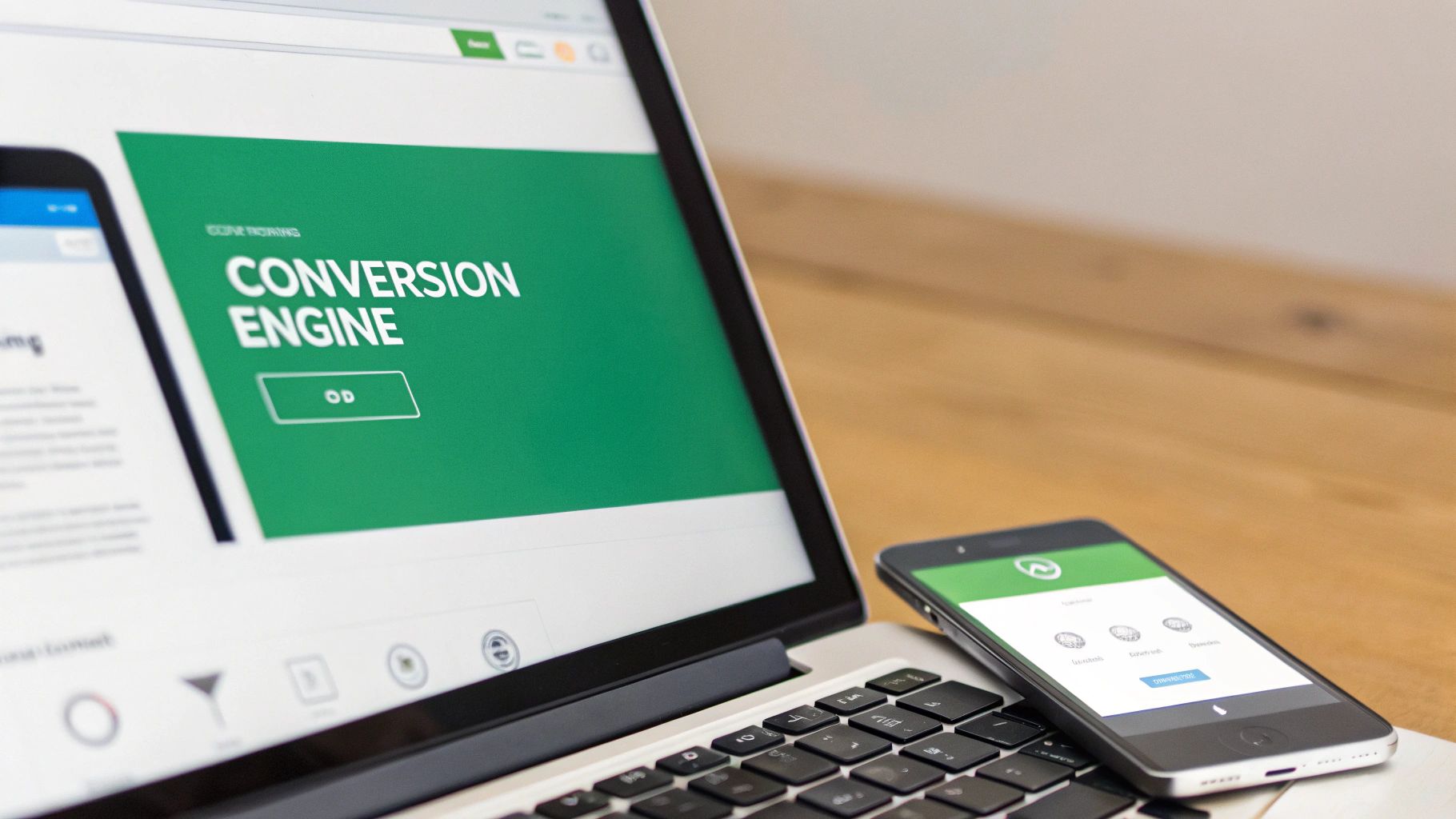
This is where technical SEO elements connect directly to real business results. Things like page speed and clear navigation aren’t just for show; they dramatically increase the odds that a visitor becomes a paying customer. A well-optimized site smoothly guides visitors from discovery to purchase.
From Visitor to Customer
Think of your website as your digital storefront. If a customer walks in and can’t find what they’re looking for, or if the aisles are cluttered and slow to get through, they’ll leave. Your website is no different.
SEO encourages you to streamline this entire journey. A clear, intuitive site builds trust and credibility from the very first click, turning casual browsers into loyal customers. This involves a few key elements:
- Fast Page Speeds: Visitors expect pages to load in two seconds or less. Any longer, and they’re likely to bounce.
- Mobile-Friendliness: Most web traffic now comes from mobile devices, so your site absolutely must look and work great on a small screen.
- Clear Calls-to-Action (CTAs): You have to tell visitors exactly what to do next, whether it’s “Buy Now,” “Contact Us,” or “Learn More.”
This user-centric approach is the foundation for turning traffic into revenue.
“A key 2023 statistic reveals that 73% of small businesses now have their own websites. But it’s shopper behavior that seals the deal—81% research businesses online before buying. If your site is missing clear contact info, 44% of B2B buyers will bail immediately.”
This data highlights just how crucial a seamless user experience is. SEO-focused sites with clear calls-to-action keep potential customers engaged and on the path to becoming actual customers. You can read the full infographic about small business website stats here.
Ultimately, a website optimized for search engines is also optimized for people. By focusing on the user, you create a powerful conversion machine that not only ranks well but also drives sales. If you’re looking to maximize these results, check out our guide on conversion rate optimization best practices.
5. Build a Sustainable Long-Term Business Asset with Benefits of SEO
Paid ads are like renting space on a billboard. You get a ton of attention as long as you keep paying the rent. But the second you stop, that billboard comes down, and your visibility evaporates. Poof. Gone.
SEO is entirely different. Think of it less like renting and more like buying the land and building your own skyscraper. It’s a real investment that builds on itself, creating a permanent fixture in your industry’s skyline. It definitely takes longer to get going—you have to lay the foundation and build it floor by floor—but what you end up with is a valuable, sustainable asset that you own.
Every helpful article you publish, every backlink you earn from a respected site, and every technical improvement you make to your website adds another floor to that skyscraper. This is one of the most powerful benefits of SEO for a small business: it creates a durable advantage that’s hard for competitors to copy.
The Power of Compounding Growth
The real magic of SEO is its compounding effect. A paid ad campaign gives you a pretty linear return: you pay X, you get Y clicks. SEO, on the other hand, builds momentum.
An article you write today might only bring in a trickle of visitors next month. But in six months, that trickle could become a steady stream. In a year? It could be a flood of qualified traffic.
And here’s the best part: that single piece of content can keep generating leads and sales for months—or even years—with little to no ongoing cost. This is why SEO often delivers one of the highest ROIs of any marketing channel out there.
SEO is the only marketing channel where your results don’t drop to zero the moment you stop spending money. In fact, well-established rankings can hold their ground for a long time, continuing to deliver value long after the initial investment was made.
Let’s break it down simply:
- PPC (Pay-Per-Click): This is a short-term play. You’re paying a toll for every single visitor. It’s fantastic for getting immediate results or testing a new offer, but it’s not an asset. The traffic disappears the moment your budget does.
- SEO (Search Engine Optimization): This is a long-term strategy. You’re building an asset that actually appreciates in value over time. Your “payment” is the upfront work of creating great content and ensuring your website offers a solid user experience.
Creating a Moat Around Your Business
A strong SEO foundation does more than just drive traffic. It builds a protective moat around your business.
Once you have dozens or even hundreds of pages ranking for valuable keywords, it becomes incredibly difficult for a new competitor to show up and knock you off your perch. They can’t just throw a pile of money at the problem to replicate the authority you’ve spent months or years patiently building.
This long-term authority rests on a few key pillars:
- A Deep Content Library: A rich collection of blog posts, guides, and service pages that genuinely answer your customers’ questions.
- A Strong Backlink Profile: Links pointing to your site from other reputable websites, which act like votes of confidence in Google’s eyes.
- Solid Technical Health: A fast, secure, and mobile-friendly website that search engines find easy to crawl and understand.
Each of these elements strengthens the others, making your online presence more powerful and resilient over time. It’s a true business asset that grows in value while protecting your slice of the market.
See How SEO Works in the Real World
Okay, let’s move beyond the theory and see what this looks like on the ground. It’s one thing to list benefits, but it’s another to see exactly how they play out for different kinds of small businesses.
After all, a local plumber trying to get more service calls has completely different priorities than an e-commerce store selling handmade jewelry nationwide. To make SEO work, you have to get practical. That means learning things like how to find low competition keywords that your specific customers are actually typing into Google.
Seeing how these strategies apply to a business like yours makes the whole concept tangible and, most importantly, actionable.
6. Benefits of SEO for Small Business: The Local Service Business
Let’s start with a classic example: a local plumbing company. Their main goal isn’t just getting clicks on a website; it’s making the phone ring with urgent service requests from people right in their neighborhood.
For a business like this, the entire SEO world revolves around their Google Business Profile (GBP). This isn’t optional—it’s everything.
Here are their quick wins:
- Fill Out Everything: Every single section of the GBP needs to be completed with detailed service descriptions, accurate hours, defined service areas, and high-quality photos of the team and their work.
- Get a Steady Stream of Reviews: Actively ask every happy customer to leave a review. Just as importantly, respond to all of them—good and bad—to show you’re engaged.
- Use Google Posts: Regularly share updates, special offers, service highlights, or photos from a recent job. This activity signals to Google that the business is alive and well.
By nailing these local signals, the plumber can start showing up in the coveted Google Map Pack for searches like “emergency plumber near me,” driving high-intent calls straight to their dispatch.
For a service business, SEO isn’t about ranking #1 globally for “plumbing.” It’s about being the undeniable top choice for someone standing in a flooded kitchen just a few miles away. That’s the real power.
7. Benefits of SEO for Small Business: The E-commerce Store
Now, let’s pivot to an e-commerce brand selling handmade leather wallets. Their audience is national, maybe even international, so their focus is completely different.
For them, the SEO battle is won or lost on their product and category pages. Their goal is to pop up the moment someone searches for terms like “slim minimalist leather wallet” or “men’s bifold wallet with coin pocket.”
This diagram shows how SEO acts as a foundational marketing asset—something you own. PPC, on the other hand, is more like renting temporary visibility.
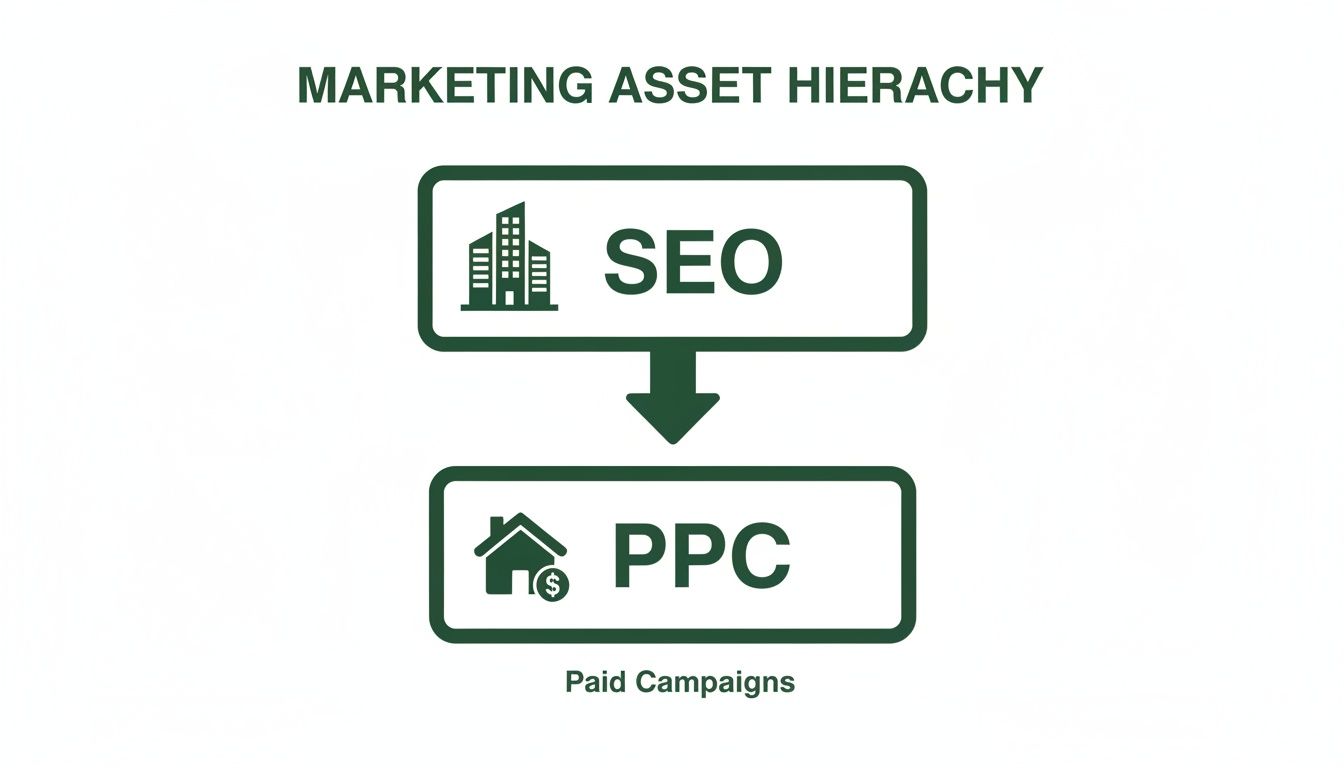
As you can see, investing in SEO builds a long-term asset. Relying only on paid ads means your visibility vanishes the second you stop paying.
Their quick wins look totally different from the plumber’s:
- Write Unique Product Descriptions: No copying and pasting. They need compelling, unique descriptions for every single wallet, naturally woven with relevant keywords.
- Use High-Quality Imagery: This is crucial. Professional photos need descriptive alt text (e.g., “Hand-stitched brown leather bifold wallet”) to help Google understand what they show.
- Feature Customer Reviews on Product Pages: Adding user-generated content like reviews and ratings builds trust and provides a constant stream of fresh, relevant content for search engines.
By optimizing these pages, the wallet company attracts shoppers who have a specific purchase in mind, turning search clicks directly into sales.
8. DIY SEO vs Hiring an Agency
Alright, you get it. You see the potential of SEO. The next logical question is a big one: should you tackle this yourself or bring in the experts?
Honestly? It depends. No one-size-fits-all answer here.
Making the right call comes down to balancing your two most precious resources: time and money. For most small business owners, this decision is the critical first step in turning SEO from an interesting idea into a real, measurable growth engine.
When to Go the DIY Route
Doing your own SEO is a perfectly fine place to start, especially if you have more time on your hands than marketing budget in your bank account. If you’re willing to roll up your sleeves and learn, you can make some serious headway on your own. It’s also a fantastic way to truly understand the nuts and bolts of your own marketing.
DIY SEO makes sense when:
- Your Budget is Tight: You’re a brand-new startup or a solopreneur, and every single dollar has a job to do.
- You Have Time to Learn: You can carve out a few hours each week to read guides, watch tutorials, and actually implement what you learn.
- Your Market Isn’t Hyper-Competitive: You operate in a local niche where getting the fundamentals right can make a noticeable impact without needing to deploy advanced, resource-heavy tactics.
Starting with the basics, like fully optimizing your Google Business Profile and writing genuinely helpful blog posts, can deliver some fantastic early wins.
When to Hire an Agency
But there’s always a tipping point—that moment when your business growth is actually being held back by not having professional help. That’s when it’s time to find a partner. The real benefits of SEO are unlocked when you have a dedicated team pushing the strategy forward consistently.
It’s time to hire an agency when the cost of your own time and the potential for missed opportunities outweighs the cost of professional services. Your job is to run your business, not become a full-time marketer.
Here are the clear signs it’s time to call in the pros:
- You’ve Hit a Plateau: Your initial efforts worked for a while, but now things have stalled. You’re not sure how to break through to that next level of growth.
- Complex Technical Issues Pop Up: Your site is slow, you’re seeing weird indexing errors in Google Search Console, or you’re facing a complex site migration that’s way over your head.
- You Need to Scale, Fast: You’re ready to get aggressive. You need a comprehensive content strategy, deep competitive research, and the firepower to execute it all quickly and effectively.
If you find yourself at this crossroads, finding the right partner is everything. To help you navigate that process, check out our guide on how to choose a digital marketing agency.
9. Common Questions About Small Business SEO
We get it. SEO can feel like a bit of a mystery box when you’re just starting out, and that’s okay—it’s a big topic with a lot of moving parts. So let’s cut through the noise and answer some of the most common questions we hear from small business owners.
No jargon, just straight talk.
How Long Does It Take to See SEO Results?
This is the big one, right? While there’s no magic switch to flip for instant rankings, you can typically start seeing real, positive movement in 3 to 6 months. For local businesses, sometimes you’ll see a jump in things like Google Map Pack rankings even faster.
The key here is consistency. Think of it like planting a tree, not flipping a light switch. The true power of SEO comes from the compounding returns that build over time—unlike paid ads, which disappear the second you stop feeding them money.
Can I Do SEO Myself for My Business?
Absolutely! You can definitely get started with DIY SEO, and focusing on the fundamentals is a fantastic first step. Honestly, it’s one of the best ways to really understand your own digital footprint.
Here’s where I’d recommend you begin:
- Optimize Your Google Business Profile: This is your single most powerful local SEO tool. Go through and fill out every single section. Don’t skip anything.
- Create Genuinely Helpful Content: Start a simple blog on your site and answer the real questions your customers are asking you every day.
- Go After Customer Reviews: Be proactive. Ask for and respond to every review you get on Google and any other platform that matters in your industry.
As your business grows—or if you find yourself in a really competitive market—that’s when hiring an expert for the technical heavy lifting and advanced strategy becomes essential to keep climbing.
10. How Much Should a Small Business Budget for SEO?
The cost can vary quite a bit. It might be a few hundred dollars a month for some basic local SEO services, or it could be several thousand for a full-scale national campaign.
But here’s a better way to think about it: good SEO doesn’t cost you money, it makes you money. The investment is all about the return. It should be generating high-quality leads and sales that far outweigh what you spend, delivering sustainable, long-term growth for your business.
Ready to unlock these benefits for your own business? The team at Mr. Green Marketing, LLC specializes in creating custom SEO strategies that drive real results. Request your free audit and performance report today.
Leave a Comment
sing in to post your comment or sign-up if you dont have any account.