
How To Choose A Digital Marketing Agency. Choosing a digital marketing agency really boils down to one thing: matching your specific, measurable business goals with their proven expertise. It’s about finding a partner who genuinely gets your vision—not just someone trying to sell you a pre-packaged bundle of services.
And that whole process? It starts with a serious look in the mirror. Long before you ever pick up the phone.
How To Choose A Digital Marketing Agency – Defining What You Actually Need from an Agency
Alright, here’s where the real work begins. Before you start drowning in a sea of agency websites, the most critical step happens inside your own company. I’m serious.
What does “growth” actually look like for you right now?
More leads for your sales team? More e-commerce revenue? Or maybe it’s just about building a brand people actually recognize. Nailing this down is the foundation for finding an agency that will become a true extension of your team.

This first phase is all about turning those big, fuzzy ideas into sharp, measurable goals. It’s how you get from a vague wish like “we need more sales” to a concrete target like, “we need to increase organic lead conversions by 25% in the next six months.”
Without that clarity, you’re just shopping for services. With it, you’re shopping for a partner.
How To Choose A Digital Marketing Agency – Start with a Simple Self-Audit
Before you can hand off the keys to anyone, you need a map of where you are right now. A quick internal audit gives you a clear baseline. And it instantly highlights your biggest opportunities. You don’t need fancy software for this—just some honest answers.
Get your team together and ask these questions:
- What’s Working Right Now? Pinpoint your current wins. Maybe your email newsletter gets a fantastic open rate, or a handful of old blog posts still pull in steady organic traffic. These aren’t just wins; they’re clues about what your audience already loves.
- Where Are the Obvious Gaps? Be brutally honest here. Is your website a relic from 2015? Is your social media presence a ghost town? Totally invisible on Google for keywords your customers are searching for every day? Find the biggest pain points.
- Who Is Your Ideal Customer? Go deeper than “males, 35-50.” What keeps them up at night? What problems are they trying to solve? Where do they hang out online? A good agency needs to know exactly who they’re talking to.
- What Is Your Capacity for Growth? This one is huge. If an agency doubled your leads next month, could your sales team actually handle the volume? Be realistic about your operational limits so a marketing success doesn’t become a customer service failure.
From Vague Ideas to Specific Goals – How To Choose A Digital Marketing Agency
Once you’ve audited your situation, it’s time to translate those findings into SMART goals. You’ve probably heard of the framework—Specific, Measurable, Achievable, Relevant, and Time-bound—and for good reason. It works. It forces clarity.
A vague goal sounds like: “I want to grow my online presence.”
A SMART goal sounds like: “I want to increase organic website traffic by 30% over the next 12 months by ranking on page one for five target keywords related to local plumbing services.”
See the difference? That level of detail is everything. It tells a potential agency exactly what success looks like, what services (like SEO) are probably needed, and how their performance will ultimately be measured.
For some businesses, the most pressing need might be generating leads through paid ads. In that case, you’d want to consider whether a specialized Social Media Marketing Agency specializing in Facebook Ads is the right fit, ensuring you get hyper-focused expertise where it counts most.
Prioritize Your Marketing Objectives – How To Choose A Digital Marketing Agency
You can’t do everything at once. Especially not on a small or mid-size business budget. So the next step is to rank your goals. Trust me, this prioritization is one of the most powerful signals you can send to a prospective agency.
Here’s a simple way to frame it:
- Critical Needs: These are the absolute must-haves. For an e-commerce store, this might be “reduce shopping cart abandonment rate.” For a local contractor, it’s probably “generate 15 qualified phone leads per week.”
- Important Wants: These goals will definitely move the needle but aren’t do-or-die emergencies. Think “increase social media engagement by 50%” or “publish one high-quality blog post per week.”
- Future Ambitions: These are the long-term plays. The big swings. “Become the #1 thought leader in our industry” or “launch a successful podcast.”
Walking into your first agency meeting with a prioritized list like this is a total game-changer. It shows you’re strategic, you’ve done your homework, and you’re serious about getting results. This prep work is also crucial for understanding the different digital marketing strategies for small business owners and figuring out which ones truly align with your top priorities.
How to Vet an Agency’s Real-World Expertise
Alright, now for the fun part. Every agency website looks polished. They all have slick graphics and bold promises about “driving results.” So, how do you tell the real experts from the ones who are just good at marketing themselves?
It’s time to put on your detective hat. You need to look past the sales pitch and dig into their actual, verifiable track record.
This is about separating the talkers from the doers. An agency’s real value isn’t in what they promise; it’s in what they have already proven they can do for businesses just like yours.
Look Past the Highlight Reel – How To Choose A Digital Marketing Agency
Case studies are an agency’s resume, but let’s be honest—they’re a highlight reel. All wins, no struggles. Your job is to read between the lines and find the real story. Don’t just accept a vanity metric like “increased traffic by 200%.” That number means nothing without context.
You have to dig deeper.
- What was the starting point? A 200% jump is far less impressive if they started with only 10 visitors a month. Always ask for the baseline data.
- What business problem did they actually solve? Was the client bleeding money on a high cost per acquisition, struggling with low-quality leads, or just invisible online? The best case studies frame the work around a specific business challenge.
- How did they really measure success? Did that traffic spike actually lead to more sales or qualified leads? A great agency ties its efforts directly to bottom-line results like revenue and customer acquisition cost.
This level of scrutiny is essential. If you want to properly vet an agency, you need to understand how they prove their value. It helps to read up on effective strategies to measure marketing ROI so you can arm yourself with the right questions.
Industry-Specific Experience Matters – How To Choose A Digital Marketing Agency
Does the agency get your industry? This isn’t always a deal-breaker, but it can be a massive advantage. An agency that crushes it for SaaS startups might not have a clue about the nuances of marketing a local plumbing business or a B2B manufacturing company.
Industry experience means they already speak your customers’ language. They get your sales cycle, your competitive challenges, and the specific regulations you might face. They won’t be learning on your dime.
Ask them directly: “Have you worked with other companies in the [your industry] space? If so, can you share some examples of the results you achieved?”
If they haven’t, it’s not an automatic “no.” A great agency can adapt—but they better be able to explain how their process and strategies would be tailored to your unique market.
The Ultimate Litmus Test – How To Choose A Digital Marketing Agency
Here’s a pro tip—one of my personal favorites. Judge an agency by how they market their own business. If their own marketing is a mess, that’s a huge red flag.
Take a few minutes and do a quick audit of their online presence:
- Check their SEO: Can you find them on Google for their own target keywords, like “digital marketing agency in [their city]”? If you can’t find them, how can you trust them to get you found?
- Review their content: Is their blog updated regularly with insightful, well-written articles? Or is it a ghost town of generic posts from three years ago?
- Analyze their social media: Are they actively engaging with their audience, or are their profiles just broadcasting sales pitches into the void?
- Examine their website experience: Does their site load quickly? Is it easy to navigate on your phone? Does it have clear calls-to-action that make sense?
Think about it—if an agency can’t execute great marketing for itself, why would you believe they can do it for you? Their own business is their most important client. And how they handle it tells you everything you need to know about their real-world skills.
2. Decode Agency Services and Match Them to Your Goals
You’ve defined your goals, and now you’re staring at the agency’s menu. SEO, PPC, social media, content marketing, email automation—it’s a dizzying list, and every service sounds important. How do you possibly know what you actually need versus what’s just an expensive, shiny object?
This is where the goals you just set become your compass. You’re not just buying services; you’re investing in outcomes. And the trick is to draw a straight line from your primary objective to the service best equipped to get you there.
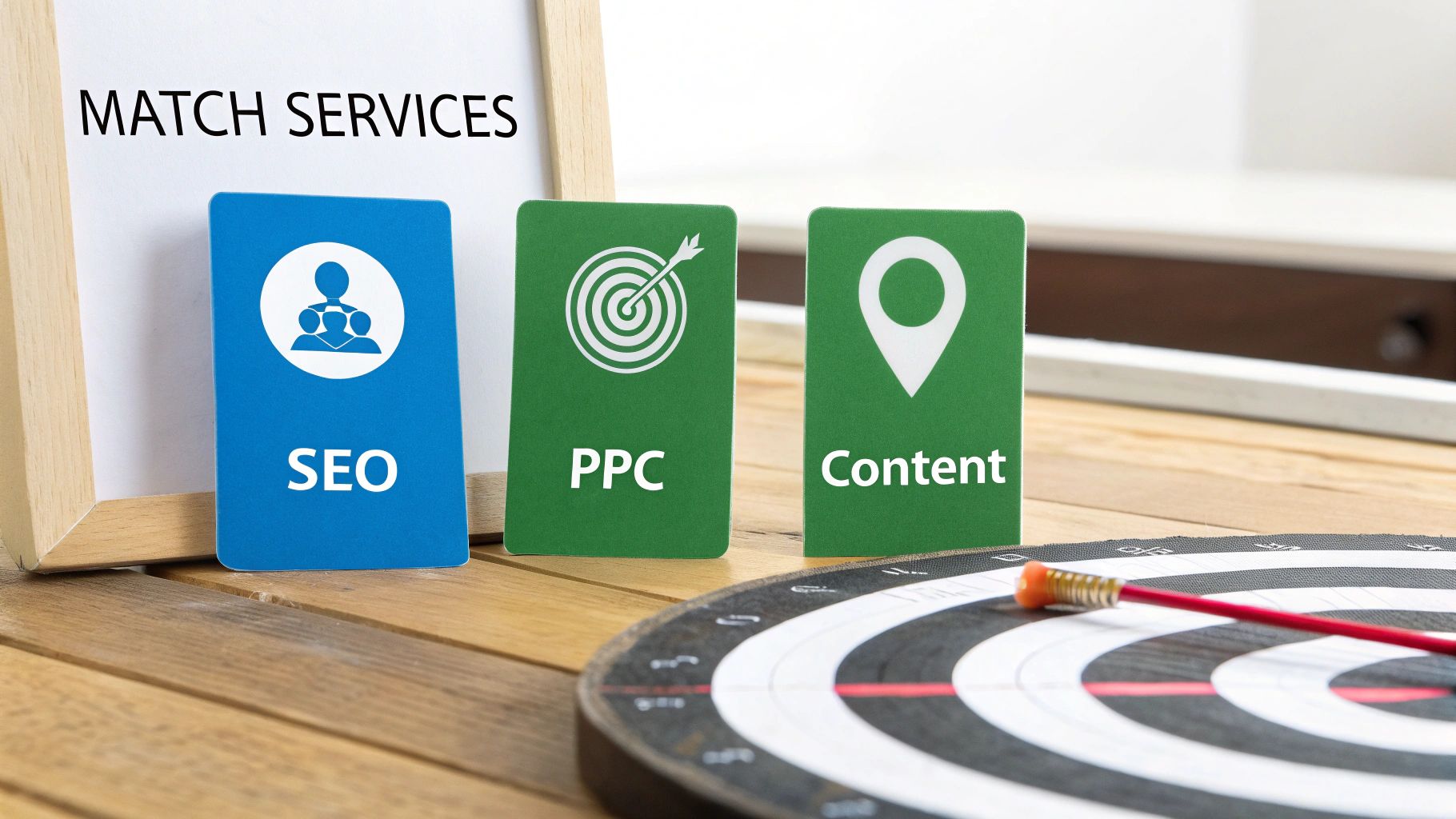
Let’s demystify the core offerings so you can have smarter conversations and make sure every dollar you spend is aimed squarely at your bottom line.
Speed vs. Sustainability: The PPC and SEO Divide
Think about your marketing needs in terms of speed. Do you need leads right now to make payroll, or are you trying to build a long-term, sustainable asset for your business? This one question often points you toward one of two foundational services.
If you need immediate results—leads, phone calls, or sales yesterday—then Pay-Per-Click (PPC) advertising is your answer. It’s like flipping a switch. You pay to appear at the top of Google, and you can start generating traffic almost instantly. Perfect for testing new offers, launching a product, or just filling a sales pipeline fast.
On the other hand, if your goal is to build a valuable, long-term asset that generates traffic for years without paying for every single click, then Search Engine Optimization (SEO) is non-negotiable. SEO is the slow-and-steady work of earning your visibility through great content and a technically sound website. It takes time—months, not days—but the payoff is a compounding return that becomes a powerful competitive advantage. Many businesses find that a deep dive into how SEO works really clarifies its immense long-term value.
A simple analogy I use with clients: PPC is like renting a house. You get a great place to live immediately, but the moment you stop paying rent, you have to move out. SEO is like buying a house. It takes longer and requires an upfront investment, but you’re building equity in an asset that’s truly yours.
To make this even clearer, here’s a quick reference table to help you connect your goals to the right services.
Matching Your Business Goal to the Right Service
| If Your Goal Is… | Prioritize These Services | Key Metric to Track |
|---|---|---|
| Immediate leads and sales | PPC Advertising (Google/Meta Ads) | Cost Per Acquisition (CPA) |
| Long-term organic growth | SEO, Content Marketing | Organic Traffic, Keyword Rankings |
| Building brand awareness | Social Media Marketing, PR | Reach, Engagement Rate |
| Nurturing existing leads | Email Marketing, Marketing Automation | Open Rate, Conversion Rate |
| Improving website performance | Web Design, Conversion Rate Optimization | Bounce Rate, Goal Completions |
| Selling products on Amazon | Amazon SEO & PPC | Total ACoS (TACoS) |
This table isn’t exhaustive, but it’s a solid starting point for focusing your search and asking the right questions.
Specialist Agency or Full-Service Partner?
Another big decision. Specialist or a full-service agency? There’s no single right answer here; it depends entirely on your immediate needs and long-term vision.
A specialist agency does one thing exceptionally well. For example:
- An e-commerce brand struggling with abandoned carts might hire an agency that only does Klaviyo email automation.
- A local roofer needing immediate leads would get huge value from a PPC-only shop that lives and breathes Google Ads.
A full-service agency offers a wider array of services under one roof. This model is ideal if you know your goals require an integrated approach—for instance, using content to fuel SEO, then promoting that content with social media ads. The coordination is seamless because it’s all one team.
Your choice here links back to the self-audit you did. If one channel is glaringly broken, a specialist is probably the perfect fix. But if you see multiple interconnected weaknesses, a full-service partner can build a much more cohesive strategy.
Keeping an Eye on the Future: AI and Emerging Trends
The world of marketing is always changing. And you don’t just want a partner who’s keeping up—you want one who’s looking ahead. The rise of AI in marketing is a perfect example.
Five years ago, it was a futuristic concept. Today, it’s a practical tool for everything from writing ad copy to analyzing customer data at scale. You don’t need to be an AI expert, but you should absolutely ask potential agencies how they’re using these new tools to get better, faster results for clients.
This forward-thinking mindset is a key differentiator. In fact, industry trends show 89% of agency leaders rank PPC as their core service, but AI-related services are catching up fast. The percentage of agencies offering them is expected to jump from 10% in 2023 to 17% by 2025, signaling a major shift.
Choosing an agency that understands these shifts ensures your strategy won’t be obsolete in a year. It’s about finding a partner who can deliver results today while preparing you for the opportunities of tomorrow.
Navigating Pricing Models and Contract Terms
Alright, let’s talk about the part everyone loves to avoid. Money and contracts. Getting this conversation right from the start is absolutely critical. And how an agency handles these questions tells you everything you need to know about their transparency and character.
This isn’t just about the price tag. It’s about understanding the value you’re getting and making sure the entire partnership is built on solid ground. You need to know exactly what you’re paying for, how they measure success, and what happens if things just don’t click.
Asking the tough questions now saves you from major headaches—and budget blow-ups—later. It’s what turns a simple transaction into a genuine partnership built on trust.
Decoding Common Pricing Models – How To Choose A Digital Marketing Agency
An agency’s pricing structure is a window into its business philosophy. Are they aiming for long-term partnerships, quick one-off projects, or a shared-risk model? Let’s break down the three main types you’ll likely see.
- Monthly Retainer: This is the industry standard. You pay a fixed fee every month for a clearly defined scope of work. Great for budgeting predictability and perfect for ongoing efforts like SEO and content marketing where results build over time.
- Project-Based Fee: Simple and straightforward. You pay a one-time fee for a specific project with a defined start and end, like a website redesign. Ideal for standalone needs, but it can get messy if you have multiple projects that need to work together.
- Performance-Based Pricing: This one sounds tempting. The agency’s pay is tied directly to the results they generate—maybe a percentage of your ad spend, a fee per lead, or even a cut of the revenue. It aligns incentives perfectly but demands crystal-clear definitions of success and rock-solid tracking to work.
Knowing the pros and cons helps you pick a model that fits your cash flow, your comfort with risk, and the kind of work you need done.
Key Questions to Ask About Contracts and Transparency
A good contract protects everyone involved. A great agency will have no problem walking you through theirs, line by line. If they get cagey or vague when you start asking about the fine print, that’s a massive red flag.
Before you even think about signing, get clear, direct answers to these questions:
- What’s the Contract Length? Are they trying to lock you into a 12-month commitment, or is it a shorter 90-180 day initial term that rolls month-to-month? Shorter trial periods are almost always better. They give both of you an out if it’s not a good fit.
- What Is the Termination Clause? How much notice do you have to give to end the contract? Is there a penalty for leaving early? Business needs change, and you need a fair and clear exit strategy. Just in case.
- Who Owns the Accounts and Creative? Non-negotiable. You must retain 100% ownership of your Google Ads account, Google Analytics profile, social media pages, and every creative asset they produce for you. If an agency wants to run things through their own accounts, walk away. Period.
- How Do You Handle Budgeting? You need to see a clean separation between their management fee and your actual ad spend. On average, businesses dedicate 7.7% of their total revenue to marketing, with about 30.6% of that going to paid ads. A good agency can justify their proposed budget against industry benchmarks like these and show you exactly where every dollar goes. You can learn more about how budgets are trending from recent industry reports.
- What Does Reporting and Communication Look Like? Who is your day-to-day contact? How often will you get reports, and what metrics are included? Crucially, what dashboards will you have access to for your own real-time data?
A trustworthy partner won’t hide your data behind a monthly PDF report. They’ll give you direct access and schedule regular calls to interpret the numbers with you, helping you make smarter strategic decisions together.
Getting into this level of detail might feel like a grind, but it’s the foundation of a healthy, productive agency relationship. Remember, you’re not just buying a service—you’re entering a business agreement that has to be crystal clear from day one.
Making the Final Decision and Kicking Things Off
Alright, here we are. You’ve sat through the demos, vetted the case studies, and survived the discovery calls. You’ve whittled the list down to one standout agency. So, what’s next? Making that final call and kicking things off is more than just a formality—it sets the entire tone for the partnership ahead.
This last step isn’t about spreadsheets anymore. It’s about making a decision with total confidence, based on something you can’t really quantify.

The Underrated Importance of Cultural Fit
Let’s be real for a minute. On paper, two agencies can look almost identical—impressive case studies, smart people, fair pricing. The tiebreaker often comes down to a simple, human element that too many businesses completely ignore.
Do you actually like their team?
This isn’t about finding a new best friend. It’s about chemistry. Do they communicate like you do? Is there mutual respect? Throughout the sales process, did they show genuine curiosity about your business, or were they just waiting for their turn to talk? Did they ask smart, challenging questions, or just nod along to everything you said?
You’re about to trust this group with a huge piece of your business. You’ll be talking to them weekly, maybe even daily. A small personality clash today can easily snowball into a massive communication breakdown three months from now.
A great agency partner feels like a natural extension of your own team. They’re proactive, they’re curious, and they communicate with the same sense of ownership you do. If the vibe feels off from the start, trust your gut.
What a Great Onboarding Process Looks Like
The moment after you sign the contract is when a top-tier agency really shows its cards. They don’t just send an invoice and go dark. They drive the process. Make it feel organized, clear, and totally seamless. A messy, chaotic onboarding is a huge red flag—if they’re disorganized now, imagine what they’ll be like when they’re managing your money.
A solid kickoff should feel like a well-oiled machine. It proves they’ve done this before and respect your time. With the digital advertising agency industry growing at a compound annual growth rate of 13.6%, the competition is fierce. The best agencies set themselves apart with exceptional client service from day one. You can dive deeper into this market with research from IBISWorld.
This is where the foundation for a successful partnership is built.
Your Kickoff and First 90 Days Checklist
An excellent agency will guide you through this, but it pays to have your own checklist to make sure nothing slips through the cracks. This sets you both up for momentum right out of the gate.
Here’s what you should expect in the first few weeks:
- The Official Kickoff Call: This isn’t just a meet-and-greet. It’s a strategic session to align on immediate next steps, confirm points of contact, and lock in a recurring meeting schedule.
- Account Access and Pixel Setup: The agency will need access to everything from your Google Analytics and Google Ads accounts to your website backend. They should provide a secure, straightforward way to share credentials. This is also when they’ll double-check that all tracking pixels are installed correctly—a critical step for measuring ROI.
- Establishing the First 90-Day Game Plan: The single most important part of onboarding. A great agency will present a detailed plan outlining exactly what they’ll accomplish in the first three months. It should include:
- Quick Wins: Low-hanging fruit they can tackle immediately to build momentum and get you some early results.
- Foundational Work: The necessary audits, research, and technical setups required for long-term success.
- Key Performance Indicators (KPIs): The specific metrics they will use to measure progress against the goals you defined way back at the start of this process.
This 90-day plan is what turns their promises into a concrete roadmap. It’s the final piece of the puzzle, ensuring the partner you chose is ready to hit the ground running and start delivering value from day one.
Got Questions? Let’s Talk Brass Tacks
Alright, you’ve done the research, sat through the meetings, and looked at a few proposals. You’re close. But I bet there are a few nagging questions still bouncing around in your head. That’s not just normal, it’s smart. Choosing a marketing partner is a huge decision for your business.
Let’s cut through the noise and tackle the questions business owners are often thinking but might not always ask out loud. This is your final, no-fluff reality check before you sign on the dotted line.
How Much Should a Small Business Really Budget for Marketing?
This is the big one, isn’t it? The honest answer is always “it depends,” but you need a starting point. A solid rule of thumb for most small businesses is to earmark 7-12% of your total revenue for marketing. If you’re a new business trying to make a name for yourself, you’ll likely need to push that closer to 15-20% to get that initial traction.
But forget percentages for a second. The better question is, “What will it take to hit my specific goal?”
- Want aggressive growth, fast? You’ll need a significant budget for paid ads (PPC) to get immediate traffic and leads flowing.
- Building for the long haul? A more moderate budget focused on SEO and content marketing will build a powerful, sustainable asset over time.
A good agency won’t just throw a price at you. They’ll break down why that budget is necessary to achieve the goals you talked about. They’ll connect the investment directly to the expected outcome.
How To Choose A Digital Marketing Agency – Does the Size of the Agency Actually Matter?
Sometimes. But probably not in the way you think. A giant, well-known agency looks impressive and has tons of resources, but will your small business account get the A-team? Or will you be handed off to a junior account manager after the sale is made?
On the flip side, a smaller boutique agency often gives you direct access to the senior strategists—the people whose experience you’re actually paying for. They live and die by the results they get for every single client.
The real question isn’t about size, it’s about alignment. Does the agency’s team, communication style, and typical client profile match what you need? A massive agency might be perfect for a national brand, while a specialized firm is the ideal growth partner for a local service business.
Focus on expertise and attention, not just the number of employees.
What Are the Biggest Red Flags I Should Watch for in a Sales Pitch?
This is where you need to trust your gut, but also keep an eye out for some classic warning signs. After hearing hundreds of these pitches over the years, a few things always make me cringe.
If you hear any of these, pump the brakes:
- “We Guarantee #1 Rankings on Google!” The oldest, tiredest line in the book. Nobody can guarantee a specific ranking. Anyone who says they can is either brand new to the game or flat-out lying.
- Vague Strategies and “Secret Sauce.” If they can’t clearly explain how they plan to get you results, that’s a huge red flag. Good marketing isn’t a secret; it’s a process built on hard work, data, and experience. Transparency is everything.
- High-Pressure Sales Tactics. An agency that’s desperate to get you to sign today is probably more worried about hitting their own sales quota than your long-term success. A real partner acts like a consultant, not a used car salesman.
Choosing an agency is a big commitment, and you’re bound to have more questions. For direct answers to other common queries, feel free to check out our complete digital marketing agency FAQ to get even more clarity.
How Long Does It Realistically Take to See an ROI?
Patience is a must in marketing, but you deserve to know what to expect. Timelines vary wildly depending on the channel, and any agency worth its salt will set those expectations from day one.
Here’s a realistic, real-world breakdown – How To Choose A Digital Marketing Agency:
- PPC (Pay-Per-Click): You can start seeing traffic and even leads within a few days of launching a campaign. But getting those campaigns optimized for a profitable Return on Ad Spend (ROAS) usually takes 1-3 months of tweaking and testing.
- SEO (Search Engine Optimization): This is the long game. Expect to see some initial movement in your rankings within 3-6 months, but the significant, needle-moving results often take 6-12 months or more to really kick in. The payoff, of course, is that those results are sustainable and compound over time.
Anyone promising you page-one rankings and a flood of organic leads in 30 days is selling you a fantasy. Real growth is built on a smart, consistent effort.
Ready to stop searching and start growing? At Mr. Green Marketing, LLC, we skip the fluff and build custom marketing plans designed to hit your specific business goals. We’re ready to listen and show you exactly what’s possible. Request your free audit today at https://mrgreenmarketing.com.
Leave a Comment
sing in to post your comment or sign-up if you dont have any account.