
Digital Marketing Audit Services. Spending money on marketing is easy. Knowing if it’s actually working? Not so much. And that’s where a digital marketing audit comes in. Think of it as a complete, no-holds-barred health check for your entire online presence, designed to stop the guesswork for good. This isn’t just a quick peek at your website speed—it’s an investigative deep-dive into every single channel you use to talk to your customers.
What Are Digital Marketing Audit Services Anyway?

It’s a strategic roadmap. One built from your own data, designed to make every single marketing dollar work harder. Its job is to uncover what’s driving real results, what’s just draining your budget, and where your biggest growth opportunities are hiding in plain sight.
The whole point isn’t just about finding problems. It’s about building a prioritized action plan. A proper audit digs into all your moving parts—SEO, paid ads, social media, your website’s user experience, content performance, and even how you show up on Amazon—to see how they all work together. A full-funnel examination from top to bottom.
Why Audits Are No Longer Optional
In the past, audits were a “nice-to-have.” Not anymore. The sheer scale and cost of digital marketing have turned them into a financial necessity.
- The Ad Spend is Massive. The global digital ad market is projected to hit roughly $786.2 billion by 2026.
- Inefficiency is Expensive. When nearly seven out of every ten ad dollars are digital, even a 10% inefficiency translates into billions of wasted spend across the board.
- Small Gains, Big Impact. For a business like yours, an audit that finds a 5–15% improvement can genuinely shift annual revenue.
This reality makes digital marketing audit services mission-critical for plugging financial leaks and finding a clear, profitable path forward.
A great audit doesn’t just give you a list of 50 things to fix. It tells you the three things you must fix this quarter to see the biggest impact on your bottom line. It delivers clarity, not just data.
Digital Marketing Audit Services – The Scope of a True Audit
So what gets put under the microscope? A thorough audit looks at your entire digital ecosystem to make sure every component is pulling its weight. The goal is to see the whole picture, not just isolated pieces.
To give you a clearer idea of what this entails, here’s a look at the core areas a comprehensive audit investigates.
Key Areas Covered in a Comprehensive Digital Marketing Audit
| Audit Area | What We Investigate | Key Question Answered |
|---|---|---|
| SEO & Technical Health | Site structure, crawlability, on-page factors, backlink profile, mobile-friendliness, and site speed. | “Is Google able to find, understand, and rank my website for the right keywords?” |
| Paid Media Performance | Ad spend efficiency (ROAS/ACoS), campaign structure, targeting, ad creative, and landing page conversion rates. | “Are my ad campaigns actually profitable, or am I just buying clicks?” |
| Website & User Experience | Navigation flow, calls-to-action (CTAs), conversion funnels, and mobile usability. | “Do visitors get frustrated and leave, and where are the friction points killing sales?” |
| Content & Social Strategy | Content relevance, audience engagement, social media channel performance, and content gaps. | “Does our content actually resonate with our audience, or is it just creating noise?” |
| Analytics & Tracking | Data accuracy, goal tracking setup, attribution modeling, and reporting clarity. | “Can I trust the numbers I’m seeing in my reports, and are we tracking what matters?” |
Each of these areas is interconnected. For example, a technical SEO issue could be crippling the conversion rate of your expensive paid ad traffic. An audit connects these dots. If you want a taste of what an analytics review looks like, some providers offer a free analytics audit to get you started.
Ultimately, these services reveal the story your data is trying to tell, providing a blueprint for sustainable growth. Our guide on the full spectrum of digital marketing services shows how these individual pieces fit into the bigger picture of your business.
Digital Marketing Audit Services – The Hidden Costs of Flying Blind
Let’s be honest—navigating digital marketing without a map gets expensive, fast. The obvious problem is the ad spend you’re wasting on campaigns that don’t convert. But the real problem, the one that quietly bleeds a business dry, is all the missed opportunities and invisible leaks.
Every month you spend chasing the wrong keywords, you’re not just losing money; you’re handing market share over to your competitors. Every potential customer who gets frustrated and bounces from your clunky website is a lead you might never see again. This isn’t just about inefficiency. It’s about actively losing ground.
Digital Marketing Audit Services – The Tangible Drain on Your Budget
The most obvious cost is wasted spend. Picture a pay-per-click (PPC) campaign with a broken conversion tracking pixel. You could pour thousands of dollars into ads that look like they’re failing, prompting you to shut off what might have been a goldmine.
Or worse—the pixel misfires, telling you an unprofitable campaign is a huge success. This is exactly how budgets get torched on phantom wins. Without regular digital marketing audit services, these technical glitches can go unnoticed for months, silently burning through your capital.
Here are a few common ways a lack of oversight costs you real money:
- Paying for Low-Quality Traffic: Bidding on broad keywords that attract clicks from people with zero intent to buy. Inflating costs without a single lead.
- Ignoring Negative Keywords: Your ads pop up for irrelevant searches like “free software” or “jobs,” forcing you to pay for clicks that will never, ever convert.
- Poor Landing Page Experience: Spending good money to get someone to your site, only for them to leave instantly because the page is slow, confusing, or unusable on their phone.
An audit reframes this entire conversation. It’s not an expense. It’s an investment in stopping the financial leaks and reclaiming revenue that’s already slipping through your fingers.
Digital Marketing Audit Services – The Intangible Costs Choking Your Growth
Beyond the direct financial drain, the intangible costs of flying blind can be even more damaging. These are the slow-burning problems that erode your brand and put a ceiling on your growth.
We’re talking about the brand damage from a clunky user experience. Or the slow fade into irrelevance because your content strategy is completely out of sync with what your audience actually wants. You can’t easily put a dollar amount on this stuff—which is what makes it so dangerous.
Digital Marketing Audit Services – Data Blind Spots in a Privacy-First World
Getting a complete picture of what’s working is getting harder every day. Digital marketing audits are now a direct response to the massive data and attribution blind spots created by privacy changes and AI-driven platforms. By 2026, global internet penetration is projected to hit 73.2%, with about 6.04 billion users online, yet marketers are struggling more than ever to see what’s actually driving results.
With the death of third-party cookies and traditional tracking methods, the data in your dashboard can be dangerously misleading. It routinely undercounts crucial influences like word-of-mouth or a customer’s journey across multiple devices. A rigorous audit can be the difference between accurately funding your high-impact campaigns and continuing to pour money into channels that only appear effective due to flawed attribution. You can find more research into how marketing is adapting on brandvm.com.
Digital Marketing Audit Services – A Look Inside the Audit Process
So, what really happens during a digital marketing audit? Let’s be clear: it’s not about some consultant vanishing for a month only to reappear with a 100-page report loaded with indecipherable jargon.
Think of it more like a thorough vehicle inspection before a cross-country road trip. We check the engine, the tires, the navigation system, and the fuel efficiency—all to make sure you get to your destination safely and efficiently. A structured, collaborative process designed to give you clarity.
Phase 1: The Kickoff and Goal Alignment
Everything kicks off with a conversation. This is hands-down the most critical step, because an audit without clear business goals is just a data-gathering exercise. We don’t even think about looking at numbers until we know which numbers actually matter to you.
During this first meeting, we nail down what success looks like. Are you aiming to:
- Increase qualified leads by 20% this year?
- Slash your customer acquisition cost (CAC)?
- Dominate organic search for your main service lines?
- Improve your Amazon ACoS (Advertising Cost of Sale)?
Your goals become the lens we use for the entire analysis. This ensures our final recommendations are tied directly to real business outcomes, not just fluffy vanity metrics.
Phase 2: Discovery and Data Gathering
Once we know the destination, it’s time to pull out the maps. This phase is all about getting the raw materials we need—your data. We’ll request secure, read-only access to your key platforms.
This typically includes:
- Analytics Platforms: Google Analytics (GA4) or Adobe Analytics.
- Advertising Accounts: Google Ads, Meta Ads Manager, LinkedIn Campaign Manager.
- SEO Tools: Google Search Console, Bing Webmaster Tools, and our own suite of tools like Semrush or Ahrefs.
- Website Backend: Access to your CMS (like WordPress or Shopify) lets us look under the hood at the technical setup.
Think of us as detectives gathering clues. And a huge part of this involves digging into specific platforms. For example, when we analyze an ad account, we’re not just looking at spend; we’re hunting for opportunities. You can find a deeper dive into this with a founder’s guide on improving Google Ads performance.
Phase 3: Cross-Channel Analysis
This is where the real magic happens. We don’t look at SEO, PPC, or social media in isolation—that’s how you miss the big picture. Instead, our specialists get together and connect the dots. The PPC expert talks to the SEO analyst, who loops in the content strategist.
We might discover that a landing page with a high bounce rate isn’t because of bad ad copy, but because a technical SEO issue is making the page load at a snail’s pace. Or maybe we find that your most engaging social media topics have never been turned into blog posts. A massive, untapped opportunity.
This collaborative analysis is what separates a true strategic audit from a simple channel report. It uncovers the interconnected problems and opportunities that siloed reports almost always miss.
We combine powerful software with decades of human experience to spot patterns, diagnose root causes, and build a cohesive story from the data.
Phase 4: The Deliverable and Strategic Roadmap
The final result of our audit isn’t a data dump. It’s a clear, prioritized action plan. We walk you through our findings, explaining not just what’s wrong, but why it matters and exactly how to fix it.
Crucially, every recommendation is scored based on two simple factors:
- Impact: How much will this move the needle on your goals?
- Effort: How much time, money, and manpower will this take to execute?
This approach lets you zero in on the quick wins first—those low-effort, high-impact tasks that build immediate momentum. From there, we lay out a practical, long-term roadmap for sustainable growth. You’ll leave the meeting knowing exactly what to do next Monday morning.
A well-structured audit follows a predictable rhythm, ensuring nothing gets missed.
Digital Marketing Audit Services – Typical Digital Marketing Audit Timeline
Here’s a snapshot of what you can expect the process to look like week-by-week.
| Week | Key Activities | Primary Outcome |
|---|---|---|
| Week 1 | Kickoff meeting, goal alignment, access requests to all platforms. | A clear project brief and confirmed access to all necessary data sources. |
| Week 2 | Deep-dive data gathering across all channels (SEO, PPC, Analytics, etc.). | Initial data sets compiled and preliminary observations noted by channel specialists. |
| Week 3 | Cross-channel analysis, team collaboration, and root cause diagnosis. | Key findings synthesized and interconnected opportunities identified. |
| Week 4 | Prioritized action plan development, deliverable creation, and final presentation prep. | A strategic roadmap with clear, actionable recommendations ranked by impact and effort. |
This timeline ensures we move from broad questions to specific, data-backed answers in just a few weeks.
Digital Marketing Audit Services – The Core Pillars of a Full-Funnel Audit
A powerful audit doesn’t just look at channels in isolation; it examines how they all work together. Let’s be honest—a siloed report is just a data dump. A real digital marketing audit service connects the dots, showing you how a technical SEO issue is tanking your ad conversion rate, or how a brilliant social post created a missed opportunity on your blog.
This is why we structure our audits around five core pillars. It’s a full-funnel approach that guarantees no stone is left unturned.
Here’s a quick look at our typical audit flow, breaking down the process from our initial deep-dive to the final, actionable game plan.
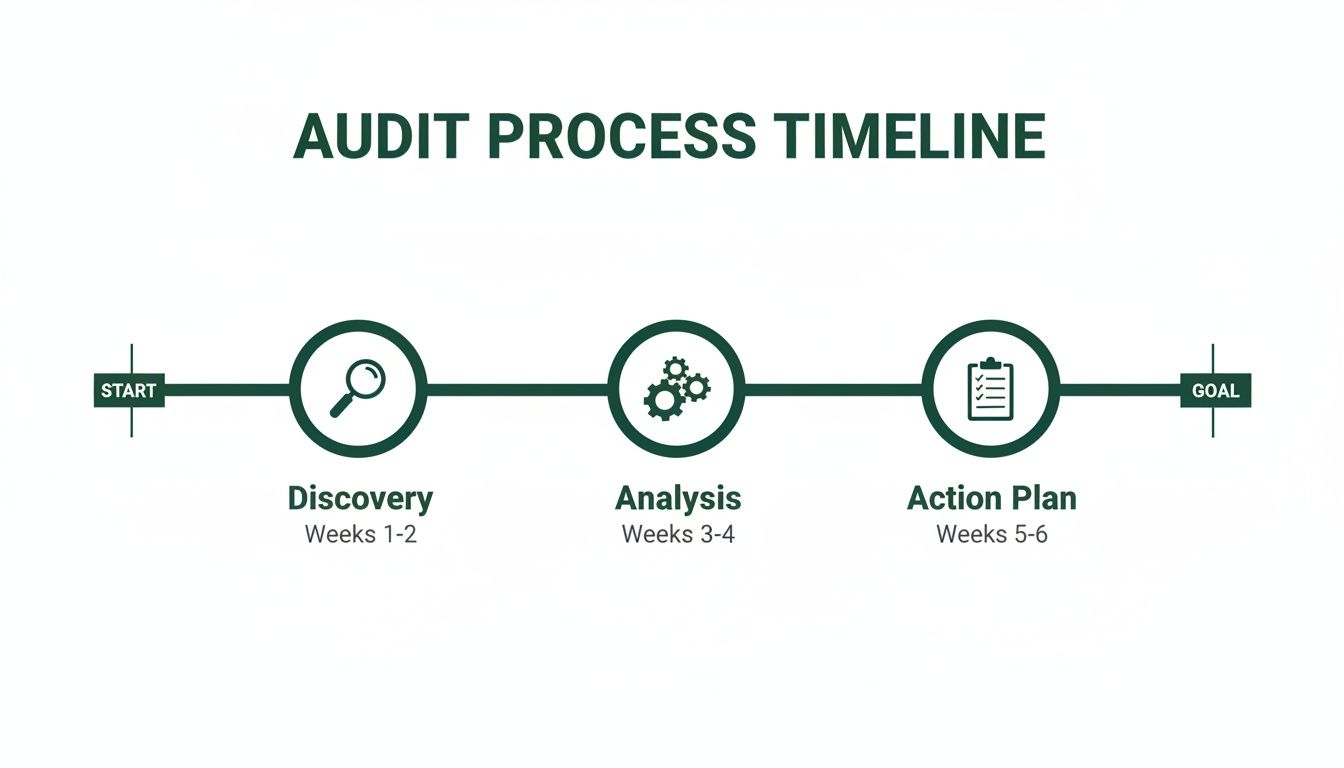
This structured timeline ensures we move methodically from broad discovery to specific, prioritized recommendations you can act on immediately.
1. The Technical and SEO Audit
This is the foundation. If your website has a cracked foundation, everything you build on top of it—your content, your ads, your brand—is at risk of collapsing. In 2024, there’s no question that SEO is a massive driver of marketing ROI. In fact, 91% of marketers report it directly improves website performance and helps them hit their goals.
At the same time, with the rise of AI, about 38% of teams are using new tools to streamline their SEO. The problem? Without a structured audit, those tools can create more complexity than clarity. Our audit brings that focus, checking everything from keyword strategy to page speed. You can find more on how these digital marketing statistics are shaping strategy on seoprofy.com.
A quick checklist for this pillar includes:
- Crawlability and Indexability: Can search engines actually find and make sense of your pages?
- Site Speed and Core Web Vitals: Are slow loading times killing your user experience and rankings?
- Backlink Profile Health: Are your backlinks helping you or hurting you? We hunt for toxic links and find new opportunities.
- On-Page SEO Elements: Are your title tags, meta descriptions, and headers actually optimized, or just filled in?
2. The Paid Media Audit
Pouring money into paid ads without regular check-ups is like driving a car that’s leaking fuel. Sure, you’re still moving, but you’re wasting a fortune along the way. A paid media audit is a forensic examination of your Google Ads, Meta campaigns, and other ad accounts to find every single drop of wasted spend.
We hunt for the inefficiencies—misaligned targeting, weak ad copy, broken tracking—it all adds up.
The goal here is simple: make every ad dollar work harder. We’re not just looking to slash costs; we’re looking to reallocate that budget to what’s actually driving conversions and profit.
A quick checklist for this pillar includes:
- Campaign Structure and Settings: Is your account organized for success, or is it a chaotic mess?
- Keyword Targeting and Negative Keywords: Are you paying for clicks that will never convert?
- Ad Copy and Creative Performance: Does your messaging resonate, or is it falling flat?
- Conversion Tracking and Attribution: Can you trust your data? Are you giving credit to the right channels?
If you’re new to the world of paid advertising, our beginner’s guide to PPC marketing demystified offers some great foundational context.
3. The Website and UX Audit
You can have the best SEO and the most brilliant ads in the world, but if your website is a confusing maze, you’ll lose the sale every single time. A website and User Experience (UX) audit analyzes how real people interact with your site. Where do they get stuck? Where do they get frustrated and just leave?
We use heatmaps, session recordings, and analytics to find the friction points killing your conversions. Sometimes it’s a button that’s hard to find. Other times it’s a checkout process with way too many steps. Small changes here often lead to the biggest wins.
4. The Content and Social Media Audit
Is your content actually doing its job? This part of the audit evaluates whether your blogs, videos, and social posts are just creating noise or if they’re building an audience and driving action.
We analyze engagement rates, find content gaps your competitors are exploiting, and check if your messaging is consistent across platforms. A winning content strategy is about creating value, not just volume. This audit tells you what to create more of, what to update, and what to stop wasting time on.
5. The Analytics and Tracking Audit
Finally, we audit the source of truth itself: your data. If your analytics setup is flawed, every single decision you make is based on a lie. This audit is an end-to-end verification that your tracking is accurate, your goals are configured correctly, and your reports are telling the true story of your performance.
We make sure your Google Analytics 4 (GA4) is set up for success and that your data is clean. Because when you can trust your numbers, you can make bold decisions with confidence.
How to Choose the Right Audit Partner
So, you’ve decided an audit is the right move. Good. But let’s be clear: not all digital marketing audit services are created equal. Not even close.
Some are little more than automated software reports that spit out a list of generic “problems” without any real context. Others deliver the kind of strategic insight that can genuinely change the direction of your business. The difference? The partner you choose. You need someone who gives you clarity, not just a mountain of data.
Look Beyond the Specialist
Here’s a classic mistake businesses make. They hire an SEO guru for an SEO audit and a separate PPC specialist for a paid media audit. On the surface, it seems logical, but it’s a recipe for a fractured, incomplete picture of your marketing.
You need a partner with cross-functional expertise. A team that understands how technical SEO clogs up your PPC Quality Scores, and how a clunky website experience kills conversion rates for both. When your experts are in the same room—figuratively or literally—they connect the dots that siloed specialists almost always miss.
Demand Sample Deliverables
This one is non-negotiable. Before you sign anything, ask to see a sample audit deliverable. This is your window into what you’ll actually get for your investment.
Don’t just glance at it. Dig in. Here’s what to look for:
- Prioritization is everything. Does the report just dump a laundry list of 50 problems on your desk? Or does it clearly rank them by impact and effort, telling you exactly which three things you must fix this quarter to see the biggest results?
- Clarity over complexity. Is it filled with technical jargon designed to impress you, or does it explain the “why” behind each recommendation in plain English? You should understand why a fix matters, not just what it is.
- Actionable next steps. A great audit doesn’t end with findings. It begins there. The report should provide a clear, step-by-step roadmap for implementation.
A good partner delivers a game plan, not a homework assignment. They cut through the noise and focus your attention on what truly moves the needle. It’s one of the most important things to weigh when you begin the process of hiring a marketing agency for any project.
Verify They Use Both Tools and Brains
Automated tools are fantastic for gathering data quickly. Tools like Semrush, Ahrefs, and Google Analytics are essential for pulling the raw numbers. But data without interpretation is just noise.
A tool can tell you your bounce rate is high. An expert can watch session recordings and tell you it’s because a pop-up is covering the “add to cart” button on mobile devices. That’s the difference between information and insight.
Ask a potential partner about their process. A quality audit combines the raw power of software with the strategic thinking that only comes from years of human experience. You’re paying for their expertise, not just their software subscription.
The Right Partner Asks the Right Questions
Finally, pay close attention to the questions they ask you during those first conversations. A partner who just wants to dive into your analytics without understanding your business goals is a major red flag.
A true strategic partner will start by asking about:
- Your business objectives for the next year.
- Your customer acquisition cost (CAC) and lifetime value (LTV).
- Who your most profitable customers are.
- What past marketing efforts have failed and why.
They need this context to analyze your data through the right lens. Choosing the right provider of digital marketing audit services isn’t just about finding someone to run a report. It’s about finding a partner who can translate data into a clear, profitable path forward for your business.
Turning Your Audit into Action

An audit is a powerful tool, but its real value gets unlocked the moment you start acting on the findings. Getting a detailed report full of insights is fantastic—but that’s the starting line, not the finish line. The true ROI from any of the best digital marketing audit services comes from turning those insights into a living, breathing marketing strategy.
And that’s the hardest part, isn’t it? Taking that dense document and making it real. A list of 50 recommendations can feel completely overwhelming. The key is to avoid that paralysis by immediately translating the prioritized roadmap into your team’s workflow.
The ultimate goal isn’t just to fix a few problems. It’s to build a culture of continuous optimization, where data-driven decisions become second nature and part of your team’s DNA.
This is all about moving forward with a clear, strategic direction that ties every marketing effort to tangible business results.
From Report to Roadmap
First things first, you need to turn the audit’s action plan into concrete tasks. A good audit partner has already done the heavy lifting by sorting items by impact and effort. Your job is to plug them into your existing project management system, whether that’s Asana, Monday.com, or a simple spreadsheet.
Here’s the most effective way to tackle it:
- Assign Clear Ownership: Every single recommendation needs a name next to it. Who is responsible for updating the meta descriptions? Who will spearhead the A/B testing on the landing pages? Accountability is non-negotiable. Without it, things fall through the cracks.
- Set Realistic Timelines: Don’t just dump everything into the next sprint. Weave the findings into your quarterly marketing plans. Quick wins—those high-impact, low-effort tasks—should be tackled first to build momentum and get some immediate results.
- Establish Benchmarks: How will you know if the changes are actually working? Before you start, document your baseline metrics. Set up benchmarks to measure improvement over time—whether it’s conversion rate, cost per lead, or organic traffic. This step is crucial for proving the value of the audit and setting your business up for sustained success.
Still Have Questions?
Good. Asking the right questions is the first step toward finding a partner who actually delivers value, not just a flashy report. It’s a complex topic, so let’s clear up a few of the most common things people ask about digital marketing audit services.
How Often Should I Get a Digital Marketing Audit?
For most businesses, a comprehensive, deep-dive audit once a year is a solid baseline. This keeps your strategy sharp and ensures it’s still aligned with your big-picture business goals.
That said, you should absolutely consider a more frequent check-up—say, every six months—if you’re:
- In a hyper-competitive industry where things change on a dime.
- Making significant shifts in your marketing budget or channel mix.
- Launching a brand-new website, a major product line, or entering a new market.
Think of it like a tune-up for your car. The more you drive it and the rougher the terrain, the more often you need a pro to look under the hood.
What Is the Typical Cost of a Digital Marketing Audit?
This is the big one, and the honest-to-goodness answer is: it varies. A lot. The cost is tied directly to the scope and depth of the analysis.
A simple, automated SEO report spit out by a software tool might be free or cost a few hundred dollars. But a truly comprehensive, multi-channel audit conducted by an experienced agency—where real humans dig into your data—can range from a few thousand to well over $10,000.
That price reflects the hours of senior-level expertise, the cross-channel analysis, and the strategic value of the final roadmap you walk away with.
Can I Do a Digital Marketing Audit Myself?
Absolutely, and you should! You can definitely perform a basic DIY audit using free tools like Google Analytics and Google Search Console to spot surface-level issues. Doing this regularly is a great way to maintain your marketing health between professional check-ups.
However, a professional service brings a depth and cross-channel insight that’s incredibly difficult to replicate on your own. Experts are trained to connect the dots—like seeing how a technical SEO flaw is tanking your PPC Quality Score or how a UX issue is killing your social media conversions.
An external audit also offers a crucial, unbiased perspective you just can’t get when you’re too close to the project.
What Is the Difference Between an SEO Audit and a Full Digital Marketing Audit?
An SEO audit is a specialized, deep dive into one single, vital channel: organic search. It’s all about your visibility on Google and other search engines.
A full digital marketing audit is much, much broader.
It includes the SEO component but also analyzes all your other key channels—PPC ads, social media, email marketing, content strategy, and website user experience. The full audit aims to understand how all these pieces work together as a system to drive business goals, not just how one channel is performing in its own little silo.
Ready to stop guessing and start knowing exactly what’s working in your marketing? The team at Mr. Green Marketing, LLC offers a free, no-obligation audit and performance report to uncover your biggest growth opportunities. Get your free audit today.
Leave a Comment
sing in to post your comment or sign-up if you dont have any account.