
Growth Marketing Strategy: Your ads still spend money. Your site still gets visits. People still know your brand. And yet growth feels flat.
That usually shows up in familiar ways. Leads arrive, but fewer become customers. Traffic climbs, but pipeline doesn’t. Sales asks for better leads while marketing asks for more budget. You try a new channel, a new offer, a new agency, a new landing page. Brief lift. Then the same stall.
A lot of business owners read that moment as failure. I read it as a signal.
It means the easy wins are gone. Good. Easy wins rarely build durable growth. What you need now isn’t another random tactic. It’s a growth marketing strategy that treats growth as a system you can inspect, improve, and run repeatedly.
Growth Marketing Strategy: Your Marketing Feels Stuck And That’s a Good Thing
When growth slows down, teams often respond incorrectly. They increase ad spend, publish more content, or demand faster lead volume. Those actions feel productive because they’re visible. They also hide the underlying problem.
The problem usually isn’t effort. It’s leakage.
You might be attracting the wrong audience. You might be getting the right audience but losing them on the landing page. You might be closing new customers and then watching them disappear because onboarding, service delivery, or follow-up isn’t strong enough. Different symptom. Same result. More activity without more progress.
Stalled growth creates clarity
A plateau forces discipline. It stops you from confusing motion with momentum.
Traditional marketing plans often assume a steady environment. Pick channels. Set campaigns. Launch. Report. Repeat next quarter. That worked better when channels were less crowded and buyer behavior was easier to predict. It breaks down when costs rise, attention fragments, and prospects bounce between search, social, reviews, marketplaces, and direct visits before they decide.
That’s why a growth marketing strategy matters. It shifts your focus from broadcasting messages to finding bottlenecks, testing improvements, and compounding what works.
Practical rule: If you can’t identify where your funnel is losing people, you don’t have a growth problem yet. You have a visibility problem.
Before you chase another campaign, get clear on where the system is underperforming. A structured review like a digital marketing audit for lead generation and funnel leaks helps because it replaces opinions with a baseline.
Growth Marketing Strategy: Guesswork gets expensive fast
The longer a team operates on assumptions, the more costly each decision becomes.
- More spend on weak traffic: Paid channels can keep delivering clicks long after they stop delivering good buyers.
- More content without a distribution plan: Publishing doesn’t help if nobody sees it and no path moves readers toward action.
- More offers with no message discipline: Constantly changing promotions can train your market to wait instead of buy.
And that frustration you feel. That’s useful.
It means the old playbook has stopped masking the gaps. Once the gaps are visible, you can build a process around fixing them.
What Growth Marketing Really Is And What It Isn’t
Growth marketing isn’t a bag of hacks. It isn’t a clever headline formula, a viral reel, or a one-time funnel rebuild.
That’s the first misconception to throw out.
A better analogy is this. Traditional campaign thinking acts like a fireworks show. You plan hard, launch big, get attention, then start over. Growth marketing works more like maintaining a greenhouse. You control inputs, monitor what responds, prune what doesn’t, and keep improving the environment so results compound over time.
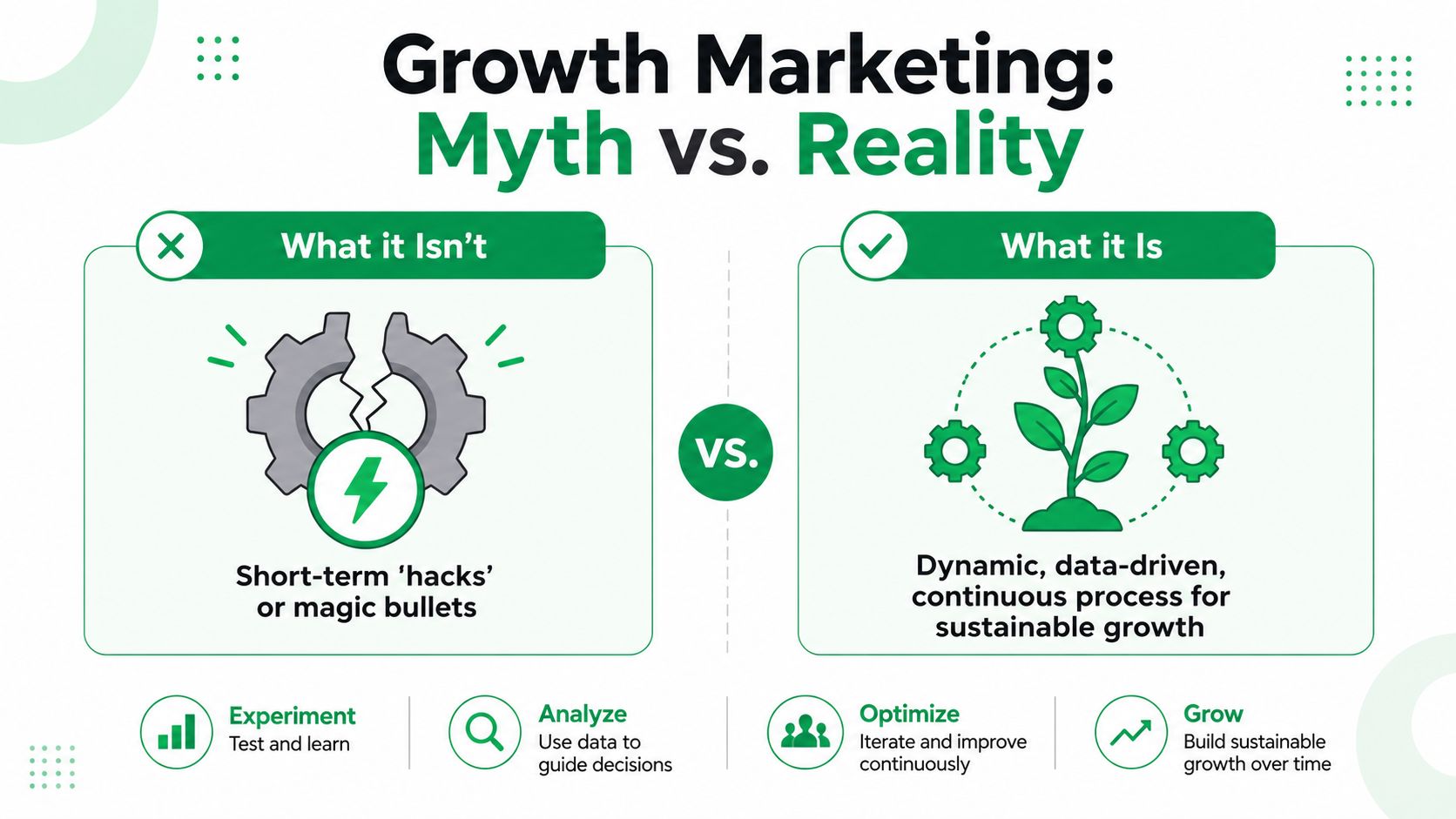
Growth Marketing Strategy: The simple distinction
Growth marketing is a continuous, test-driven process across the full customer journey.
That means acquisition matters, but so do activation, retention, referral, and revenue expansion. If you only optimize top-of-funnel traffic, you’re often paying to pour more people into a broken experience.
Here’s the practical difference:
| Traditional marketing focus | Growth marketing focus |
|---|---|
| Channel execution | System performance |
| Campaign launches | Ongoing experiments |
| Awareness and lead volume | Full-funnel conversion and customer value |
| Reporting on activity | Learning from outcomes |
| Annual or quarterly planning cycles | Fast feedback and iteration |
What people get wrong
A lot of teams hear “growth” and immediately think startup theater. Fast tests. Loose ideas. Constant pivots. That’s not strategy. That’s impatience dressed up as innovation.
Growth marketing has structure.
- It starts with a hypothesis: “If we reduce form friction, more qualified prospects will book.”
- It uses evidence, not ego: The loudest opinion in the room doesn’t win.
- It values downstream impact: A cheaper lead isn’t better if sales can’t close it.
- It requires cross-functional work: Marketing, sales, product, service, and operations all affect growth.
Growth marketing treats marketing less like a department that creates promotion and more like a function that improves commercial performance.
And yes, creativity still matters. But creativity without feedback loops turns into expensive guessing.
The businesses that get traction from this approach stop asking, “What’s the next tactic?” They ask better questions. Where do prospects hesitate? Which audience segment reaches value faster? Which message attracts interest but not intent? Small shift. Big difference.
Growth Marketing Strategy: The Core Frameworks of a Growth Strategy
If strategy feels abstract, use a map. The most useful one in growth work is the AARRR funnel, often called the pirate funnel. It gives you a way to look at the whole customer journey without drowning in scattered metrics.
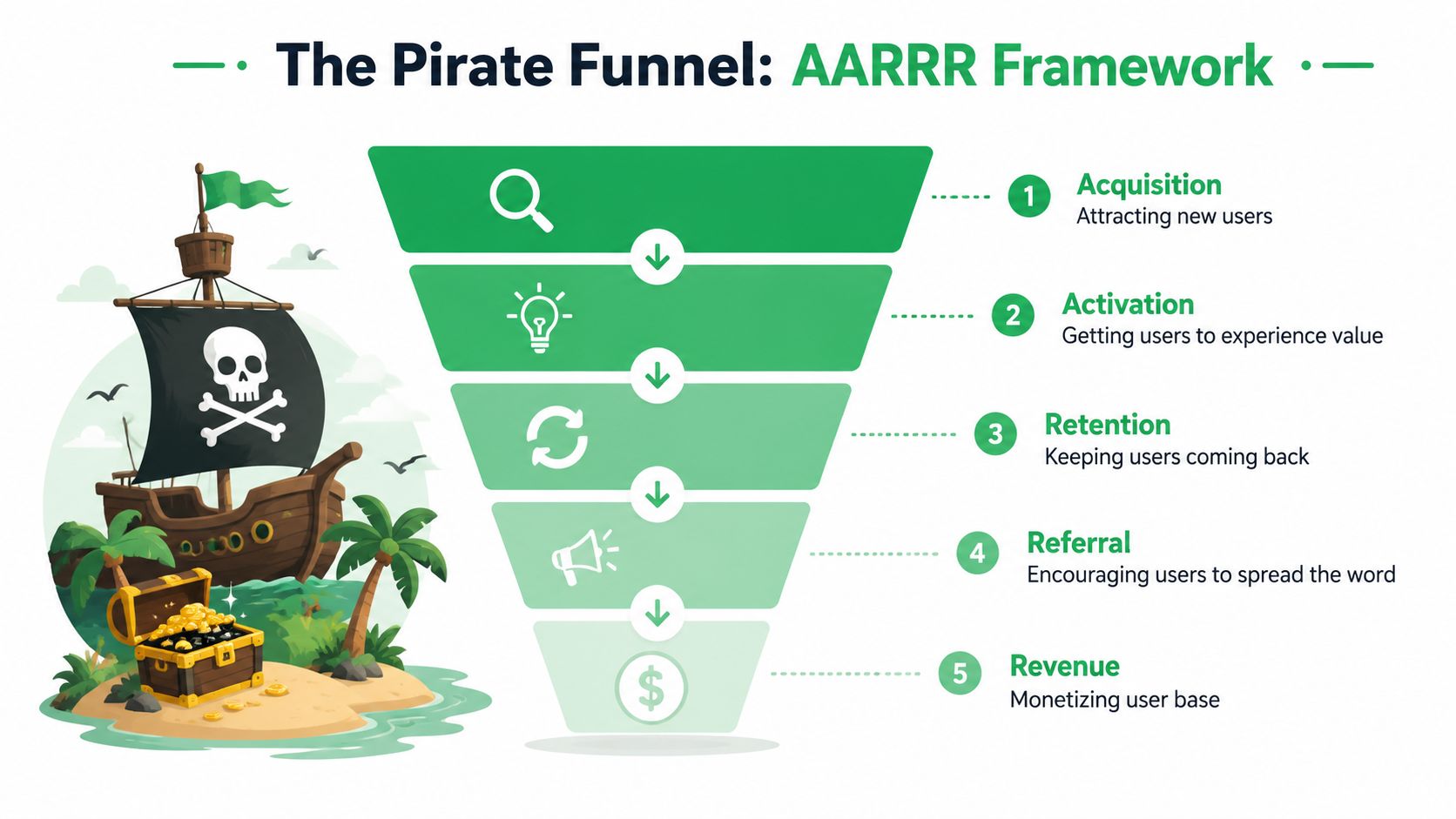
Read the funnel like an operator
Each stage has one job and one key question.
- Acquisition
Can the right people find you? This includes search visibility, paid traffic, marketplace placement, referrals, social discovery, and partnerships. - Activation
Do people experience value fast enough to care? For SaaS, that might be product onboarding. For local services, it might be how quickly a lead reaches a real person. For e-commerce, it could be the clarity of product pages and checkout flow. - Retention
Do customers come back, renew, reorder, or stay engaged? Retention is where many businesses realize their growth problem isn’t traffic at all. - Referral
Do satisfied customers bring in other customers? Referrals rarely happen by accident. They usually require timing, prompts, and an experience worth talking about. - Revenue
Are you monetizing efficiently? Pricing, packaging, upsells, repeat purchase design, and sales process all sit here.
A lot of owners jump straight to acquisition because it’s visible. Smart teams inspect the entire funnel first. The biggest leak isn’t always at the top.
For a sharp example of how audience attention can move through multiple stages of the funnel, FindClout’s guide on meme conversions is worth reading. Not because every business needs memes, but because it shows how creative content can support awareness, retargeting, and conversion when it’s built into a system.
Growth Marketing Strategy: Your North Star Metric matters
The second framework is your North Star Metric. That’s the single measurement that best reflects the value customers receive from your business.
Not every company picks the same kind of metric, and that’s the point. A useful North Star isn’t just a revenue line on a dashboard. It connects customer success to company growth.
A good North Star Metric does three things:
- Represents core customer value
- Helps teams align on one growth priority
- Encourages decisions that improve the business, not just reporting optics
If your team tracks everything with equal urgency, nobody knows what actually matters.
Here’s where owners get tripped up. They choose a metric that’s easy to pull, not one that’s strategically useful. Followers. Sessions. Impressions. Those can be supporting indicators, but they don’t anchor a growth marketing strategy. The North Star should force better decisions, especially when trade-offs show up.
Growth Marketing Strategy: Building Your Growth Engine A Step-by-Step Guide
Frameworks are helpful. Process is what makes them useful.
The most effective growth teams run a repeatable loop. Analyze. Ideate. Prioritize. Test. Learn. Then run it again with better information than before. That’s the engine.
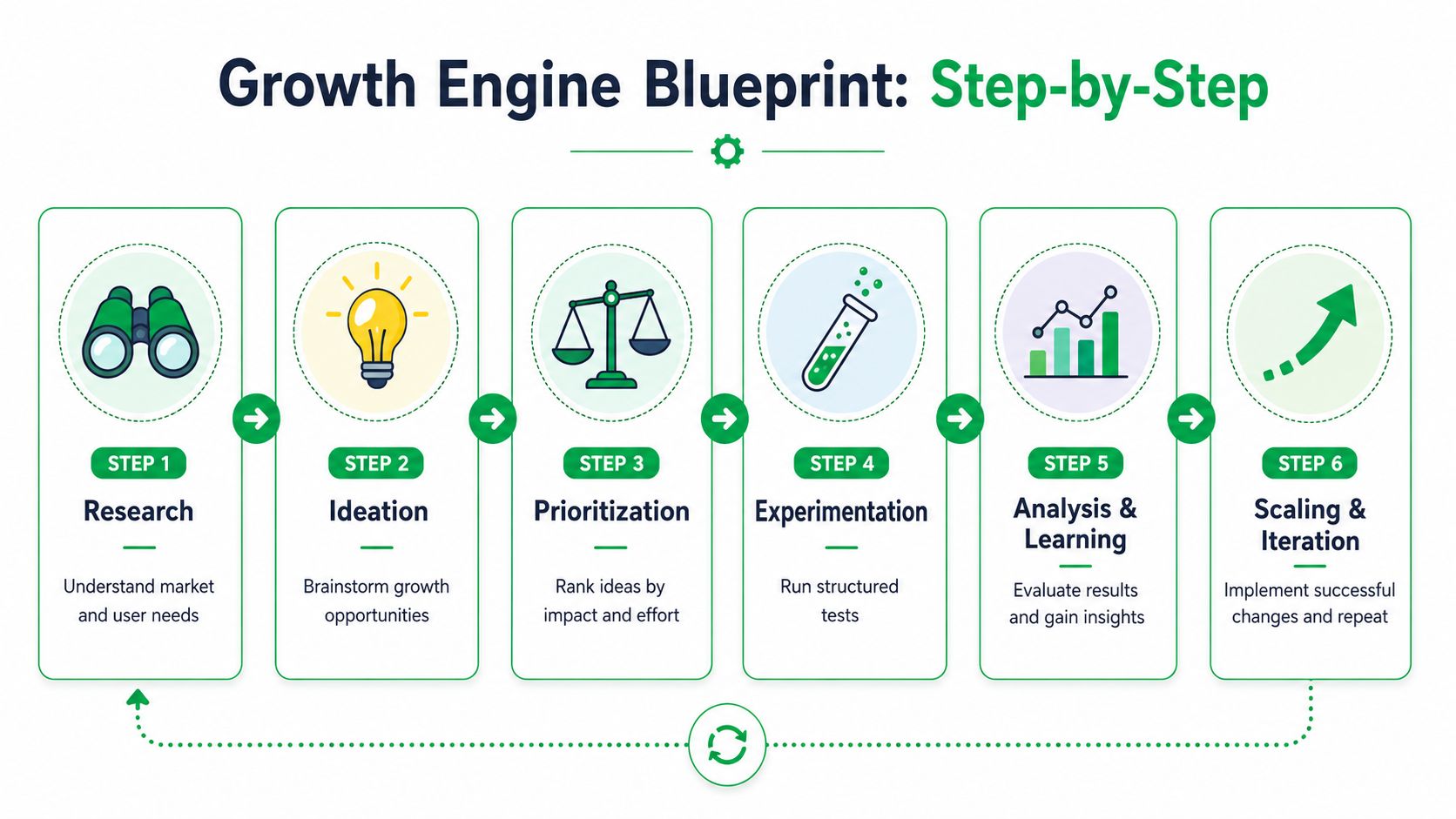
Step one begins with evidence
Start by looking at behavior, not assumptions.
Review analytics, CRM stages, call quality, sales notes, search queries, heatmaps, product usage, support tickets, marketplace data, and customer interviews. You’re looking for friction. Long pages with low engagement. High add-to-cart but weak checkout completion. Demo requests that stall before sales contact. A strong click-through rate paired with poor lead quality.
Then turn observations into hypotheses.
- Bad hypothesis: “We should redesign the homepage.”
- Better hypothesis: “If we simplify the homepage message and reduce competing calls to action, more qualified visitors will book a consultation.”
That distinction matters because you can test a hypothesis. You can’t test vague ambition.
Growth Marketing Strategy: Prioritize before you build
Teams often don’t fail because they lack ideas. They fail because they chase too many weak ones.
Use a simple filter like ICE:
| Filter | What to ask |
|---|---|
| Impact | If this works, will it move an important part of the funnel? |
| Confidence | Do we have enough evidence to believe it’s worth testing? |
| Ease | Can we launch this without creating weeks of delay? |
This keeps your growth backlog honest. A modest landing page test with clear logic often beats a giant rebrand project that takes months and teaches you nothing until it’s done.
A practical way to support this cadence is to plan content and campaign experiments in a visible operating rhythm. A working content calendar built around testing priorities helps teams avoid random execution.
Growth Marketing Strategy: Test small, learn fast
Run the smallest valid version of the idea first.
That could mean:
- A landing page variant instead of rebuilding the full site
- A revised product image set instead of rewriting the whole catalog
- A different call script for one service line before retraining the entire team
- A segmented email flow for a high-intent audience before broad rollout
And when the results come in, don’t ask only, “Did it win?” Ask, “What did this teach us?”
Field note: A failed test that reveals buyer hesitation is often more valuable than a weak win you can’t explain.
There’s strong support for this kind of operating model. Companies that adopt a rapid experimentation culture grow at a rate 3x to 8x higher than their industry peers who rely on traditional, long-cycle planning according to Harvard Business Review’s article on online experiments.
Scale carefully
Winning tests need a second layer of scrutiny.
Before you scale, verify three things:
- The result is repeatable
- The quality of customer or lead remains strong
- Operations can support more volume
Many teams get sloppy. They find a winner, pour budget on it, and create a new bottleneck downstream. Growth isn’t just about lifting one metric. It’s about improving the system without breaking another part of it.
Growth Marketing Strategy: Growth Tactics for Different Business Models
The process stays the same across industries. The pressure points don’t.
A SaaS company, an Amazon seller, and a local service business can all run disciplined growth experiments. They just won’t test the same things, and they shouldn’t.
SaaS companies should obsess over activation
A SaaS business often looks healthy from the outside. Sign-ups come in. Trials start. Demo requests land. But growth stalls because users never reach the first meaningful outcome.
One common experiment is onboarding simplification. Instead of asking new users to complete every setup task at once, the team reduces the path to one clear success moment. Maybe it’s importing a contact list, connecting a calendar, publishing a first report, or inviting one teammate.
That kind of test usually reveals a trade-off. More onboarding guidance can improve activation, but too much hand-holding can create friction. Tooltips, product tours, lifecycle email, in-app checklists, and sales-assisted onboarding all have their place. The right mix depends on user intent and product complexity.
A practical SaaS loop might look like this:
- Problem: Trial users sign up but don’t experience value quickly.
- Hypothesis: A shorter onboarding checklist will help users reach the first key action faster.
- Test: Show one path for self-serve users and another for high-intent demo users.
- Learning: Keep what reduces confusion, remove what creates noise.
E-commerce and Amazon brands need tighter conversion control
For e-commerce and Amazon sellers, traffic is only half the game. Listing quality, product page clarity, pricing presentation, image sequencing, review velocity, and checkout friction shape whether visits turn into revenue.
An Amazon-focused business might test:
- Main image alternatives to improve search click behavior
- A+ Content revisions to answer objections faster
- Offer bundles to raise average order value qualitatively
- Post-purchase email timing to support repeat purchase and review generation
For direct-to-consumer brands, paid social can drive demand, but weak product detail pages kill efficiency fast. I’ve seen teams blame Meta or Google when the actual issue was on-page uncertainty. Shipping details buried. Return policy unclear. Variant selection clumsy. Not glamorous, but decisive.
The fastest way to waste paid media budget is to send expensive traffic to a page that still has unanswered buyer questions.
The trade-off here is constant. Aggressive conversion design can lift short-term sales while hurting trust if it feels pushy. Good growth work protects both.
Growth Marketing Strategy: Local service businesses win on speed and follow-up
Local services have a different challenge. The lead often doesn’t want a nurture journey. They want an answer now.
That changes the experiments worth running. Instead of obsessing over impressions, smart local operators test response speed, booking flow, estimate form friction, call routing, review requests, service-area page messaging, and Google Business Profile offers.
A local plumber, dentist, med spa, law firm, or HVAC company can apply the same loop:
- Acquisition test: Try different service-area page angles based on intent
- Activation test: Reduce form fields and offer call-first scheduling
- Retention test: Add simple reminder and follow-up sequences
- Referral test: Send review and referral prompts after the service experience, not weeks later
And yes, human execution is paramount. If the phone rings and nobody answers, no landing page test can save that.
One strategy, different expressions
The point isn’t to copy tactics from another business model. It’s to apply the same strategic discipline to your own customer journey.
SaaS usually wins through product adoption.
E-commerce wins through conversion and repeat behavior.
Local services win through intent capture and follow-through.
Different battlefield. Same method.
Measuring What Matters Reporting and Metrics
Most reporting decks are too busy to be useful.
They include traffic charts, channel summaries, reach screenshots, cost graphs, and social snapshots. Everything looks active. Nobody leaves with a clearer decision. That’s the problem.
A growth dashboard should help you answer one question fast. Where is the system improving, and where is it leaking?
Build a weekly dashboard you can actually use
Keep it narrow. Tie your reporting to the funnel stages you already chose and review the same core indicators every week.
A useful dashboard often includes:
- Acquisition signal: Which channels are bringing qualified attention
- Activation signal: Whether new visitors or users are reaching first value
- Retention signal: Whether customers come back, renew, reorder, or stay active
- Referral signal: Whether happy customers are generating advocacy
- Revenue signal: Whether monetization is improving without hurting experience
You don’t need a mountain of charts. You need a small set of metrics that connect to action.
Leading indicators versus lagging indicators
This distinction changes how fast you can respond.
| Indicator type | What it tells you |
|---|---|
| Leading indicators | Early signs that future performance may improve or decline |
| Lagging indicators | Outcomes that confirm what already happened |
If activation quality drops, revenue pain often shows up later. If sales calls improve and booked appointments rise, revenue may follow after the sales cycle catches up. That’s why growth reporting has to combine both views.
For Amazon-focused teams, measurement gets even more specific because ad performance and retail performance affect each other. If you sell on the marketplace, this explainer on ad measurement for Amazon brands is a useful companion to broader funnel reporting.
And if your current reporting still revolves around vanity metrics, build from a stronger framework for measuring marketing campaign effectiveness in a business context.
The purpose of reporting isn’t to prove marketing worked. It’s to show what to do next.
That shift alone changes the quality of decisions.
Your Next Step Toward Sustainable Growth
A strong growth marketing strategy isn’t a document you finish and file away. It’s an operating discipline.
You identify where performance stalls. You form a clear hypothesis. You test with intention. You learn quickly. Then you improve the next cycle with better judgment than the last one. That’s what scalable growth looks like in practice. Not magic. Not chaos. Repetition with intelligence.
Most businesses don’t struggle because they lack ideas. They struggle because they don’t have a reliable process for deciding which ideas deserve time, budget, and team attention.
That’s why the next step should be simple. Establish your baseline. Find the leaks. Decide where to test first.

If your growth has felt noisy, inconsistent, or harder than it should, that’s not a reason to keep improvising. It’s a reason to get precise. Start with the funnel, not the latest tactic. Start with evidence, not assumptions. Then build the engine.
If you’re ready to turn scattered marketing activity into a repeatable growth system, Mr. Green Marketing, LLC is a smart place to start. Their team offers a free, no-obligation audit and performance review to help you identify funnel leaks, missed visibility opportunities, and practical quick wins you can act on right away.
Leave a Comment
sing in to post your comment or sign-up if you dont have any account.