
E-commerce marketing services are, in a nutshell, the complete system you use to attract shoppers, turn them into buyers, and keep them coming back. And it’s not about just one thing, like running a Facebook ad. It’s the entire game plan – from making sure your products show up on Google to sending that perfectly timed email that brings a customer back for another purchase.
E-commerce Marketing Services – Your Store’s Digital Blueprint
Let’s be real: trying to grow an online store without a marketing plan is like building a house with no blueprint. You might get a few walls up, but you’re heading for a structural collapse. E-commerce marketing services provide that essential framework. The digital equivalent of picking a prime retail location, creating a stunning window display, and staffing your store with a top-notch sales team.
Think about it. You wouldn’t open a physical shop down a dark, hidden alley and just hope people find it. The same exact logic applies online. Your store has to be visible right where your customers are looking.
More Than Just Ads
It’s a huge misconception that marketing just means buying ads. While advertising definitely has its place, a truly effective e-commerce strategy goes so much deeper. It’s a complete ecosystem built around the customer’s entire journey with your brand.
- Attraction: Getting the right kind of traffic—people who are actually interested in what you sell—to your site through channels like SEO and social media.
- Conversion: Turning those visitors into paying customers. This is all about making your website easy to use, trustworthy, and persuasive.
- Retention: Building genuine loyalty to encourage repeat business. This is often where the real profit is, since it costs far less to keep a customer than to find a new one.
When all these pieces work together, they create a powerful system that sells your products 24/7, long after you’ve clocked out for the day.
The goal isn’t just to make a sale; it’s to create a customer. A well-executed marketing plan builds a relationship that turns a one-time buyer into a lifelong fan of your brand.
The sheer scale of online shopping is mind-boggling. The global e-commerce market has blown past $6.42 trillion in sales and is on a trajectory to hit nearly $7.89 trillion by 2028. With billions of people shopping online, just showing up isn’t enough. You need a deliberate, expert-led strategy to carve out your piece of that massive pie.
And a key part of scaling in this environment is using technology to your advantage. Modern e-commerce marketing services heavily rely on e-commerce marketing automation to handle repetitive tasks and deliver personalized experiences. Think automated abandoned cart reminders or product recommendations tailored to a user’s browsing history. This is how you work smarter, not harder, to grow your store.
E-commerce Marketing Services – The Core Channels That Drive E-commerce Sales
Let’s get into the engine room. A successful e-commerce business never relies on just one marketing channel. Instead, it’s a coordinated system where each part has a specific job, but they all work together to build unstoppable sales momentum.
Understanding these core channels is the first step toward building that system. It’s all about showing up in the right places at exactly the right time.
Your customers are everywhere—searching on Google, scrolling through TikTok, checking their email. If you’re not meeting them where they are, a competitor will be. The best e-commerce marketing services weave these different avenues into one cohesive strategy that guides customers from discovery all the way to checkout.
This visual breaks down how different marketing efforts come together to attract, guide, convert, and retain customers.
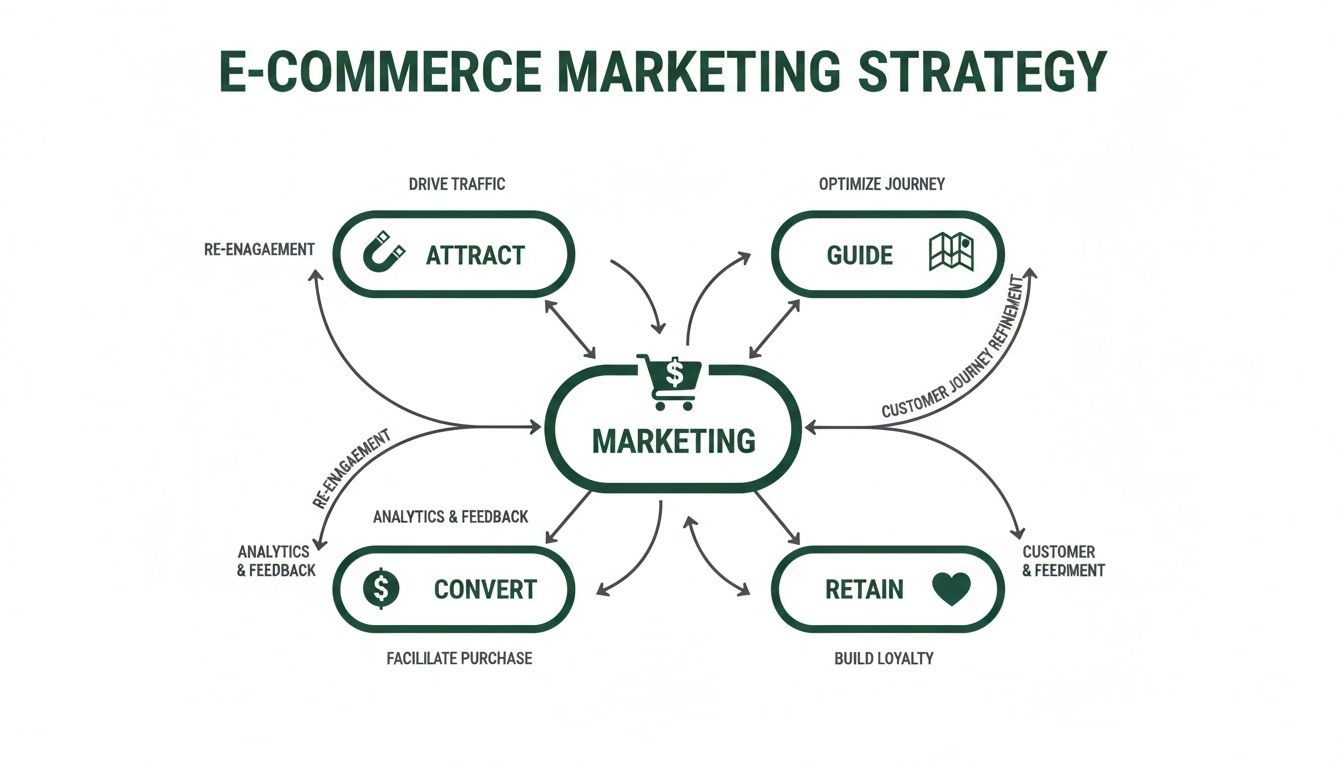
As you can see, every stage of the customer journey requires a different approach, moving from broad awareness to building lasting loyalty.
To give you a clearer picture, this table breaks down the core marketing channels, their primary goals, and what success looks like for each.
E-commerce Marketing Channels at a Glance
| Marketing Channel | Primary Goal | Key Deliverable Example | Typical KPI |
|---|---|---|---|
| SEO | Drive long-term, “free” organic traffic from search engines. | Optimizing product pages for high-intent keywords. | Organic Traffic, Keyword Rankings |
| PPC | Generate immediate, targeted traffic and sales. | Running Google Shopping ads for specific products. | Return on Ad Spend (ROAS) |
| Social Media | Build brand community and drive discovery-based purchases. | An Instagram ad campaign targeting lookalike audiences. | Engagement Rate, Conversion Rate |
| Email Marketing | Nurture leads and retain existing customers. | An automated abandoned cart email sequence. | Open Rate, Click-Through Rate |
| CRO | Maximize sales from existing website traffic. | A/B testing the checkout page design to reduce friction. | Conversion Rate |
Each of these channels plays a unique role, and when they work in concert, the results are far greater than the sum of their parts. Now, let’s dig into what each one actually involves.
1. E-commerce Marketing Services – Search Engine Optimization (SEO)
Think of SEO as the digital foundation of your store. It’s the long-term play that makes your products discoverable when someone types “women’s running shoes size 8” into Google. This isn’t about quick wins; it’s about building authority and trust with search engines so they consistently send you high-intent, organic traffic.
And the best part? That traffic is free.
Good e-commerce SEO involves optimizing everything from your product descriptions and category pages to your site’s loading speed. It ensures that when a potential customer is actively looking for what you sell, you’re one of the top results they see. It’s the difference between being on main street and being tucked away in a back alley.
2. E-commerce Marketing Services – Pay-Per-Click (PPC) Advertising
While SEO builds momentum over time, PPC advertising—like Google Ads or Meta Ads—delivers immediate traffic. You pay for your ad to appear at the top of the search results or in a social feed for a specific audience. It’s like buying a front-row seat for the exact shoppers you want to reach, right when they’re ready to buy.
This channel is incredibly powerful for new product launches, promotions, or simply getting in front of customers while your SEO efforts ramp up. A well-managed campaign can generate sales from day one. If you want to dive deeper, you can learn more about the fundamentals of PPC marketing in our beginner’s guide.
A great strategy uses SEO and PPC together. SEO builds the sustainable, long-term organic presence, while PPC provides the immediate, targeted visibility to capture sales now. They’re not competitors; they’re partners.
3. E-commerce Marketing Services – Social Media Marketing
Social media is your brand’s community hub. It’s where you build relationships, share your brand’s story, and turn casual followers into loyal customers. Platforms like Instagram, Facebook, and TikTok have become powerful sales channels, allowing users to discover and purchase products without ever leaving the app.
But it’s not just about posting product photos. It’s about creating engaging content that resonates with your audience, running targeted ad campaigns to reach new lookalike customers, and fostering a sense of community that makes people feel connected to your brand.
4. E-commerce Marketing Services – Email Marketing
Email marketing is where you nurture the relationships you’ve built. And it’s arguably one of the highest-ROI channels because you’re communicating with an audience that has already opted in—they want to hear from you.
This is your direct line to your customers for:
- Promoting sales and new arrivals to drive immediate revenue.
- Sending abandoned cart reminders to recover potentially lost sales.
- Sharing valuable content that builds brand loyalty and keeps you top-of-mind.
- Creating personalized product recommendations based on past purchases.
It’s the engine of customer retention, turning one-time buyers into lifelong fans who purchase again and again.
5. E-commerce Marketing Services – Conversion Rate Optimization (CRO)
Finally, all the traffic in the world won’t help if your website is confusing or difficult to use. That’s where Conversion Rate Optimization (CRO) comes in. CRO is the science of improving your website to turn more visitors into customers. It’s about plugging the leaks in your sales funnel.
This could mean simplifying your checkout process, improving your site’s mobile experience, or testing different product images and calls-to-action to see what works best. Even small tweaks can lead to significant increases in sales, making CRO a critical part of any serious e-commerce plan. It maximizes the value of every single visitor you worked so hard to attract.
Measuring Success With E-commerce KPIs That Matter
Data can feel like a tidal wave. You’re drowning in numbers, but which ones actually tell you if you’re making money? Forget vanity metrics like social media likes; we’re focused on the key performance indicators (KPIs) that tell the real story of your store’s health.
And this isn’t just about tracking numbers for the sake of it. It’s about turning analytics into action. These are the metrics that show you what’s working, what’s broken, and where your biggest growth opportunities are hiding.
Think of KPIs as the dashboard of your car. You wouldn’t drive cross-country without checking your fuel gauge, oil pressure, or speedometer. These metrics are your gauges for business growth, and flying blind is a recipe for disaster.
6. E-commerce Marketing Services – The Profitability Pair: Customer Acquisition Cost and Lifetime Value
Let’s start with the two numbers that determine your long-term survival. Customer Acquisition Cost (CAC) is simply the average amount you spend to win a new customer.
Lifetime Value (LTV), on the other hand, is the total revenue you can expect from a single customer over their entire relationship with your brand. This one’s the long game.
The magic happens when you pit them against each other. The LTV to CAC ratio is your ultimate profitability indicator. A healthy ratio, generally seen as 3:1 or higher, means you’re acquiring customers who will pay you back three times over. If your ratio is 1:1, you’re just breaking even to get a customer in the door—a dangerous place to be.
Your marketing isn’t just an expense; it’s an investment. The LTV to CAC ratio proves whether those investments are actually growing your bottom line or just spinning your wheels.
7. E-commerce Marketing Services – Measuring Your Marketing Engine: Return on Ad Spend
While LTV/CAC looks at long-term health, Return on Ad Spend (ROAS) is all about the immediate impact of your advertising. It answers a simple, critical question: “For every dollar I put into this ad campaign, how many dollars did I get back in sales?”
It’s calculated by dividing your ad revenue by your ad cost. Spend $100 on Google Ads and generate $400 in sales? Your ROAS is 4x. This metric is non-negotiable for any paid advertising.
Understanding what’s “good” is critical here. E-commerce marketing benchmarks show that the median Customer Acquisition Cost (CAC) can be as high as $156, making efficient spending absolutely crucial. A strong agency uses this data to build strategies that beat the averages. For instance, paid search campaigns should aim for a 4-6x ROAS, while email marketing can deliver a massive 6-10x ROAS. You can learn more about these industry performance benchmarks on WebFX.com.
8. The Core Transactional Metrics
Beyond the big-picture numbers, a few daily metrics tell you how well your store is performing at the point of sale. These are the KPIs you should be checking constantly.
- Conversion Rate (CVR): What percentage of your website visitors actually buy something? If 100 people visit and 2 make a purchase, your CVR is 2%. This is the single best indicator of how effective your website is at selling. A typical e-commerce CVR hovers around 1-3%.
- Average Order Value (AOV): This tells you the average amount customers spend each time they check out. Increasing your AOV is one of the fastest ways to boost revenue without needing more traffic. Simple tactics like product bundling, smart upsells, or offering free shipping over a certain amount are all designed to push this number higher.
- Cart Abandonment Rate: What percentage of shoppers add items to their cart but bail before paying? A high rate—the industry average is a painful 70%—is a huge red flag. It often signals problems with your checkout process, surprise shipping costs, or a lack of trust.
These core metrics provide a real-time pulse on your business. By tracking them consistently, you can spot trends, fix problems before they get out of hand, and make smart decisions that directly impact your sales.
Navigating Modern Trends in E-commerce
The digital shelf is always shifting, and keeping up can feel like a full-time job in itself. And what worked wonders last year might barely move the needle today. That’s why a huge part of any smart e-commerce marketing service is staying ahead of these curves.
This isn’t about jumping on every shiny new trend. It’s about spotting the genuine shifts in how people find, shop for, and connect with brands online. These are the trends with real staying power—the ones that are redefining the customer journey and directly hitting your bottom line.
9. Social Commerce Is the New Mall
Remember when social media was just for catching up with friends? Those days are long gone. Today, it’s a fully integrated storefront. Social commerce is the explosion of buying and selling directly on platforms like Instagram, TikTok, and Facebook. A customer can go from seeing a product they love in their feed to checking out in just a couple of taps.
It’s a massive departure from the old way of doing things, where you had to drag users away from their endless scroll and onto your website. Now, the transaction happens right where the discovery happens. Faster. More impulsive. Incredibly effective.
The modern shopper values convenience above all else. By turning social feeds into shoppable experiences, you remove friction and meet customers exactly where they are, transforming passive browsing into active buying.
The numbers don’t lie. The rise of social and mobile commerce is completely reshaping the game. Global social sales have rocketed past $1.17 trillion, and mobile devices now drive 59% of all online retail. Just look at TikTok—57% of marketers are now building it into their strategies, with a massive 32% reporting it delivers their best return on investment. You can dig into more data on these powerful marketing shifts on HubSpot.com.
10. Mobile-First Is Non-Negotiable
That brings us neatly to the next non-negotiable trend: thinking mobile-first. And I mean truly mobile-first, not just a desktop site that shrinks down and sort of works on a phone. The vast majority of online shopping now happens on a smartphone.
This means your entire customer experience has to be built for the small screen:
- Lightning-Fast Load Times: Every single second counts. A slow site will send shoppers bouncing over to a competitor before your first image has even loaded.
- Simple Navigation: Can customers easily tap through your menus with their thumb? Is the search bar obvious and easy to use?
- Streamlined Checkout: This is where so many sales are lost. Complicated forms, too many steps, or asking for pointless information will absolutely destroy your conversion rate.
If your site isn’t designed with a mobile user in mind, you are actively leaving money on the table. No exceptions.
11. AI-Powered Personalization and Optimization
Finally, let’s talk about AI. Yes, it’s a buzzword, but its practical application in e-commerce is impossible to ignore. Artificial intelligence is the engine that makes true personalization possible at scale.
We’re moving way beyond just using a customer’s first name in an email. AI algorithms can analyze browsing behavior, purchase history, and demographic data to deliver what really matters: genuinely relevant experiences. This covers everything from product recommendations that feel like a personal shopper picked them out to ad campaigns that dynamically find the most profitable audiences. It’s the key to making every customer feel like your brand just gets them.
As you navigate these modern e-commerce trends, remember that a seamless customer journey is everything. Understanding how to improve ecommerce customer experience is vital for long-term growth and loyalty. Adopting these trends isn’t just about looking modern; it’s about connecting with your customers in a more meaningful and profitable way.
How to Choose the Right E-commerce Marketing Partner
And here we are. You know the channels and the metrics, but picking the right agency can still feel like a shot in the dark. It’s a huge decision. The right partner can completely change the trajectory of your business, while the wrong one will burn through your budget with little to show for it.
So, how do you find a team that will actually deliver? It all comes down to asking the right questions and knowing what a good answer really sounds like. You’re not just looking for a vendor to check off tasks; you’re looking for a true partner who’s as invested in your growth as you are.
Vetting Questions That Cut Through the Noise
When you’re on a discovery call, a slick sales pitch can easily mask a lack of substance. Your job is to push past the fluff. Use these questions to steer the conversation and find out if they’re focused on results or just empty promises.
- “How do you measure and report on success?”
A great agency will immediately start talking about business metrics—ROAS, LTV to CAC ratio, and conversion rates. If they lead with vanity metrics like “impressions” or “clicks,” it’s a massive red flag. You want a partner who ties every single action back to your bottom line. - “Can you show me a case study from a business my size or in my industry?”
This one is critical. A strategy that worked for a nine-figure corporation will likely be useless for a scrappy, growing brand. They must be able to show you clear, data-backed examples of how they’ve helped businesses just like yours solve the exact problems you’re facing. - “What does your onboarding process look like?”
The first 90 days are make-or-break. A solid answer will outline a structured plan: technical audits, deep-dive audience research, competitor analysis, and meticulous tracking setup. A vague response like “we’ll get started on some ads” tells you they lack a real strategy. - “Who will be my day-to-day point of contact?”
You need to know if you’ll be working directly with an experienced strategist or getting passed off to a junior account manager. Direct access to the person actually running your campaigns is a huge advantage.
A true marketing partner doesn’t just execute tasks; they provide strategic guidance. They should challenge your assumptions, bring new ideas to the table, and act as an extension of your own team.
Red Flags You Cannot Ignore
Just as important as knowing what to look for is knowing what to run from. Some agencies rely on flashy guarantees and confusing jargon to get you to sign on the dotted line, but these are almost always signs of trouble ahead.
Keep an eye out for these classic red flags:
- Guaranteed #1 Rankings: This is the oldest trick in the book. No one can guarantee a specific Google ranking, period. Search engine algorithms are far too complex and are constantly changing. Any agency making this promise is either clueless or dishonest.
- Vague, Fluffy Reporting: Your monthly reports should be crystal clear. They need to show exactly what was done, what the results were, and what the plan is for the next month. If you get a report filled with confusing charts and no clear insights about revenue, be very skeptical.
- A “Secret Sauce” Mentality: Transparency is everything. If an agency is unwilling to explain their process because it’s “proprietary,” they’re probably hiding the fact that there is no process. You have a right to know exactly where your money is going.
- High-Pressure Sales Tactics: An agency that’s a good fit won’t need to strong-arm you into a long-term contract on the first call. They’ll be confident in their ability to deliver real value and will let their results do the talking.
Choosing a partner is a major step. For those looking to refine their broader approach, our guide on e-commerce strategy consulting can help you define your goals before you even start the search for an agency. This preparation ensures you find a partner who aligns perfectly with your vision for growth.
Taking Action With a Quick Marketing Audit
Okay, that was a lot to take in. It’s easy to feel overwhelmed by all the moving parts, but the secret is turning information into action—even small, simple actions. Instead of trying to fix everything at once, let’s just start with a quick pulse check.
This isn’t a deep, forensic analysis. Think of it more like a quick walkthrough of your store to spot the most obvious opportunities—the low-hanging fruit you can grab right now to make a real difference.
The 5-Minute Health Check
Run through this list. If you answer “no” to any of these questions, you’ve just found an immediate area for improvement.
- Mobile Performance: Grab your phone and pull up your website. Is it fast? Can you easily tap buttons with your thumb? Is the text readable without having to pinch and zoom? With over 59% of all e-commerce traffic now coming from mobile devices, a clunky experience is an absolute sales killer.
- On-Page SEO Basics: Go to one of your most important product pages. Does the title clearly state what the product is, using words a real customer would type into Google? Trying to be too clever or vague with product titles is a surefire way to become invisible online.
- Social Profile Optimization: Head over to your brand’s Instagram or Facebook page. Is there a clear, working link to your store right there in the bio? Are your recent posts actually showing off your products, or are they just random content? Your social media profiles should be direct pathways to a sale.
This quick check isn’t about finding every single flaw. It’s about identifying one or two things you can fix this week to plug the leaks in your sales funnel. Small, consistent improvements are what build unstoppable momentum over time.
This self-assessment is a fantastic starting point, but a professional analysis will uncover the deeper, less obvious issues that are truly holding your growth back. If you want to see the full picture, a comprehensive review is essential. You can learn more about what goes into a professional evaluation in our guide to digital marketing audit services.
Your Next Step to Real Growth
Did you spot a few problems? That’s actually great news. It means you have clear, untapped opportunities to grow your business. The next step is to get a detailed, data-backed plan from experts who live and breathe this stuff every single day.
We’re here to show you exactly where your biggest growth opportunities are hiding. Request a free, no-obligation performance audit from us at Mr. Green Marketing. We’ll dig into your site, your competitors, and your current strategy to give you a clear, actionable roadmap for boosting your sales.
Frequently Asked Questions About E-commerce Marketing
Let’s dig into the questions we get asked all the time. These aren’t just minor details—they’re the critical questions that turn a marketing budget from a blind expense into a smart, growth-driving investment. You need real answers, not fluff, and that’s what we’ll cover here.
How Much Should My Business Budget for Marketing
This is the big one, right? While there’s no universal “right” answer, a solid benchmark for e-commerce brands is to set aside 10% to 15% of their total revenue for marketing.
But the percentage is only half the story. A brand new store needs to make a splash, so a bigger slice of that budget will fuel customer acquisition—think Google Ads and social media campaigns. On the other hand, an established brand might funnel more funds into customer retention with things like sophisticated email marketing, which almost always delivers a higher long-term ROI. Your budget isn’t a static number; it’s a living part of your business that should evolve with your goals.
How Long Until I See Real Results
This is a classic “tortoise and the hare” scenario, and it really depends on the marketing channel you’re using.
- PPC & Social Ads (The Hare): These are built for speed. You can start seeing traffic, clicks, and even sales almost immediately, sometimes within the first week of a campaign launch. They’re perfect for driving immediate revenue and testing new offers.
- SEO (The Tortoise): This is the long game. Building genuine authority with Google is a marathon, not a sprint. You’ll likely see the needle start to move in 3-6 months, but the real, game-changing results often take 6-12 months to fully kick in. The payoff, however, is massive: a steady stream of “free” traffic from customers who are actively searching for what you sell.
The smartest brands don’t pick one over the other. They use the hare to generate cash flow now while the tortoise builds an unstoppable foundation for the future.
Should I Hire an Agency or Build an In-house Team
This is a huge decision that really comes down to three things: resources, expertise, and speed.
Building an in-house team gives you total control and people who live and breathe your brand day in and day out. But that comes with a hefty price tag: salaries, benefits, training, and thousands of dollars in software subscriptions. It’s a serious commitment.
Bringing on an agency gives you instant access to a full roster of specialists—an SEO strategist, a PPC manager, a CRO expert—often for less than the cost of one senior marketing hire. You plug directly into their proven systems, enterprise-level tools, and the cross-industry knowledge they’ve gained from working with dozens of other brands.
The right agency isn’t just a company you hire; they become a true extension of your team. They bring an objective outside perspective, deep channel-specific knowledge, and a framework built for one thing: delivering measurable growth.
For most e-commerce stores looking to scale efficiently, partnering with an agency is the fastest and most cost-effective path forward. Ultimately, it’s about finding the model that fits your budget, timeline, and what you want your business to look like in the years to come.
Ready to stop guessing and start growing? At Mr. Green Marketing, LLC, we build data-driven marketing plans that deliver real, measurable results. Let us show you exactly where your biggest growth opportunities are hiding. Request your free, no-obligation audit today.
Leave a Comment
sing in to post your comment or sign-up if you dont have any account.